Monthly Archives: June 2025

Transforming The Imperfect

Sermon preached on Sunday 29th June 2025 – St Peter and St Paul based on Acts 12:1-11, Matthew 16:13-19

May I speak and may you hear through the Grace of our Lord: Father, Son and Holy Spirit. Amen.

Today the church celebrates Peter and Paul, hence our very brief foray into back into red vestments. Two men, both in their way founders of the Christian church. Peter an original disciple and Paul the visionary missionary. However, our texts on this occasion focus on Peter or Simon Peter or Cephas.

They also feature the most amazing jail break ever. Not one for cinematic viewing, with explosions, masked accomplices and a speedy get away car, but an unopposed walk out to freedom, or at least for the moment, freedom.

A week or so ago, Charlie and I accompanied some 90+ Year 6 pupils to their annual Year 6 Leavers’ service. The coach journey was noisy, with excitement and anticipation, and the day was very warm as we threaded our way through to the cathedral from our drop off point, to the great West door, or doors to be more precise.

For many students, this was their first visit to the cathedral, and it’s always great to see their expressions change from their normal everyday ‘we’re too ‘grown up’ for this now’, to a real ‘Wow!’ moment as they step through the door.

Of course, when they look back at the jigsaw puzzle that is the West window, and hear about its destruction at the hands of the Cavaliers during the English Civil war – although the legend of masses of Cavaliers on horseback entering the cathedral and shooting their guns or lobbing the bones of the saints and bishops to break the window is not supported by specific records – it becomes even more amazing.

However, standing in front of the Great Screen behind the high altar and seeing all of the figure sculptures, most of which had been removed in the Tudor reformation and thus spared this destructive mayhem, a real sense of the majesty of Christ at the very centre of those who were part of his story and who took up and continued the work he had started on earth become apparent.

There, placed above Jesus’ head to the left, or at Jesus’ right hand is Peter, holding an exceptionally large key. In fact if we look at our very own East Window we can see Peter in the top left hand corner – with Paul, holding those keys.
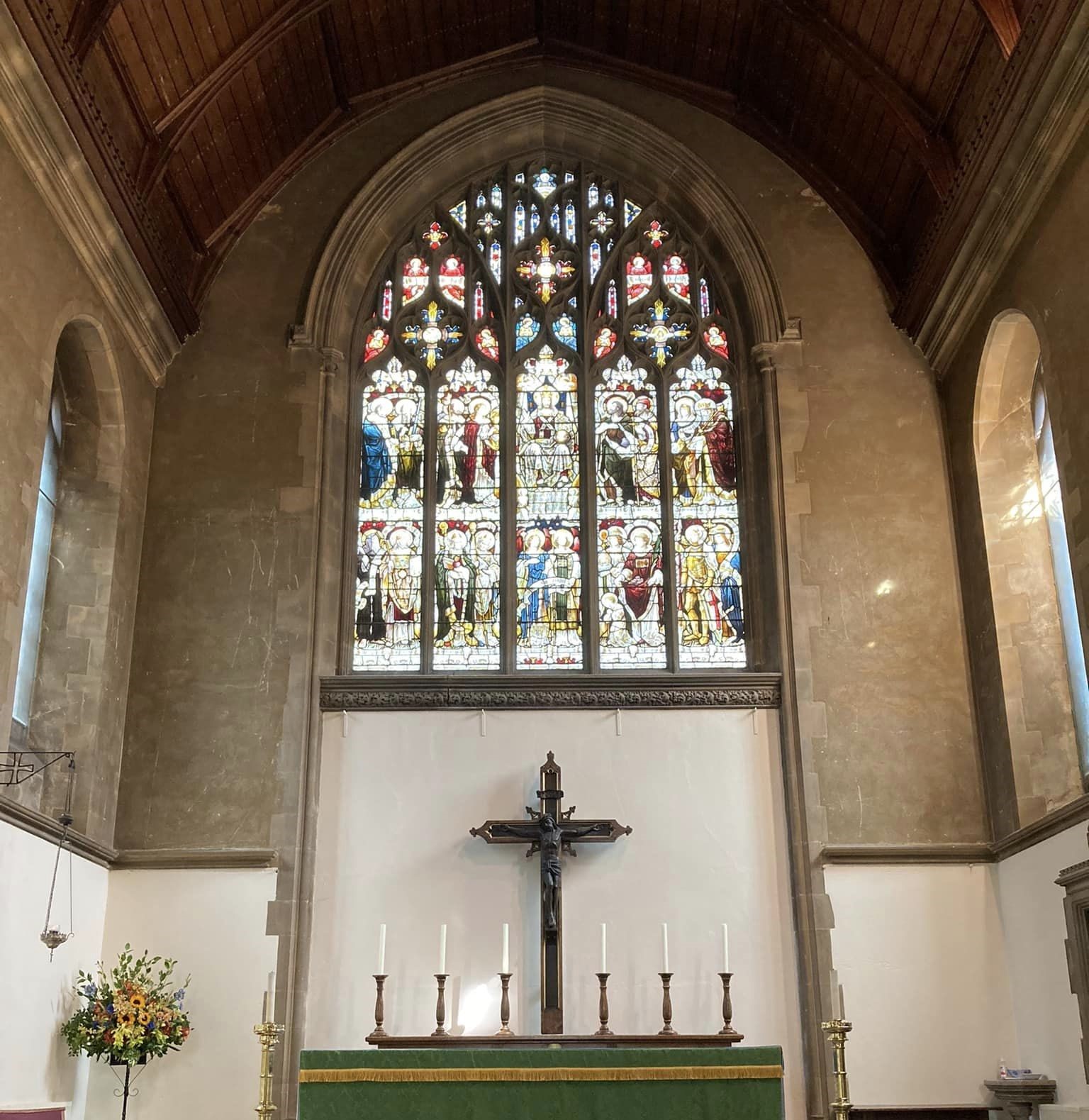
The East Window at St James’ Church, West End, Southampton

Peter, the disciple, who so often gets it wrong as he works his way through coming to faith, but whose faith and trust in God, in the person of Jesus is unshakeable. His is a journey of transformation, and our two readings this morning reveal that journey. In fact, these two moments, separated by a few years, reveal a shaping of faith that many of us can relate to. Peter is not perfect, but he is faithful—and more importantly, God is faithful to him.

In our gospel reading, Jesus asks a pointed question, ‘But who do you say that I am?’ and it is Simon Peter who answers with boldness and clarity, ‘You are the Messiah, the Son of the living God.’ This is Peter at his finest, as moment of divine insight; and Jesus responds not with mere affirmation but with a calling: ‘‘Blessed are you, Simon son of Jonah! … I tell you, you are Peter, and on this rock, I will build my church… I will give you the keys of the kingdom of heaven’.

People often wonder when and why Simon becomes Peter, and here we have the moment. The name Peter or Petros in Greek. literally means ‘stone’ or ‘rock’. The term ‘rock’ in the Bible often symbolizes strength, stability, and reliability, yet we know Peter was not always any of these things. He would deny Christ. He would falter. But Jesus sees the finished product even while Peter is still under construction. And God doesn’t wait for us to be perfect to call us. He calls us, then perfects us.

We also have to remember that whilst Peter was the ‘rock’, Jesus remained the cornerstone, the foundational stone in a building, acting as a reference point for the rest of the structure. Again, holding symbolic significance, representing that strength and stability, and the beginning of a new endeavour. Later in Ephesians 2, we hear of the Jews and Gentiles coming together as God’s people, ‘built on the foundation of the apostles and prophets, with Christ Jesus himself as the chief cornerstone’.

But now let’s turn to our reading from Acts. Here we see Peter, no longer the impetuous fisherman, nor the fearful denier by the fire. He is a leader of the church. And he is in prison. King Herod has killed James, and Peter to be next. He is chained between soldiers, guarded by sixteen men. The situation is hopeless from a human standpoint.

But the passage says, ‘the church prayed fervently to God for him’. And in the darkest hour—the night before his execution—God sends an angel. Chains fall off. Iron gates miraculously open. And Peter walks out, dazed, into the freedom only God can give.

This is the same man who once sank in fear on the water. This is the same man who once wept bitterly after denying Christ. but who at the beginning of the passage is sleeping in peace on the eve of death. What has changed? Well, Peter has learned to trust God completely. He doesn’t panic. He doesn’t beg. He rests – knowing now, after years of walking with Jesus, that even in prison, God is in control.

So where does that leave us? Where are we on our own journey of transformation? Some of us are like Simon in Matthew’s gospel—full of zeal, making bold confessions, still growing. Whilst some of us are like Peter in Acts – learning to be at peace and placing our trust in God in all eventualities.

And God sees us not as we are, but as the people we are becoming. He is building His church—not on perfect people—but on those who confess him truly and trust him deeply. And Peter’s journey, from bold confession to miraculous deliverance, reminds us that no one is beyond God’s reach, and no situation is beyond His power. So let us place our complete trust in him now, because God is still writing our stories. Amen.

The Waiting Game

Sermon preached on the 7th Sunday of Easter based on Acts 16:16-34 and John 17:20-26

May I speak and may you hear through the Grace of our Lord; Father, Son and Holy Spirit. Amen

I’m not very good at waiting. If something needs doing, then I want to get it done as soon as possible; but sometimes waiting is the only thing to do.

So, what to do in this period of waiting? Well the first thing you could do is to do absolutely nothing. Time to catch your breath, to rest up and regain some energy; but also not conducive to being prepared when the waiting is over.

Or perhaps you could fret and pace continuously up and down, putting forward different conjectures and scenarios, trying to cover all eventualities. Surely one will turn out to be close to what is likely to happen.

Or maybe there is a third way to use this time of waiting. A time of waiting that we find ourselves in right now. A time of waiting between Ascension and Pentecost, which we know is just seven days away…

However, let’s think back to the those first disciples, still in hiding from the authorities, witnesses to some amazing events; the reappearance of their teacher after witnessing his death on the cross, satisfying themselves that this miraculous thing had happened and then watching as he ascended back to his Father, with a promise that they would not be left alone to continue the work he had prepared them for, but that a helper, the Holy Spirit would be sent.

But when? Waking up each morning wondering if this was the day, then retiring at night still fearful but hoping that tomorrow would be different. What could they do to fill this time? Do nothing; restlessly throw ideas backwards and forwards or do something else.

Yes, you’ve guessed it they went for the third option – prayer!

The disciples, after Jesus’ ascension, were instructed to wait in Jerusalem for the promised Holy Spirit. This waiting was not a passive activity, but a time of fervent prayer seeking guidance and power from the Holy Spirit. They recognized their dependence on God and understood that the Holy Spirit was essential for their mission and ministry. It also emphasized the importance of waiting with a purpose, trusting in God’s timing and anticipating the fulfilment of his promises. 

In the Old Testament, the Holy Spirit’s presence was known and experienced through God’s active involvement in the lives of individuals, particularly prophets, kings, and those called to specific ministries. The Spirit was seen as a powerful force of God, bringing about specific tasks, empowering individuals, and inspiring holiness as seen in the books of Moses, Judges and particularly Isaiah. 

From the very beginning the Holy Spirit represented God’s creative and sustaining presence, the very creator of life according to Psalm 104. The Old Testament prophets even spoke of the Holy Spirit’s role in the coming Messiah, as seen in Isaiah 42  – ‘Here is my servant, whom I uphold, my chosen, in whom my soul delights; I have put my spirit upon him’; and again in Isaiah 11 – ‘A shoot shall come out from the stock of Jesse, and a branch shall grow out of his roots. The spirit of the Lord shall rest on him.’

The Holy Spirit also inspired holiness in believers, as mentioned in Psalm 143:10 – ‘Teach me to do your will, for you are my God. Let your good spirit lead me on a level path’. However, they also knew that while the Holy Spirit’s presence was obvious, it was not poured out on everybody during the Old Covenant, but rather limited to specific individuals and occasions. So perhaps the disciples were wondering which one of them might be chosen to receive its power.

And so they continued to pray.

Now I’m not going to spoil how their waiting ended; you’ll have to come back next week to find that out, but I wanted to think more about their choice of activity in that waiting time – prayer.

In fact our reading from Acts emphasised that prayer was still the go to occupation when you were waiting to be shown where God wanted you to be. We heard that Paul and Silas, who had started their missionary journey in Antioch, now found themselves in Philippi, and were on their way ‘to the place of prayer’ when they were waylaid by a female divinator, whose powers they curtailed, thus leading to much annoyance by the girl’s owners and accusations of unlawful sedition.

Unbowed by their punishment and ill-treatment, they spend the night ‘praying and singing hymns to God’, waiting to see what how he would rescue them from this situation. The response was an earthquake and voluntary self-incarceration which proved to be the spark for the Holy Spirit to come into play and convinced the jailer and his family to seek salvation and become believers in God.

Just like the Holy Spirit, salvation can be seen as a gift from God, not something earned through good works. Yes, it involves turning away from sinful behaviour and acknowledging the need for God’s forgiveness, but it also signifies a new spiritual life and relationship with God.

It also provides hope for the future as believers are promised eternal life in heaven, wherever that is as Vicky told us on Thursday, but we know its a place of peace and joy where God dwells with his people. 

This is the prayer that Jesus was praying in our Gospel this morning. A prayer that included a request, ‘Father, I desire that those also, whom you have given me, may be with me where I am, to see my glory’, in order that we will all be united, ‘I in them and you in me, that they may become completely one.’ A prayer that shows that we will become an intrinsic part of the Trinity when the Holy Spirit resides within us.

An incredibly powerful prayer for us to look forward to being answered in time. But we are still here and we are still in that waiting room.

And this period of waiting provides a valuable lesson for those of us who believe. It highlights the importance of prayer when we are encouraged to engage in persistent and heartfelt prayer, seeking God’s guidance, strength, and power. And just as the disciples were anticipating the arrival of the Holy Spirit, we too can anticipate God’s presence and power in our lives, learning to trust God’s plan for our lives, so we can demonstrate our reliance on God’s power, rather than our own abilities. 

In this waiting time we should pray for God’s will to be done in our lives and in the world. ‘Our Father in heaven, hallowed be your name, your kingdom come, your will be done, on earth as it is in heaven… Amen