Tag Archives: apostles

When You Come in Fourth

Sermon preached on Sunday 12th May – Easter 7 based on Acts 1:15-17, 21-end,

May I speak and may you hear through the Grace of our Lord; Father, Son and Holy Spirit. Amen

In one of the many art museums that I recently visited in Australia, there was a photographic exhibition of Olympians who came fourth. It portrayed them as they either crossed the line in a race or realised the final positionings of the medals. After all, those who come fourth have just missed out on receiving not only a tangible form of recognition, but whoever remembers who came fourth?

Today in our reading from Acts we have one such person, who came so close, but will forever be remembered, if we even remember his name, as the one that wasn’t chosen to join the most important and influential group within the Christian church.

Throughout this period, we are encouraged to look more closely at the Acts of the Apostles as the fledgling church emerges through the words and actions of those who had become disciples of Jesus. Many of those had become part of a group of people, who had witnessed not only his teaching first hand, but been with him since his baptism by John and had recently witnessed his crucifixion and subsequent predicted but still miraculous resurrection.

The group of the original eleven remaining disciples, who had been chosen by Jesus had now become apostles. As Vicky explained last week, a disciple is a student, a learner, a believer, whilst an apostle is a messenger, one who is sent to deliver those teachings to other.

These eleven, along with Judas had been the ones chosen to work closely with Jesus on a day to day basis for the last three years, gradually being changed from disciples, which all believers are, into apostles.

Now, following the death of Judas, they were feeling obliged to find a replacement, after all eleven is an uneven number, twelve is much more biblical. Had Jesus chosen twelve disciples to mirror the original twelve tribes of Israel, signifying the renewal of the covenant between God and humans.? Or was it because Jesus had chosen the twelve, that the remaining apostles felt a divine purpose that there should continue to be twelve of them.

It’s a shame that we miss out several verses around and within the scripture chosen for today as the answer to the above question was actually given by Peter, when he quotes the psalms not only about the fate of Judas, seen at that time as the betrayer or enemy of Jesus, but from Psalm 109:8 ‘May another take his place of leadership

So here we have a crowd of believers, numbering ‘about one hundred and twenty’. This group included men and women and it is likely that it also included Mary the mother of Jesus, and his brothers, as the apostles had been staying together in Jerusalem where they had been joined in constant prayer together.

We know this because when Peter stands up his opening words ‘Friends’ are translated from the Greek word adelphoi for brothers and sisters, referring to believers, both men and women, as part of God’s family, although the NRSV translation that the Church of England prefers, give the translation as men or brothers.

This gives us an indication that the replacement is not going to be a radical one for that time! Indeed, Peter confirms that it is to be ‘one of the men’ who had accompanied them throughout this whole time.

How to make that choice though? Even without it being a patriarchal society, it was highly implausible that they would have considered Mary, of Mary and Martha fame, despite her being one of the best students of Jesus, learning at his feet, she may not have qualified as having witnessed the baptism.

What of Jesus’ brothers, in particular James and Jude. There had been a time that they were very sceptical about Jesus’ claims as he went around preaching a different gospel. From within what would have been a devout Jewish family, this would have jarred with their beliefs about the Messiah, but we now realise that they had subsequently become believers with their presence among the group. In fact, James would go on to have a prominent role within the Jerusalem church and both would have books included in New Testament.

The decision then wasn’t to be taken directly by the apostles but handed over to God in prayer for them to then go on to cast lots, almost a game of chance, but a traditional Jewish way for making decisions, between two of the men who met the qualification, Joseph called Barsabbas (also known as Justus) and Matthias.

The holy dozen was therefore restored.

What about the one though who had not been chosen, who essentially came fourth? What was his reaction? Well, he could have had a silent hissy fit and feeling rejected left the group in a huff or been angry with the leaders.   

He might even have been angry with God. After all, it was God that had had a hand in this selection, as they had prayed, therefore it was God who decided to not pick Barsabbas. It’s one thing for a person to tell you ‘No,’ but for God to say ‘no’?

 Yet we don’t hear of him having any of these negative responses. We see no indication that he reacted with disappointment, because we don’t hear anything about him after this. However, Christian tradition being what it is, he was believed to be one of the seventy disciples sent out by Jesus in Luke’s gospel to the cities he was to visit and is possible that we do see that he stuck around and continued to make God his priority and focus, as with his plethora of names, he could be Judas called Barsabbas, who was chosen to be part of an important delegation sent to Antioch from the apostles and elders of the church.

And as for Matthias? Not another peep in the whole of the New Testament, but again Christian tradition suggests that he did fulfil his apostolic role, by taking the gospel to Aethiopia, not at that time the Ethiopia of the North African continent, but in a region called Colchis in modern day Georgia in Eastern Europe, where he was crucified.

What then does all of this tell us about being disciples and apostles in today’s world, because that is what we are called to be, students of Christ to be sent out as messengers to share that knowledge. How many of us will be remembered in the annals of Christian history? Not many of us I would say.

But we still undertake those roles, knowing that God is always with us. We know that prayer opens the door to a closer relationship with him and that anyone can be called by God, at any time, to further his kingdom and share his message, and also know that God will lead the conversation.

And if God can call us to serve him at any moment of life, then we are never too old or too young to share his love with others. We may be aware that God often chooses the weak and the humble to serve, but that he always equips those whom he calls.

We may not be famous, or need to be placed on a pedestal when we share his Word, because we know that the glory goes to him, not us, but that we are blessed and loved in doing so.

Put very simply, sharing the love of Christ and the message of God comes through our words and actions. It is these things that will be remembered long after we are gone.

Amen

What Does It Take For Us To Believe?

'This is impossible' said Alice

‘This is impossible’ said Alice

Readings for the Second Sunday of Easter: Acts 4:32-35; 1 John 1:1 – 2:2; John 20:19 – end

On the second Sunday of Easter we find out that not everyone was yet ready to believe the incredible Easter news that Jesus was alive. Some people still had their doubts, including the apostle Thomas. We also hear how another apostle, John, was persuading a group of Christians that what he had witnessed first hand was the truth. Put that alongside the growing number of believers who were learning a new way of living as a community and suddenly the question of what it would take to enable us to believe is one that we might ask; which is exactly what I did in my sermon this morning

May I speak and may you hear through the grace of our Lord; Father, Son and Holy Spirit. Amen

If you don’t mind I’d like to start by conducting a straw poll with a show of hands. There are two main choices, but possibly an infinite number of circumstances and experiences that could fall into either of those categories.

I want you to think about your journey to faith, from when you first took an interest in Christianity to a point when you knew you believed. I wonder whether this was a sudden and datable experience or whether it was more of a gradual process, where you can perhaps remember a time when you didn’t believe and now you do but you don’t know exactly when that happened. Perhaps you’ve always believed or maybe you’re still on that journey.

None of these choices are better than the other, but it would be interesting to know, if you’re willing to share. Put your hands up [Reader, you too can join in, although remember that statistically the result will be 100% for whichever choice you raise your hand to] if your belief followed a sudden, ‘Damascus road’ type experience…… and now if your belief has been more gradual…… We’re actually quite representative of the average, which is about three-quarters describing it as gradual and a quarter as sudden.

I’d actually quite like to stop and hear from some of you about your journeys but I suppose I better carry on… because the really interesting bit might not be when it happened for those already there, but what it takes for us to believe.

The Incredulity of St Thomas blog

The Incredulity of St Thomas, Benjamin West (1738 -1820)

For Thomas it was the sheer physical proof of placing his hands on a man with whom he had spent the best part of the last three years and who he knew had been crucified, had died and had been shut up in a rock tomb and was now according to his friends and fellow disciples very much alive again; a man who was speaking to him and asking him not to doubt but to believe. This apparently indisputable proof led Thomas to publicly declare that Jesus was indeed ‘My Lord and my God’.

Where then does it leave those of us who will probably never have the opportunity to physically encounter Christ, at least not in the same way that those first disciples did? We are told that we are blessed more if we come to believe without seeing. Do we, therefore, come to belief because there are first-hand witness statements available to this event?

The First Letter of John

The First Letter of John

We don’t know for sure who the author of the first letter of John was, but from the very earliest of times it was believed to have been written by John, the fisherman and apostle of Jesus and bears striking similarities to the Gospel of John. Here is someone writing to one of the first group of Christians, who are somewhat unsure as their faith is being tested by spurious claims about whom Jesus really was; that he wasn’t actually human and didn’t really suffer on the cross; that he only ‘seemed’ human.

John writes to reassure these believers, that as a first-hand witness of Jesus’ ministry he and his friends saw and heard and touched Jesus when they became his disciples and shared his life. In this way their testimony is very convincing – they believed that Jesus was none other than the ‘Word’ of God – the source and meaning and purpose of life.

Even so, an eyewitness account is not quite the same as having concrete facts and figures, to inform our belief. Now before you get too excited I am not going to pull the ‘white rabbit’ of incontrovertible evidence out of my theological training ‘top hat’ but in amongst the minutia of historical data plenty of scholars and historian have investigated what might be myth and what could be reality.

WDITFUTB_Lament over the Dead Christ blog

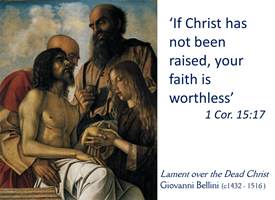
Lament over the Dead Christ, Giovanni Bellini (c1432 – 1516)

We know that without a resurrection Christianity is counterfeit. As the apostle Paul tells the Corinthians, ‘If Christ has not been raised, your faith is worthless’ 1 Corinthians 15:17. Accordingly, since a resurrection requires death, Jesus’ death by crucifixion has to be regarded as true. This ‘fact’ is attested to by a number of ancient sources, including the non-Christian historians, Josephus and Tacitus, who were therefore not biased toward a Christian interpretation of events.

We know that the chances of surviving crucifixion were very bleak and no evidence exists that Jesus was removed whilst still alive. The unanimous professional medical opinion is that Jesus certainly died due to the rigours of crucifixion, and even if he had somehow managed to survive, it would not have resulted in the disciples’ belief that he had been resurrected.

Il Precusore,

Il Precusore, Giulio Aristide Sartorio (1860 – 1932)

What about the empty tomb? Well its location was known to Christians and non-Christians alike. So if it hadn’t been empty, why would the chief priest have devised a plan to give a large sum of hush money to the guards, telling them to say that ‘His disciples came by night and stole him away while we were asleep’ Matthew 28:12-13. It would also have been pretty impossible for the large group of believers to have suddenly sprung up in the same city where Jesus had been publicly executed just a few weeks before and for those same believers to have been willing to die brutal martyr’s deaths if they knew this was all a lie.

Were people hallucinating when they encountered the risen Christ? Well, usually hallucinations are something that happens in an individual’s brain and not repeatedly on separate occasions and certainly not to groups of up to 500 people! 1 Corinthians 15:6 Even if they were visions, brought on by the apostle’s grief over the death of their leader, surely the body would have still been in the tomb.

Pascal's Wager

Pascal’s Wager

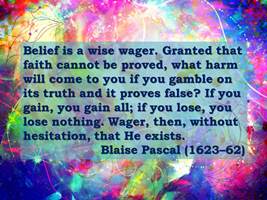
Convincing facts and figures? Well maybe. Or perhaps Pascal’s Wager might be the reason why people believe. Pascal was a seventeenth-century philosopher who theorised that humans live their lives by wagering that believing in God is a good bet because if when they die he does exist then they have gained the best of everything, on the other hand if they don’t believe and then find out he does exist then they made the worst choice and will have lost everything. However if they were to discover after death that God never existed then it didn’t matter what you believed.

So by believing, you are in a win-win situation. This sort of hedging my bets is just one accusation made against Christians who assume that because they believe in the right God, they are automatically good and have a one-way ticket to everlasting life. However, it also assumes that God would always reward blind faith above living a conscious Christ-centred life and all of the obligations that that might bring.

WDITFUTB_Belief is truth blogPerhaps belief and faith are different then… that belief is something that our logical, human minds hold to be true whilst faith is something that is felt deep within our hearts. Or could it be that faith is based on belief and that is why faith alone is not possible because belief always brings about actions and reactions?

Some people might even say that faith is truth held in the mind and that belief is a fire in the heart. Perhaps we just can’t separate the mind and heart, because as we heard ‘The community of believers were of one heart and one mind’ Acts 4:32

I hope you’ve been aware that I’ve been careful to never actually define what it is exactly that we understand and count as belief. Some might say that’s a cop-out; that the church is forever allowing so much laissez-faire around declaring what it believes and stands for that it nullifies any claims it might have to the truth. Well, I’m sure that for the majority of us it will include the belief that Jesus died and was resurrected in order that we might ‘have life in his name’, but that for each of us that might mean something slightly different depending where we are on our journey of faith.

As we walk together in fellowship with each other and with God, let’s make sure that we’re not only helping each other to increase in faith, but that we are sharing our beliefs with others so that God’s joy may be complete. After all didn’t Jesus say ‘Blessed are those who have not seen and yet have come to believe’. So let’s go and open a few more eyes to the truth of what we believe.

Amen

John 20:29

John 20:29

Go back

Your message has been sent

Warning
Warning
Warning
Warning

Warning.