Tag Archives: believe

Spiritual Gifts

Sermon preached on 19th January 2025 based on 1 Corinthians 12:1-11 and John 2:1-11

Receiving a gift can be very exciting. Maybe we only have to look back a few weeks to Christmas Day, or a Christmas Day from your childhood, and waking up to find all those presents under the tree. Wondering which ones might be yours.

When you opened them though, I wonder what your reaction was. The best ones drew amazement, that you’d received the very thing you’d wished for and had been thinking about since at least September!

Or maybe you were surprised and unsure about what the gift actually was or did, so you need time to think about it?

Or even opening it and immediately setting it aside, perhaps it would do as a donation for a raffle prize, or to a charity shop, but importantly to remember to say thank you to the person who gave it to you.

Now what if we were to do the same with the gifts that we receive from God through the Holy Spirit? Putting them to use straight away, setting them aside through fear and uncertainty or rejecting them all together.

Our passage today from Corinthians talks about us being pagans, people without God, easily led astray by worthless enticements and trickery. Like the magicians in the court of Pharoah we might have viewed our gospel reading concerning the turning of water into wine as a magic trick.

Until we realise that despite his reluctance to begin his ministry with a somewhat unusual miracle, Jesus was indeed ready to show us what gifts he possessed… and which his mother already knew about!

Perhaps also, the disciples, who had only just recently thrown everything over to follow this man were reassured that God was indeed with Jesus and that the Holy Spirit was a living gift to enable these things to happen and to reveal his glory in order to strengthen their belief in him.

What about ourselves then? Well, we know that God has known us since before we were in the womb, knitting us together to become the people we are. So, he would be very aware of the strength of our characters, and the abilities we have, even if we’re not quite aware of them always. He would know the inherent skills we display and the skills that lie in our sub-conscious, waiting to be activated.

Did you notice though that there is one gift of the Spirit that is given to everyone – the manifestation of the Spirit for the common good. This underpins the Christian faith and is the thing that unites not only Christians with a desire to serve others, and to insist on the dignity of every individual, but also can be found in many other faiths and religions around the world. Perhaps showing God’s ultimate sovereignty because he has ultimately activated them in everyone.

Then we come to individual gifts, those wise men and women among us who know how to act for the best and guide us to do good. A gift subtly different from having great knowledge as viewers of University Challenge and Only Connect will verify.

Those people who encourage us in our faith and our own sense of belief, whether we are able to work miracles or to speak out about choices being made on our behalf? The skills to communicate and teach or to solve problems that will benefit everyone.

And within each of these gifts there are subtleties – the gift of the surgeon’s skill to save lives, equally as valuable as the hand held in the act of friendship and love that can comfort and offer healing.

All of these are produced through the gift of the Spirit and may be given to us as and when they are needed in our lives.

So how do we respond? It is with great joy and excitement and an inner confidence that this is who we are meant to be. Or with uncertainty, unsure how to use the gift that you’ve been presented with something that you don’t believe you have the skills or capacity to be able to deal with. Or even that you dismiss the gift, certain that it’s not meant for you because you already know what’s what?

 What it all boils down to is ‘do you believe this?’ Is God through the Holy Spirit able to discern for us the paths we should take through life and equip us with the necessary skills to do so?

This very question is being asked in this year’s Week of Prayer for Christian Unity. The exact question that Jesus asked Martha before bring Lazarus out of the tomb alive again. ‘I am the resurrection and the life. Those who believe in me, even though they die, will live, and everyone who lives and believes in me will never die. Do you believe this?’ She said to him, ‘Yes, Lord, I believe that you are the Messiah, the Son of God, the one coming into the world.’

Or our signature doubter, Thomas, “Put your finger here and see my hands. Reach out your hand and put it in my side. Do not doubt but believe”. Thomas answered him, “My Lord and my God!

Recognising our common belief and the fact that God, though the Holy Spirit has given each and every person a gift that can be used to bring us together, is a challenge as well as an invitation to deepen connection and belonging and to live faithfully as disciples of Christ.

Perhaps then as we shortly share our common belief in the words of the Creed, we will remember that it comes from the Latin word credo, meaning ‘I believe and trust’.

And try to remember, as St. Jerome once said, ‘never look a gift horse in the mouth’. Amen

God’s Promises

Part of an Old Testament series working our way through the key figures and stories, in which Abram looms large. Based on Genesis 15:1-6

May I speak and may you hear through the Grace of our Lord; Father, Son and Holy Spirit. Amen

Look towards heaven and count the stars, if you are able to count them.’ Then he said to him, ‘So shall your descendants be.’

A promised reward, a question of lineage, a vision of progeny, a silent indication of trust and a recognition of righteousness. In these six short verses lie the nub of the three great Abrahamic faiths. To date adherents of these number some 3.8 billion people in all the corners of the world, of which we are but a few. However, we first need to go back almost to the beginning, to understand why this one man would be so important both to God and to ourselves.

Our Old Testament reading begins with us needing to know after what things ‘the word of the Lord came to Abram in a vision’. Here is a man with an impeccable lineage, whose eight times Grandfather was Shem, the son of Noah. His father, Terah, had set out with their family from Northern Mesopotamia to travel to the land of Canaan, what would become the promised land of Moses and the Israelites, but only got a far as Haran in Eastern Turkey.

However, God called Abram to leave behind his kindred and strike out once more towards Canaan, with the promise that I will make of you a great nation, and I will bless you, and make your name great, so that you will be a blessing’ (Genesis 12:2). Having reached Canaan, the question of progeny is affirmed, ‘To your offspring I will give this land.’ However, Abram and his wife Sarai remain childless, and a famine forces them into Egypt, where Abram’s sense of self-preservation allows him to use Sarai as a bargaining pawn with Pharoah. Deceit uncovered, they are sent out of Egypt, where the now wealthy and prosperous Abram is once more travelling, and whose destination of the land of Canaan is literally decided by Lot.

God again gives an insight into the breath and length of Abram’s future prolificacy, ‘I will make your offspring like the dust of the earth; so that if one can count the dust of the earth, your offspring also can be counted’ (Genesis 13:16). Yet, Abram and Sarai remain childless, blessed only with the offer of more riches and accolades by the King of Sodom, which Abram rejects, but receiving the blessing of the high priest Melchizedek. Now God offers Abram a vision, not only has he acted a shield and protector of him, but his ‘reward shall be very great’. For Abram though, there is only one reward that will do – an heir, a natural heir of his own.

Being childless can be a painful and heartbreaking process to go through. As human beings we inherently desire to reproduce, to leave a small part of our DNA embedded in our children and children’s children. Abram’s deepest desire to produce offspring allows him the tenacity to question all the promises God has already made to him.

God’s blessing though is not just to produce a physical miracle. The body can be a frail and vulnerable organism, but the divine Spirit is vital and lifegiving. Having promised an incalculable number of descendants comparative to particle of the dust of the earth, he now get’s Abram to look heavenward towards the stars.

For us looking up at night we can not imagine the vastness of the that promise, with our few pinpricks of light moving across the sky, but for Abram in a land where light pollution doesn’t exist, the stars almost smother the darkness.

Yet none of this would have meant anything without Abram’s unshakeable faith that God would deliver. The enormous compassion of God in responding to what Abram desperately wants is only matched by Abram’s trust that God will deliver it. God sees his trust and ‘reckoned it to him as righteousness’ (Genesis 15:6). 

This willingness on the part of God to accept our trust in him as the equivalent of actual goodness is an abiding characteristic. We see it over and over again; ‘your faith has made you well’ to the haemorrhaging woman, the ten lepers, the blind beggar, but no more so than Jesus’ response to the penitent thief on the cross.

Here, as Paul will later refer to in Romans (4:3) and Galatians (3;6), is the first instance of justification by faith. Faith here is not based on the performance of good deeds or religious devotion – although they may be important ways of expressing our faith. Rather that faith is trusting God’s promises and acting as if it will be fulfilled. Throughout the bible God makes many promises – specifically in the New Testament, Jesus promises that he will be with us always and ‘whoever lives and believes in me shall never die’. For us, genuine faith holds on to those promises whatever life throws at us and acts accordingly believing them to be true.

At Abram’s calling God tells him that ‘all the families of the earth shall be blessed.’ because of him. Whatever, your description of family covers, a brother, a sister, a mother or father, adopted or fostered, church or community, you are blessed to be a part of it, and by placing our trust in God, we too can be a blessing to others, for he always keeps his promises.

The 200 billion trillion stars in the universe testify to the magnitude of his greatness, our faith in him testifies to our willingness to always look upwards and outwards and be beacons of hope in this world.

Amen

Go back

Your message has been sent

Warning
Warning
Warning
Warning.

Breathe Out… Breathe In

Sermon preached for Easter 2 on Sunday 11th April 2021 based on readings Acts 4:32-35 and John 20:19-end

May I speak and may you hear through the Grace of our Lord; Father, Son and Holy Spirit. Amen

Are you sitting comfortably…

Breathe in…breathe out…breathe in…breathe out.

I’ve recently started using an app on my phone which teaches basic meditation as a way of slowing down a little and making space for quietness from time to time.

Breathe in…breathe out…breathe in…breathe out.

The first thing it makes you do, apart from sitting comfortably is to focus on your breathing and suddenly you realise that you’re consciously thinking about something that you subconsciously have done all your life.

Breathe in…breathe out…breathe in…breathe out.

You find yourself with your hand on your diaphragm, trying to make sure that your stomach and abdominal muscles are fully engaged to make your lungs work more efficiently – and it’s then you begin to think that you’ve actually forgotten how to breathe…

Yet breathing is the thing that keeps us alive: it’s the reaction to the proverbial slap on the bottom by the midwife when we are born; it’s the air passing through our larynx to give us speech and laughter. It’s also the last thing we will do when we face the end of our mortal life. Breathing is a natural and necessary part of creation, but it is also a means by which God imparts his Spirit.

Throughout the bible we hear how the breath of God enlivens and invigorates. From the second account of creation in Genesis,

Then the Lord God formed man from the dust of the ground,
and breathed into his nostrils the breath of life; and the man became a living being’
Genesis 2:7

to the quickening of the dry bones and Ezekiel’s prophetic command to the four winds,

So I spoke the message as he commanded me, and breath came into their bodies.
They all came to life and stood up on their feet—a great army’
Ezekiel 37:10

However, in our gospel reading this morning we hear that the risen Christ comes and stands among his amazed and probably terrified disciples and breathes on them both as a soothing and galvanising action, ‘Peace be with you. As the Father has sent me, so I send you.’ When he had said this, he breathed on them and said to them, ‘Receive the Holy Spirit’.

He then says something that seems a little disjointed in verse 23, ‘If you forgive the sins of any, they are forgiven them; if you retain the sins of any, they are retained.’ However, there is a connection.

In Greek there are many different words for breathe, but two of them appear just four times in the gospels and all of them are an action of Jesus and all of them are connected to the Holy Spirit.

At the crucifixion scene, Mark tells us that Jesus uttered a loud cry and breathed his last, and that the Centurion witnessed that in this way he breathed his last; whilst Luke tells us that it was after committing himself into this Father’s hands, that Jesus breathed his last. In all of these verses the Greek work for breathed is ekpnéo meaning to expire, to breathe out, to exhale.

However, Matthew’s account doesn’t mention breathing, he has Jesus crying out with a loud voice before yielding up his spirit, using the Greek word aphiēmi, for yield, which has a number of meanings but most commonly means to forgive. Luke also uses this word just before Jesus’ last breath when he tells us that Jesus says,

“Father, forgive them, for they know not what they do.”
Luke 23:34

We could reasonably surmise that Luke and Matthew are connecting the breathing out of the Spirit with the forgiveness that Jesus gave. So, Jesus forgave us and breathed out the Holy Spirit on the cross.

But let’s go back to that locked room and the next time that breathed is mentioned in the gospels. And when he had said this, he breathed on them and said to them, ‘Receive the Holy Spirit.’ However, breathed here is a different Greek word emphysáō , which means to breathe into, breathe on, or blow in and echoes the action of God in the story of creation. Jesus breathed out his Spirit on the cross. But here he is breathing out his Spirit onto the disciples, because he is sending them as the Father sent him, to bring life and peace to everyone by forgiveness of their sins.

This then is the purpose of the Holy Spirit, to provide life, to energise and to activate. Just like those disciples gathered together, they had now received the Spirit and were being transformed into a people who sought to live and work for the common good, who valued forgiveness as an essential grace and who through the Spirit gave their testimony with great power, no longer afraid and no longer doubting.

What then of Thomas? The absentee disciple, whose doubt would not be satisfied unless he had physical proof and who did not at this time receive the breath of the Spirit. For him the sense of touch activated his belief, but he too would go on to receive the Spirit at Pentecost.

What then do we need to believe? There’s a wonderful verse in the Book of Job,

But there is a spirit within people,
the breath of the Almighty within them,
that makes them intelligent
Job 32:8

This does not necessarily mean academic or clever, but more intuitive. Life is breathed into us at the moment of conception but there is an unconscious desire to understand what it means to be fully human.

When we encounter Jesus, whether through our baptism, a gradual awareness or a seismic moment of conversion it is then that the Spirit within us is activated and becomes a living breathing force that blesses us and sends us out to bless and bring life, peace and forgiveness to others.

Jesus breathed out his Spirit on the cross. But, after the resurrection, Jesus breathes his Spirit into us. So, it’s worth getting that breathing correct

Breathe in…breathe out…breathe in…breathe out           

Amen

Go back

Your message has been sent

Warning
Warning
Warning
Warning

Warning.

Go back

Your message has been sent

Warning
Warning
Warning
Warning.

What Does It Take For Us To Believe?

'This is impossible' said Alice

‘This is impossible’ said Alice

Readings for the Second Sunday of Easter: Acts 4:32-35; 1 John 1:1 – 2:2; John 20:19 – end

On the second Sunday of Easter we find out that not everyone was yet ready to believe the incredible Easter news that Jesus was alive. Some people still had their doubts, including the apostle Thomas. We also hear how another apostle, John, was persuading a group of Christians that what he had witnessed first hand was the truth. Put that alongside the growing number of believers who were learning a new way of living as a community and suddenly the question of what it would take to enable us to believe is one that we might ask; which is exactly what I did in my sermon this morning

May I speak and may you hear through the grace of our Lord; Father, Son and Holy Spirit. Amen

If you don’t mind I’d like to start by conducting a straw poll with a show of hands. There are two main choices, but possibly an infinite number of circumstances and experiences that could fall into either of those categories.

I want you to think about your journey to faith, from when you first took an interest in Christianity to a point when you knew you believed. I wonder whether this was a sudden and datable experience or whether it was more of a gradual process, where you can perhaps remember a time when you didn’t believe and now you do but you don’t know exactly when that happened. Perhaps you’ve always believed or maybe you’re still on that journey.

None of these choices are better than the other, but it would be interesting to know, if you’re willing to share. Put your hands up [Reader, you too can join in, although remember that statistically the result will be 100% for whichever choice you raise your hand to] if your belief followed a sudden, ‘Damascus road’ type experience…… and now if your belief has been more gradual…… We’re actually quite representative of the average, which is about three-quarters describing it as gradual and a quarter as sudden.

I’d actually quite like to stop and hear from some of you about your journeys but I suppose I better carry on… because the really interesting bit might not be when it happened for those already there, but what it takes for us to believe.

The Incredulity of St Thomas blog

The Incredulity of St Thomas, Benjamin West (1738 -1820)

For Thomas it was the sheer physical proof of placing his hands on a man with whom he had spent the best part of the last three years and who he knew had been crucified, had died and had been shut up in a rock tomb and was now according to his friends and fellow disciples very much alive again; a man who was speaking to him and asking him not to doubt but to believe. This apparently indisputable proof led Thomas to publicly declare that Jesus was indeed ‘My Lord and my God’.

Where then does it leave those of us who will probably never have the opportunity to physically encounter Christ, at least not in the same way that those first disciples did? We are told that we are blessed more if we come to believe without seeing. Do we, therefore, come to belief because there are first-hand witness statements available to this event?

The First Letter of John

The First Letter of John

We don’t know for sure who the author of the first letter of John was, but from the very earliest of times it was believed to have been written by John, the fisherman and apostle of Jesus and bears striking similarities to the Gospel of John. Here is someone writing to one of the first group of Christians, who are somewhat unsure as their faith is being tested by spurious claims about whom Jesus really was; that he wasn’t actually human and didn’t really suffer on the cross; that he only ‘seemed’ human.

John writes to reassure these believers, that as a first-hand witness of Jesus’ ministry he and his friends saw and heard and touched Jesus when they became his disciples and shared his life. In this way their testimony is very convincing – they believed that Jesus was none other than the ‘Word’ of God – the source and meaning and purpose of life.

Even so, an eyewitness account is not quite the same as having concrete facts and figures, to inform our belief. Now before you get too excited I am not going to pull the ‘white rabbit’ of incontrovertible evidence out of my theological training ‘top hat’ but in amongst the minutia of historical data plenty of scholars and historian have investigated what might be myth and what could be reality.

WDITFUTB_Lament over the Dead Christ blog

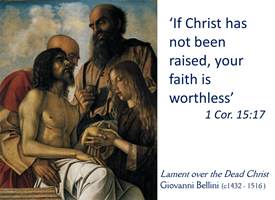
Lament over the Dead Christ, Giovanni Bellini (c1432 – 1516)

We know that without a resurrection Christianity is counterfeit. As the apostle Paul tells the Corinthians, ‘If Christ has not been raised, your faith is worthless’ 1 Corinthians 15:17. Accordingly, since a resurrection requires death, Jesus’ death by crucifixion has to be regarded as true. This ‘fact’ is attested to by a number of ancient sources, including the non-Christian historians, Josephus and Tacitus, who were therefore not biased toward a Christian interpretation of events.

We know that the chances of surviving crucifixion were very bleak and no evidence exists that Jesus was removed whilst still alive. The unanimous professional medical opinion is that Jesus certainly died due to the rigours of crucifixion, and even if he had somehow managed to survive, it would not have resulted in the disciples’ belief that he had been resurrected.

Il Precusore,

Il Precusore, Giulio Aristide Sartorio (1860 – 1932)

What about the empty tomb? Well its location was known to Christians and non-Christians alike. So if it hadn’t been empty, why would the chief priest have devised a plan to give a large sum of hush money to the guards, telling them to say that ‘His disciples came by night and stole him away while we were asleep’ Matthew 28:12-13. It would also have been pretty impossible for the large group of believers to have suddenly sprung up in the same city where Jesus had been publicly executed just a few weeks before and for those same believers to have been willing to die brutal martyr’s deaths if they knew this was all a lie.

Were people hallucinating when they encountered the risen Christ? Well, usually hallucinations are something that happens in an individual’s brain and not repeatedly on separate occasions and certainly not to groups of up to 500 people! 1 Corinthians 15:6 Even if they were visions, brought on by the apostle’s grief over the death of their leader, surely the body would have still been in the tomb.

Pascal's Wager

Pascal’s Wager

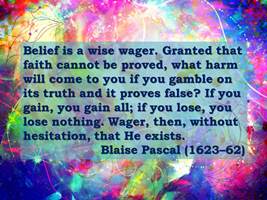
Convincing facts and figures? Well maybe. Or perhaps Pascal’s Wager might be the reason why people believe. Pascal was a seventeenth-century philosopher who theorised that humans live their lives by wagering that believing in God is a good bet because if when they die he does exist then they have gained the best of everything, on the other hand if they don’t believe and then find out he does exist then they made the worst choice and will have lost everything. However if they were to discover after death that God never existed then it didn’t matter what you believed.

So by believing, you are in a win-win situation. This sort of hedging my bets is just one accusation made against Christians who assume that because they believe in the right God, they are automatically good and have a one-way ticket to everlasting life. However, it also assumes that God would always reward blind faith above living a conscious Christ-centred life and all of the obligations that that might bring.

WDITFUTB_Belief is truth blogPerhaps belief and faith are different then… that belief is something that our logical, human minds hold to be true whilst faith is something that is felt deep within our hearts. Or could it be that faith is based on belief and that is why faith alone is not possible because belief always brings about actions and reactions?

Some people might even say that faith is truth held in the mind and that belief is a fire in the heart. Perhaps we just can’t separate the mind and heart, because as we heard ‘The community of believers were of one heart and one mind’ Acts 4:32

I hope you’ve been aware that I’ve been careful to never actually define what it is exactly that we understand and count as belief. Some might say that’s a cop-out; that the church is forever allowing so much laissez-faire around declaring what it believes and stands for that it nullifies any claims it might have to the truth. Well, I’m sure that for the majority of us it will include the belief that Jesus died and was resurrected in order that we might ‘have life in his name’, but that for each of us that might mean something slightly different depending where we are on our journey of faith.

As we walk together in fellowship with each other and with God, let’s make sure that we’re not only helping each other to increase in faith, but that we are sharing our beliefs with others so that God’s joy may be complete. After all didn’t Jesus say ‘Blessed are those who have not seen and yet have come to believe’. So let’s go and open a few more eyes to the truth of what we believe.

Amen

John 20:29

John 20:29

Go back

Your message has been sent

Warning
Warning
Warning
Warning

Warning.