Tag Archives: Gift

Feeling Anxious? Why Worry?

Sermon preached on Sunday 8th February 2026 based on Romans 8:18-25 and Matthew 6:25-34

May I speak and may you hear through the Grace of our Lord’ Father, Son and Holy Spirit. Amen

Everyone has anxieties or worries – everyone… I may be anxious about climbing up into this pulpit, in this robe without tripping up! I may be anxious about how, what I’ve written on these pages, may be heard or understood. I may be anxious that I won’t have time to have a coffee between this service and the next! Lots of anxieties and worries.

No doubt you too could make a list of the things you are anxious about at this time, and some of them will be fleeting moments of thoughts and desires for a positive outcome, whilst others may be deep-seated concerns around health issues or disquiet about events in our world and society.

Everyone has worries… The fact is we live in an anxious age. Alarming news headlines, mounting financial burdens, growing strains in our relationships, medical niggles and changes in our health. All of these often make the future seem very fragile, and in amongst it all anxiety whispers, ‘What if?’ – although more often it shouts!

Yet, into all that noise, Scripture speaks steady, countercultural, gracious words, ‘Do not worry.’ Both of our passages today do not deny suffering or dismiss our needs. What they actually do is locate our lives within the wider purposes of God, that draw us into a vocation of hope and trust; hope that is strong enough to hold our pain; and trust that can free us to live in today.

Even so, ‘Jesus’ and ‘anxiety’ do not sit easily together. What Jesus is trying to show us is that deep down as human beings we can be controlled, even dominated and bullied by our anxieties, but that these worries are futile because that don’t produce any real fruit.

The concerns he highlights are about eating, drinking and clothing. Certainly, in biblical times, where there were no welfare systems or charity safety nets, they were genuine worries about simply surviving, and yes, even today people have to make choices about whether they might put a meal on their table or provide basic needs for their families. So, for them, their worrying was very much justified, even sensible if it came up with a resolution.

And when we place it against our modern day lives, it can often mean our worries turn out to be more about the things we desire rather than things we need. However, I hope we would never tell anyone who was at risk of starving, that food is unimportant. Worrying is natural and reasonable, but each of us sits on a dividing line, that has positive anxiety on one side, which helps us to avoid making mistakes and negative anxiety on the other, that projects us into the not yet existent future rather than living in the present moment. So how can we manage it?

Paul tells us that creation itself is groaning as it waits for glory, whilst Jesus tells us not to worry about tomorrow, because God already knows what we need. Together these passages can teach us how to live faithfully between the ache of the present and the promise of the future.

Paul begins with realism. He does not pretend that faith removes suffering. “The sufferings of this present time,” he says, are real. Also, groaning is not the same as moaning or complaining. Complaining is saying that ‘This shouldn’t be happening’, whereas groaning says, ‘This hurts – yet I’m still holding on’. It is the sound of faith under pressure, the cry of someone who knows that the world is not as God intended it to be.

It also reminds us that anxiety is not a personal failure; it is a symptom of living in a fractured world, because we feel it in our bodies, our finances, our relationships, and our fears.

Paul also refuses to let suffering have the final word. “I consider that the sufferings of this present time are not worth comparing with the glory about to be revealed.” This is looking at it from the perspective of hope through the resurrection, and it’s not just wishful thinking. It is about having confidence in the faithfulness of God, as it looks forward to what we cannot yet see, because if we could already see it then it wouldn’t be hope.

The future glory of God does not erase today’s pain, but it re-frames it. This is the hope we confess in the Creed: “We look for the resurrection of the dead, and the life of the world to come.” Such hope teaches us patience. Not passive resignation, but a steady, prayerful waiting upon God.

So, if it is Paul that addresses the ache of the world, then it is Jesus who addresses the anxiety of the heart. Three times Jesus says, “Do not worry.” And then he speaks about the most ordinary things: food, drink, clothing. This is because Jesus knows our worries are generally practical. He points to birds who do not store grains, and to flowers that do not spin threads. These are not sentimental illustrations, but signs of God’s sustaining care. Our anxiety often arises when we live ahead of ourselves—when tomorrow’s uncertainties overwhelm today’s calling. Jesus gently calls us back to the present moment and reminds us that the same God who clothes the lilies and feeds the birds is attentive to our lives.

Jesus also doesn’t say that our needs don’t matter, just that they do not have to rule us. Instead, we should ‘Strive first for the kingdom of God […] and all these things will be given to you as well.’ Seeking the kingdom means orienting our lives around God’s values, God’s justice, God’s love. When we do, our priorities shift. Worry loosens its grip because our security is no longer tied to outcomes we cannot control.

And Jesus ends with words that are both compassionate and practical. “Do not worry about tomorrow, for tomorrow will bring worries of its own.” In other words, God gives grace in daily portions. Just think of the number of times we have prayed, ‘Give us today our daily bread’, not ‘oh and some for tomorrow as well, and if you can manage it a few fallback items in the larder’. Today’s grace is enough for today.

And whilst we are seeking the kingdom our calling is being reshaped, so that anxiety no longer governs it. It means that our daily work, our care for others, our stewardship of creation, and our commitment to justice and mercy are not distractions from the kingdom of God. They are ways in which the kingdom is being made visible here and now.

So, Jesus does not end this teaching by telling us to try harder not to worry. He ends it by inviting us to trust deeper. The birds still fly, the flowers still bloom, and God is still faithful. The same God who clothes the fields and feeds the sparrows knows each of our names, our needs and what our tomorrows hold. To worry about that suggests we are alone. To believe what Jesus tells us means that we are being held.

So, when we leave this place and tomorrow brings its own questions—about money, health, family, or the future, perhaps we could remember that God is already in our tomorrow, and that we do not need to carry anything that God has promised to provide.

Take today as the gift it is. Walk in trust, not in fear. Seek the kingdom, not control. And rest in the assurance that the God who calls us is more than enough—today, and every day.

Amen

He Sang A Love Song To The Earth

Advent Wreath blog

The watching and waiting are nearly over

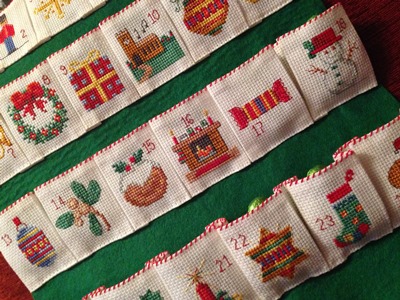
As Advent draws to a close and the Advent calendar chocolates are nearly all eaten, we approach the climax to our Christmastide celebrations. We’ve watched and we’ve waited… for what?

  • We’ve watched as greed and consumerism cheapens the meaning of a gift.
  • We’ve waited to hear the Good News amongst the stories of abuse and exploitation.
  • We’ve watched as helpless innocents are slaughtered by false religion.
  • We’ve waited to hear the angels sing above the cacophony of self-interest.

An almost emptly Advent calendar

An almost emptly Advent calendar

These are certainly not the things we still watch and wait for; they’re the result of ignoring the very thing that was revealed so many years in a message of love and hope for the whole world. For somewhere out there in the darkness, a child was assuredly being born to a surrogate mother; his paternity in question; his homelife unsecure and his future seemingly uncertain; and yet his message was simple… love God; love yourself; love each other. Only then will we truly be able to celebrate Christmas for what it really is.

 He Sang A Love Song To The Earth

He sang a love song to the earth,
and the seraphim in joyous trembling
heard words so sweet and clear;
as in radiant host they swept the skies
to bring good news to a waiting world
that lay so dark and drear.

Within a shroud of blackest night,
pierced by a woman’s cry,
an infant babe, slipped into life;
the godhead veiled in flesh.
and darkness swaying mesmerised,
retreated from the dazzling light.

Yet still among the silent streets
rang out creation’s babel sounds;
deafening those who strained to hear
the messengers divine; who joined
the lullaby his mother sang,
now echoing through the air

Do we, like them, refuse to hear
its simple melody. A song of peace,
a song of joy; if we could only see
the human face behind our fears,
the love amidst the hate;
the Christ child born in everyone
His song to set us free.

angels_song

The Angels Echoing The Song

Wishing you all a Joyous, Peaceful and Blessed Christmas!

← Back

Thank you for your response. ✨

It’s Called Christmas For A Reason – The Wise Men’s Story

The Wise Men Came Travelling

The Wise Men Came Travelling

Originally written for a Messy Church service storytelling slot to celebrate Epiphany

I want to tell you the story of three men who decided to leave their comfortable homes and travel a very long distance in search of…..well at the beginning they weren’t entirely sure what or who it was they were searching for? They just knew that it was so important that they set out on a new adventure.

Some people called them wise men…but I’m not so sure they were very wise to consider going on such a journey …at least not at the start. Others call them kings… In fact only one of them was a king and his name was Balthazar. He was a very kind king and looked after his wives and servants very well. His life was extremely comfortable, because he could afford to buy anything he wanted. The trouble was he had bought everything that he wanted and now he was bored!

He was also very intelligent and liked to try and find out everything about the world around him. He read loads of books and his favourite subject was history. However, he was not as clever as his best friend Melchior, who was indeed a wise man. Melchior, was also very rich and so he could spend all of his time studying the stars. That is he looked up at them at night and watched them as they moved across the sky, and during the day when the sun hid the stars he plotted their movements on his charts. Whenever Balthazar went to visit his friend he had to try and find him behind a mountain of papyrus rolls

Also living in the city was another man called Caspar, who was also a friend of the king. He was a man who thought a lot about the world – about how it was created; about who created it; about why it was created; about why he had been created! He had read all of the ancient scriptures of lots of different faiths and had come to the conclusion that there must have been a very powerful God who had done all of these things

One day Melchior, rushed into the palace when Caspar was visiting Balthazar. He was very excited and told them both to come and see what he had discovered. He spread out a large chart on the table in front of them and pointed to a small object that was separate from all of the other stars.

“I noticed it the other night…I’m sure it wasn’t there the night before! Come and see it for yourselves.

They all went back to Melchior’s house and waited…..and waited….and waited. Actually they had to wait for quite some time as it had been lunch time when Melchior had rushed to the palace and the sun needed to set before the stars would be visible…

Eventually though, when the night was very dark, they saw an incredible sight…. on the skyline a bright light was shining… it was brighter than all the other stars and seemed to twinkle and sparkle as if it was waiting for them to make a decision.

“I think I know what this means,” said Caspar, “I read about a star appearing in the sky when God wants to send a message to the world”

Balthazar and Melchior wondered how a star was going to tell them a message. Stars can’t talk after all.  But they did notice that the way the star hovered over them it seemed to be saying ‘Follow me’ before it disappeared as the sun rose. Over the next few days they kept on seeing the star and each night it seemed to flicker more brightly and urgently.

Eventually they came to a decision. Caspar had reread one of the ancient books and declared that the stars appearance was because a very, very special person had been born…a prince or a king!

Melchior said that the star was moving very slowly westward, so perhaps that was where it had happened. Balthazar just thought it was the chance for a great adventure and began making plans for a journey…. and because he wasn’t sure how long that journey was going to be he packed lots of things, including gifts for whoever they were going to meet…after all it’s only polite to take a present when you go visiting.

The three men travelled for many months and days through the desert. They tended to sleep during the day when the sun was at its hottest and then set out again as the sun set and the stars began to appear; and every night the brightest star in the sky seemed to lead them onward into new lands, never stopping. Even when it was a cloudy night the light seems to glow through the clouds so that they could see where it was.

Then one day they were sleeping in their tents when some men entered their camp. They told Balthazar, Melchior and Caspar that they were King Herod’s guards and that their master would like to welcome them to his country, so they were escorted to the palace of King Herod

Now King Herod wasn’t a very nice king. He was greedy and cruel and extremely jealous of anyone who threatened his power. None of his own people were ever allowed to see him. Only the important people were allowed into his palace. So we’ve got to stay outside…

…However, Balthazar, Melchior and Caspar were allowed in. King Herod seemed very friendly to his three visitors. Apparently he asked them lots of questions about their journey, about how they had got there and where they were going. Melchior, who was very excited about how the star had led them on their journey, told Herod about his discovery and Caspar tried to explain that they were looking for a very important person, possibly a new king… Balthazar just felt uneasy.

After a while, despite all the splendour and luxury of the palace, the three men thought it would be wise to continue on their way. Especially as the star had moved on – and they had to spend three or four nights travelling very swiftly to catch up with it. King Herod had made them promise to let him know when they found the new king, so that he could come to welcome him. Balthazar thought that was one promise he really didn’t want to keep, and had kept his fingers crossed behind his back when he said they would!

After a few more days they approached the town of Bethlehem. They were only expecting to top up their food supplies and allow their camels some rest, as the city was not very grand – there were no majestic palaces, or magnificent houses within its walls; only ordinary houses, in ordinary streets. Yet the star seems to be hovering right over the town, as if it had come to a stop.

As they made their way through the twisting and winding streets, they kept asking themselves was this the place? Surely not! Yet the star was right there in the sky above them and was shedding its light onto a particularly small, very plain looking house. The three men stood in front of the wooden door

“You knock,” said Caspar

“No, you knock,” replied Melchior

“Oh for goodness sake, I’ll knock,” sighed Balthazar, as he rapped very smartly on the door. At the sound of the knock, a woman’s voice from within the house bid them to come in and so they entered the house.

At first it seemed very gloomy, then they made out a young woman sitting on a stool, with a child on her knee. Maybe it was the light from the star, or maybe it was the candle but the room seemed to glow with light and all three men fell down on their knees as they felt the presence of someone very special. It may not have been a palace, there may not have been hundreds of servants or furniture of gold and silver, but there was definitely someone royal there – a future king.

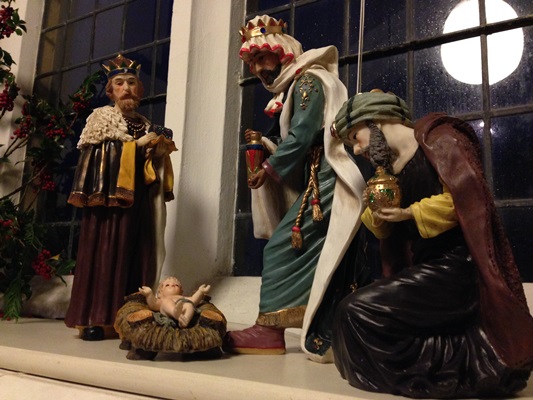
Balthazar then remembered the presents that they had brought and he laid down his gift of gold – certainly fit for a king! Melchior had some frankincense, which would be useful if he turned out to be a great priest and teacher. When Caspar hesitantly laid his gift of myrrh in front of the cradle the others were a bit confused. Surely myrrh was used when people had died.

“He may need it later on,” explained Caspar

Mary, the child’s mother, just smiled and thanked them for their gifts.

“His name’s Jesus, and Joseph, my husband and I, are very grateful. He is truly a gift from God.”

The three men bowed again and each thought that they would remember this journey and this night and this child for a very long time. As they left they knew that were all leaving wiser than when they had arrived.

Oh, and by the way – they never did tell King Herod where they had found the child. Which was just a well, as Herod did turn out to be a very, very nasty man!

Wise Men Came Travelling

Wise Men Came Travelling

The visit of the Wise Men or Magi to the Holy Family is celebrated in the Church of England as Epiphany on Twelfth Night (6th January). An epiphany is a moment of sudden and great revelation, which the wise men experienced on seeing the Christ child. Despite their names not being recorded, some traditions believe they may all have been Eastern kings –  and of the three Balthazar is an alternate form of the Babylonian king Belshazzar, mentioned in the Book of Daniel.

As to whether there were only three of them, this may be an assumption from the fact that there were just three gifts mentioned in Matthew’s Gospel (Chapter 2:1-12); in the East, the Magi traditionally number twelve,

However many there were, they certainly didn’t arrive on the night of Jesus’ birth, as the family had relocated from a stable to a house (Matthew 2:11). It would also seem that only Mary was there at the time of the visit to her child, who was likely to have been several months old but no more than two years old (Matthew 2:16)

And the star that they followed? Now known as the Star of Bethlehem or the Christmas star, and which astronomers throughout the ages have attempted to link to unusual astronomical events, such as a conjunction of Jupiter and Saturn, a comet or a supernova. Whatever it was it led them to the correct place.

May Christ’s love be revealed in and through you this Christmastide!

← Back

Thank you for your response. ✨