Tag Archives: honour

There Is Always Hope

A thought for our Remembrance Sunday Service

When all else has gone there is always hope. When we hit rock bottom, there is always hope. When we can see no light at the end of the tunnel, there is always hope. Hope is the one think that we can be assured of because very often it is the only thing that is left when we feel that all hope has gone, which seems a real contradiction.

Today we are honouring the memory of the millions of men and women who answered the call of their country to fight against evil and oppression. Who fought to liberate innocent men, women, and children, caught up in conflicts whose agendas were against human rights, racially motivated or politically expedient.

From the First World War, we hear so many poignant stories of young men, barely adults (and sometimes not even that) taking up arms, marching away from their homes and villages, dreaming of being heroes and finding themselves in what might be described as the depths of hell on the Western Front.

From the Second World War, with more sophisticated weaponry, aviators took to the skies, using their planes like the infantry had used swords and bayonets in dog fights. Flying long range missions to drop bombs on strategic targets to try and disrupt and demoralise those targeted. Until the ultimate weapon of destruction was unleashed.

From more recent conflicts, in Afghanistan and the Middle East, trying to establish basic human rights for young men and in particular young women and today we find ourselves living in a world where once more innocent children and civilians are living in fear for their lives, for their families and for the future.

Wars are designed to spread fear, to crush resistance and to demonstrate both physical and psychological power, but the one thing they can never defeat is the hope of peace and restoration.

Today men and women of all faiths and none in our armed services, answer the call to bring about peace in the face of war and terror. They are willing to sacrifice their lives, if necessary; but as Christians we have the ultimate hope through the sacrificial death and resurrection of Jesus, that even death will not be the end.

For the Thessalonians, Paul was reassuring them that they should not be grieving deaths in their community without hope. If this life is all we have, then its end in death produces considerable grief. However, Paul says that if you believe that Jesus died and was raised (the basic Christian affirmation the Thessalonians had accepted), then you can also believe that God will raise our loved ones. Those who also believed in the death and resurrection of Christ are caught up into his eternal life.

Paul refers to Jesus’ own words, that the Son of Man will return in the clouds with the angels gathering the elect from the four corners of the earth to meet him and at this point the dead and the living will be gathered as one.

This is the hope that trumps all other hopes.

However, later this morning we will gather together to remember all those who have died in war and conflicts, those of our families and the unknown soldiers, sailors, and aviators. To honour their memory. Those long dead and those killed in more recent clashes.

We will remember that: ‘they shall grow not old, as we that are left grow old; age shall not weary them, nor the years condemn.’

But above we will pray for peace to be the hope of all nations, that there will be no more killing of innocent civilians and children, that we respect the sanctity of human life because our common belief is that all life is precious to God and in him is our greatest hope.

Amen

Based on 1 Thessalonians 4:13-18

Go back

Your message has been sent

Warning
Warning
Warning
Warning.

The Beehive Church

Collaborative Honey Bees

Collaborative Honey Bees

Having just finished and handed in one of my final portfolios, it has given me an opportunity to reflect on the sort of ministry I would hope to engage with in the future – and it’s all to do with bees! Now before you succumb to an image of a wild apiarist reverend roaming the parish bedecked in a wide-brimmed veil touting honey as a cure-all, think instead about collaboration.

We have much to learn about working together collaboratively, and by that I don’t mean working well as a team under the authority and  expertise of a ‘good’ leader. No indeed, because for so long we have had a hierarchical model of leadership in the Church, where decisions are filtered downwards and authority is shared amongst those deemed to be ‘worthy’ or competent; but it doesn’t have to be like that.

The fact is we already have the ultimate authority in God, and collaborative ministry is nowhere better demonstrated than through the Holy Trinity, which acts as an example of synergy, the whole being greater than the parts and yet each part is distinctive and committed to working together both internally as well as externally

One true leader

One true leader

True collaboration can only take place when we place God at the pinnacle of the leadership tree, and when every ministry that is revealed through the gifts or charisms imparted by the Holy Spirit to each person are equally esteemed and valued. These gifts are all undoubtedly diverse, but the leader that facilitates opportunities for all to be heard, establishes lines of communications between different groups and safeguards accountability, while at the same time recognising that others may be better equipped to undertake various tasks is surely one that will succeed in fulfilling their primary role of reminding the community whose initiative they need to follow and who the source of their mission and unity is.

Not an easy task for someone whose personality tends towards natural introversion, who will often carry out a task independently to simply get it done quickly. However, over the last few years I have been introduced to more and more examples of collaborative ministry and have come to realise just how important it is; and above all I truly believe that in order to progress the work that God asks us to undertake, we need to use Christ as our example and the Holy Spirit as our guide,

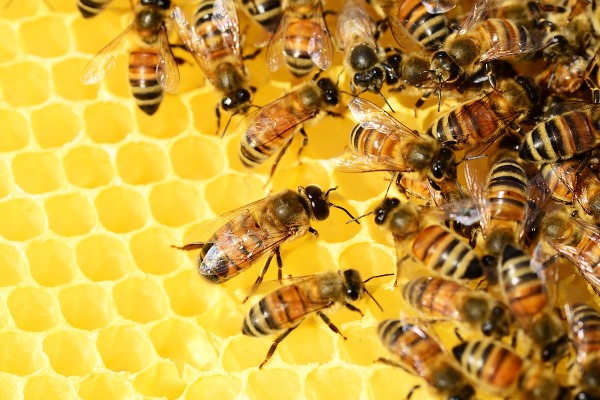
What then has this to do with bees? Well the writer Tolstoy spent a lot of time musing philosophically about the collaborative nature of bees within a beehive, often comparing it to the Christian church, not always in a kind way. However, what we can learn from honeybees is that they collaborate together almost unconsciously to ensure that the colony not only survives but thrives.

The fruits of the hive

The fruits of the hive

Foraging bees will continuously collect nectar, often being led to new sources by any one of its apparent insignificant members, whose dance can influence the rest of the hive to venture to new and plentiful supplies, whilst the worker bees use this raw material to construct complex precise honeycombs all without the need for supervisors, each contributing a small piece of beeswax before moving aside to allow a co-worker to add their contribution. At the same time the bees respect nature by giving back to their habitat the gift of pollination.

Admittedly the drone bees could be considered the lotharios of the bee world, but hey-ho it takes all sorts; and at the very centre of the hive is the queen bee, without whom the colony would not survive and yet who selflessly gives herself to ensure the next generation of bees is produced and nurtured*.

What then of the product of this collaboration – surely there is nothing sweeter than being prepared to share with others the glorious fruits of all this shared ministry.  It’s just a thought, but maybe the ‘beehive church’ is one that we could all be striving toward. Why not let me know what you think?

The collaborative church

The collaborative church

*Within this analogy, God the creator is wholly represented through all of his creation, whilst the Holy Spirit provides the wisdom, energy and drive. At the centre is Christ, the selfless example of whom the minister is called to represent and emulate.

Go back

Your message has been sent

Warning
Warning
Warning
Warning

Warning.