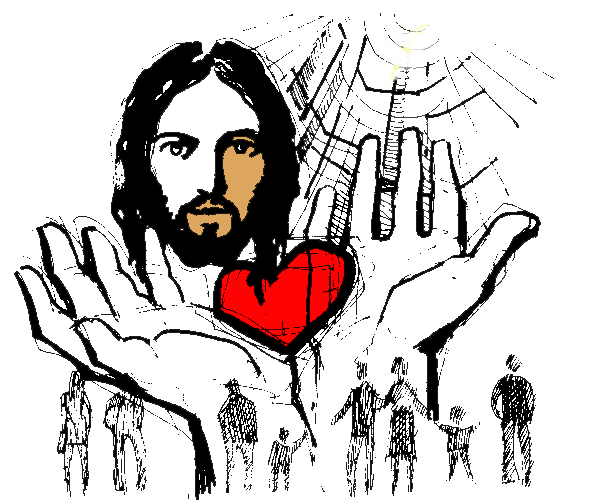
Sermon preached on Sunday 9th June 2024 – Trinity 2 – based on Mark 3:20 to end.
May I speak and may you hear through the Grace of our Lord: Father, Son and Holy Spirit. Amen.
Who is my mother? Well, if I was being asked to complete an official form to aid my family history I think I could answer that one correctly; Peggy Missin, born 12th September 1932 in Clenchwarton, Norfolk, died 8th February 2018. Who is my brother? Well, again that’s quite easy – no one, I was an only child.
Of course this wasn’t the answer that Jesus was looking for in today’s gospel. Indeed it wasn’t even the question, which was – Who are my mother and my brothers?
We are only three chapters into Mark’s gospel, which unlike Matthew, doesn’t start with a sixteen verse genealogical list of Jesus’ lineage. No, Mark starts simply with the lead up to the beginning of Jesus’ ministry.
From the other gospel’s we can piece together some ‘facts’ about Jesus’ early life. According to Luke, Jesus was born in Bethlehem, he was presented in the Temple as a baby and recognised by Simeon as the Messiah, but soon afterwards was taken into Egypt as a refugee from the genocide ordered by King Herod. When this danger had passed he returned with his family, not to Bethlehem, but his familial home town of Nazareth, about ninety miles to the north, where he grew up without much incident that we know of, apart from his theological debating skills at the age of twelve with the elders in Jerusalem on a Passover visit.
In Jesus’ day, Nazareth had a population of about a hundred and fifty, most of whom were interrelated. The Nazarites, were a small sect of Jews who believed they were the shoot – the “Netzer” – from the stump of Jesse, from whom according to Isaiah, the promised Messiah would come. However, the negative references to Nazareth in the Gospel of John suggest that ancient Jews did not connect the town’s name to prophecy. They followed the teachings of Rabbi Shammai and were strictly orthodox and ultra-conservative. They had as little to do with the outside world as possible, much like Hasidic Jews today.
Some thirty years later and further south, in the wilderness of Judea, a relative of Jesus appeared, namely John, who was preaching a baptism of repentance for the forgiveness of sins, with a view that the arrival of the Messiah was imminent, a prophecy fulfilled when Jesus presented himself for John’s baptism.
After John the Baptist was taken into custody by the authorities and imprisoned, Jesus now steps forward and announces his ministry, ‘The time is fulfilled, and the kingdom of God has come near; repent, and believe in the good news.’
His speech in the synagogue at Nazareth creates an uproar. ‘“The Spirit of the Lord is on me, because he has anointed me to proclaim good news to the poor. He has sent me to proclaim freedom for the prisoners and recovery of sight for the blind, to set the oppressed free, to proclaim the year of the Lord’s favour.”
He then goes on to prophecy about God’s judgment upon Israel. It was not what the elders wanted to hear. They dragged him out of the synagogue, took him out to the edge of town and were prepared to stone him to death. But for some reason, they stopped short. Jesus walked away and never looked back. He left his home and his family and moved to the nearby city of Capernaum on the northern shore of the Sea of Galilee.
Things were different there. The synagogue was more open to his teaching, ‘They were astonished at his teaching, for he taught them as having authority, and not as the scribes.’
He won the loyalty of four local fishermen – Peter, Andrew, James and John; the local tax collector, Levi or Matthew; as well as seven more disciples and any number of followers. As important as his teaching, he also had the power to heal the sick and perform all sorts of miracles. People flocked to Capernaum to hear him teach and receive his healing touch.
But with rising popularity came criticism. His teaching was unlike anything they’d ever heard before. He broke the laws of ritual cleanliness, he violated the Sabbath, he spoke openly of a kingdom not of this world, he communicated directly and intimately with God.
His behaviour and his speech was so radical that they looked to label it as anti-social linking it to perceived mental health issues. He wasn’t conforming to the status quo. In a word, he didn’t fit the mode. When it became clear that he had no intention of conforming to the expectations of the religious leaders, they began to say, ‘He is insane’
Apart from clinical diagnosis, people’s perception of mental health draws a thin line between sanity and insanity, and when it appeared, even to his friends, that he’d gone over the edge, they sent word to Nazareth for his family to come at once. So, it fell to his mother and his brothers to come to Capernaum and take him home.
When they got there, they found Jesus teaching in a home. The place was packed. People were standing in the doorway and spilling out into the courtyard straining to hear him. Mary and her sons couldn’t get in, so they sent word, “Tell the teacher that his mother and brothers are outside.” But when Jesus got the message, he said, “Who are my mother and my brothers?”
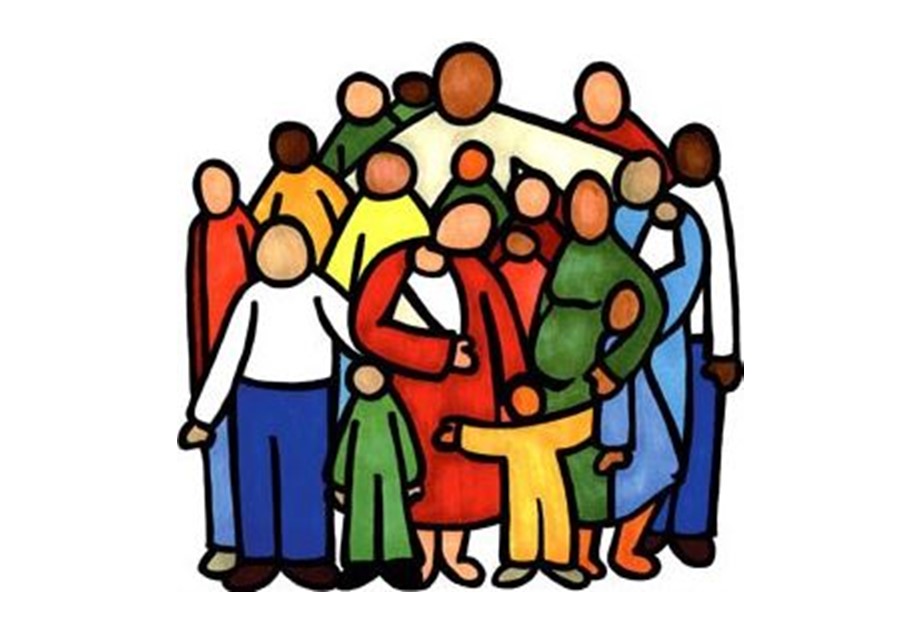
And looking at those who sat around him, he said, ‘Here are my mother and my brothers! Whoever does the will of God is my brother and sister and mother.’
When Mary and the others were told what he’d said, what were they to do. On the surface it seems like a harsh thing to say. Was Jesus now rejecting his family altogether? The fact is, he wasn’t saying, ‘these people are not my mother and brothers, he wasn’t denying the relationship he had with his biological family; he merely expanded the conception of the family circle to include any number of others. He pointed to a spiritual, rather than a physical, kinship as the basis for life in the kingdom of God.
The Spirit of God unites us as family in a bond of love able to withstand the storms of life and last throughout all eternity. It transcends the boundaries of age, race, nationality and gender. It encompasses people from every station and walk of life.
Whilst we are children of our parents, we are also children of God, and, as we grow in our relationship to God, we’re called to seek God’s will for our lives and follow the leading of God’s Spirit, even when it means overriding the connections to our families.
It can be hard to break away from the authority of our parents, just as it’s hard, as parents, to cut the apron strings with our children. However, Jesus clearly defined the boundaries of parenthood when he asked the question, “Who are my mother and my brothers?” There could be no mistake about it, his relationship to God came first and foremost, and so must ours.
The Good News is that Jesus’ relationship with his family did not end here; it moved to a new level. Mary became one of Jesus’ most devout followers. She stayed by his side, if at a distance, to the very foot of the Cross. And his brother, James, while hardly mentioned in the gospels, shows up in the Book of Acts as the leader of the church in Jerusalem.
‘Here are my mother and my brothers! Whoever does the will of God is my brother and sister and mother.’ Take a look around you, we so often talk about our church family. These people who are sitting around you are our brothers and sisters in Christ.
Just like in every extended family, we may not know them that well, we may move in different social circles, we may hold different views and opinions and not agree with them all the time; but we are bound together in our love of God and Jesus’ command to love one another.
And the family ties don’t stop here in this building. Our fellow Christians are in the next town, the next city, in fact our family extends right around the world, wherever God’s name is proclaimed and honoured.
And the best thing we can do for this family is to grow it. I paid a visit to The Vyne, yesterday with my family. This beautiful house and estate was passed to the National Trust because the family lineage ran out with no more heirs to pass it on to. We can’t let this happen to our Christian family.
This afternoon I will baptise two young children, who are beginning their journey of faith, they will receive the sign of the cross on their foreheads, with the words, ‘Christ claims you for his own’ and an exhortation to ‘not be ashamed of Christ. You are his forever’
Today, two more young people being added to the family. What will you do to extend our family further…?
The Spirit of the Lord is on you, because he has anointed you to proclaim good news to the poor. He has sent you to proclaim freedom for the prisoners and recovery of sight for the blind, to set the oppressed free, to proclaim the year of the Lord’s favour.
Amen.


 boruachelohim