Tag Archives: baptism

Who Is My Mother, Who Is My Brother…?

Sermon preached on Sunday 9th June 2024 – Trinity 2 – based on Mark 3:20 to end.

May I speak and may you hear through the Grace of our Lord: Father, Son and Holy Spirit. Amen.

Who is my mother? Well, if I was being asked to complete an official form to aid my family history I think I could answer that one correctly; Peggy Missin, born 12th September 1932 in Clenchwarton, Norfolk, died 8th February 2018. Who is my brother? Well, again that’s quite easy – no one, I was an only child.

Of course this wasn’t the answer that Jesus was looking for in today’s gospel. Indeed it wasn’t even the question, which was – Who are my mother and my brothers?

We are only three chapters into Mark’s gospel, which unlike Matthew, doesn’t start with a sixteen verse genealogical list of Jesus’ lineage. No, Mark starts simply with the lead up to the beginning of Jesus’ ministry.

From the other gospel’s we can piece together some ‘facts’ about Jesus’ early life. According to Luke, Jesus was born in Bethlehem, he was presented in the Temple as a baby and recognised by Simeon as the Messiah, but soon afterwards was taken into Egypt as a refugee from the genocide ordered by King Herod. When this danger had passed he returned with his family, not to Bethlehem, but his familial home town of Nazareth, about ninety miles to the north, where he grew up without much incident that we know of, apart from his theological debating skills at the age of twelve with the elders in Jerusalem on a Passover visit.

In Jesus’ day, Nazareth had a population of about a hundred and fifty, most of whom were interrelated. The Nazarites, were a small sect of Jews who believed they were the shoot – the “Netzer” – from the stump of Jesse, from whom according to Isaiah, the promised Messiah would come.  However, the negative references to Nazareth in the Gospel of John suggest that ancient Jews did not connect the town’s name to prophecy. They followed the teachings of Rabbi Shammai and were strictly orthodox and ultra-conservative.  They had as little to do with the outside world as possible, much like Hasidic Jews today.

Some thirty years later and further south, in the wilderness of Judea, a relative of Jesus appeared, namely John, who was preaching a baptism of repentance for the forgiveness of sins, with a view that the arrival of the Messiah was imminent, a prophecy fulfilled when Jesus presented himself for John’s baptism.

After John the Baptist was taken into custody by the authorities and imprisoned, Jesus now steps forward and announces his ministry, ‘The time is fulfilled, and the kingdom of God has come near; repent, and believe in the good news.’

His speech in the synagogue at Nazareth creates an uproar.  ‘“The Spirit of the Lord is on me, because he has anointed me to proclaim good news to the poor. He has sent me to proclaim freedom for the prisoners and recovery of sight for the blind, to set the oppressed free, to proclaim the year of the Lord’s favour.”

He then goes on to prophecy about God’s judgment upon Israel.  It was not what the elders wanted to hear.  They dragged him out of the synagogue, took him out to the edge of town and were prepared to stone him to death. But for some reason, they stopped short.  Jesus walked away and never looked back.  He left his home and his family and moved to the nearby city of Capernaum on the northern shore of the Sea of Galilee.

Things were different there. The synagogue was more open to his teaching, ‘They were astonished at his teaching, for he taught them as having authority, and not as the scribes.’

He won the loyalty of four local fishermen – Peter, Andrew, James and John; the local tax collector, Levi or Matthew; as well as seven more disciples and any number of followers.  As important as his teaching, he also had the power to heal the sick and perform all sorts of miracles.  People flocked to Capernaum to hear him teach and receive his healing touch.

But with rising popularity came criticism.  His teaching was unlike anything they’d ever heard before.  He broke the laws of ritual cleanliness, he violated the Sabbath, he spoke openly of a kingdom not of this world, he communicated directly and intimately with God.

His behaviour and his speech was so radical that they looked to label it as anti-social linking it to perceived mental health issues. He wasn’t conforming to the status quo. In a word, he didn’t fit the mode.  When it became clear that he had no intention of conforming to the expectations of the religious leaders, they began to say, ‘He is insane’

Apart from clinical diagnosis, people’s perception of mental health draws a thin line between sanity and insanity, and when it appeared, even to his friends, that he’d gone over the edge, they sent word to Nazareth for his family to come at once. So, it fell to his mother and his brothers to come to Capernaum and take him home.

When they got there, they found Jesus teaching in a home.  The place was packed.  People were standing in the doorway and spilling out into the courtyard straining to hear him.  Mary and her sons couldn’t get in, so they sent word, “Tell the teacher that his mother and brothers are outside.”  But when Jesus got the message, he said, “Who are my mother and my brothers?” 

And looking at those who sat around him, he said, ‘Here are my mother and my brothers! Whoever does the will of God is my brother and sister and mother.’

When Mary and the others were told what he’d said, what were they to do. On the surface it seems like a harsh thing to say. Was Jesus now rejecting his family altogether? The fact is, he wasn’t saying, ‘these people are not my mother and brothers, he wasn’t denying the relationship he had with his biological family; he merely expanded the conception of the family circle to include any number of others.  He pointed to a spiritual, rather than a physical, kinship as the basis for life in the kingdom of God. 

The Spirit of God unites us as family in a bond of love able to withstand the storms of life and last throughout all eternity.  It transcends the boundaries of age, race, nationality and gender.  It encompasses people from every station and walk of life.

Whilst we are children of our parents, we are also children of God, and, as we grow in our relationship to God, we’re called to seek God’s will for our lives and follow the leading of God’s Spirit, even when it means overriding the connections to our families.

It can be hard to break away from the authority of our parents, just as it’s hard, as parents, to cut the apron strings with our children. However, Jesus clearly defined the boundaries of parenthood when he asked the question, “Who are my mother and my brothers?”  There could be no mistake about it, his relationship to God came first and foremost, and so must ours.

The Good News is that Jesus’ relationship with his family did not end here; it moved to a new level.  Mary became one of Jesus’ most devout followers.  She stayed by his side, if at a distance, to the very foot of the Cross.  And his brother, James, while hardly mentioned in the gospels, shows up in the Book of Acts as the leader of the church in Jerusalem.

‘Here are my mother and my brothers! Whoever does the will of God is my brother and sister and mother.’ Take a look around you, we so often talk about our church family. These people who are sitting around you are our brothers and sisters in Christ.

Just like in every extended family, we may not know them that well, we may move in different social circles, we may hold different views and opinions and not agree with them all the time; but we are bound together in our love of God and Jesus’ command to love one another.

And the family ties don’t stop here in this building. Our fellow Christians are in the next town, the next city, in fact our family extends right around the world, wherever God’s name is proclaimed and honoured.

And the best thing we can do for this family is to grow it. I paid a visit to The Vyne, yesterday with my family. This beautiful house and estate was passed to the National Trust because the family lineage ran out with no more heirs to pass it on to. We can’t let this happen to our Christian family.

This afternoon I will baptise two young children, who are beginning their journey of faith, they will receive the sign of the cross on their foreheads, with the words, ‘Christ claims you for his own’ and an exhortation to ‘not be ashamed of Christ. You are his forever’

Today, two more young people being added to the family. What will you do to extend our family further…?

The Spirit of the Lord is on you, because he has anointed you to proclaim good news to the poor. He has sent you to proclaim freedom for the prisoners and recovery of sight for the blind, to set the oppressed free, to proclaim the year of the Lord’s favour.

Amen.

The Right Man In The Right Place At The Right Time

San Juan Bautista, Alvise Vivarini, c1475

Sermon preached on the second Sunday of Advent 2020 based on the following readings 2 Peter 3:8-15a and Mark 1:1-8

May I speak and may you hear through the Grace of our Lord; Father, Son and Holy Spirit. Amen

We have a saying in our family, ‘Patience is a virtue, virtue is a Grace. Grace is a little girl who wouldn’t wash her face!’ It was often quoted when one or other of the children were eager to attain something sooner rather that wait. Of course, waiting when you’re very young can be a hard thing to do, especially if it’s something exciting that might be about to happen; but it’s no less hard waiting whatever your age.

In Peter’s letter he is faced with a congregation who are disillusioned and impatient by the non-appearance of Jesus coming in glory, definitely an event to be excited about. Even so, the ‘I want it now’s don’t get – they need to learn a little more grace. Instead he encourages them to live lives of holiness and godliness, to wait in ‘peace, without spot or blemish’. After all God’s time-relativity is different to ours. Except, there is still the need to be ready for the unknown moment of his return to the Earth.

But patience is not an attribute recognised by the writer of Mark’s gospel, as he takes us back to the beginning of the story. He starts off like a bullet train out of the station and to be honest never slows down or pause to take on water or fuel till the very end… an end that actually needed something added to it later!

His opening sentence is like a shout, a proclamation, a declaration of intent, ‘the beginning of the good news’. This is the gospel ‘of Jesus Christ, the Son of God, a word derived from the Anglo-Saxon term god-spell, meaning ‘good story’. No starlit stable, no paternity angst, no migratory gift bearers, just straight into the reason that he was here on earth amongst us – to redeem us for all time.

Nevertheless, his first appearance is heralded by an unlikely character, a wild man of the desert, clad in camel’s hair and sustained by a diet of kosher protein and wild honey (locusts are mentioned in Leviticus as a ‘clean’ food). John the Baptist certainly dressed like Elijah and was fulfilling the prophecy of Isaiah to be ‘the messenger’ who was preparing the people of God for the long-awaited Messiah.

But why was this messenger so different from the many prophets that God had send before? What was it about this man that was attracting people to come out into the wilderness from the region of Judea and Jerusalem to be dipped in a river as a sign that were re-turning towards God – a baptism of repentance.

Well, it had been about 500 years since Malachi had stepped off the earthly stage, and since then no genuine prophetic voices had been heard.  Without a prophet, people in the land began to divide into parties and groups, each claiming the right to interpret the scriptures and lead the people.

So, the time was ripe for the long-awaited Messiah to appear, even so we could ask why this was the moment in time that God chose to do so? What we do know is that he came according to God’s time schedule, as Paul states in Galatians, ‘When the fullness of time had come, God sent his Son, born of a woman, born under the law, in order to redeem those who were under the law’ (Galatians 4:4-5)

And if we were to try and put forward a reason why it was a perfect time for the spread of the gospel, we might assume that the Pax Romana, a time of peace in the Roman Empire, and great road and water transport systems, allowed for information to be passed quickly. In addition, Greek was a common language with allowed the Gospel to be communicated to a wide range of peoples, although language is no barrier to the Holy Spirit.

Today’s technological advances in global communications might suggest that now would have been a better time to reveal the Messiah, but would people be prepared to go and submit to a need for repentance from an eccentric looking, religious firebrand in the wilderness of our city suburbs? Yet alone recognise and accept Jesus?

But do not ignore this one fact, beloved,
that with the Lord one day is like a thousand years,
and a thousand years are like one day.

2 Peter 3:8

God always communicates with us in ways we can understand and twenty first century humanity has sufficient reason to believe in Jesus. That he chose to come some two thousand years ago does not change the fact that he came and fulfilled everything that the Bible had predicted. Two thousand years ago, people were ready and able to understand just enough to get the message across; after all for the Lord, ‘a thousand years are like one day’ so it was God’s perfect time for him to come to us.

But it was not to be in the way that most people expected. He would not be a military leader. He would not crush the Romans and set up a Jewish state. The true Messiah would seem utterly defeated before he won.

Yet win he would, and John the Baptist knew this. Although his water of baptism would physically and metaphorically wash people clean from their sins, the power and glory of Jesus would lie in his ability to immerse, plunge or drench people in the Holy Spirit (from the Greek word baptizo).

For us, this drenching means that we are forgiven and brought back into a proper relationship with God; we are blessed with powerful gifts to prepare us for service and for building up the body of Christ, and we are given hope for the future, whatever that looks like and whenever it happens

As Peter says, ‘The Lord is not slow about his promise, as some think of slowness, but is patient with you, not wanting any to perish, but all to come to repentance.’ We can’t hurry time, but this Advent we can repeat our heartfelt wish – Maranatha – come Lord Jesus. Come amongst us and be with us once again and we will welcome you

Amen

Maranatha written in the Southwick Codex

Go back

Your message has been sent

Warning
Warning
Warning
Warning.

On A Midnight Train From Georgia

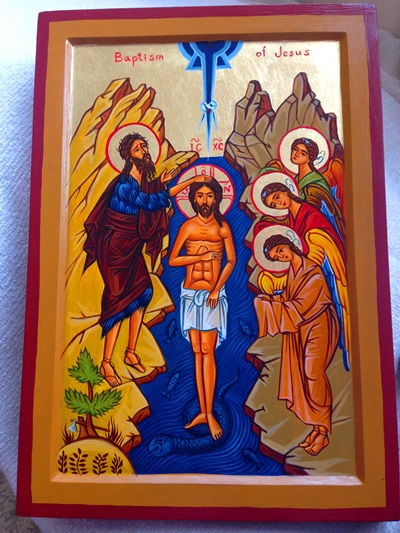
Baptism of Christ Icon - written by Tamara Rigishvili

Baptism of Christ Icon – written by Tamara Rigishvili

To be honest I don’t know if it really was put on the midnight train, or any train for that matter. Maybe it came by plane or postal van, but however it travelled, it arrived safely at my door last week.

The truth though is that it did come from Georgia – Tbilisi, Georgia to be exact – some 2,653 miles to the east of my home, where the very talented artist Tamara Rigishvili lives and works. However, the creation of this beautiful icon came about in what was for me an unusual series of events, which culminated in owning what has become to me a very important representation of the story of Jesus’ baptism.

In April of 2014, I wrote about using this icon to explain the actions performed while making the sign of the cross in Coming Into The Presence of God. Wanting to upload an image of the icon that has been used on that day, I googled several images and came up with one that was taken from Tamara’s website. However, I felt that I needed to get authority to do that, and so I e-mailed her and sought permission, asking her to check out the contents of my blog and with the promise of a link to her site.

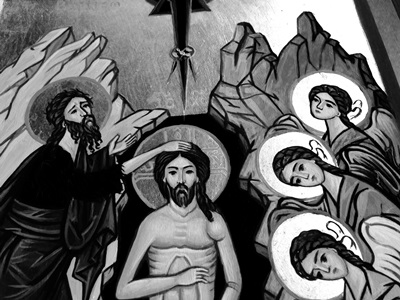
Christ submerged in the water of the Jordan

Christ submerged in the water of the Jordan

Thus a correspondence was begun between two people, thousands of miles apart, who did not know each other, did not necessarily speak the same language (although Tamara’s English is excellent, whilst my schoolgirl Russian is yet to be tested); connected by their common faith, and which resulted in my asking if she would ‘write’ a copy of the icon for me. True to her word, she completed the icon over a three month period and it was then carefully packaged and despatched…

… In the meanwhile, as part of my spiritual direction at college, it was suggested that I meditate on Matthew 3:13-17. This description of Jesus’ baptism is just one of the bible’s explicit passages where the Trinity appear together.

And when Jesus had been baptised, just as he came up from the water, suddenly the heavens were opened to him and he saw the Spirit of God descending like a dove and alighting on him. And a voice from heaven said, ‘This is my Son, the Beloved, with whom I am well pleased.’
Matthew 3:16-17

As a Trinitarian at heart, I have always found that the three-fold nature of God; Father, Son and Holy Spirit has both fascinated and frustrated me. On the one hand each has its own separate identity and characteristics, on the other they are all one and the same. I do not argue against this nor do I find it easy to explain – although traditionally in the Church of England, as a curate it usually falls to their lot to preach on Trinity Sunday each year – so I better get my thoughts in some order by then!

The passage itself presents a beautiful image of being submerged beneath water, and then a figure rising in a sparkling cascade to see the sky above suffused with a pure light that is concentrated in a shaft centred on their head and a clear voice filling the air with a confirmation of their worthiness. What, it was suggested, if that figure were you?

So often we can feel unworthy, and could not imagine such a thing, but we are invited to do so by God as he offers us his love and grace. ‘This is my daughter… this is Linda… this is [insert your name here]’.

I don’t believe that God arranges for these things to come together without a purpose, so as I spend time contemplating that passage alongside my beautiful icon, I hope and pray that you too will accept that grace, knowing that you ARE worthy to receive it.

Matthew 3:13-17

Matthew 3:13-17

For more details of Tamara Rigishvili artwork, please do visit her website

Go back

Your message has been sent

Warning
Warning
Warning
Warning

Warning.

Changing Doubts Into Hope

Baptism with water and the Holy Spirit

Baptised with water and the Holy Spirit

It’s not often that you start a talk in church with a piece of music. However last Sunday, the second of Easter (yes we are still celebrating Easter long after the chocolate eggs have been eaten and the hot-cross buns finally toasted) I decided to see if the congregation were up for a bit of ‘Name that Tune’ The piece in question was the theme tune from Star Wars, Episode 4, ‘A New Hope’

We were celebrating a Eucharist, made all the more special because it was to include a baptism. Our readings included the story of Thomas meeting the resurrected Jesus and it was, looking to the future we are being offered, that we hopefully were to discover that morning

First though I want to ask you a question… Is it just me?? Or do we all have moments of doubts? Doubts about whether we are capable of doing something – if we have the ability or the strength? Doubts about whether we can trust others to carry out the things they have promised to do. Doubts about what the right thing to do is? Doubts about what our purpose in life is? Doubts about where God is in our lives? Is it just me??

Everyone doubted that Noah could build an ark – and yet he went on to achieve this incredible feat of engineering; Sarah doubted that she would ever have children and even laughed in God’s face and yet she went on to be the co-founder of a great nation Moses doubted that he had the articulate skills to face up to Pharaoh, yet with the help of his brother Aaron he went on to bring the Israelites out of Egypt and into the Promised Land. Elijah doubted that God was with him when he fled in fear for his life to Mount Horeb and yet it was there that he encountered him in that ‘still, small, voice’ guiding him as to what to do; Peter doubted when he walked on the water and yet there he was at Pentecost speaking out boldly and clearly, and of course the eponymous Thomas

So the other disciples told him, ‘We have seen the Lord.’ But he said to them, ‘Unless I see the mark of the nails in his hands, and put my finger in the mark of the nails and my hand in his side, I will not believe.’ John 20:25

So it certainly seems that God has no problem with us having doubts from time to time, after all we’re only human and we’re very often not in a position to see the bigger picture or what the future holds for each of us. What is it that we need to turn those doubts into belief I wonder? What proof will be good enough? For Thomas it was physical proof that the man he had been following and believed in had truly risen from the dead and was very much alive and standing in front of him. Maybe the only proof we’ll accept is when something we’ve doubted would happen has actually happened then we’ll believe it, or maybe if something didn’t happen when we feared it might. Good concrete evidence is often what we seek to allay our doubts and fears

Doubt often comes about because of a fear of failure; fear that we will let people down; fear that what we desire won’t come about. And maybe it won’t – not in the way we think or hope it will… and that I think is the key. The need to change our outlook from negative to positive, changing our doubts into hopes, putting our faith in God not in ourselves. All the while we hold on to our doubts then we are stopping ourselves from believing that things are possible.

Psalm 16 is sometimes translated with the subtitle ‘the hope of the faithful, a prayer of trust and security in God’ and it’s a beautiful lament from David which contains the following lines,

I praise you, Lord, for being my guide. Even in the darkest night, your teachings fill my mind. I will always look to you, as you stand beside me and protect me from fear. With all my heart, I will celebrate, and I can safely rest. I am your chosen one. You won’t leave me in the grave or let my body decay. You have shown me the path to life, and you make me glad by being near to me.’

Appropriate words as we celebrate Christ’s resurrection, but also appropriate for our own lives, as Peter in his first letter tells us, ‘By his great mercy he has given us a new birth into a living hope through the resurrection of Jesus Christ from the dead’ – a living, breathing hope that has been placed in all of us.

Font blog

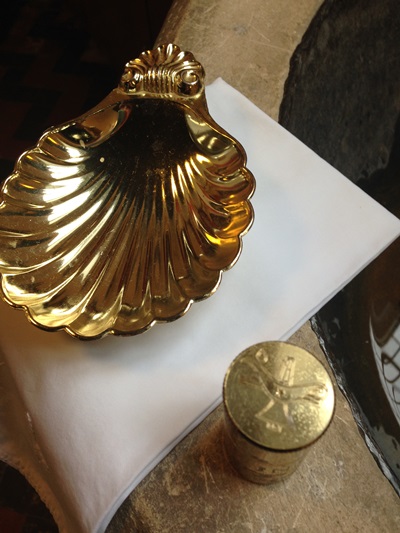
The waters of baptism in the font at St John the Evangelist, Hedge End

And this morning we witnessed that hope being placed into a young child, Noah; whose baptism symbolised a new birth, not of water but of the Spirit. A hope that will be new and vibrant, a hope that will be reflected in the love and example that he receives from his parents, grandparents and godparents; a hope that Noah will need to have reaffirmed from time to time not only by his family, but by the whole family of Christ.

Because it’s all our responsibility to look to the hope that has already been placed in our own lives and to remain steadfast in trusting that God knows what he’s doing and all will be well.

Regrettably, as we’ve already seen, there may still be creeping moments of doubt. Again as Peter puts it, ‘even if now for a little while you have had to suffer various trials.’ And let’s be honest, all of us have and may be having to face various trials, some more than others, some harder to bear than others. Maybe our faith has been tested to the limits, but, if through it all, we don’t lose hope and believe that we will be given the strength to endure it, then just like metal that when it is tempered by fire is made stronger, so our faith will emerge with genuine hope for whatever the future may bring; and just like Thomas we will be able to declare, ‘My Lord and my King

Jesus tells his disciples, standing there right next to him, that they are blessed because they have seen for themselves with their own eyes and have no reason to doubt only to believe. How foolish we must seem to others to believe in something we’ve never seen, yet we have all come to or are coming to faith in so many different ways. What is it that convinces us that we should believe? Is it a personal encounter with Jesus; is it the love shown to us by those around us; is it an example of a friend, or was it that we just couldn’t believe that our lives are nothing more that this brief span of time. Whatever it was that started you on your journey of faith, be hopeful and hold on to it and remember how blessed you are.

The promises we make to the newly baptised, to support them in prayer, example and teaching we should also make to each other. We should push all of our doubts to one side as we are welcomed into the fellowship of faith and remember instead the one hope to which we are all called

Let’s celebrate that hope, and as always, may Christ’s peace rest in you…Amen

Expect the unexpected in our font!

Always expect the unexpected in our font!

Go back

Your message has been sent

Warning
Warning
Warning
Warning

Warning.