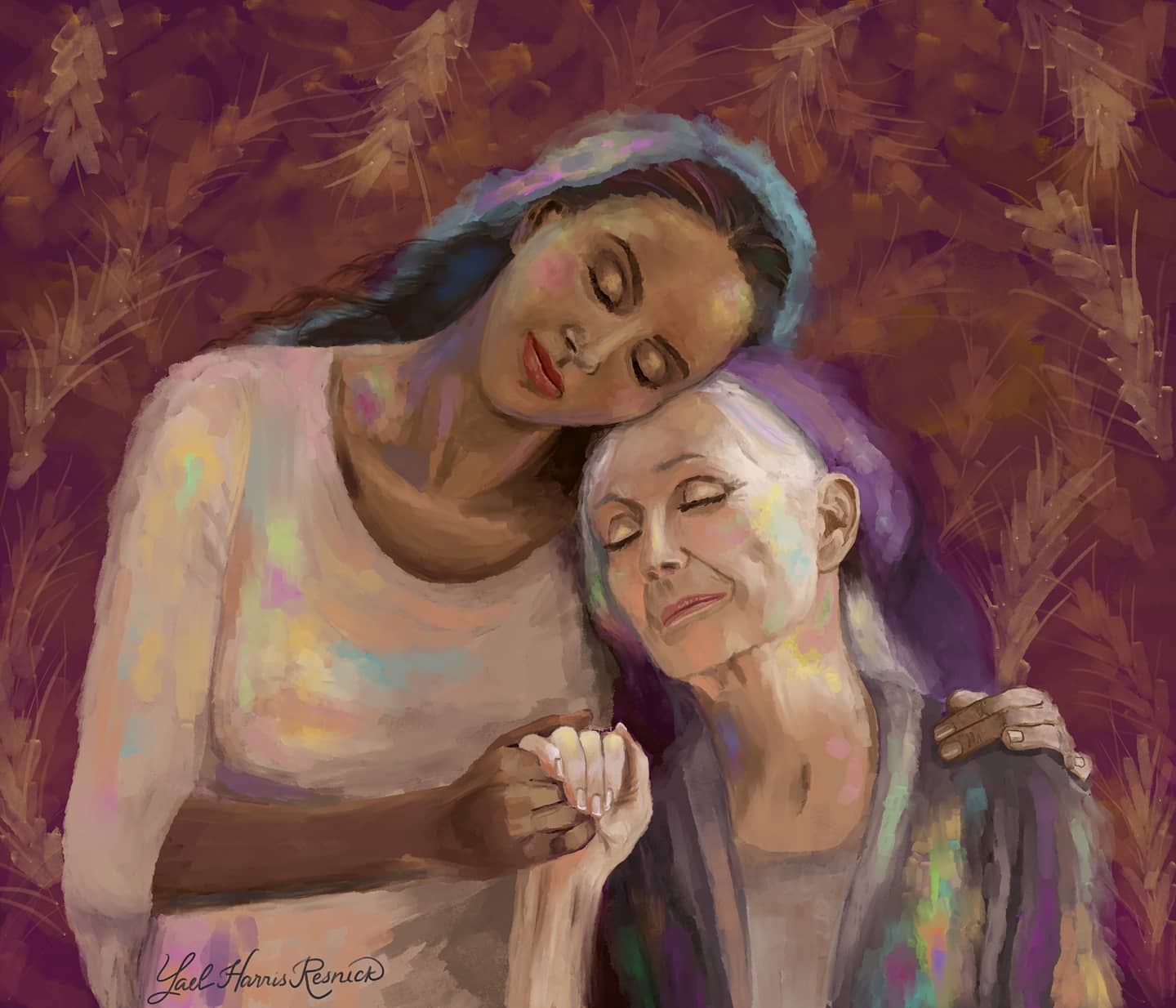
Continuing our Old Testament series, a talk based on Ruth 1: 1-18, 22
May I speak and may you hear, through the Grace of our Lord; Father, Son and Holy Spirit. Amen.
Ruth – one of only two books of the Old Testament dedicated to the life story of a woman. So their place in the Jewish faith must warrant special consideration. Mild, obedient, and virtuous; or free-thinking, feisty and highly respected for their own worth? As always, their characters are a mixture of both. Bound by their culture, limited by circumstance, yet determined to make a distinct mark on history.
Culturally, Ruth was a Moabite; a point made clear in the opening verses, part of a group of West Semitic people who lived in the highlands east of the Dead Sea. The land of Moab had been established by its namesake, Moab the son of Lot and a nephew of Abraham. But his parentage was ill-desired being born of an incestuous relationship between his father and Lot’s daughters and God was not best pleased by this or their worship of foreign gods. Hence there was a history of condoned conflict between the Moabites and Israelites.
Yet our story begins with a family seeking respite from a time of famine in the land that last week we heard described as a land flowing with milk and honey, and a promise that God would be with them against anything they would face. The land though was under the control of the Judges. A people, who had trusted God to get them through the wilderness were now a people loosely connected within a judiciary system, but also a period when ‘everyone did what was right in their own eyes.’
Everyone did what was right in their own eyes
Judges 17:6
A lack of trust in God and sense of thinking that he knew best finds Elimelech uprooting his family and taking them to live in this neighbouring country, where they integrated themselves further after his death by his son taking Moabite wives. But this land, where the grass had seemed to be greener was about to become a place where three women were left in a place of real vulnerability.
Perhaps at this point though we should consider the thought of what it means to continue to place your trust in God in the difficult times. What it might have looked like if they had stayed in Bethlehem? What it means for us to trust God when our head and our heart are telling us different things, because as we will realise later, the move to Moab may have been hasty.
However, back to the situation in Moab. Three women widowed in a society that provided rules for what should happen to them – in fact it was a God given command to care for the widow and the orphan, and the consequences for not doing so were to incur God’s anger as expressed in Exodus (22:23-24), ‘If you do mistreat them, I will heed their cry out to me and my anger shall blaze forth.’
On a practical level, Naomi had some protection through her marriage – as when she had married Elimelech she became part of her husband’s household, and now without sons – who would have taken on this duty of care – she came under the protection of her former husband’s male relatives. Where did that leave her two daughter-in-laws though? In theory they could have married another of Naomi’s sons, which Naomi points out is likely to be a physical impossibility, and she is certain that the decisions made by her dead husband have brought about a loss of God’s blessing.
In addition, whilst she is returning to her own culture, the younger women would be abandoning their own. Hence Orpah decided to stay in Moab and return to her family. Ruth, however, sees an opportunity for a new and different life. Her genuine love and respect for Naomi is passionately declared, ‘where you go, I will go… Your people shall be my people, and your God my God.’
For Ruth, this meant forsaking her homeland to help provide for Naomi with no guarantee of security for herself. Ruth expressed her loyalty to Naomi in a solemn vow, calling judgment upon herself if she ever left her. More tellingly though, Ruth made a commitment to follow Naomi’s God as well. She would abandon the gods of Moab, and Ruth and Naomi would both be committed to the one true God of Israel. Significantly, when Ruth said, ‘May the Lord do thus and so to me… if even death parts me from you’ she uses the covenant name Yahweh, which convinces Naomi that Ruth was serious.
The story of Ruth and Naomi shows what true loyalty is like, but in addition to loyalty, Ruth exhibited respect, love, friendship, and humility. Just as she chose loyalty to Naomi and to Naomi’s God, it shows us how we should choose loyalty to God and to his people over any commitment to the world. To trust rather than to worry, as Jesus tells us in Matthew’s gospel (6:33), ‘but strive first for the kingdom of God and his righteousness, and all these things will be given to you as well…’
Our thoughts can be deceptive, often strong and confusing, but we can always come to God and ask him for wisdom and insight whenever we need it. In the meantime, hang in there, and trust that he does know where he’s going and where he’s leading us! For Ruth, though, the risks were great and there were many unknowns, but like Jesus’ friend Mary, Ruth had chosen the most important thing. Her mind was made up, because she knew the person she was following, just as we can know the person of Jesus.
In Bethlehem, the harvest had begun, and Ruth’s loyalty was followed by the provision of many blessings. She was to remarry, to a man she truly loved and would give birth to a son named Obed, who would be the grandfather of King David, and provide a direct lineage to Jesus himself.
‘I found him whom my soul loves. I held him, and would not let him go.’
Song of Solomon 3:4
Despite Ruth’s non-Jewish, outsider status, God worked through her life to change the history of the world. In Song of Solomon, the bride, representing us, God’s beloved, clings to her bridegroom, ‘I found him whom my soul loves. I held him, and would not let him go.’ So, hold on tight, everyone, and don’t let go. The road ahead may be difficult, but there’s a great future to look forward to. Amen.





 boruachelohim