Tag Archives: independence

Letting Go

Talk based on John 17:11-19

I wonder how many of you, if you’ve ever been a parent, or have trained someone in an apprenticeship or simply have given some instructions and then had to leave someone to carry them out without supervision. Then we come a point that we all have to let someone go in order for them to flourish on their own. It can cause much heartache and a lot of prayer that they will remember everything you have taught them.

I can remember both of my girls leaving home and the feeling of helplessness that I wouldn’t be there to step in and protect them if they came up against some adversity, and over the years, like everyone I suspect, from time to time things have not always gone smoothly. but I have prayed to God that he would be there with them, and sure enough whether the outcome was what I would have wanted or not, he seems to have answered my prayers.

Of course, I haven’t had to face those times of feeling powerless to act alone, and reaching out for prayer from others and sharing my concerns has helped me see what is happening a little clearer and gain greater understanding that a mother cannot always make things better with a hug and a magic kiss – although it works with my grandchildren… but that prayer can be the most valuable thing I can do.

In today’s gospel, Jesus’ prayer for his disciples continues from that we heard on Sunday, and like a lot of John’s gospel it is full of theological toing and froing around the topic – but at its heart it is telling us that Jesus will be letting go of his earthly protection of the disciples and it handing them into the care of the Father. He has taught them how to live by God’s Word and has warned them of the dangers they will face as his followers in their lives on earth. He knows that this will set them at odds with a lot of people. He needs them now to take up the reins of his ministry and start to do things for themselves, however hard that might be to start with.

So how good a job did they do on their own?

For nearly 2000 years the Word of God has been lived by millions of people, from that small group of Jews become Christians to worldwide mission and founding principles of many democracies. Not everyone has agreed that it is linked to a higher power than that on earth. Its radical idea of living in a loving community, of showing vulnerability and forgiveness has caused many to decry its power. For the disciples themselves, not many lived to see old age but became matyrs. However, they remained true to their mission and set an example for others to follow. And follow they did, which is probably one of the reasons that we are here today.

How often though do we feel like giving up on this difficult world of ours, so resistant to the gospel and its values; when we look at our divided world, where not even those who believe in Christ are united. Yet Jesus, who is fully aware that we share his same lot of being hated by the world, does not ask the Father to remove us from the world, but to protect us, as we do our best to carry out our mission, and we must continue to pray for healing and the overcoming of division. For the disciples and for us, we shouldn’t ask to be taken out of the world with all its messiness. This is where we belong until the time comes for us to follow Jesus to the place he was going to. We can face all of the risks and the struggle that it sometimes is for survival because we can be assured of God’s protection.

Jesus tell us that we too are being ‘sent’ in his name to continue his mission. Our mission as his followers is in the midst of and in the depths of the world. He wants his love and message inserted in the centre of the world, the city, the neighbourhood. In following him in mission and love, we are ourselves blessed. Jesus’ love for the disciples didn’t fade because he wasn’t with them any longer, it endures eternally. When he asks God to protect and guide them this is a request that includes all those that have come after and are going forward today

The reality of the risen Christ is that, from now on, nothing and no one will ever be able to separate us from his love and the same is true for those we love. Parents and guardians spend their best years guiding children in life and in faith. Then there is a gradual letting go as they grow into adulthood.

Like Jesus we should pray for those who move beyond our active care. This morning, at this very moment, my daughter Ruth is in hospital undergoing a planned C-Section operation for the early arrival of my latest grandchild. She is beyond my physical reach, but I am praying for her and the doctors and nurses, for their skills and protection. But most of all I have placed them in God’s hands, because the Father’s arms are a safe place for them and for us.

Amen

Go back

Your message has been sent

Warning
Warning
Warning
Warning.

When Is A Toilet Not A Toilet?

Can all members of the public use the Public Conveniences?

Can all members of the public use the Public Conveniences?

You may well be asking what has a question about toilets got to do with ordination training? Yet it has turned out recently to be the most basic and essential necessity of finding a toilet that really brought it home to me how we so often both intentionally and unintentionally exclude a large group of people within society

One of my fellow ordinands, Helena, is a former lawyer and is a passionate advocate and fierce protector of people’s rights. She also has Multiple Sclerosis and uses a mobility scooter and therefore knows first-hand what the world looks like to a disabled person. She, like the majority of disabled people, doesn’t just want and need to be as independent as possible, but believes that each and every one of us has to become much more aware of what needs to be done to create a naturally inclusive society; which brings me back to toilets!

We’ve all heard the stories of inconsiderate able-bodied car drivers who blatantly park in a disabled parking space thus denying any genuine blue badge holders from doing so; but what about all those who deliberately use the designated disabled toilets, because they are the closest, which on becoming blocked force the person in the wheelchair to have no facilities at all?

That is just one specific instance, but what about when a community in which disabled people live shows too little consideration or awareness of their needs? A case in point is when we went on a field trip to a neighbouring village to the college. Firstly, I have to say that I am not singling out this particular community, as regretfully it is not unique, and it should be acknowledged that the organisers of the trip should have completed a health and safety assessment prior to the visit. However, if what happened, on the surface appears laughable, it is also deeply thought provoking

Everybody needs to go to the toilet – fact. Everybody is aware that not all buildings they visit will have toilet facilities – fact. Everybody knows that where public toilets are provided they can use them…………

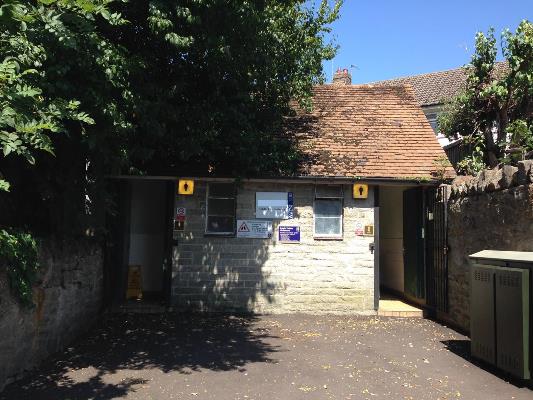
The church we were visiting did not have a toilet, which was reasonable enough given its age and listed-building status; the vicarage did have toilets (as you would expect) except the vicarage itself was inaccessible to a person in a wheelchair. Where then was Helena, who not unreasonably had reached the point when she wished to avail herself of these facilities, to go? The public conveniences were about 200 yards from the vicarage but on arriving at them we saw that there was no designated disabled toilet, in fact there were steps to get into both the ladies and gents (see picture above)

Where else could we try? Fifty yards down the road, the Catholic church was situated in a lovely new building with signposted disabled parking and push button entry access to presumably up to date toilet facilities – but the building was locked and empty. Around the corner there was a public house, and calling through the open back door we asked if we were able to use their toilets. We may, but whilst we could get into the pub, the toilets had a step down to them. Retracing our steps, we were advised that a key had been found for the village hall, this was some 500 yards in the opposite direction. Here there was a small disabled toilet, barely large enough to allow Helena to enter with her scooter and hopelessly maintained so that the clutch rail would not stay upright. We spend several minutes with the two of us trying manoeuvre ourselves, one holding up the rail, the other trying to fit into the cubicle, before I could step outside and she was finally able to relieve herself – so much for self-esteem and independence!

All in all this farce lasted about 40 minutes, and I jokingly said to Helena that it was good job she could hold on. To my dismay she told me that for many disabled people this was not the case – it’s called ‘social incontinence’, where lack of disabled facilities force otherwise continent people to resort to incontinence products simply to be able to go out into the world for any length of time. One more example of the removal of a person’s dignity.

Helena was just one person in that place at that time, but how many more people have come up time and again against the same problems and instead of feeling welcomed and able to play their full part in their communities have felt excluded and devalued.

What good is it, dear brothers and sisters,
if you say you have faith but don’t show it by your actions?
James 2:14

It is a hundred years since people and governments became more aware of the need to make provision for the disabled, following the many thousands of men who returned incapacitated from the First World War, either blind or limbless. One hundred years in which we have come a long way to recognise the equality of all in society and yet we still exclude and marginalise the disabled through not consulting or considering fully their needs, so that they can just BE

Maybe it’s time to look around the places you live and work in, remembering that it’s not just toilets but other things like ramps and rails; and when you spot something that needs changing, then do what needs to be done to make that change happen, including asking the people for whom you are doing it  what it is they really need.

Helena, endures much in the way that she has to adapt in order to undertake her studies and she shouldn’t have to. As I walk alongside her she has made me more and more aware of issues that should change and transform how we think and act as individuals, as a society and as Christians. This sort of teaching, in my mind, will always be more valuable than anything that an academic text book has to say.

An inclusive society means no-one should feel excluded

An inclusive society means no-one should be excluded

This piece has been written with the full permission of my friend and fellow Ordinand, Helena 

Go back

Your message has been sent

Warning
Warning
Warning
Warning

Warning.