Tag Archives: Simon

Transforming The Imperfect

Sermon preached on Sunday 29th June 2025 – St Peter and St Paul based on Acts 12:1-11, Matthew 16:13-19

May I speak and may you hear through the Grace of our Lord: Father, Son and Holy Spirit. Amen.

Today the church celebrates Peter and Paul, hence our very brief foray into back into red vestments. Two men, both in their way founders of the Christian church. Peter an original disciple and Paul the visionary missionary. However, our texts on this occasion focus on Peter or Simon Peter or Cephas.

They also feature the most amazing jail break ever. Not one for cinematic viewing, with explosions, masked accomplices and a speedy get away car, but an unopposed walk out to freedom, or at least for the moment, freedom.

A week or so ago, Charlie and I accompanied some 90+ Year 6 pupils to their annual Year 6 Leavers’ service. The coach journey was noisy, with excitement and anticipation, and the day was very warm as we threaded our way through to the cathedral from our drop off point, to the great West door, or doors to be more precise.

For many students, this was their first visit to the cathedral, and it’s always great to see their expressions change from their normal everyday ‘we’re too ‘grown up’ for this now’, to a real ‘Wow!’ moment as they step through the door.

Of course, when they look back at the jigsaw puzzle that is the West window, and hear about its destruction at the hands of the Cavaliers during the English Civil war – although the legend of masses of Cavaliers on horseback entering the cathedral and shooting their guns or lobbing the bones of the saints and bishops to break the window is not supported by specific records – it becomes even more amazing.

However, standing in front of the Great Screen behind the high altar and seeing all of the figure sculptures, most of which had been removed in the Tudor reformation and thus spared this destructive mayhem, a real sense of the majesty of Christ at the very centre of those who were part of his story and who took up and continued the work he had started on earth become apparent.

There, placed above Jesus’ head to the left, or at Jesus’ right hand is Peter, holding an exceptionally large key. In fact if we look at our very own East Window we can see Peter in the top left hand corner – with Paul, holding those keys.
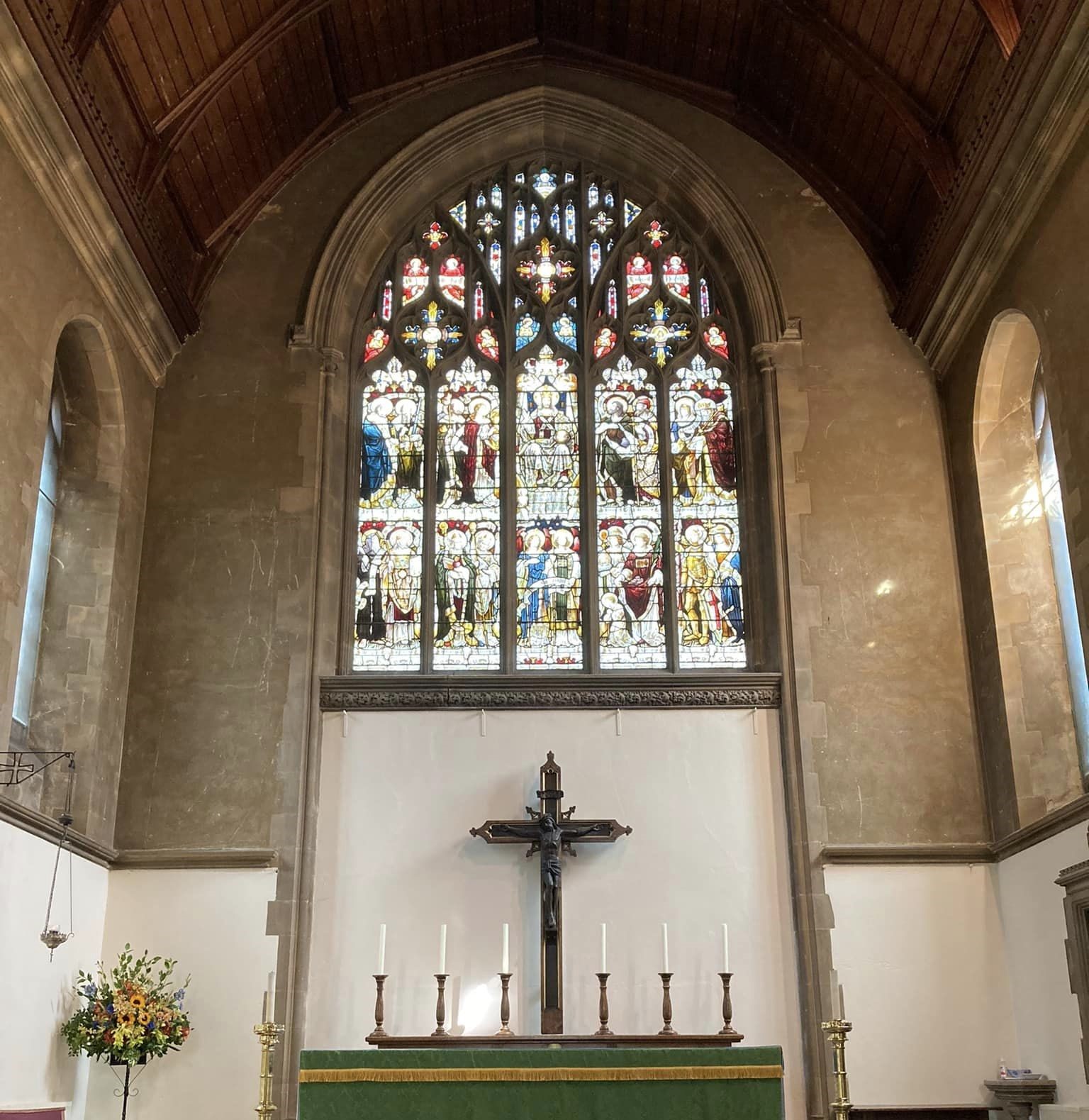
The East Window at St James’ Church, West End, Southampton

Peter, the disciple, who so often gets it wrong as he works his way through coming to faith, but whose faith and trust in God, in the person of Jesus is unshakeable. His is a journey of transformation, and our two readings this morning reveal that journey. In fact, these two moments, separated by a few years, reveal a shaping of faith that many of us can relate to. Peter is not perfect, but he is faithful—and more importantly, God is faithful to him.

In our gospel reading, Jesus asks a pointed question, ‘But who do you say that I am?’ and it is Simon Peter who answers with boldness and clarity, ‘You are the Messiah, the Son of the living God.’ This is Peter at his finest, as moment of divine insight; and Jesus responds not with mere affirmation but with a calling: ‘‘Blessed are you, Simon son of Jonah! … I tell you, you are Peter, and on this rock, I will build my church… I will give you the keys of the kingdom of heaven’.

People often wonder when and why Simon becomes Peter, and here we have the moment. The name Peter or Petros in Greek. literally means ‘stone’ or ‘rock’. The term ‘rock’ in the Bible often symbolizes strength, stability, and reliability, yet we know Peter was not always any of these things. He would deny Christ. He would falter. But Jesus sees the finished product even while Peter is still under construction. And God doesn’t wait for us to be perfect to call us. He calls us, then perfects us.

We also have to remember that whilst Peter was the ‘rock’, Jesus remained the cornerstone, the foundational stone in a building, acting as a reference point for the rest of the structure. Again, holding symbolic significance, representing that strength and stability, and the beginning of a new endeavour. Later in Ephesians 2, we hear of the Jews and Gentiles coming together as God’s people, ‘built on the foundation of the apostles and prophets, with Christ Jesus himself as the chief cornerstone’.

But now let’s turn to our reading from Acts. Here we see Peter, no longer the impetuous fisherman, nor the fearful denier by the fire. He is a leader of the church. And he is in prison. King Herod has killed James, and Peter to be next. He is chained between soldiers, guarded by sixteen men. The situation is hopeless from a human standpoint.

But the passage says, ‘the church prayed fervently to God for him’. And in the darkest hour—the night before his execution—God sends an angel. Chains fall off. Iron gates miraculously open. And Peter walks out, dazed, into the freedom only God can give.

This is the same man who once sank in fear on the water. This is the same man who once wept bitterly after denying Christ. but who at the beginning of the passage is sleeping in peace on the eve of death. What has changed? Well, Peter has learned to trust God completely. He doesn’t panic. He doesn’t beg. He rests – knowing now, after years of walking with Jesus, that even in prison, God is in control.

So where does that leave us? Where are we on our own journey of transformation? Some of us are like Simon in Matthew’s gospel—full of zeal, making bold confessions, still growing. Whilst some of us are like Peter in Acts – learning to be at peace and placing our trust in God in all eventualities.

And God sees us not as we are, but as the people we are becoming. He is building His church—not on perfect people—but on those who confess him truly and trust him deeply. And Peter’s journey, from bold confession to miraculous deliverance, reminds us that no one is beyond God’s reach, and no situation is beyond His power. So let us place our complete trust in him now, because God is still writing our stories. Amen.

Come and See…

Sermon preached on the Second Sunday of Epiphany based on the following readings John 1:29-42 and 1 Corinthians 1:1-9

May I speak and may you hear through the Grace of God; Father, Son and Holy Spirit. Amen

‘Come and see, come and see,’ was a request I often got from one of the children, to go with them and admire what they had been drawing or chalking on the easel. I’d learned not to declare, ‘what a wonderful elephant’ when it turned out to be a fire engine; risking disappointment that their efforts were unrecognisable. Instead, a few tentative enquiries and invitation to tell me all about what each bit represented, to listen to what I was looking at helped me see what was being revealed right in front of my eyes.

 Our gospel passage this morning is another epiphany moment as Jesus begins his calling of the disciples, with an invitation, not only to come and see where he was staying, but to come and listen to what he had to say, so that his identity would be recognised and understood

Just a few verses before we had been given by John the most beautiful description of Jesus as the Word made flesh. He is God revealed to humans – in ourselves the expression of God – so that we might see him and believe. The question is – what do we see and what do we believe?

But first, let’s return to what John, the writer of the gospel, saw and believed on that first encounter with Jesus. Do we actually know that John was there? The consensus among theologians is that here was a group of Galilean fishermen, from a community around Bethsaida, which actually means ‘Fishtown,’ and that along with brothers Simon and Andrew were the sons of Zebedee, James and John.

Andrew is a disciple of John the Baptist along with one other, who are eyewitnesses to John’s testimony and affirmation of who Jesus was revealed to be through his baptism and who are standing with him when he declares for the second time that ‘Here is the Lamb of God.’

John the Baptist gives Jesus this new title that does not appear elsewhere in the Gospels. Yet it would have had great significance for those listening. A sacrificial lamb, pure of all blemishes, innocent and meek, and it is worth reflecting on this title as an image of the meekness of Jesus who, even in the fiery, apocalyptic book of Revelation, believed to have been authored by John the Gospel writer as well, still appears as a lamb ‘standing as if it has been slaughtered.’

John the shadowy, beloved disciple does not reveal himself as the other disciple with Andrew, but the visionary quality of the language points to him being present as the other eyewitness. However, it is Andrew who after accepting Jesus’ invitation to ‘come and see’ and spending time listening to what Jesus had to say makes the boldest declaration to his brother, Simon. ‘We have found the Messiah, the anointed or holy one,’ the prophesied promised deliverer of the Jewish nation and saviour of humankind. It is significant that Simon’s brother makes this confession early on, as later, the retitled Peter will make the same bold statement having witnessed several miracles and declaring his continuing allegiance to Jesus’ mission.

For John the Baptist he is the Son of God, for Andrew the Messiah, for John the Evangelist the Lamb of God, for Peter the Holy One. Each of them have received the invitation to ‘come and see,’ and each of them sees Jesus as something different. So, what is it about Jesus that each of us who receive that same invitation actually see?

The invitation to get to know Jesus is a personal one. It starts at a different time and in different circumstances for each of us. Andrew and John were asked directly, ‘What are you looking for’ and their response was for a teacher, ‘Rabbi.’ They were looking for someone who could help them learn more about God and his purposes, as well as a guide to how they should live. How true is that for you?

Are you attracted by Jesus as a shepherd, a person who protects and leads people in the right direction, securing for them a place of safety and nourishment.

Or is it the angry Jesus, who rails against injustice and demands restitution and freedom from everything oppressive and unjust. Who values those with the least power as the most precious.

Perhaps, it’s the compassionate Jesus, whose healing power can work miracles and bring suffering to an end, who rejoices at the restoration to full life, yet weeps at the death of a loved one before offering hope for eternal peace and reunion.

Even maybe the Jesus who shares our tiredness and emotions, revealing himself to be fully human and capable of wanting to escape from life at times, to take stock and re-emerge refreshed and restored to carry on the work we have been given.

Whatever it is that makes us first accept that invitation to ‘come and see’ it is only the catalyst to get to know him better, to listen to what he has to say and to be confident to make that invitation available to others to come to know him better.

Despite the failings of the Corinthian church to be united in their understanding of God, Paul is positive when he reminds them that by accepting the invitation to get to know Jesus, they have been enriched in speech and knowledge, given spiritual gifts and strengthened so that they will be able to persevere until the day when they are fully united with Jesus. It is also addressed to ‘all those who in every place call on the name of our Lord Jesus Christ, both their Lord and ours.’

The Gospel of John was written to prove that Jesus Christ is the Son of God. As an eyewitness to the love and power displayed in the miracles of Jesus, John gives us an up-close and personal look at Christ’s identity. He shows us that Jesus, though fully God, came in the flesh to distinctly and accurately reveal God, and that Christ is the source of eternal life to all who believe in him.

Each of us is given that chance to take a close and personal look at Christ’s identity when we recognise the moment and respond to his invitation to ‘come and see.’ Whatever it is that attracted us to get to know the person of Jesus more, to listen to his words, to be moved by his actions there will be others out there waiting for that same invitation.

Let’s pray at their epiphany moment we are the ones to say to them ‘come and see’ for yourself.

Amen

Go back

Your message has been sent

Warning
Warning
Warning
Warning.