Author Archives: lindasgalvin

Hail To Christ, The King

Hail to Christ, the King

Hail to Christ, the King

On Sunday we came to the last Sunday of the church’s year. It goes out with a bang, celebrating Christ as King. The evening brought a quieter more reflective time when we could think about just what sort of king Jesus is.

Using some of the liturgy from Liturgies for High Days by Dorothy McRae-McMahon, we thought about a different kind of royalty, one bereft of privilege and wealth, whose power lies in truth, faithfulness and grace for all people. We also remembered Jesus’ faithfulness to his calling, entering into the pain of our lives and yet able to leap free of all its bondages.
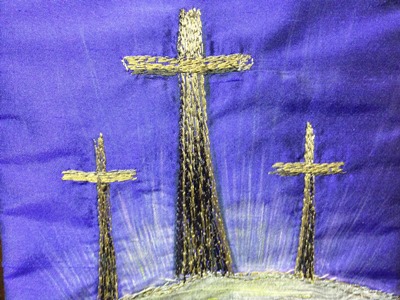
The cross that frees us from bondage

The cross that frees us from bondage

Our reading for the evening was one of those ones that lends itself naturally into a meditative retelling. Here is my version of Luke 23:32-43:

The journey through the streets had been tortuous, the crowd pressing in on either side. The sounds of jeering and weeping had mingled together to form a cacophony that heralded their progress. Now they had left the city gate and slowly climbed the skull-shaped hill called Golgotha. Three condemned men, each bearing the burden of a death sentence, brought out to this seemingly god-forsaken place to be nailed to a cross and hoisted high so that all might see that justice had been done.

Few people had made the effort to ascend the incline; there was a perfectly good view from the shaded city walls, and they were even more grateful for that distance as the midday sun rose to its zenith, its heat intensifying the stench of decay that hung in the sultry air over the place.

Jesus’ thoughts, however, were not for his own physical discomfort but that God might show mercy to those who had condemned him, and he cried aloud, ‘Father, forgive them; for they do not realise what they are doing’. Some of those who heard these words felt a pang of guilt sweep over them and turned away, ashamed.

Are there times when we too turn away in shame?…

But beneath the crosses the guards, who had seen it all before, bickered over who should have his redundant clothing before drawing straws; the winner triumphant that he had obtained such a seamless tunic so cheaply. Whilst the representatives of the Jewish leaders, perhaps sensing the remorseful sentiments of the woman who had gathered there, tried to add justification of their part in the proceedings by scoffing at Jesus, pointing out that this man who claimed to be the chosen Messiah of God seemed incapable of saving himself despite his claim to have saved others. Hearing this, the soldiers joined in, offering a toast to the ‘King of the Jews’ with a sponge soaked in sour wine. Even so, they could see no glorious death of a king in battle, no pomp and ceremony, and soon grew tired of mocking this inaptly titled monarch.

When might our desire for ritual and symbols blind us from the simple truth?…

One of the criminals, hearing these things, turned and spoke in derisory tones to the man who hung beside him in silent sufferance, ‘Are you not the Messiah? Save yourself and us!’ His thoughts were, that if this was the hope of Israel then surely he could save not only himself from this punishment but them also, however unlikely that was… and it was a slim hope that he would not die today.

However, the other rebuked him harshly; pointing out that self-preservation was not necessarily the main reason to call on God in these circumstances, particularly when they were both there for being condemned justly for their actions. It was clear to him that Jesus was a victim of a miscarriage of justice; what’s more he had recognised the holiness of this innocent man. Perhaps, he told the other, they should fear God’s ultimate punishment more.

Where does it leave us if we only call on God in times of crisis?

Turning to Jesus, an honest and heartfelt plea came to his lips, ‘Jesus, remember me when you come into your kingdom.’ As the figure at his side turned to look at him with a full gaze, he saw not a broken and bloodied man but a saviour in all his resplendent majesty who spoke immeasurable words of reassurance, ‘Truly I tell you, today you will be with me in Paradise.’

IMG_5817

Back to the service then, as we sang ‘Jesus remember me, when you come into your kingdom’ as a prayerful chant and thought about our ‘king’ who calls us to have a more generous love for the world; to bravely dream of the future where we might be a new hope for better things to come and to remain steadfast in our faith in the possibility of Christ’s reign of love.

Hail to Christ, the King,
ruler who lays down the power to destroy,
leader who treads through the costly journey
and into the shadow places of life,
that we might find the rising of life before us:

Hail to Christ, the King,
born to be first witness to God’s truth,
whose might lies in mercy,
whose throne is placed in the midst of humble people.

Hail to Christ, the King

← Back

Thank you for your response. ✨

Some material has been reproduced from Liturgies for High Days, Dorothy McRae-McMahon ©SPCK. The meditation is my own.

The purple stole used in the service as a focal point was created by Deborah Ireland. See here for more information about her work

Don’t Sweat The Small Stuff?

Don't sweat the small stuff?

Don’t sweat the small stuff?

Readings: James 1:17-27; Mark 7:1-8, 14-15, 21-23

May I speak and may you hear through the grace of our Lord: Father, Son and Holy Spirit

There’s an American idiom that you may have heard of, ‘Don’t sweat the small stuff’. It’s basically something that might be said to someone in order to tell them not to worry about things that are not important. It’s actually not a bad thing to suggest, because sometimes we worry about getting the small things sorted out and forget to look at the bigger picture. So are the small things unimportant?

The bigger picture as far as Jesus was concerned was teaching people what their attitude needed to be in relation to God, not whether they had dotted the ‘I’s and crossed the ‘T’s on their membership application to the Christian faith.

In this section of Mark’s gospel people are flooding to him – he has just fed the five thousand, had a brief respite in prayer; and then walked out to his disciples in their boat, when they were fighting against an adverse wind, to calm the weather and their fears. On landing he has been immediately recognised and word has spread and people are rushing about the region, bringing to him their sick, begging for and being granted healing.

Now in this passage, the Pharisees and scribes, who had no doubt been sent out from Jerusalem to gather evidence against him are interrupting a well-deserved meal break to tell him that he’s breaking Jewish law by eating with unwashed hands. No wonder he decides to tell them as it really is! ‘Stop sweating the small stuff!’

To the Jews, and in particular the Pharisees, however, the small stuff was important. They believed that, alongside the written Torah, there existed another body of oral laws, interpretations and traditions transmitted by God to Moses orally and then memorised. In fact there are 613 statutes stated in the Halakhah, or Jewish Law, most of which are derived from the Torah’s books of Leviticus and Deuteronomy … never easy reads!… but some are laws that have been enacted by the rabbis, who have interpreted the Torah over time.

A few of them are related to particular groups of people such as the Nazarites, whilst a large proportion of the others relate to sacrifices and offerings which can only be made in the Temple, which no longer exists. There are some that sound rather quaint to our ears, such as ‘not to make a bald spot in mourning’ or ‘not to eat worms found in fruit once they have left the fruit’… presumably it’s okay to eat them whilst they are still in the fruit then! But there are some that are abhorrent… that a rapist must marry his victim if she is unwed and is never allowed to divorce her. Certainly tells us a lot about the status of women if nothing else.

The laws to which Mark was referring to, and which he explained in some detail to his mainly Gentile audience, are part of the Kashrut, the Jewish dietary laws concerning kosher foods and its preparation and handling, and were part of a highly complex and developed system of purity regulations. For orthodox Jews even today they throw up problems, such as how you are going to use a dishwasher for both meat and dairy utensils in a kosher home. Still sweating the small stuff!

Kashrut symbols blog

For many modern non-orthodox Jews, however, they believe that the laws of kashrut are simply primitive health regulations that have become obsolete and that the legalistic aspect of traditional Judaism reduces religion to a set of rituals devoid of spirituality, which was not the intention of Halakhah, which can be translated better as ‘the path that one walks’. So they no longer see the need to sweat the small stuff, perhaps having been persuaded by changes in society that these laws are no longer important or relevant to their faith.

However, back in first century Palestine, Jesus points out the hypocrisy of the Pharisees, in that by interpreting and applying scripture in this way they are only honouring God with what they say rather than what they do. His kingdom message has nothing to do with how and what you eat, that is not what will stop you becoming pure. Rather the challenge of the gospel is much more a challenge of the heart. He is insisting that good and bad external and physical actions come from internal and spiritual sources, and that it is human motivation that is the real problem.

His list of evil intentions seem full on, and perhaps it is easy for us to glance at the list and feel comfortable with the fact that on the whole we’re fairly sure we haven’t indulged in many of them, especially the biggies like fornication, murder or adultery. Yet can we be quite sure that in some small way we haven’t practiced theft… the pen ‘borrowed’ from work and never taken back; or licentiousness… the extra packets of cakes or food bought which never got eaten and which had to be thrown away; or slander… the sarcastic insult offered veiled with a smile? What about envy, pride or avarice?

Yes, we might say, but that’s only the small stuff… even so, Jesus doesn’t seem to rank them in order of importance; they are all equally said to be possible evil intentions that are present in and come from the human heart.

He also at this stage doesn’t seem to offer a solution as to what we can to do to either avoid or resolve this problem, we are simply left to infer it… of course later on and with our gift of hindsight we do know what the solution will be, through Christ’s ultimate revelation of the kingdom. However, our reading from the letter of James, does give us something concrete to act upon. It tells us that rather than drawing from our hearts those things that make us sordid that we should listen to that part of us that God has already placed within us.

We are to be quick to listen so that we can exercise self-control and know what the right thing to do is; take time to consider what the effect of our words might be on others so that we act with kindness; to be patient so that our actions are those of love rather than hate.

Christians are called to be above reproach and yet we are only too well aware that we so often fall short. But despite this we can’t casually set aside bits of scripture that we don’t like or understand. We shouldn’t allow ourselves to justify our actions because society around us doesn’t seem to worry about the small stuff; that’s how we become tainted by the world.

Yes, we make mistakes and get it wrong… yes we can seek forgiveness… and yes we will be forgiven; but we need to take an honest look at how we behave and change the things that make us follow human traditions rather than being doers of the word.

‘Do not think that I have come to abolish the Law or the Prophets;
I have not come to abolish them but to fulfil them’. Matthew 5:17

The important thing is that Jesus came not to set aside the law but to fulfil it. The scriptures were not necessarily irrelevant then or now. They act as signposts to the reality that was Jesus. Everything that they were getting at reached a climax in Jesus Christ, and from then on everything was different. He became the perfect law, the law of liberty. So by keeping his law we can constantly remind ourselves of our relationship with the divine so that it becomes an integral part of our existence.

The Pharisees were more concerned that the rules were followed and that keeping the laws was more important than how people were treated. Jesus was more concerned with how we treat others; that we were love God and our neighbours as ourselves, because on those two commandments hang all the law and the prophets.

Should we sweat the small stuff?… I’ll let you decide.

Amen

Do not think that I have come to abolish the law or the prophets; I have come not to abolish but to fulfil' Matthew 5:17

‘Do not think that I have come to abolish the Law or the Prophets; I have not come to abolish them but to fulfil them’ Matthew 5:17

← Back

Thank you for your response. ✨


Salt and Light

You are the salt of the earth... the light of the world

You are the salt of the earth… the light of the world

A fifth Sunday at St James, West End provided the opportunity to come together for evening worship in the style of Taizé. Prayer and silence are at the heart of Taizé worship along with the singing of repeated prayer chants, often highlighting simple phrases from the Psalms or other pieces of scripture, which are designed to help meditation and prayer.

A  candlelit San Damiano Cross, a large Romanesque rood cross, is usually the central focal point and is the cross that St. Francis of Assisi was praying before when he is said to have received the a divine commission to rebuild the Church. St James is lucky enough to have its own copy and was placed in the centre of the chancel steps for our service

Focusing on the San Damiano Cross

Focusing on the San Damiano Cross

What follows is excerpts from the evening service, including a meditation on Salt and Light.

Opening prayer (said together):

God our Father, be with us in our time of worship. When we pray, help us to concentrate our thoughts on you; when we listen to the reading of the Bible, help us to understand it; when we sing your praise help us to sing because we really love you: help us to worship you in spirit and in truth, through Jesus Christ our Lord. Amen.  

Opening Chant:
Confitemini Domino quoniam bonus.
Confitemini Domino. Alleluia!
(Give thanks to the Lord for he is good).

Psalm 27:1-6, 13-14 was read, with a special emphasis on verse 14

Wait for the Lordbe strong, and let your heart take courage; wait for the Lord!

Before the next chant:

Wait for the Lord, his day is near. Wait for the Lord: be strong, take heart!

Our reading Matthew 4:23 – 5:16 then led us into our meditation, that was in two parts. Firstly concerning salt

13 ‘You are the salt of the earth; but if salt has lost its taste, how can its saltiness be restored? It is no longer good for anything, but is thrown out and trampled underfoot.

 ‘You are the salt of the earth!’

Salt, that precious commodity that purifies, preserves and penetrates;
and we are called to be as salt into the world of human society
to purify, preserve, and penetrate that society for the kingdom of God

Who hasn’t felt the tiny flecks of salt on their skin when next to the ocean?
Or maybe you remember the jars packed with salt and green beans at harvest time
to provide a delicious treat in the depths of winter;
or licked your lips and tasted the saltiness after physical exertion?

Silence

Salt – as precious as gold
It paid the Roman soldier his salarium
and indicated your standing in society
as to whether you sat above or below the salt.

Salt – to purify and to heal
A gargle for sore throat, a soother of stings and burns,
a pain reliever for toothache and sore gums
a natural ‘miracle’ medicine

Salt – to preserve and penetrate
Adding flavour and preventing food from spoiling
and saving people from starvation
A symbol of fellowship and the common meal

Yet salt can become contaminated,
often burnt in ovens to increase the heat,
then no longer useful it is thrown out onto the ground
and mixes with the dirt and gets trampled underfoot

Silence

Therefore, God calls us, his precious creation,
to be like salt, to penetrate society
and show in our lives and our dealings with others
how in living differently and seeking purity
that we can bring healing and hope,
both now and for the future through Christ;
and to avoid those things that would contaminate us,
and seek ways of making life liveable, healthy and good

Silence

Taste and see...

Taste and see…

We are also blessed with special receptors on our tongues that can detect saltiness and know when things are good;
so take your pinch of salt, and if you want dip your finger in and taste and see that the Lord is good [small glasses with a pinch of salt had been given out to everyone at the beginning]

Our service continued by singing, as a chant, the chorus from the beautiful anthem ‘Taste and See the Goodness of the Lord’ by James Moore Jr. I am sure we didn’t do it as much justice as the soloist at the Washington National Cathedral*, but it provided a special moment in the midst of our worship.

Taste and see, taste and see the goodness of the Lord.
O taste and see, taste and see the goodness of the Lord, of the Lord.

Then concerning light:

14‘You are the light of the world. A city built on a hill cannot be hidden. 15 No one after lighting a lamp puts it under the bushel basket, but on the lampstand, and it gives light to all in the house. 16 In the same way, let your light shine before others, so that they may see your good works and give glory to your Father in heaven.

‘You are the light of the world’

Light is vital to enable us to see in the darkness
and to help us to avoid stumbling.
Light is also an expression of inner beauty,
truth and the goodness of God.

Who hasn’t stood under the night sky and gazed up at the infinity of space
and seen the pin pricks of light of a million stars?
Or been awakened by the sunlight creeping in through their curtains;
or come home on a winter’s evening to a darkened house and been grateful to flick on the light?

The psalmists tell us that ‘In [God’s] light we see light’ (Psalm 36:9) and that
‘[His] word is a lamp to my feet and a light to my path’ (Psalm 119:105)
Through God’s grace our darkness is illumined and banished
and we are filled with spiritual light, joy and peace.

Silence

Light dispels the darkness and nothing can be hidden;
From others, from ourselves, from God
Everything is known to God, who sees all.
Yet there is great freedom and joy for those
who live in God’s light and who seek his truth.

As believers that light shines in our hearts
and we are called to act as light-bearers of Christ
so that others may see the truth of the gospel
and be set free from those things that blind them

Silence

We should seek to show light and healing in every part of our lives
to every relationship, every activity, every word;
to bring Christ’s light and hope, joy and peace
to those who need it the most;
as well as discovering God’s light shining in unexpected places
revealing his glory.

Silence

glory of god blogSo let us light our candles and place them at the foot of the cross
to better illuminate that glory.

During the following chant, we were invited light a candle and place it in the bowl of sand at the foot of the Taizé cross.

The Lord is my light, my light and salvation: in God I trust, in God I trust

There followed five minutes of silence, introduced by saying together:
Lord, you are living water, You are light and fire, You are love.
Come, O Holy Spirit! Come, O Holy Spirit

Our service concluded with intercessions and a final chant:

Within our darkest night, you kindle the fire that never dies away, that never dies away. (repeat)

 and a final prayer:

Be with us Lord as we go out into the world. May our lips that have sung your praises always speak the truth; may our ears which have heard your word listen only to what is good, and may our lives as well as our worship be always pleasing in your sight, for the glory of Jesus Christ our Lord. Amen.  

Before we departed, having said the Grace.

There are not many fifth Sundays during the year, so it was nice to be able to be part of something special , something that was beautiful as well as uplifting, exactly what worship should be like.

Salt and light reveal the glory of the Lord

Salt and light revealing the glory of the Lord

*YouTube link to a soloist singing Taste and See The Goodness of the Lord at the Washington National Cathedral © James Moore Jr.  

The Service was put together by David Forster and Linda Galvin using both resources from the Taizé community and original material.

Mere Mortals

Mere Mortals

© ‘Mere Mortals’ Linda Galvin

A piece of artwork based on Psalm 8:3-4, and completed on my pre-ordination retreat. The idea came out of a talk by Abbot Stuart Burns OSB on the unimaginable greatness of God…somewhere in there are the mere mortals!

When I look at your heavens,
the work of your fingers,
the moon and the stars that
you have established;
what are human beings that
you are mindful of them,
mortals that you care for them?

Psalm 8:3-4

← Back

Thank you for your response. ✨

Servanthood – A Call To Serve

Based on Readings: Acts 11:27-12:2; Matthew 20:20-28

Your first sermon in a new church is always a tricky affair. How will the congregation react? What’s it like up in the pulpit? Is your style of preaching appropriate? Although you may have preached many times before, when you have been doing so in one particular church, in one particular place, to one particular group of people, you know that you have built up a relationship and a rapport over many years. Suddenly, the people looking back at you from your new viewpoint are strangers and this is the first time they have heard your thoughts and are eager to see what the new Curate has to say.

Add to all of that the fact that it’s the church’s Patronal Festival, when the life and character of the particular saint that the church is dedicated to has probably been discussed, dissected and generally mulled over for many years and you feel you have to come up with something new?

Sunday 26th July 2015 saw me climbing up into the pulpit at St James, West End, Southampton, to do just that. Here then is an abridged version of my talk.

May I speak and may you hear through the grace of our Lord; Father, Son and Holy Spirit

Today we are here to celebrate the patronal festival of St James. James the fisherman, not to be confused with James brother of Jesus or James the author of an epistle. He is one of the closest companions of Jesus, alongside Peter and John, and together with them he is one apostle about whom we know quite a lot about his background and character. We know his father was Zebedee, a Galilean fisherman from whose boat James and his brother John answered Jesus’ call, and biblical scholars have reasoned that their mother was Salome, about whom we’ll hear more about in a minute.

I wanted to find out some interesting facts about James, but I suspect that you may have heard them all before… however, they are all new to me and here are a few I found especially interesting.

St James 'Son of Thunder'

St James ‘Son of Thunder’

 James has a nickname… ‘Son of Thunder!’ Whoa, that’s great… ‘Son of Thunder!’ …makes him sound like he should be in an Avengers movie. Apparently he got this after John and he asked Jesus if they should ‘call down fire from heaven’ to destroy a village and its inhabitants who had been less than welcoming. Needless to say his offer was declined.

You may have also wondered why there is a scallop shell on the church logo. Well, I hope that today you will all be going home to dine on Coquilles St Jacques à la Provençale…no?

This delicious dish of scallops, white wine and mushrooms is traditionally eaten on St James’ feast day, a reference to the saint’s appearance at the battle of Clavijo in the 9th century, riding on a white horse and adorned in scallop shells. On that occasion the Christians were able to defeat the Moors and the rallying cry of the Spanish troops, from that time became ‘Santiago!’

In our New Testament reading, we hear of James’ violent death at the hands of Herod Agrippa. He was the first of the apostles to suffer martyrdom, just over a decade after Christ’s crucifixion and resurrection. However, the Spanish have a special place for St Iago, as James is translated, as they believe that his remains were buried in Compostela, having been transported there in a stone boat by angels, a place that has become the third greatest place of Christian pilgrimage after Jerusalem and Rome.

Some really interesting facts and stories; speaking of a man of great loyalty, fiery of spirit but willing to serve Christ to the point of offering up his life. However, in our gospel reading he and his brother have to stand by and watch as their mother tries to secure a favourable position for her boys in the new earthly kingdom she believes Jesus is bringing about. In Mark’s gospel this incident sees the brothers themselves asking for this advantageous position, but Matthew, writing some 25 years later, distances the disciples from this overly ambitious request and chooses their mother to press their case. Interestingly, it’s possible that this was because of their family relationship, as Salome is identified by the gospel writer John, as Jesus’ mother’s sister, making her his aunt and the brothers his full cousins.

What it shows is that the disciples were still thinking about personal reward and distinction without personal sacrifice. Jesus, however, knows that the kingdom he is to bring about is not about earthly values, and that whilst he doesn’t doubt their faith and commitment, it will be the Father’s decision as to what that looks like in the long run. You can imagine what the other apostles, said to James and John afterwards, perhaps some of them chastised them that their mother had spoken out in such a way or they were annoyed that the brothers were trying to gain extra favour. Whatever, it was they were angry about, Jesus points out that being one of his followers is not about human leadership values but instead true greatness comes through servanthood.

I wonder though what we think of when we are called to become servants or even as Paul puts it slaves. I suspect we could have a vision of Downton Abbey and life downstairs, although this particular portrayal is certainly a rosier picture than what it was actually like for many servants. But it’s not really about being powerless at the mercy of others. Instead, we should think about what servants do… they serve… Only three weeks ago at my ordination service the role of serving was emphasised time and again throughout the service. Let me read just one bit from the declarations that we had to make – first the bishop read out the job description.

They are to serve the community in which they are set, bringing to the church the needs and hopes of all the people. They are to work with their fellow members in searching out the poor and weak, the sick and lonely, and those who are oppressed and powerless, reaching into the forgotten corners of the world, so that the love of God may be made visible.

This then is the role of a deacon, to be a servant and what my title is for this first year. However, I don’t stop being a deacon after the year’s up, in fact you never stop being a deacon. Thomas is still a deacon; Bishop Tim is still a deacon and Archbishop Justin is still a deacon*. Once a deacon always a deacon, but despite it being a clerical title every one of you here could also be called deacons.

We are all called to serve in a variety of ways. We are called to serve in the worship life within this church building, whether as ministers or choir members; as servers or sidespeople; as cleaners or flower arrangers for example – everyone offering their gifts and time to build up the church community. But we are also called to serve and to be available to our wider community finding out ways in which the church as a body can meet their needs and be a beacon of hope. The great thing is that we are not called to do it alone as individuals, but to work with and support each other, being proactive as well as reactive. Then, as we serve we will become the visible signs of God’s love to all his people.

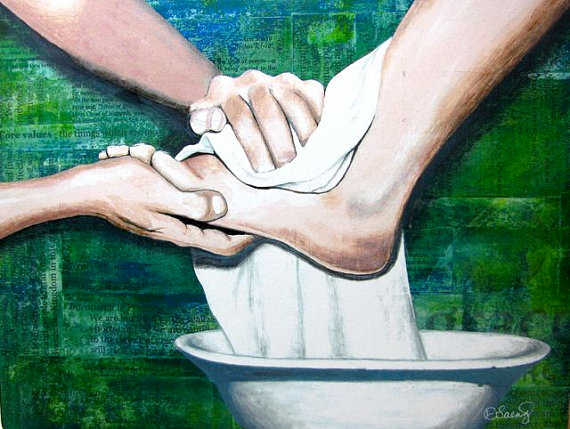
Deacons scarf blogOne of the visible symbols of being a clerical deacon is that I wear my stole slightly different to Thomas, who has been priested and I know some of you wondered why. Again it is to do with servanthood. During the Last Supper Jesus removed his outer robe and tied a towel around his waist in order to wash his disciples’ feet. In the ordination service it was the bishop or in my case the abbot who did just that to me.

For Christ it was a way of showing the extent to which he was prepared to humble himself to take on the form of a servant. He was demonstrating to us that we have to set the needs of others before our own. When we remove our outer pride and clothe ourselves in humility then we too can bow down in readiness to serve others

To some people in our society nowadays that seems like an alien concept, where self-satisfaction counts for more than self-giving. Surely by becoming a servant we also make ourselves vulnerable to abuse – we become doormats rather than open doors. I would disagree – if we are serving God and actively seeking how we can bring about justice and mercy for the vulnerable then we will have opened the doors to Christ’s kingdom.

Perhaps we should all consider how we can become more like those visible signs of Christ to those around us. Are we prepared to offer everything so that God’s kingdom can be brought about both on earth and in the future? It’s certainly a challenge and not an easy one. Jesus knew this, but he had trust in his followers. He never doubted that James and John would maintain their loyalty; he knew they had ambitions and their faults, but they didn’t turn away from him – they were prepared to give their all. In the same way he has trust in all of us.

For those of us who were here on my first Sunday, we sang the words ‘Brother, sister, let me serve you; let me be as Christ to you; pray that I may have the grace to let you be my servant too’. We have all been called to serve in this place. God has placed us here for a purpose; to serve him and to serve one another. Unquestionably, in doing that we cannot fail to become those visible signs of Christ’s love.

Amen

*Reverend Thomas Wharton (Priest in Charge, St James, West End); Tim Dakin (The Right Reverend The Lord Bishop of Winchester) and Justin Welby (His Grace The Lord Archbishop of Canterbury)

©The image used at the top of this blog is copyright and permission to use it has been sought from and granted by the artist. For details of how you can purchase a copy of this or of any of Debbie’s other artworks please visit https://www.etsy.com/uk/shop/DebbieSaenz


← Back

Thank you for your response. ✨

The End Is Only The Beginning

Winchester Cathedral Crucifrice 'Credit Helena Del Pino'
Winchester Cathedral Crucifrice ‘Photo Credit Helena Del Pino’

So much has happened over the last three weeks that I have been meaning to share, and kept promising myself that I would do so as soon as the dust settled. However, one thing I have learned about ministry so far is that dust never really settles or if it does then something is seriously wrong!

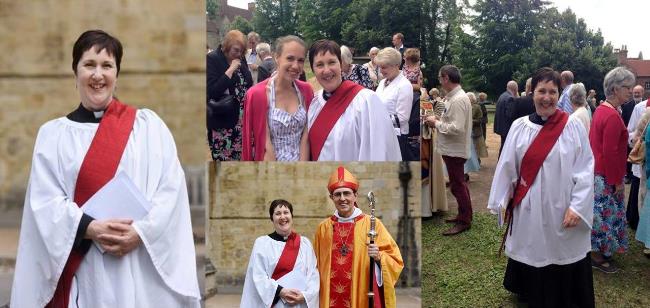
When I starting writing this blog it was to record my journey through my training as an ordinand, my thoughts and experiences and hopefully offering an insight into all that entailed. That training culminated in my being ordained a Deacon on the 5th July in Winchester Cathedral, along with six fellow ordinands, some of whom had been alongside me over the last two years.

New Deacons, Petertide 2015 'Photo Credit Winchester Diocese'

New Deacons, Petertide 2015 ‘Photo Credit Winchester Diocese’

The seclusion of the pre-ordination retreat

The seclusion of the pre-ordination retreat

 The preparations for the ‘big’ day had actually started during the week before when we had been secluded on a pre-ordination retreat at Park Place, Wickham, led by Abbot Stuart Burns OSB.

The Abbot gave us a lot to think about over those days, with stimulating talks and plenty of space and time to reflect on what our ministry would might look and feel like.

Some of us enjoyed the solitude and chance to indulge in our creative sides, whilst others needed the stimulation of social opportunities when we came together – others simply caught up on some sleep in order to be re-energised. However we chose to spend our time there was a real sense of God’s presence and an affirmation that we really were meant to be here despite any last minute doubts or concerns.

Putting on your collar for the first time feels a bit strange

Strangeness of wearing a collar for the first time

Sunday morning felt very strange as we donned our collars for the first time; suddenly it was all becoming very real. Even so, Morning Prayer and a good breakfast set us up as we made our way to the Cathedral and the opportunity to see our families as they arrived – hugs and kisses and so many happy faces in the congregation. Quickly, we changed into our robes before taking our places within the body of the church before the choir struck up with a spine-tingling introit from the West Door.

When I had told my friends and guests that the service may last up to two hours some of them had tried not to look too horrified; but it is true that time really does fly when you’re enjoying yourself! There are moments within any service that can transport you away from the ordinary and for me this proved to be true – such as knowing that your friends and family were standing up to show their support during the laying on of hands; the foot-washing when an Abbot not only washes your feet but kisses them as well and the glorious Sanctus during the Eucharist Prayer which resonated around the cathedral walls and pierced deep into my soul. Then it was out into the Close for greetings and photographs. Somehow, I couldn’t stop grinning!

After ordination

Joy overflowing! ‘Photo credit for individual portrait and new deacon with bishop Winchester Diocese’

The day’s celebrations, however, had not quite finished and it was back to our house where friends and family gathered for lunch and popping a few bottles of prosecco.

For surely I know the plans I have for you, says the Lord,
plans for your welfare and not for harm,
to give you a future with hope.
Jeremiah 29:11

So the end of one part of my training has drawn to a close, but what a great beginning to my new form of ministry. Hopefully over the coming weeks, months and years I will be able to share with you some of that as the new Assistant Curate of St James, West End takes up her post.

Celebrations with friends and family

Celebrations with friends and family ‘Photo Credit Lyn Colman’

← Back

Thank you for your response. ✨

Savouring Solitude

Savouring the solitude of Alton Abbey

Savouring the solitude of Alton Abbey

Prior to my ordination, after which life will change and inevitably get a lot busier, I decided to spend a day on a personal retreat at Alton Abbey. This community of Benedictine monks offers generous hospitality, prayerful worship and a space to simply be, all the while surrounded by a  natural and inviting arbors from which you can gaze at the world in contemplation.

Alton Abbey 011 blog

Be still, and know that I am God. Psalm 46:10

I went there principally to gain a sense of stillness; a few hours to calm the mind and refresh the soul, but as the day wore on I realised that there is never complete stillness in solitude. For God’s presence is fully alive in creation and she demonstrates her vivacity in a vibrant showy display of life in sight, sound and smell.

On other occasions It might have been a day for expressing myself in poetry or art, but I discovered that this day was purely a time for sitting and waiting, observing and listening. Let me share some of these moments with you now.

Alton Abbey 4 blog

The Abbey houses bathed in sunlight

Firstly, I have to acknowledge that I visited on a glorious, sunny day – something that the Brothers told me was unusual, as the Abbey often has its own micro-climate of fog and rain, and summertime has its own pleasures when the freshness of spring has given way to abundant blooms and lushness of grass and burgeoning leaves on trees. So after a period of settling into the room I have been allocated for the day I ventured out into the gardens and grounds

A walk along the first path I saw from the doorway took me past the overflowing honeysuckle (see title picture) with its sweet scent and colourful trumpets, before I came to a pause, suddenly aware of the movement and sounds that were coming to me. A row of trees whispered loudly that they were very much alive as their leaves danced in rhythm with the breath of the Spirit; their rippling tones a background pulse to the melody of the birds whose notes rose and fell as if urgently repeating a song of sheer joy.

Woodland shades

Woodland shades

Choices… whether to take the woodland path or enter the formal garden with its gated entrance and a notice that stated, ‘You are welcome, the rabbits are not! Please shut the gate behind you’. I plumped for the shady woods.

Fallen fruits, yet like sparrows 'not one of them will fall to the ground unperceived by your Father' Matthew 10:29It was cooler and quieter here, and yet underneath my feet crunched the husks of autumnal beech nuts, reminding me of harvest abundance. Whilst the cascade of lace-capped hydrangea and towering rhododendrons gave promises of future profusion and growth. Even the flowers that had fallen to the floor, still radiated beauty; and in the dappled shifting shade, glints of light flashed like beacons signalling a presence.

Fallen blooms, yet like sparrows ‘not one of them will fall to the ground
unperceived by your Father’ Matthew 10:29

On days like this, time ticks imperceptibly onward and I found it was necessary to hurry back into the Abbey Church to join the Brothers in Midday Prayer, then lunch, which even though it was taken in silence, was much appreciated and gave one time to digest one’s thoughts.

The drowsy courtyard steeped in peace

The drowsy courtyard steeped in peace

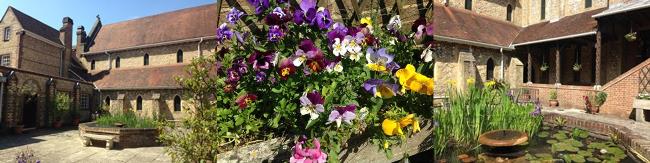
The sun by now was high above in a cloudless sky and although I am not normally a sun-worshiper of any kind, I was drawn to the tranquility of the courtyard where I settled on a stone bench and closed my eyes, Warmth has its own life, as it seeps into your bones and lingers on the surface of your skin. My sense of drowsiness was dispelled by the sound of water erupting in shimmering jets of cascading jewels that fell to tumble over a moss-covered fountain, splashing the lily pads, under which fish found shade, their diaphanous tails swirling in lazy circles. All the while the tall purple and yellow irises quivered in anticipation  as gentle bees brushed their petals and a kaleidoscope of pansies turned their faces to the sun, exuding a honeyed fragrance so familiar from childhood.

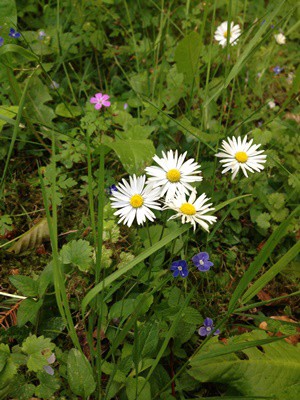
Alton Abbey Daisies 012 blogThere is nowhere that creation is out of place and as I left the courtyard, my feet grazed the small stubborn weeds that had pushed their way up through the cracks in the paving and brushed against delicate ferns that sprouted in vertiginous splendour high up on the walls. These humbler plants, despite attempts to eradicate their existence, are no less beautiful, and as I walked around the side of the church to seek a shadier nook I encountered tiny white daisies nestling with bright blue speedwell and baby pink cranesbill, which had escaped the mower’s blades.

As always when you visit somewhere for the first time, you’re never one hundred percent sure whether you might stray into areas that are private; secret places full of hidden treasures. Yet the well-worn wall seat was placed invitingly at the end of the two pools of water and seemed a perfect place to linger before Evening Prayer and Supper. Here I was rewarded with a deep feeling of peace, as if God had saved the best till last. Here was life in abundance from the immeasurable variety of insects, including carmine and turquoise bodied dragonflies hovering on lacy wings, and the unseen life within the silty mud, that sent bubbles up to break the tension of the water’s surface, to the chattering house martins that swooped overhead.

I will give you hidden treasures, riches stored in secret places. Psalm 45:3

I will give you hidden treasures, riches stored in secret places. Psalm 45:3

As the day drew to a close, and I packed my bag and said farewell to the Brothers, I reflected how lucky I was to have been granted that time and that space to simply be another small part of God’s incredible creation. Those images and thoughts that filled my time there will no doubt sustain me for quite a while to come; a point in time both sacred and divine, a moment of sheer grace.

Alton Abbey blooms blog

Exuberant life in seed and bloom

For more information about Alton Abbey, its people and the work it does, click here

← Back

Thank you for your response. ✨

Letting Go And Moving On

Butterfly transformation

Therefore, if anyone is in Christ, he is a new creation. The old has passed away; behold, the new has come. 2 Corinthians 5:17

The last few weeks have been a series of consciously starting to let go, as I, and many of my fellow final year ordinands, come to the end of our formal training. I suspect that this process has been happening over a much longer period, but our final weekend at college brought us together as we ‘prepared for ministry’.

As part of that we were asked to plan a creative act of worship, and under the leadership of Sue (Smith), we, that is Ruth (Peet), Jenny (Tebboth) and I, worked collaboratively to do just that. What we produced turned out to be a powerful release as we thought about how we were continuously being transformed. That enabled us to let go of those things that may still be causing us to worry, to hesitate, to hold us back; which we could lay down at the foot of the cross and then to commit ourselves to moving out toward our new or existing ministries.

We wanted to share some of the ideas that went into creating this service as they might be helpful to others who are also on this pathway or who may be in need of laying something down before moving on.

A weighty pebble to hold

A weighty pebble to hold

Gathering
On entering the room we were each given a weighty pebble which we were asked to hold on to at all times if possible until later. These were to represent the worries and burdens that we might consciously or unconsciously be carrying with us at this time. By keeping hold of the pebble we became aware of their weight. Sue then introduced our service.


Transformation

Our training has been all about formation; however, over the last two or three years we can now see how our lives have also been transformed. Taking the example of the life cycle of the butterfly, we took a moment to think we are now in that process

For many people this proved to be a trigger to simply sit and consider just how far they had travelled and to realise that it would soon be time to emerge from the chrysalis – scary prospect but one that we didn’t do on our own, as the words of The Butterfly by Margaret Orford reminded us

My hands are warm to the butterfly
I am trying to set free.
Delicate, frail creature of beauty,
what can it know of me?
I am outside its comprehension.
It knows sunshine and showers,
darkness and the feel of flowers.
We do not ask it to do the impossible
and know Man.
So we with God,
who looks with tenderness on our frailty,
trying to guide us.
Trust him!
He knows the way and if we let him,
will open windows,
and cradling us gently in hands we cannot comprehend.
will lift us up and set us free.

These rocks have let go...

These rocks have let go…

Release
Ruth then led us in a meditation which culminated with us placing our pebbles around the foot of a cross.

(Holding our rock …) God is always leading us to new places on our journey through this life towards the kingdom, and sometimes that means letting go of people, places and things that are familiar to us. For some of us this experience is particularly acute right now.

We may be moving to a new home in a new community; we may be finding a new way of being in a familiar community; both these transitions mean letting go of an old way of being … and beginning a new journey, finding out who we are in a profoundly different role.

For all of us, as God calls us forward, inevitably there are people and places and things and aspects of life we need to let go. The rock we are holding represents all this. These rocks have let go of their original place, hewn by wind and rain, and buffeted by storms and sand and sea, they are all the more beautiful for that. And the new rock face revealed creates the potential for other unique and beautiful new creations.

The rocks are heavy, not necessarily because the things we need to let go are heavy, but because the knowledge that we need to let go and the act of doing so may weigh on us so heavily. We may have been carrying this weight for a while, and we have represented this by holding onto the rock this evening.

We follow in the footsteps of many: Abraham let go of his home and moved to a new land.The Jews left the familiarity of Egypt to journey through the desert. The apostles gave up their means of living to follow Jesus. Jesus … gave up life itself for us. Now … it’s our turn. Still holding the rock … let’s think now about the things we are letting go … think about all that has been good in them … all the experiences that have taught us and shaped us … and we thank God for them now ……

Now we focus on one aspect … it may be the thing that we have to let go that is weighing on us most heavily … and in it let us find something good … an experience, a lesson, or an act of kindness we can cherish and take with us … and let us thank God for that now ……

Looking at the rock, we can imagine it laying on a beach. Now we ask God to show us a new thing that he wishes to grow in us, when the warmth of his love hits us like the sun bursting through clouds onto the surface of the rock. May the tiny sparkles the sun reveals on the rocks surface, represent the beginnings of new joys for us in the service of God ……

Then, when you are ready, and only if you feel that you can … take your rock and let go of it at the foot of the cross as a sign that you are letting go of the past and moving on … not forgetting … remaining grateful for all that we have received … but simply giving it to God and letting it go ……

Jesus said … ‘Truly I tell you, there is no one who has left house or wife or brothers or parents or children, for the sake of the kingdom of God, who will not get back very much more in this age, and in the age to come eternal life.’ (Luke 18:29-30)

Moving Onwards
For many of us this was a significant moment as we realised that what was happening to us was very much real; but we were not left to dwell too long before the tension was broken by the song ‘Be who you were born to be’ by Bliss which encouraged us to look forward instead

Gotta jump off that cliff and be who you were born to be

Gotta jump off that cliff and be who you were born to be


Stepping out...

Stepping out…

Getting ready to step out
Just before we took those first steps to go out though we were encouraged by Jenny’s prayers:

Lord God, you are the one who makes all things new. Not discarding the past but redeeming it for a richer way forward. Thank-you for all we have been learning and for the way you have been forming us. Thank-you for this place and for the care and teaching we have received. We pray for the work and development of this college and for all the staff and students here

Lord in your mercy….hear our prayer

As we have released those things which we hold close but need to surrender we have empty hands to receive all that you will give. Help us to fix our eyes on Jesus the author and perfecter of our faith who we follow and whose Spirit is our companion and helper so that we can go forwards confident that the way ahead is known to you and that you will equip us for every work that you have prepared.

Lord in your mercy…hear our prayer

We pray for your Spirit of wisdom and revelation so that we may know you better. Enlighten our hearts to know the hope to which you have called us…. And help us to know your incomparably great power. Fill us with hope and expectation, faith and especially with your love for people we will meet and reveal to us where you are at work already so that we may work in tune with you.

Lord in your mercy…hear our prayer

We pray for those communities where we will be working…….. We pray for those who will be training us………. We pray for our families as they adjust with us to our new situation…… We commit ourselves to your unfailing love

Let us say the Lord’s Prayer together:

Our father in heaven hallowed be your name, your kingdom come your will be done on earth as in heaven. Give us today our daily bread; forgive us our sins as we forgive those who sin against us. Lead us not into temptation but deliver us from evil. For the kingdom, the power and the Glory are yours now and forever, Amen

shutterstock_85086514Stepping Out
And so we were now ready to step out, hopefully a bit more confidently than before. Our final act was a commitment to hand everything over to God to whom we knew we could return whenever we needed to. Each person made this commitment by laying their ‘feet’ along a path, strewn with a few rocks on which we might stumble from time to time, but that led out towards the door and our new ventures… we were finally moving on!

Leavers Feet

← Back

Thank you for your response. ✨


Ember Days

Ember DaysThen one of the seraphim flew to me, holding an ember which he had taken with tongs from the altar. He touched my mouth with it. ‘See,’ he said, ‘now that this has touched your lips, your guilt is taken away and your sin atoned for.’ Then I heard the voice of the Lord saying,
‘Whom shall I send? Who will go for us?’ ‘Here I am,’ I said; ‘send me!’
Isaiah 6:6-8

The days are passing quickly now, flurries of letters and documents are being exchanged to ensure that everything will be in place for my ordination. College work is being completed and deadlines met. It is now less than nine weeks before I stand before the bishop and make my vows that will admit me to holy orders and I when I will become a deacon.

Ordination traditionally takes place during Petertide or Michaelmas. In Winchester this happened at the former time on the Saturday and Sunday nearest to St Peter’s Day (29th June) and this year it will be over the weekend of the 5th-6th July. As the time approaches I become more aware that whilst this has been very much a personal journey I have been uplifted and supported by a whole host of others, not least through their prayers.

During the church year, there are special periods set aside for prayer and fasting, some of these are known as Ember Days or Weeks, when prayers are sought and offered for all those preparing for ordination and for the parishes and people that they are being sent to serve alongside. Often, these requests are in the form of Ember cards, that are made and given to friends, family and congregations – a handy aide-memoire.

It also seems appropriate to use the image of an ember for this part of the journey as well. After all an ember is a glowing, hot coal made of greatly heated wood, coal, or other carbon-based material [in the hothouse of a theological training college!] that remains after, or sometimes precede, a fire. Embers can glow very hot, sometimes as hot as the fire which created them [God and those who have led them to faith]. Although outdoor types are often careful to throw water over them or cover them with earth [the world that still doubts or does not know] because they radiate a substantial amount of heat long after the fire has been extinguished, and can rekindle a fire that is thought to be completely extinguished or which has new fuel added to it [our ministry to hearth and home, wayfarer and wanderer?]

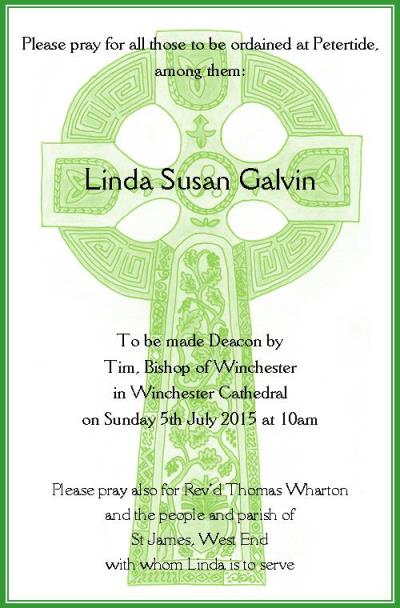
So here is my ember card featuring a design I created of a celtic cross:

You did not choose me but I chose you. And I appointed you to go and bear fruit. John 15:16

You did not choose me but I chose you. And I appointed you to go and bear fruit. John 15:16

and if you are the praying type then here is a prayer you might like to use:

Dear Lord,
You call us all into fellowship
both within and without your church:
hear our prayer that those who are called
to be your faithful people,
through their vocation and ministry,
and who are soon to be ordained,
may each be an instrument of your love;
and grant that they may receive
the necessary gifts of grace
in order to do your work;
we ask this through our Lord and Saviour,
Jesus Christ, who is alive and reigns with you,
in the unity of the Holy Spirit,
one God, now and for ever.
Amen.

← Back

Thank you for your response. ✨

As Our Prayers Rise Before You

As our prayers rise before you

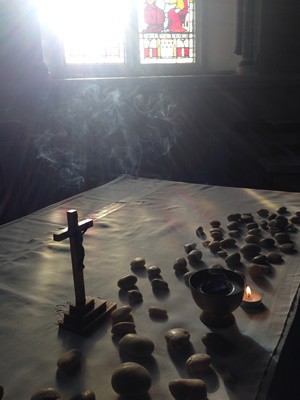
The smoke of the burning incense went up with the prayers of God’s people – Revelation 8:4

Prayer is a powerful tool; it’s a tool that enables us to communicate with God either directly or through the advocacy of Christ, more often than not in the power of the Holy Spirit. If you were to dip your hand into your prayer toolbox you should not be surprised that at different times and in different circumstances you would find a diverse range of tools that you could draw out; yet each one of them would fit your purpose.

Throughout my training I have had opportunities to experience different forms of prayer; from the strict, traditional Prayer Book style to free-flowing extemporary prayer. However, the one constant is the discipline of saying Morning, Evening  and Night Prayer (Compline), although I have to confess that  the first of these has been more faithfully undertaken as against the occasional imperceptible mutterings as I drift off to sleep.

Morning Prayer, like most church liturgy changes with the seasons. There are moments throughout the year when certain phrases cause one to catch your breath or make your heart sing; in fact in Epiphany season I been known to break into song when reading the Jubilate – A Song of Joy; but just about all of them are preceded by an opening prayer that sets the right tone for the day ahead:

The night has passed, and the day lies open before us;
let us pray with one heart and mind.

Silence is kept.

As we rejoice in the gift of this new day,
so may the light of your presence, O God,
set our hearts on fire with love for you;
Amen

prayersrising2 blog

… so may the light of your presence…

Each morning and evening we are also given one or more of the Psalms to read. However, these too are prayers and throughout the Psalms, David and the other writers poured out their hearts to God in prayer, expressing honest feelings of anguish and desperate pleas for protection. They grieved painful confessions of sin, confidently expressed their hope and trust in God, and joyfully lifted praises to God.

In the same way they enable us to give voice to our feelings, whether of despair when we are at a low point in our lives or sheer exuberance at the scope and majesty of creation. They bring us into contact with the ancient people and places of our history – some long-lost civilizations; but they can also speak into current situations.

I suspect that we all have our favourites but for me Psalm 104 ranks high on my list as it sweeps through the beauty of creation; from the heavens spread out like a curtain to the deeps in which the Leviathan play; the springs and brooks that quench the thirst of the wild donkeys to the cypress trees where storks dwell and the conies and wild goats taking refuge on the stony cliffs. How food is brought forth from the earth with wine to gladden hearts, oil to soothe and bread for strength. A true prayer of thanksgiving!

May God hold you in the palm of his hand

Christ, as a light illume and guide me

Sometimes though prayer can be difficult; when we are tempted to ask, ‘Why me?’ So often we seek responses to our prayers in very exact ways, and when they don’t appear to be answered ‘just so’ we may become disillusioned and distrusting. As part of a sermon recently we were asked to look at it in a slightly different way. Instead of asking. ‘Why has this happened to me?’ try removing the ‘Why’. Suddenly it becomes, ‘This has happened to me.’ Now our prayer can be for strength and guidance on how we are going to deal with the situation and thus be able to move forward, even if we need to take it day by day.

Which leads us to the evening of the day, when with that same one heart and mind that we started the day with we ask that the end of the day may be holy, good and peaceful, as our prayers rise before God; before finally, looking for a quiet night and perfect end to our day in a responsory prayer:

In peace we will lie down and sleep:
for you alone, Lord, make us dwell in safety.
Abide with us, Lord Jesus,
for the night is at hand and the day is now past.
As the night watch looks for the morning,
so do we look for you, O Christ.
The Lord bless us and watch over us;
the Lord make his face shine upon us and be gracious to us;
the Lord look kindly on us and give us peace
Amen


Heights & Depths blog

And for those who are still out there seeking, this beautiful prayer is taken from Celtic Daily Prayer, Morning Prayer from the Northumbrian Community:

May the peace of the Lord Christ go with you,
wherever He may send you.
May He guide you through the wilderness,
protect you through the storm.
May He bring you home rejoicing
at the wonder He has shown you.
May He bring you home rejoicing
once again into our doors.

Prayer, as I said at the beginning is as different and individual as we are, and whether our prayers are whispered in the dark or shouted from the rooftops, whether they come in fancy words or stuttering sobs, know that each and every one of them is heard. So never feel that your prayer time is wasted or that you don’t have time to pray. Those few precious moments could make all the difference to your day. Amen

Prayers have been reproduced from Daily Prayer ©The Archbishops’ Council 2005 and Celtic Daily Prayer ©2000, 2005 The Northumbria Community Trust

← Back

Thank you for your response. ✨