Tag Archives: faith

Hail To Christ, The King

Hail to Christ, the King

Hail to Christ, the King

On Sunday we came to the last Sunday of the church’s year. It goes out with a bang, celebrating Christ as King. The evening brought a quieter more reflective time when we could think about just what sort of king Jesus is.

Using some of the liturgy from Liturgies for High Days by Dorothy McRae-McMahon, we thought about a different kind of royalty, one bereft of privilege and wealth, whose power lies in truth, faithfulness and grace for all people. We also remembered Jesus’ faithfulness to his calling, entering into the pain of our lives and yet able to leap free of all its bondages.

The cross that frees us from bondage

The cross that frees us from bondage

Our reading for the evening was one of those ones that lends itself naturally into a meditative retelling. Here is my version of Luke 23:32-43:

The journey through the streets had been tortuous, the crowd pressing in on either side. The sounds of jeering and weeping had mingled together to form a cacophony that heralded their progress. Now they had left the city gate and slowly climbed the skull-shaped hill called Golgotha. Three condemned men, each bearing the burden of a death sentence, brought out to this seemingly god-forsaken place to be nailed to a cross and hoisted high so that all might see that justice had been done.

Few people had made the effort to ascend the incline; there was a perfectly good view from the shaded city walls, and they were even more grateful for that distance as the midday sun rose to its zenith, its heat intensifying the stench of decay that hung in the sultry air over the place.

Jesus’ thoughts, however, were not for his own physical discomfort but that God might show mercy to those who had condemned him, and he cried aloud, ‘Father, forgive them; for they do not realise what they are doing’. Some of those who heard these words felt a pang of guilt sweep over them and turned away, ashamed.

Are there times when we too turn away in shame?…

But beneath the crosses the guards, who had seen it all before, bickered over who should have his redundant clothing before drawing straws; the winner triumphant that he had obtained such a seamless tunic so cheaply. Whilst the representatives of the Jewish leaders, perhaps sensing the remorseful sentiments of the woman who had gathered there, tried to add justification of their part in the proceedings by scoffing at Jesus, pointing out that this man who claimed to be the chosen Messiah of God seemed incapable of saving himself despite his claim to have saved others. Hearing this, the soldiers joined in, offering a toast to the ‘King of the Jews’ with a sponge soaked in sour wine. Even so, they could see no glorious death of a king in battle, no pomp and ceremony, and soon grew tired of mocking this inaptly titled monarch.

When might our desire for ritual and symbols blind us from the simple truth?…

One of the criminals, hearing these things, turned and spoke in derisory tones to the man who hung beside him in silent sufferance, ‘Are you not the Messiah? Save yourself and us!’ His thoughts were, that if this was the hope of Israel then surely he could save not only himself from this punishment but them also, however unlikely that was… and it was a slim hope that he would not die today.

However, the other rebuked him harshly; pointing out that self-preservation was not necessarily the main reason to call on God in these circumstances, particularly when they were both there for being condemned justly for their actions. It was clear to him that Jesus was a victim of a miscarriage of justice; what’s more he had recognised the holiness of this innocent man. Perhaps, he told the other, they should fear God’s ultimate punishment more.

Where does it leave us if we only call on God in times of crisis?

Turning to Jesus, an honest and heartfelt plea came to his lips, ‘Jesus, remember me when you come into your kingdom.’ As the figure at his side turned to look at him with a full gaze, he saw not a broken and bloodied man but a saviour in all his resplendent majesty who spoke immeasurable words of reassurance, ‘Truly I tell you, today you will be with me in Paradise.’

IMG_5817

Back to the service then, as we sang ‘Jesus remember me, when you come into your kingdom’ as a prayerful chant and thought about our ‘king’ who calls us to have a more generous love for the world; to bravely dream of the future where we might be a new hope for better things to come and to remain steadfast in our faith in the possibility of Christ’s reign of love.

Hail to Christ, the King,
ruler who lays down the power to destroy,
leader who treads through the costly journey
and into the shadow places of life,
that we might find the rising of life before us:

Hail to Christ, the King,
born to be first witness to God’s truth,
whose might lies in mercy,
whose throne is placed in the midst of humble people.

Hail to Christ, the King

← Back

Thank you for your response. ✨

Some material has been reproduced from Liturgies for High Days, Dorothy McRae-McMahon ©SPCK. The meditation is my own.

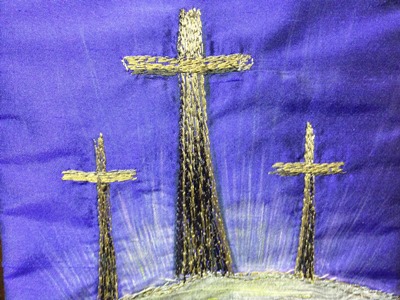
The purple stole used in the service as a focal point was created by Deborah Ireland. See here for more information about her work

Letting Go And Moving On

Butterfly transformation

Therefore, if anyone is in Christ, he is a new creation. The old has passed away; behold, the new has come. 2 Corinthians 5:17

The last few weeks have been a series of consciously starting to let go, as I, and many of my fellow final year ordinands, come to the end of our formal training. I suspect that this process has been happening over a much longer period, but our final weekend at college brought us together as we ‘prepared for ministry’.

As part of that we were asked to plan a creative act of worship, and under the leadership of Sue (Smith), we, that is Ruth (Peet), Jenny (Tebboth) and I, worked collaboratively to do just that. What we produced turned out to be a powerful release as we thought about how we were continuously being transformed. That enabled us to let go of those things that may still be causing us to worry, to hesitate, to hold us back; which we could lay down at the foot of the cross and then to commit ourselves to moving out toward our new or existing ministries.

We wanted to share some of the ideas that went into creating this service as they might be helpful to others who are also on this pathway or who may be in need of laying something down before moving on.

A weighty pebble to hold

A weighty pebble to hold

Gathering
On entering the room we were each given a weighty pebble which we were asked to hold on to at all times if possible until later. These were to represent the worries and burdens that we might consciously or unconsciously be carrying with us at this time. By keeping hold of the pebble we became aware of their weight. Sue then introduced our service.


Transformation

Our training has been all about formation; however, over the last two or three years we can now see how our lives have also been transformed. Taking the example of the life cycle of the butterfly, we took a moment to think we are now in that process

For many people this proved to be a trigger to simply sit and consider just how far they had travelled and to realise that it would soon be time to emerge from the chrysalis – scary prospect but one that we didn’t do on our own, as the words of The Butterfly by Margaret Orford reminded us

My hands are warm to the butterfly
I am trying to set free.
Delicate, frail creature of beauty,
what can it know of me?
I am outside its comprehension.
It knows sunshine and showers,
darkness and the feel of flowers.
We do not ask it to do the impossible
and know Man.
So we with God,
who looks with tenderness on our frailty,
trying to guide us.
Trust him!
He knows the way and if we let him,
will open windows,
and cradling us gently in hands we cannot comprehend.
will lift us up and set us free.

These rocks have let go...

These rocks have let go…

Release
Ruth then led us in a meditation which culminated with us placing our pebbles around the foot of a cross.

(Holding our rock …) God is always leading us to new places on our journey through this life towards the kingdom, and sometimes that means letting go of people, places and things that are familiar to us. For some of us this experience is particularly acute right now.

We may be moving to a new home in a new community; we may be finding a new way of being in a familiar community; both these transitions mean letting go of an old way of being … and beginning a new journey, finding out who we are in a profoundly different role.

For all of us, as God calls us forward, inevitably there are people and places and things and aspects of life we need to let go. The rock we are holding represents all this. These rocks have let go of their original place, hewn by wind and rain, and buffeted by storms and sand and sea, they are all the more beautiful for that. And the new rock face revealed creates the potential for other unique and beautiful new creations.

The rocks are heavy, not necessarily because the things we need to let go are heavy, but because the knowledge that we need to let go and the act of doing so may weigh on us so heavily. We may have been carrying this weight for a while, and we have represented this by holding onto the rock this evening.

We follow in the footsteps of many: Abraham let go of his home and moved to a new land.The Jews left the familiarity of Egypt to journey through the desert. The apostles gave up their means of living to follow Jesus. Jesus … gave up life itself for us. Now … it’s our turn. Still holding the rock … let’s think now about the things we are letting go … think about all that has been good in them … all the experiences that have taught us and shaped us … and we thank God for them now ……

Now we focus on one aspect … it may be the thing that we have to let go that is weighing on us most heavily … and in it let us find something good … an experience, a lesson, or an act of kindness we can cherish and take with us … and let us thank God for that now ……

Looking at the rock, we can imagine it laying on a beach. Now we ask God to show us a new thing that he wishes to grow in us, when the warmth of his love hits us like the sun bursting through clouds onto the surface of the rock. May the tiny sparkles the sun reveals on the rocks surface, represent the beginnings of new joys for us in the service of God ……

Then, when you are ready, and only if you feel that you can … take your rock and let go of it at the foot of the cross as a sign that you are letting go of the past and moving on … not forgetting … remaining grateful for all that we have received … but simply giving it to God and letting it go ……

Jesus said … ‘Truly I tell you, there is no one who has left house or wife or brothers or parents or children, for the sake of the kingdom of God, who will not get back very much more in this age, and in the age to come eternal life.’ (Luke 18:29-30)

Moving Onwards
For many of us this was a significant moment as we realised that what was happening to us was very much real; but we were not left to dwell too long before the tension was broken by the song ‘Be who you were born to be’ by Bliss which encouraged us to look forward instead

Gotta jump off that cliff and be who you were born to be

Gotta jump off that cliff and be who you were born to be


Stepping out...

Stepping out…

Getting ready to step out
Just before we took those first steps to go out though we were encouraged by Jenny’s prayers:

Lord God, you are the one who makes all things new. Not discarding the past but redeeming it for a richer way forward. Thank-you for all we have been learning and for the way you have been forming us. Thank-you for this place and for the care and teaching we have received. We pray for the work and development of this college and for all the staff and students here

Lord in your mercy….hear our prayer

As we have released those things which we hold close but need to surrender we have empty hands to receive all that you will give. Help us to fix our eyes on Jesus the author and perfecter of our faith who we follow and whose Spirit is our companion and helper so that we can go forwards confident that the way ahead is known to you and that you will equip us for every work that you have prepared.

Lord in your mercy…hear our prayer

We pray for your Spirit of wisdom and revelation so that we may know you better. Enlighten our hearts to know the hope to which you have called us…. And help us to know your incomparably great power. Fill us with hope and expectation, faith and especially with your love for people we will meet and reveal to us where you are at work already so that we may work in tune with you.

Lord in your mercy…hear our prayer

We pray for those communities where we will be working…….. We pray for those who will be training us………. We pray for our families as they adjust with us to our new situation…… We commit ourselves to your unfailing love

Let us say the Lord’s Prayer together:

Our father in heaven hallowed be your name, your kingdom come your will be done on earth as in heaven. Give us today our daily bread; forgive us our sins as we forgive those who sin against us. Lead us not into temptation but deliver us from evil. For the kingdom, the power and the Glory are yours now and forever, Amen

shutterstock_85086514Stepping Out
And so we were now ready to step out, hopefully a bit more confidently than before. Our final act was a commitment to hand everything over to God to whom we knew we could return whenever we needed to. Each person made this commitment by laying their ‘feet’ along a path, strewn with a few rocks on which we might stumble from time to time, but that led out towards the door and our new ventures… we were finally moving on!

Leavers Feet

← Back

Thank you for your response. ✨


What Does It Take For Us To Believe?

'This is impossible' said Alice

‘This is impossible’ said Alice

Readings for the Second Sunday of Easter: Acts 4:32-35; 1 John 1:1 – 2:2; John 20:19 – end

On the second Sunday of Easter we find out that not everyone was yet ready to believe the incredible Easter news that Jesus was alive. Some people still had their doubts, including the apostle Thomas. We also hear how another apostle, John, was persuading a group of Christians that what he had witnessed first hand was the truth. Put that alongside the growing number of believers who were learning a new way of living as a community and suddenly the question of what it would take to enable us to believe is one that we might ask; which is exactly what I did in my sermon this morning

May I speak and may you hear through the grace of our Lord; Father, Son and Holy Spirit. Amen

If you don’t mind I’d like to start by conducting a straw poll with a show of hands. There are two main choices, but possibly an infinite number of circumstances and experiences that could fall into either of those categories.

I want you to think about your journey to faith, from when you first took an interest in Christianity to a point when you knew you believed. I wonder whether this was a sudden and datable experience or whether it was more of a gradual process, where you can perhaps remember a time when you didn’t believe and now you do but you don’t know exactly when that happened. Perhaps you’ve always believed or maybe you’re still on that journey.

None of these choices are better than the other, but it would be interesting to know, if you’re willing to share. Put your hands up [Reader, you too can join in, although remember that statistically the result will be 100% for whichever choice you raise your hand to] if your belief followed a sudden, ‘Damascus road’ type experience…… and now if your belief has been more gradual…… We’re actually quite representative of the average, which is about three-quarters describing it as gradual and a quarter as sudden.

I’d actually quite like to stop and hear from some of you about your journeys but I suppose I better carry on… because the really interesting bit might not be when it happened for those already there, but what it takes for us to believe.

The Incredulity of St Thomas blog

The Incredulity of St Thomas, Benjamin West (1738 -1820)

For Thomas it was the sheer physical proof of placing his hands on a man with whom he had spent the best part of the last three years and who he knew had been crucified, had died and had been shut up in a rock tomb and was now according to his friends and fellow disciples very much alive again; a man who was speaking to him and asking him not to doubt but to believe. This apparently indisputable proof led Thomas to publicly declare that Jesus was indeed ‘My Lord and my God’.

Where then does it leave those of us who will probably never have the opportunity to physically encounter Christ, at least not in the same way that those first disciples did? We are told that we are blessed more if we come to believe without seeing. Do we, therefore, come to belief because there are first-hand witness statements available to this event?

The First Letter of John

The First Letter of John

We don’t know for sure who the author of the first letter of John was, but from the very earliest of times it was believed to have been written by John, the fisherman and apostle of Jesus and bears striking similarities to the Gospel of John. Here is someone writing to one of the first group of Christians, who are somewhat unsure as their faith is being tested by spurious claims about whom Jesus really was; that he wasn’t actually human and didn’t really suffer on the cross; that he only ‘seemed’ human.

John writes to reassure these believers, that as a first-hand witness of Jesus’ ministry he and his friends saw and heard and touched Jesus when they became his disciples and shared his life. In this way their testimony is very convincing – they believed that Jesus was none other than the ‘Word’ of God – the source and meaning and purpose of life.

Even so, an eyewitness account is not quite the same as having concrete facts and figures, to inform our belief. Now before you get too excited I am not going to pull the ‘white rabbit’ of incontrovertible evidence out of my theological training ‘top hat’ but in amongst the minutia of historical data plenty of scholars and historian have investigated what might be myth and what could be reality.

WDITFUTB_Lament over the Dead Christ blog

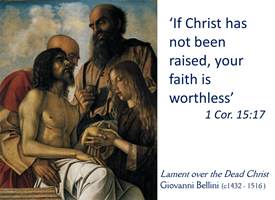
Lament over the Dead Christ, Giovanni Bellini (c1432 – 1516)

We know that without a resurrection Christianity is counterfeit. As the apostle Paul tells the Corinthians, ‘If Christ has not been raised, your faith is worthless’ 1 Corinthians 15:17. Accordingly, since a resurrection requires death, Jesus’ death by crucifixion has to be regarded as true. This ‘fact’ is attested to by a number of ancient sources, including the non-Christian historians, Josephus and Tacitus, who were therefore not biased toward a Christian interpretation of events.

We know that the chances of surviving crucifixion were very bleak and no evidence exists that Jesus was removed whilst still alive. The unanimous professional medical opinion is that Jesus certainly died due to the rigours of crucifixion, and even if he had somehow managed to survive, it would not have resulted in the disciples’ belief that he had been resurrected.

Il Precusore,

Il Precusore, Giulio Aristide Sartorio (1860 – 1932)

What about the empty tomb? Well its location was known to Christians and non-Christians alike. So if it hadn’t been empty, why would the chief priest have devised a plan to give a large sum of hush money to the guards, telling them to say that ‘His disciples came by night and stole him away while we were asleep’ Matthew 28:12-13. It would also have been pretty impossible for the large group of believers to have suddenly sprung up in the same city where Jesus had been publicly executed just a few weeks before and for those same believers to have been willing to die brutal martyr’s deaths if they knew this was all a lie.

Were people hallucinating when they encountered the risen Christ? Well, usually hallucinations are something that happens in an individual’s brain and not repeatedly on separate occasions and certainly not to groups of up to 500 people! 1 Corinthians 15:6 Even if they were visions, brought on by the apostle’s grief over the death of their leader, surely the body would have still been in the tomb.

Pascal's Wager

Pascal’s Wager

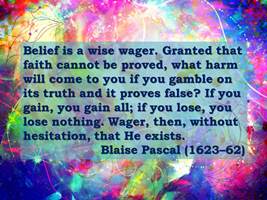
Convincing facts and figures? Well maybe. Or perhaps Pascal’s Wager might be the reason why people believe. Pascal was a seventeenth-century philosopher who theorised that humans live their lives by wagering that believing in God is a good bet because if when they die he does exist then they have gained the best of everything, on the other hand if they don’t believe and then find out he does exist then they made the worst choice and will have lost everything. However if they were to discover after death that God never existed then it didn’t matter what you believed.

So by believing, you are in a win-win situation. This sort of hedging my bets is just one accusation made against Christians who assume that because they believe in the right God, they are automatically good and have a one-way ticket to everlasting life. However, it also assumes that God would always reward blind faith above living a conscious Christ-centred life and all of the obligations that that might bring.

WDITFUTB_Belief is truth blogPerhaps belief and faith are different then… that belief is something that our logical, human minds hold to be true whilst faith is something that is felt deep within our hearts. Or could it be that faith is based on belief and that is why faith alone is not possible because belief always brings about actions and reactions?

Some people might even say that faith is truth held in the mind and that belief is a fire in the heart. Perhaps we just can’t separate the mind and heart, because as we heard ‘The community of believers were of one heart and one mind’ Acts 4:32

I hope you’ve been aware that I’ve been careful to never actually define what it is exactly that we understand and count as belief. Some might say that’s a cop-out; that the church is forever allowing so much laissez-faire around declaring what it believes and stands for that it nullifies any claims it might have to the truth. Well, I’m sure that for the majority of us it will include the belief that Jesus died and was resurrected in order that we might ‘have life in his name’, but that for each of us that might mean something slightly different depending where we are on our journey of faith.

As we walk together in fellowship with each other and with God, let’s make sure that we’re not only helping each other to increase in faith, but that we are sharing our beliefs with others so that God’s joy may be complete. After all didn’t Jesus say ‘Blessed are those who have not seen and yet have come to believe’. So let’s go and open a few more eyes to the truth of what we believe.

Amen

John 20:29

John 20:29

← Back

Thank you for your response. ✨

Righteous Anger – A Necessary Emotion

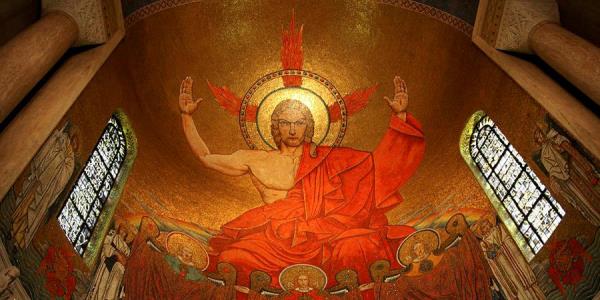
The righteous anger of Jesus, Basilica of the National Shrine of the Immaculate Conception, Washington DC

Mosaic of Christ in Majesty, Basilica of the National Shrine of the Immaculate Conception, Washington DC. Often known as ‘The Angry Jesus’

The third Sunday of Lent sees Jesus clearing the temple in Jerusalem. It is one of the few times that we see him displaying such raw emotion as he angrily removes the ‘thieves‘ from his Father’s ‘house of prayerMatthew 21:13. Often we consider anger as a negative emotion but there are undoubtedly times when it is right to be angry. It is how we use that feeling and who we direct that anger to that can be important.

The sermon I delivered this morning reflect some of the nuances that I had heard in an Oxcept Lecture by Diocesan Canon Angela Tilby entitled ‘Fragile Selves: Shame and Healing in an Age of Envy‘ and an informal talk given by Reverend Joseph John from St John’s Cathedral in Peshawar, Pakistan

May I speak and may you hear through the grace of our Lord; Father, Son and Holy Spirit. Amen

Let’s imagine I am driving down one of the side streets in Hedge End. There is a long row of parked cars on my side of the road, so glancing ahead, as it’s all clear, I pull over onto the other side of the road and start to overtake them. About fifty yards down the road another driver suddenly decides to pull out of their driveway and turn towards me. I can see they are determined to have their right of way. They gesticulate repeatedly that I should reverse back down the road, the whole fifty yards. I in turn glare and gesticulate that it would be easier for them to simply reverse back up their drive, but they are having none of it and start to shout something, which luckily is unheard through the windscreen; and which is also lucky because they can’t hear the words coming from my car either! Eventually, after what seems like several minutes of stalemate, I decide it is easier to simply reverse, and do so rather slowly and erratically as I can feel my heart beating rapidly and tears pricking at the corner of my eyes. The final hand gesture as the other car whooshes past, its driver’s eyes fixed straight ahead, was I feel unnecessary and I have to sit there for a few minutes to regain my composure and let the angry feelings subside.

I knew I’d ‘lost it’, rather like a toddler, kicking and screaming on a supermarket floor, and the whole incident served no real purpose other than to raise my blood pressure and make me feel slightly ashamed. The trouble is that when we ‘lose it’ then our anger, as an emotion, is selfish, destructive, and amoral… However, as Paul tells us in his letter to the Ephesians ‘Be angry but do not sin; do not let the sun go down on your anger’, which tells us that anger in itself is not an emotion we should avoid altogether

Be angry but do not sin; do not let the sun go down on your anger
Ephesians 4:26

This morning we heard of Jesus’ very vivid and public display of anger and it comes as something of a shock… although not as much of a shock as it must have been for the animal traders and money changers. We much prefer to think of Jesus as meek and mild, gentle and loving, but as with all of his actions, his anger had a purpose.

And it wasn’t the first time he had displayed this emotion. In Capernaum, with the Pharisees waiting to accuse him of breaking the Sabbath by healing the man with a withered hand, ‘He looked around at them with anger; deeply grieved at their hardness of hearts’. Even his own disciples came in for a tongue-lashing occasionally. When Peter rebukes him for foretelling his death and resurrection, Jesus then rebukes Peter, ‘Get behind me, Satan! For you are setting your mind not on divine things but on human things’; hardly said with a mild sigh of, ‘Oh Peter, Peter, Peter. Let me explain it one more time’

Get behind me, Satan! For you are setting your mind not on divine things but on human things
Matthew 16:23

When Jesus gets angry he is angry for the right reasons. It is not a selfish anger but focussed on the behaviour and injustice involved. He is not angry about the ‘weaknesses’ of others, but arises out of his concern for their spiritual well-being; they are defiling God’s holiness and in the case of the temple, God’s worship. It does not involve hatred or ill will. He is also fully in control and knew that when he had achieved the desired result of accomplishing God’s will that there was no need to become bitter or to hold grudges

Sometimes we need to become angry about things that are happening around us and in the wider world, at the injustices we see being inflicted on innocent victims, the abuse of children and violence against those who are defenceless, but we need to do so for the same reasons and in the same manner that Jesus has demonstrated. We need to make our voices heard in certain situations where no other voices are speaking up, in other words we need to raise awareness of situations. People are very quick to complain about the church and Christians in general when they ‘poke their noses’ into social situations, but at least it shows we care enough to state an opinion that might upset someone! And we shouldn’t underestimate the effect that holding regular prayer vigils, such the monthly ecumenical world-wide prayers for the Middle East or the annual Women’s World of Prayer can have on bringing issues to a wider audience.

However, should we not be in a position to interact with the public sphere then taking our concerns to God in private can create a safe space in which to express our anger about a situation. As the psalmist points out, ‘With my voice I cry to the Lord; with my voice I make supplication to the Lord. I pour out my complaint before him; I tell my trouble before him’. So there are occasions when we are justified in being angry and there are some things we are justified in being angry about. But what about when we are angry with God? What should we do then?

With my voice I cry to the Lord; with my voice I make supplication to the Lord.
I pour out my complaint before him; I tell my trouble before him
Psalm 142:1-2

Maybe we have to ask ourselves why we are angry with God. We often live our lives believing that life is supposed to be easy and that God should prevent tragedies from happening. When he doesn’t, we get angry with him. Sometimes we forget human involvement, with all its flaws and weaknesses and instead think that God has lost control of his creation and consequently our lives, so we blame God. It’s then that we realise our inability or unwillingness to acknowledge that in fact we are not always in control and that when things happen, it is then we have to trust that God understands the reason and that he will give us his peace and strength to get through any difficult situation. Trusting him in this way is an incredibly hard thing to do… but God is a God of compassion and hope, as well as being full of grace and love.

And God does understand when we get angry through frustration and disappointment. He knows our hearts and he knows how difficult and painful life can be in this world. Perhaps instead of being angry with God, we should pour out our hearts in prayer, and trust that he really is in control and that he already knows how these things fit into his ultimate plan for the world

Recently it was brought home to me how this trusting was more powerful than any acts of anger or retaliation could ever be. The Reverend Joseph John is currently on sabbatical at Cuddesdon College. He is a cathedral vicar at St John’s Cathedral in Peshawar, Pakistan. When Pakistan achieved independence in 1947 a lot of its schools and hospitals were Christian institutions and even after 1956 when it was declared an Islamic Republic, the Christian communities, which now make up only 3% of the population, were successfully integrated as freedom of religion and equal citizenship was guaranteed to all citizens.

However, on the 22nd September 2013 two Taliban suicide bombers killed over 147 of the congregation at All Saints Church, Peshawar; among several of Joseph John’s close relatives. There was a lot to be angry about

Nearly two years later, whilst still seeking justice from the government, the Christians there have a wish is to be recognised and supported as the church that God called them to be. They know that they cannot simply expect God to produce peace, but must pray and work for it. This means listening deeply and trying to understand people who are different and also seeking to resolve differences without conflict and violence. The work that the church undertakes is not exclusively with Christians, in fact 95 percent of those benefitting from their education, development work and health care are Muslims.

They know that it requires courage and humility, and that it often requires sacrifice; but they continue to serve their neighbours, as Joseph John puts it, ‘by washing their wounds’. Their anger has been channelled into seeking justice and continuing to act faithfully because they trust that God is with them in this work and has a plan for all the people of Pakistan, even if they don’t know exactly what it is at this moment in time.

When Jesus speaks of the temple being destroyed and rebuilt in 3 days, those with him are also unable to see the connections to the bigger picture until it is revealed through Christ’s resurrection; then the pieces fell into place. Their knowledge and wisdom is limited to what the human mind tells them is logical. So are we foolish to proclaim Christ crucified, in order to save all who would believe its message? Human wisdom appears weak because it requires proof and concrete knowledge, but God’s wisdom and power dwarfs our understanding and therefore we just have to hand over ourselves to him and trust that eventually that wider vision will be revealed in all its glory. Amen

Concrete things as against those only glimpsed dimly

Concrete things as against those only glimpsed dimly

Trust in the Lord with all your heart;
don’t rely on your own intelligence.
Proverbs 3:5

← Back

Thank you for your response. ✨

Running The Race

Run in such a way that you may win the prize

Run in such a way that you may win the prize

Sometimes phrases just seem to get stuck in your head for no apparent reason. Over the last few days it has been a quote from Paul’s first letter to the Corinthians:

Do you not know that in a race all the runners run,
but only one receives the prize?
So run that you may obtain it.
1 Corinthians 9:24

For those whose know me well, they would agree that I have a very competitive streak – I play to win. Whether it is board games or quizzes I will look for strategies that will give me an advantage; but that doesn’t mean I cheat. On the contrary, I’m the one checking the rules to ensure that we are playing the game fairly. I suspect that can make me a bit of a pain to those who simply want to play the game for a bit of fun and even worse when I come up against another person whose aim is to do exactly the same. Self-control can sometimes go out of the window and the sulks can follow it!

The fact is that I was brought up to make sure that whatever I chose to do, it should be given the same amount of care and attention, so that you always do it to the best of your ability. As my father used to say, ‘If a thing’s worth doing, it’s worth doing well

The same should be true of our faith life. Over the last few weeks I have been learning and putting into practice new techniques for Christian meditation. I have been learning to control my breathing so that it falls into rhythm with a prayer mantra – Maranatha, Come Lord Jesus – at the same time trying to lay aside the thoughts that immediately fill your mind and run parallel to the prayer, such as ‘I don’t think I’m doing this right, because I’m thinking about the fact that I’m not doing this right!’. It has got better as I’ve practised more, but the problem is not the technique, it’s the discipline to make sure I do it at least once a day that is the hard part and ultimately the most important.

A person can’t watch the Olympics on television and suddenly get up and run a marathon in record-breaking time – It’s more likely that they’ll break themselves. Athletes require discipline to train their bodies so that they can achieve their personal best. In the same way we have to train our hearts and minds to have the strength and control to stay faithful to our beliefs – whether it’s in prayer, meditation, reading the bible or the way we live our everyday lives according to the rules

Being constant and always striving to do your best is never going to be easy, and there will be days when we just want to collapse in a heap by the side of the road and say ‘I give up,’ but failure is not falling down, but staying down. By keeping the prize in mind and reaching for our goals we can force ourselves to get up and carry on so that we might be the eventual winner of the race we have been set.

Every athlete exercises self-control in all things. They do it to receive a perishable wreath, but we an imperishable. So I do not run aimlessly; I do not box as one beating the air. But I discipline my body and keep it under control, lest after preaching to others I myself should be disqualified.
1 Corinthians 9:25-27

In the meantime, anyone for a game of Monopoly… but be aware I will be going for hotels on Mayfair and Park Lane!

Competitiveness in a box

Competitiveness in a box

← Back

Thank you for your response. ✨

Let’s Talk About Money

Generous Giving

Generous Giving

I was recently asked to preach a sermon on giving. Not that our giving isn’t already generous in so many ways, but from time to time it’s useful to be reminded not only why we need to give as a response to a generous God, but also how we need to respond to requests to review our level of giving. This topic can be quite a tricky one for lots of churches and so I thought it would be good to share a slightly adapted version. The readings that informed these ideas were Deuteronomy 15:1-11; 2 Corinthians 8:1-3, 9:6-12 and Matthew 6:19-34.

May I speak and may you hear through the grace of our Lord; Father, Son and Holy Spirit

Today, on Bible Sunday, as on any day really, we are asked to think carefully about how important the bible is in helping to bring us closer to and to know God better; about his plans for us and for his world and just what our part in those plans might be, as followers of Christ… and it’s important to remember that ALL of us have a part to play.

The passages above all have a common theme running through them – they speak of the generosity of a God who knows no limit to his blessings for us, and they help us see the response that is expected on our part… to be equally generous in our giving, both of ourselves physically and our prosperity materially. So, I could say that I’m not going to ask you to give serious thought as to what and how you give – but quite honestly that would be as blatant a lie as those telephone calls you get from time to time….

‘Hello madam. How are you today…. now don’t worry, I’m not trying to sell you anything…..’

Now perhaps, like me, you occasionally want to slam the phone down immediately, because you know that that’s exactly what they do want to do, and it’s annoying that they don’t just say straight out what they want from you; so perhaps you will choose to stop reading at this point and click off of the page. But what I am asking you to do… in fact what I’d rather you did, is to carry on and discover some of the reasons, all revealed and supported within the bible, as to how and why each of us needs to be as generous as we are able, and afterwards to spend some time reflecting and praying about your levels of giving and what you might do about that.

We hate talking openly about money, it makes us feel uncomfortable, sometimes we feel a sense of indignation or even guilt but that doesn’t mean that it shouldn’t be talked about. As church members it can seem that the Church is always asking for more… more of our time, more of our money… so that we’re never left in peace. There’s always some job that needs paying for; the parish share to be met, the books to be balanced. So why then should we give?

For where your treasure is, there your heart will be also – Matthew 6:21

If we drive a car we know that we have to pay out to maintain it, if we don’t then eventually the car will stop working and it will be very expensive to repair or replace. If we have a hobby we have to invest a bit of money setting ourselves up with materials and equipment and as we get more proficient at it we may have to spent a bit more on different tools. The buildings in which we sit for church, have been dedicated and sanctified as a place where Christians can gather. If they fell down around our ears we could still gather there, because they’re not just buildings. They also aren’t buildings that should be preserved as pristine museums, so that people can drop in and visit it and say how wonderful it must have been to worship there; so it seems sensible that we try and ensure that we and future generations at least have a roof over our heads.

Therefore, our giving enables worship – whether we are giving of our time on Sunday to be with God, sing his praise, hear his word, share his sacraments, which is the first part of our giving. Or the second part, that our giving of money helps maintain the holy place where we worship, a place of history, a place of beauty, a place of peace and challenge, a place to glorify God.

Our giving of money also helps provide wages and resources for those who minister to us, who lead us in worship, for our music and others who enrich our worship. We need people leading us who are trained and knowledgeable and dedicated to helping us grow in our knowledge of Christ both in word and deed. If we are to sustain and enable that leadership we have to understand that it costs. The early church often paid its leaders in kind – in Matthew’s gospel for example:

Go and preach, ‘The Kingdom of heaven is near!’ … Do not carry any gold, silver, or copper money in your pockets; do not carry a beggar’s bag for the trip or an extra shirt or shoes or a walking stick. Workers should be given what they need – Matthew 10:7, 9-10

Likewise, the medieval church, who asked for donations of bread, wheat, mead and vegetables; although we’ve moved on from that now and use money instead, which is much better because quite frankly I don’t think our ministers or anyone else we have to support could cope with vast quantities of eggs and butter and pots of jam landing on their doorsteps and I’m pretty certain the gas board or the petrol station or the local council wouldn’t understand either when they tried a bit of bartering for their bills.

Our giving enables discipleship – Our giving of time and talent can help children and young people grow in the Christian faith and help those who study together to understand the gospel more fully, so that all can learn how to live faithfully. But it is our giving of money that can help provide resources for this learning, both in our own congregation and throughout our dioceses.

I wonder though how many of us use our own money to provide resources for the church? We think we are being generous… and we are, but we’re actually hiding the true cost of discipleship. We should be coming to the church and our treasurer and saying in order to do this it’s going to cost this, please can you reimburse me. Of course it may be that after having received the money you decide to offer it back as a donation, and you can say that that’s a load of faff, but it’s more valuable that we do realise the true cost. However, we don’t have a bottomless pit of money, but if we all become more aware then we can make sure that we can all contribute to that.

Our giving enables service – our giving of time and talent can assist our congregation in its service to the community, caring for some of those who are most vulnerable in our society. Every single church member can say that they give to the church, in so many different and diverse ways, you serve at his altar, you sing in the choir, you make cups of tea, you comfort the sick, the lonely and the bereaved, you clean, you organise, you lead, you turn up each week; and that’s absolutely wonderful and very sacrificial, but that can’t be treated wholly as a substitute for financial giving

One of the hardest passages in the bible to read is that of the young man who wants to follow Jesus, he knows exactly how he should behave and treat others, he does all those things that we can all do it without dipping our hands into our pockets, but Jesus says it’s not enough, you have to shed your reluctance and reliance on making sure that your nest egg is large enough and instead trust God that he will provide for you.

Therefore do not worry, saying, “What will we eat?” or “What will we drink?” or “What will we wear … your heavenly Father knows that you need all these things. But strive first for the kingdom of God and his righteousness, and all these things will be given to you as well – Matthew 6:31-33

I can almost hear you thinking, ‘Yes, but it would be super if we actually got to use the money that we give, on things that we want to happen and support,’ and it’s true that over the last few years I’ve got tired of thinking that every penny we give is often not quite sufficient to meet the demands of the diocesan Parish Share and has to be topped up by such hard work by the fundraising and social committees.

However, giving to an overarching hierarchy is nothing new either – the early churches were doing it when collecting for the church in Jerusalem, and they appears to do it with a spirit of generosity like the churches in Macedonia; but I believe things will change, particularly in the Winchester Diocese over the next few years, and that hopefully we might be in the more joyful position of deciding exactly what we want to spend our money on with the Parish Share review; which doesn’t mean that we have less to raise but it does mean that we can really get stuck into thinking of way in which the Good news can be brought to more people.

And there’s the nub… Our giving reflects our faith. We could say ‘why can’t the church do less, cut its cloth according to its means, and be content with what we already do, with what we already give’. Well, I suppose that’s one way to go – we could become more inclusive, look after our church; our people, but that would be like ‘storing up for ourselves, ‘treasures on earth, where moth and rust consume and where thieves break in and steal -Matthew 6:20

Surely, we have to realised what the real treasure is – that God has given us life and love, that he has shown us the extent of this love in the life and death of Jesus and that he has promised us new life through Jesus’ resurrection. Right now we can hear the good news of the gospel… and it certainly is good news for ourselves; it’s good news to know that we have personal salvation, it’s such good news that we almost what to hug it and keep it close to us. Yet, if it’s such good news for us why aren’t we bursting to share it with other – the gospel that we proclaim by word and example is a gospel for the world, a gospel for everyone. As Jesus said to his first disciples:

Go therefore and make disciples of all nations, baptizing them in the name of the Father and of the Son and of the Holy Spirit, and teaching them to obey everything that I have commanded you. And remember, I am with you always, to the end of the age – Matthew 28:19-20

I think sometimes we forget that each us of is individually called to proclaim the Gospel, not just a special few, but everyone. So our giving enables mission – our giving of time and talents assists in providing outreach to the community, providing a Christian presence in every part of life, while our giving of money helps to fund projects to bring the gospel to those who have yet to be challenged by it, and enabling the wider Church to comment on the social, moral and political issues of our time.

How more effective it is, when the world takes notice because it sees a group of people who are willing to make generous investment of their time, energy, gifts and money to share and spread the gospel…

The Widow's Mite by James C. Christensen

The Widow’s Mite by James C. Christensen

God calls us to be infinitely generous, like the widow and her mite in Luke’s gospel:

For the others offered their gifts from what they had to spare of their riches; but she, poor as she is, gave all she had to live on – Luke 21:4

That’s a really hard message to hear and live out, but what about making a start by at least considering what we have to spare…maybe we’re still reluctant sometimes to increase our giving because we honestly don’t think we have any money to spare

A Hotey Money Box

A Hotey Money Box

I actually surprised myself the other day when I looked at my ‘hotey’ money box. ‘Hotey’ – as in Don Quixote? Yes, I know he’s lost an ear, but it steadfastly refuses to stick back on… We made these at the beginning of Lent. So every time I come back from the shops and have those small coins that make your purse or wallet bulge I pop them in the box, and I also help my husband David prevent himself from wearing holes in his trouser pockets by relieving him of his pocket shrapnel as well…

As you can see it’s pretty full now, and looking at it I think there’s at least £50 in there – just made up of the small amounts of money that was spare and that we haven’t really missed – on average £3 a week … and it doesn’t have to be saved up to be given as a one off gift. Those are great for specific purposes, but it’s much more valuable knowing as a church that you are receiving a regular income, so that you can plan and budget for all the things you want to do and support. That’s not to say that we all have a lot to spare, all of our circumstances are different, but it was interesting to realise that perhaps if we do have some spare capacity to consider what we could do with it. Just imagine if everyone only had a spare 50p a week to increase their regular giving – an average congregation of 70 people could be equally sharing an increase of £1820 per year – a £1 would double that to £3640.

At the beginning, I said that I wanted this to be an opportunity to hear how and why each of us needs to be as generous as we are able, using the bible as our guide. It was not my aim to make anyone feel angry or guilty, but for you to go away prepared to review and reflect, and to then come to a decision, so that the next time you are approached to consider increasing your giving you know what your answer will be. At the end of the day, as Paul said to the Corinthians:

Each of you must give as you have made up your mind, not reluctantly or under compulsion, for God loves a cheerful giver – 2 Corinthians 9:7

Our giving of time, talent and money is a giving for the Gospel… for the Good News, and this fact was brought home to me the other day when I was privileged to be able to look through and choose some books that Sheila and Gordon Rose’s family had passed on to the church; among them were several bibles, and in many of them were personal greetings. One that stood out for me was this one in the front of  a Good News bible.

Gordon had written ‘To Sheila, hoping that it will always be “Good News”’

However on this Bible Sunday, I’m going to let Sheila have the last word, with a prayer that she had written and that was tucked into the front of her bible

A Prayer on Opening My Bible
As I settle for this time of quiet, O God, hush my heart and quicken my understanding.
I bless you for scribes, scholars and translators who have served your holy will.
I bless you for the great Bible Societies that have made this book available in my language.
I pray for a living expectancy, as I wait to learn what you will say to me as I read.
I pray for courage to face new challenges and to embrace new truth
For Christ’s son
Amen

Sermon delivered on Bible Sunday, 26th October 2014

← Back

Thank you for your response. ✨

V Is For Vulnerable

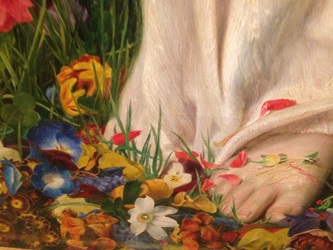
Detail from Gentle Spring by Frederick Sandys (1829-1904)

Detail from Gentle Spring by Frederick Sandys (1829-1904)

For someone who keeps a lot of their deepest emotions well hidden, I hesitate to write this. Yet, whilst I don’t believe it is my nature to be completely self-indulgent, I have a feeling that my experiences are not in any way unique, but that they may resonate with others and therefore be of some help.

It’s really hard when you’ve done your very best and it turns out that it’s not actually good enough. Some of which is down to your level of understanding and some of which is not having been given the proper blueprint and tools to complete the task in the first place.

When we set out to do something new we will have many things at our disposal. We will have some previous generic knowledge as to how we might approach the task; to which we will add new learning, from books or instructions and if possible from other people. We will take all of this and try to form it into a cohesive understanding of what we need to do and then attempt the task. Add into this a willingness and desire to do our very best and we open ourselves up to the vulnerability of being tested and tried and sometimes found wanting.

This is the most painful part of the whole process. It’s the tears at a drop of a hat time; when you feel vulnerable to any sense of judgement or act of kindness; when you want to withdraw even deeper into your shell….

Detail from Gentle Spring by Frederick Sandys (1829-1904)

Detail from Gentle Spring by Frederick Sandys (1829-1904)

… and it’s easy to stay there, and bemoan the situation, scrutinising your discomfort internally or if you’re lucky sharing it with your closest confidantes; and if this stage is the most painful, then the next stage is often the hardest.

It will come inevitably to a point though when you can no longer disguise what you’re feeling on the inside and then the dam will burst and you will find that all of your anxieties and fears are laid bare. In some ways your worst nightmare and in others a blessed relief.

For this is where the healing process can begin. Not some overnight miracle, but a gradual reflection on why what has happened has happened and how you can move forward from it. You will need to be honest with yourself and recognise what part your own desires and expectations have played in the situation; where things might have been done differently, both on yours and others parts.

You also have to be prepared to accept that the advice and encouragement you are being offered is genuine and that you are worthy to receive it; because we don’t always recognise ourselves when seen through the eyes of others, but they are so often the mirrors to our souls.

We can then be ready to move on. A little stronger, a little wiser

The Lord is close to the broken hearted and saves those who are crushed in spirit (Psalm 34:18)

Life itself is never easy, and our trials may be incomparable, even trivial, to those faced by others on a daily basis. Our greatest comfort though is knowing that if we can hold on to our faith then the bigger picture for us is already known by God, and that he will be beside us as we travel over the rough and the smooth paths to get there

So I would encourage you to be prepared to allow yourself to be vulnerable from time to time, to open yourself up emotionally and honestly; because in that way you may just find out where your strengths lay.

Detail from Gentle Spring by Frederick Sandys (1829-1904)

Detail from Gentle Spring by Frederick Sandys (1829-1904)

← Back

Thank you for your response. ✨

The pictures that accompany this blog are details from the painting Gentle Spring by Frederick Sandys (1829-1904), a Victorian Pre-Raphaelite painter; which hangs in the Ashmolean museum in Oxford. It’s relevance is simply no more than that it is such a beautiful painting that draws my attention on each visit, and each time makes my heart soar.

A Chinese Legend


The Noble Bamboo

The Noble Bamboo

In the church, we have just celebrated Ascension, when the risen Christ traditionally ascends to heaven, having been crucified on the Easter cross. Ahead, we look forward to Pentecost; when the promised Advocate or Holy Spirit will be given to his followers. Without these things happening we would have nothing distinctive about our faith. 

If there is no resurrection of the dead, then Christ has not been raised;
and if Christ has not been raised, then our proclamation has been in vain
and your faith has been in vain.
1 Corinthians 15:13-14

So for his death not to have been in vain there had to have been a purpose. The son of God, who came to earth, and set aside his divinity to take on earthly flesh had to die in order that he and us might live and there is no doubt that giving your life for the greater good is the ultimate sacrifice anyone can make. Throughout history men and woman have made this sacrifice, as martyrs, as servicemen and women and civilians serving their country, as ordinary everyday people; in the hope that it helps others to live.

At Morning Prayer in college recently a fellow student read a beautiful story which illustrated this selflessness perfectly. However, it also made me think that God does not contain himself to our slightly arrogant assumption of exclusivity. For example, I have always been amazed at the fact that creation stories from around the world contain so many similar attributes. For those who believe in a creator God, this is not so strange, as we cannot be so precious that we think God only revealed the story of creation,  based on a Mesopotamic myth and passed down in verbal form, before being adapted to Israel’s belief in one God, by a group of Yahwehist writers in the late 7th or 6th century BC

God indeed reveals himself time and again in all of his creation, both physically and linguistically and so I hope you enjoy reading this legend from China and draw your own conclusions about where God could be working his purpose out in the world right now

A Chinese Legend

Once upon a time, in the heart of the Western Kingdom, lay a beautiful garden. And there in the cool of the day was the Master of the Garden wont to walk. Of all the denizens of the garden, the most beautiful and most beloved was a gracious and noble bamboo. Year after year, Bamboo grew yet more noble and gracious, conscious of his Master’s love and watchful delight, but modest, and gentle withal. And often, when Wind came to revel in the garden, Bamboo would cast aside his grave stateliness, to dance and play right merrily, tossing and swaying and leaping and bowing in joyous abandon, leading the Great Dance of the Garden which most delighted the Master’s heart.

Now upon a day, the Master himself drew near to contemplate his Bamboo with eyes of curious expectancy. And Bamboo, in a passion of adoration, bowed his great head to the ground in loving greeting. The Master spoke:

“Bamboo, Bamboo, I would use thee.”

Bamboo flung his head to the sky in utter delight. The day of days had come, the day for which he had been made, the day to which he had been growing hour by hour, the day in which he would find his completion and his destiny. His voice came low:

“Master, I am ready. Use me as thou wilt.”

“Bamboo ” — the Master ‘s voice was grave — “l would fain take thee and — cut thee down.”

A trembling of a great horror shook Bamboo. “Cut. . . me.. . down! Me… whom thou, Master, hast made the most beautiful in all thy garden. . . to cut me down! Ah, not that, not that. Use me for thy joy, 0 Master, but cut me not down. “

“Beloved Bamboo” — the Master’s voice grew graver still — “if I cut thee not down, I cannot use thee.”

The garden grew still. Wind held his breath. Bamboo slowly bent his proud and glorious head. There came a whisper:

“Master, if thou canst not use me but thou cut me down.. then… do thy will and cut.”

“Bamboo, beloved Bamboo, I would . . . cut thy leaves and branches from thee also.”

“Master, Master, spare me. Cut me down and lay my beauty in the dust; but wouldst thou take from me my leaves and branches also?”

“Bamboo, alas, if I cut them not away, I cannot use thee.” The sun hid his face. A listening butterfly glided fearfully away.

And Bamboo shivered in terrible expectancy, whispering low.

“Master, cut away.”

“Bamboo, Bamboo, I would yet… cleave thee in twain and cut out thine heart, for if I cut not so, I cannot use thee.”

Then was Bamboo bowed to the ground.

“Master, Master. . . then cut and cleave.”

So did the Master of the Garden take Bamboo and cut him down and hack off his branches and strip off his leaves and cleave him in twin and cut out his heart. And lifting him gently, carried him to where was a spring of fresh, sparkling water in the midst of his dry fields. Then pulling one end of broken Bamboo in the spring and the other end into the water channel in his field, the Master laid down gently his beloved Bamboo. And the spring sang welcome and the clear sparkling waters raced joyously down the channel of Bamboo’s torn body into the wailing fields. Then the rice was planted, and the days went by, and the shoots grew and the harvest came.

In that day was Bamboo, once so glorious in his stately beauty, yet more glorious in his brokenness and humility. For in his beauty he was life abundant, but in his brokenness he became a channel of abundant life to his Master’s world.

Living Water

Living Water

← Back

Thank you for your response. ✨

Changing Doubts Into Hope

Baptism with water and the Holy Spirit

Baptised with water and the Holy Spirit

It’s not often that you start a talk in church with a piece of music. However last Sunday, the second of Easter (yes we are still celebrating Easter long after the chocolate eggs have been eaten and the hot-cross buns finally toasted) I decided to see if the congregation were up for a bit of ‘Name that Tune’ The piece in question was the theme tune from Star Wars, Episode 4, ‘A New Hope’

We were celebrating a Eucharist, made all the more special because it was to include a baptism. Our readings included the story of Thomas meeting the resurrected Jesus and it was, looking to the future we are being offered, that we hopefully were to discover that morning

First though I want to ask you a question… Is it just me?? Or do we all have moments of doubts? Doubts about whether we are capable of doing something – if we have the ability or the strength? Doubts about whether we can trust others to carry out the things they have promised to do. Doubts about what the right thing to do is? Doubts about what our purpose in life is? Doubts about where God is in our lives? Is it just me??

Everyone doubted that Noah could build an ark – and yet he went on to achieve this incredible feat of engineering; Sarah doubted that she would ever have children and even laughed in God’s face and yet she went on to be the co-founder of a great nation Moses doubted that he had the articulate skills to face up to Pharaoh, yet with the help of his brother Aaron he went on to bring the Israelites out of Egypt and into the Promised Land. Elijah doubted that God was with him when he fled in fear for his life to Mount Horeb and yet it was there that he encountered him in that ‘still, small, voice’ guiding him as to what to do; Peter doubted when he walked on the water and yet there he was at Pentecost speaking out boldly and clearly, and of course the eponymous Thomas

So the other disciples told him, ‘We have seen the Lord.’ But he said to them, ‘Unless I see the mark of the nails in his hands, and put my finger in the mark of the nails and my hand in his side, I will not believe.’ John 20:25

So it certainly seems that God has no problem with us having doubts from time to time, after all we’re only human and we’re very often not in a position to see the bigger picture or what the future holds for each of us. What is it that we need to turn those doubts into belief I wonder? What proof will be good enough? For Thomas it was physical proof that the man he had been following and believed in had truly risen from the dead and was very much alive and standing in front of him. Maybe the only proof we’ll accept is when something we’ve doubted would happen has actually happened then we’ll believe it, or maybe if something didn’t happen when we feared it might. Good concrete evidence is often what we seek to allay our doubts and fears

Doubt often comes about because of a fear of failure; fear that we will let people down; fear that what we desire won’t come about. And maybe it won’t – not in the way we think or hope it will… and that I think is the key. The need to change our outlook from negative to positive, changing our doubts into hopes, putting our faith in God not in ourselves. All the while we hold on to our doubts then we are stopping ourselves from believing that things are possible.

Psalm 16 is sometimes translated with the subtitle ‘the hope of the faithful, a prayer of trust and security in God’ and it’s a beautiful lament from David which contains the following lines,

I praise you, Lord, for being my guide. Even in the darkest night, your teachings fill my mind. I will always look to you, as you stand beside me and protect me from fear. With all my heart, I will celebrate, and I can safely rest. I am your chosen one. You won’t leave me in the grave or let my body decay. You have shown me the path to life, and you make me glad by being near to me.’

Appropriate words as we celebrate Christ’s resurrection, but also appropriate for our own lives, as Peter in his first letter tells us, ‘By his great mercy he has given us a new birth into a living hope through the resurrection of Jesus Christ from the dead’ – a living, breathing hope that has been placed in all of us.

Font blog

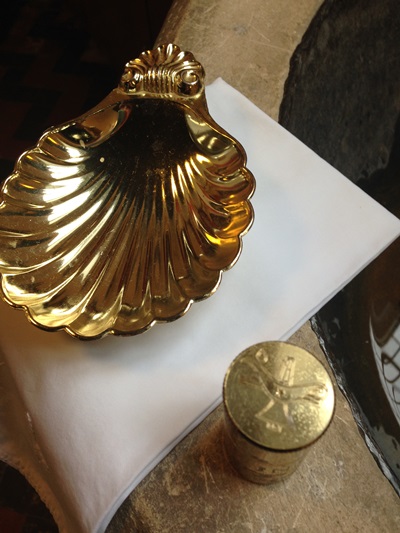
The waters of baptism in the font at St John the Evangelist, Hedge End

And this morning we witnessed that hope being placed into a young child, Noah; whose baptism symbolised a new birth, not of water but of the Spirit. A hope that will be new and vibrant, a hope that will be reflected in the love and example that he receives from his parents, grandparents and godparents; a hope that Noah will need to have reaffirmed from time to time not only by his family, but by the whole family of Christ.

Because it’s all our responsibility to look to the hope that has already been placed in our own lives and to remain steadfast in trusting that God knows what he’s doing and all will be well.

Regrettably, as we’ve already seen, there may still be creeping moments of doubt. Again as Peter puts it, ‘even if now for a little while you have had to suffer various trials.’ And let’s be honest, all of us have and may be having to face various trials, some more than others, some harder to bear than others. Maybe our faith has been tested to the limits, but, if through it all, we don’t lose hope and believe that we will be given the strength to endure it, then just like metal that when it is tempered by fire is made stronger, so our faith will emerge with genuine hope for whatever the future may bring; and just like Thomas we will be able to declare, ‘My Lord and my King

Jesus tells his disciples, standing there right next to him, that they are blessed because they have seen for themselves with their own eyes and have no reason to doubt only to believe. How foolish we must seem to others to believe in something we’ve never seen, yet we have all come to or are coming to faith in so many different ways. What is it that convinces us that we should believe? Is it a personal encounter with Jesus; is it the love shown to us by those around us; is it an example of a friend, or was it that we just couldn’t believe that our lives are nothing more that this brief span of time. Whatever it was that started you on your journey of faith, be hopeful and hold on to it and remember how blessed you are.

The promises we make to the newly baptised, to support them in prayer, example and teaching we should also make to each other. We should push all of our doubts to one side as we are welcomed into the fellowship of faith and remember instead the one hope to which we are all called

Let’s celebrate that hope, and as always, may Christ’s peace rest in you…Amen

Expect the unexpected in our font!

Always expect the unexpected in our font!

← Back

Thank you for your response. ✨

A State Of Flux

State of Flux

State of Flux

Why are you so full of heaviness, O my soul, • and why are you so disquieted within me?
Psalm 42:6

Just lately I have been feeling really unsettled and I just can’t put my finger on it. On the surface nothing has obviously happened that might cause this feeling of unrest; in fact things have been falling into place and my self-confidence has been gradually increasing – but still there is a feeling of general unease.

Obviously, looking back there are many changes that have taken place in my life over the last few months; the excitement and nervousness about starting college; learning how to split my week between study and wanting to continue to serve my home church; as well as pulling back on some of my voluntary commitments. Alongside these, in my personal life, I have been rediscovering what it means to be part of a married couple, now that the girls have left home and are more or less independent.

These are all definite changes, and as I’ve written about before, change is not something to be concerned about, but is necessary for us to grow as people and in our faith. So I don’t think it’s that. Perhaps it’s more about transformation

You might say that change is actually only the events or things that we either choose or have thrust upon us, which will have an effect on us in some way. What comes out of those changes is transformation, because we will never be the same and we can never go back to being the person we were before.

This can apply to so many life events, but a vivid example, where this is clearly apparent is where death and loss are concerned. Mags Blackie in a recent post, spoke about Kay Warren, an American pastor’s wife and her family’s emotional journey through grief, following the suicide of her son. There was an expectation from people around them, that life would eventually get back to ‘normal’. However, Kay’s observation was that her true friends recognised that this wasn’t going to happen, ‘they don’t pressure their friend to be the old familiar person they’re used to; they’re willing to accept that things are different’. 

Clearly this and similar events involve huge and uncomfortable changes and where our faith is concerned, those changes might not on the surface be so obvious. If we were to look to biblical times, there are many more examples where ordinary people have come into contact with God and the changes that that entailed transformed them and their lives forever. We can think of Peter, who after meeting Jesus, was transformed from a humble fisherman to a leader of Christ’s church; or Mary Magdalene, a woman with a troubled past, but who’s devotion to Jesus transformed her into the one who was trusted to reveal his resurrection to the other apostles.

Yet none of these things happened overnight, it was something that occurred gradually, and whilst it was emerging there would often be a period when they were in a state of flux – uncertain of what was to be done but aware that it preceded a new direction for their lives.

What I am certain of is that no-one once they have come into contact with God, as creator, redeemer or sustainer can remain unchanged. So if you too are seeing changes in your lives and are feeling uncomfortable or unsure about it – just hold on in there, for all will eventually be revealed.

Perhaps for me this period of unrest is just one of those moments, when I am beginning to realise that things are irrevocably changing and that life is not going to ever be the same again. In that case, I’m going to take a deep breath and say, ‘Let the transformation continue…’

O put your trust in God; • for I will yet give him thanks,
who is the help of my countenance, and my God.
Psalm 42:7

← Back

Thank you for your response. ✨