Tag Archives: God

Bearing the Cross

Embroidered cross on altar frontal, St Peter's, Dyrham

Embroidered cross on altar frontal, St Peter’s, Dyrham

As a man of sorrow and acquainted with grief
your only Son was lifted up
that he might draw the whole world to himself.
May we walk this day in the way of the cross
and always be ready to share its weight,
declaring your love for all the world.

The above forms part of a prayer of thanksgiving for Morning Prayer during Passiontide, and as we move into Holy Week and having this morning been given a palm cross,  my thoughts have moved towards just exactly what it might mean for each of us to bear our cross… or even crosses.

If we are incredibly lucky, we might feel that our lives are pretty carefree, we have everything to meet our basic needs; food, water, shelter. Our emotional needs are also met through our families and friends  and we may even have a sense of financial security – a bit of spare cash to indulge in treats from time to time. Our crosses, although apparently light, are still with us however.  Outward crosses that carry responsibility to everyone around us. How can we not declare our love to the world?

Often, as well, we carry internal crosses. The things that we choose to bear alone; things that we are ashamed of doing and saying; things that might diminish us in other people’s eyes; things that are not hidden away from God, and who alone knows the sorrow in our hearts and our desire for repentance. How can we not allow ourselves to be uplifted?

For many people though, the cross they have to bear, like Jesus’, is an enormous weight of worries, hurts and strains. Often it is borne in situations that are not of their making or problems from which they can see no way of escape. Daily life is a struggle and at times unbearable. How can we not offer to share their load?

For Jesus the way of the cross was one that he decided to take willingly. Yet even as he made his way up to Calvary, his human frailty caused him to stumble, allowing another, Simon of Cyrene to join him in bearing the great physical weight of the wooden cross. What was even more incredible was the immeasurable weight of the world’s wrongdoings, sorrows, grief and hatred that he also chose to bear. How can we not be grateful?

We adore you, O Christ, and we bless you;
by your holy cross, you have redeemed the world

The Way Of The Cross To Calvary - embroidered panel by Sue Symons. One of 35 panels that form the Bath Abbey Diptychs

The Way Of The Cross To Calvary – an embroidered panel by Sue Symons from her exhibition “One Man’s Journey To Heaven”, one of 35 panels that form the Bath Abbey Diptychs*

*Sue Symons explains that the large black circle depicts the weight of the cross and the white circle is Christ, diminished in size as he bears its horrendous weight. http://www.bathabbey.org/whats-on/events/bath-abbey-diptychs

Go back

Your message has been sent

Warning
Warning
Warning
Warning

Warning.


Coming Into The Presence of God

Out of the Window blog2

Coming into the presence of God

Another weekend at Cuddesdon brings new insights and experiences. Whilst not my first choice, the title of the workshop ‘Embodied Prayer in Orthodox Spirituality’ filled me with a sense of intrigue.

I would class my churchmanship as neither high nor low, but rather open to a smorgasbord of traditions. I therefore, was quite receptive to finding out more about what some might class as the high end of the church where orthodoxy is concerned.

In fact where orthodoxy is concerned the Western church is somewhat of an upstart according to the Syriac Orthodox Church of Antioch, which claims to use the oldest surviving liturgy in Christianity. However, I digress…

Our main purpose of the day would be to explore contemplative or noetic prayer as well as embodiment prayer – the former both involves silence and stillness (hesychia) and monologistic prayer (i.e. repeating a word or phrase such as the Jesus Prayer) – whilst the latter included prostration and the sign of the cross.

Standing to pray

Standing to pray

As the latter was more unfamiliar to me I will mention that first. Embodiment prayer, as the name suggests involves using the body in prayer and there are many ways of doing this – whether standing or kneeling or prostrating yourself – all the while offering prayer either using a set form of words or your own words. Some of which postures may seem unfamiliar practices to your average Anglican!

The Sign of the Cross

The Sign of the Cross

When it comes to making the sign of the cross during worship, it is a gesture that very often gives an immediate clue as to people’s Anglican tradition – that is those of an Anglo-Catholic persuasion. Again, this was something that I was not used to doing either in worship or prayer. Nevertheless, when it was explained using an illustration of an icon based on the baptism of Christ I was able to better appreciate its meaning.

The Baptism of Christ

The Baptism of Christ hand written by Tamara Rigishvili *

This beautiful icon [which is written not painted] shows the Trinity as a straight line from the heights of heaven to the depths of the waters – we can therefore image our bodies when we are standing upright representing that line. Our heads are warm because of the activity of our brains, from which flows creative energy (the Father), our stomachs are the watery region (the Son submerged at his baptism) and our lungs breathing air in and out (the life giving Holy Spirit or Holy Ghost)

Imagine if you will then, your thumb and first two fingers, held together as a trinitarian symbol, tracing a line from your head to your stomach up to your right shoulder then across to your left and then resting in the middle by your heart – ‘In the name of the Father, of the Son and of the Holy Ghost, Amen.’ – its symbolism becomes clearer and more affective.

However, it was the practical session on contemplative prayer that was to prove the most rewarding. Noetic prayer, as it is also known, uses a form of silent prayer (hesychia) in which the body is stilled, the ‘chattering mind’ silenced, thus creating a space where you are open to receive God. Of course it’s never that easy to just switch off your thoughts, but it allows an awareness of both intrusions and physical discomforts and lets them be by bringing yourself back to the awareness of the sense of stillness within your whole body. External noises also become absorbed so that they don’t become a distraction. It is into this space that prayer subconsciously occurs.

Psalm 46:10

Psalm 46:10

There is plenty of biblical evidence of being called to stillness in order to hear God’s voice… within many of the Psalms for example – ‘Be still and know that I am God’ (Psalm 46:10) or ‘For God alone my soul waits in silence‘ (Psalm 62:1) – and Jesus takes time to be alone with his Father, no doubt in silence as well… whether in the desert or drawing apart from his followers on occasions.

Of course, I would not, after only a couple of sessions, claim in any way to be an expert, but the technique is basically to find a comfortable place to sit, with both your feet on the ground and to work your way up your body, recognising the sensations in each part as you still yourself, drawing back to your feet, your knees, your hands, etc., should thoughts intrude; all the while becoming aware of your breathing and its natural rhythm……

What was the prayer that formed inside me during this time? Well it actually turned out to be a piece of poetry… from out of the stillness and the silence by which I came into the presence of God

Coming Into the Presence of God

Warmth suffuses the window pane,
As sunshine splashes, in gold and yellow rays
on the cushioned sill;
Sharp shadows are softened and shimmer.
I draw my knees closer
and sink into silent stillness.
The world is on pause.

Invisible neurons continue to fire;
exposed in intermittent patches of tingling energy
through soles of feet and top of scalp.
Pain ebbs and flows,
absorbed in gentle eddies;
while breath synchronises
with the ticking of the mantel clock
and thus fades as if time is motionless…

Even so the heartbeat of the earth
still pulses in sounds it offers;
received in encoded messages,
yet unencrypted to the keen ear.
A solitary bird, unseen, chirrups its joy,
and wood pigeons coo in rhythmic metre,
unfazed by passing traffic’s intrusion.

A creak, a sigh,
the door and I hold our breath;
but the inevitable slam is muted;
fading away, as calmness interrupts
and a sense of presence grows.
Like a glimmer through closed eyelids;
which open as a breeze brushes my skin

Outside, the tender branches of the trees,
laden with buds and burgeoning leaves
ripple and vibrate, echoing the silent force
of life and spirit.
Springtime flowers bend to the earth,
then dip and bob like cheery marionettes;
all proclaiming divine mystery

Recalled back into the room
by gentle chink of plate and cup,
a signal of beckoning refreshment,
and congenial chatter….
Still hold the moment a little longer
to remember another meal
and revelation in broken bread,
gone and yet forever present

The day’s workshops were led by the Reverend Jim Barlow, presently the Assistant Curate at St Peters, Burnham, Buckinghamshire and previously a student at Ripon College, Cuddesdon

*Tamara very kindly gave me permission to use her beautiful artwork in this piece. To find out more about her work please look on her website http://www.tamarapaint.com/

Go back

Your message has been sent

Warning
Warning
Warning
Warning

Warning.

The Body of Christ

We are the body of Christ

We are the body of Christ

The New Testament module I have just completed was interesting in many ways. Its main focus was on several of the Pauline letters, including the epistles to the Galatians, Romans and Corinthians. New insights were gained into the background, setting and context of these letters as well as the character of Paul himself. This was particularly challenging as my natural tendency is to regard Paul with a small measure of annoyance and a gritting of teeth.

Don’t get me wrong, I have learned to love and admire St Paul; for his sheer hard work and determination in setting up the early churches, his zealousness for spreading the message of Christ and his genuineness in his beliefs. It’s just that sometimes I wonder, ‘Is that really what you meant Paul?’

One passage though, in which he explained the metaphor of ‘the body of Christ’ brooks no argument from me and we were asked to prepare a sermon on it as part of the course. Here then is a copy of that sermon, intended with my own church congregation in mind, but here delivered hopefully to an equally receptive, varied and open online congregation.

The passage it relates to is 1 Corinthians 12:12-26

As the writing on the barn wall stated, “All animals are equal…” This declaration by the animals in George Orwell’s novel Animal Farm laid down a rule which many democratic societies have upheld as a basic principle. However, if we are all equal doesn’t that mean that we all have to be the same? Not physically the same but doing the same thing, thinking the same thoughts, making everything neat and uniform, because in this way we will surely achieve unity. Won’t we? And isn’t uniformity the thing that we as a church strive for in our liturgy, church management and doctrine?

Well equality is not the same as uniformity and uniformity is actually not really helpful to true unity. As the animals later discovered when they added a codicil to the rule – “All animals are equal, but some are more equal than others.” There is something more that needs to happen and Paul points to it in one of his clearest and least controversial statements in his first letter to the church in Corinth, when he identifies what it means to be the body of Christ

We could so easily just look at the analogy of each of the members of the church being represented as different body parts. We all have different roles to play which could equate to a particular limb or organ within a body – the choir representing the harmonious vocal chords; the sidespeople as helpful hands; ‘Jonathan’ [in my own church], who likes to disagree with every sermon, as the grumbling appendix!… Each of us creating a complete and unified metaphorical human being that is wonderfully made, but which can occasionally stumble and fall, but invariably picks itself up again.

 Still is this what Paul really means and is this the only way we can think of being one body?

For a start we are all different, and that’s great; because it would be an odd shaped body if we were all the same part. After all, like a body, we need the unique gifts offered by all of the various members. These various gifts provide diversity, a diversity that is God-given; and coming as they do from such a source they need to be used for the good of all. Paul recognises that the thing that unites us is the Holy Spirit and it is through the work of the Holy Spirit that believers become bound together into one body.

However, our diversity needs to be based on interdependency rather than independence… Just as we use different parts of our bodies to perform different tasks, we all have particular talents which make us very good at the jobs we choose to do; and sometimes we can jealously guard those jobs that we like doing, thereby preventing others from a chance of receiving equal recognition. In addition, if we perceive that these are highly skilled tasks we can begin to give them a superior status, which often leads to pride. Yet the work we perform in God’s name cannot be based on a belief of self-sufficiency – our successes are built on the grace of God and the shoulders of those that support us –this sermon would be pretty pointless if the church and its people weren’t present – and a lot has happened in the past and behind the scenes to bring everybody to this particular point in time. Just take a moment to think why and how it is you are here today?

Moreover, who are we to judge the worthiness of each role played within the church? Just as our limbs depend on muscles, and tendons; nerves and microscopic synapses to function efficiently, and would be useless without them, so we have to ensure that every role a person has is equally valued. Furthermore, we need to realise that if we are working towards a common purpose – a united body – then we have to recognise that there will be some within that ‘body’ who may be vulnerable and therefore need to be nurtured and cared for.

Often, living in a society that prizes outward signs of power and achievement, we can despise weakness and vulnerability, but Paul turns this on its head, so that as Christians we should honour those ‘less respectable members’ and instead afford them mutual respect. It could be anyone of us that fluffs their lines in the readings, or takes a long time to get up to the altar rail or forgets the milk for refreshments…If we learn to be more accepting then the church will truly function as the body of Christ

Of course there are going to be time when we do disagree with each other, but it will be how we deal with this that counts. If our disagreements are forever aired publicly, rather than quietly and with concern for the other person, then we run the risk that we lower the respect that we need to have for each other as well as the respect that others have for us. We devalue the whole

What then should the shape of the whole look like? Well, in a world that is forever dieting and primping to maintain the body beautiful, we need to put that image aside. Our body should be fluid and growing, accepting new members so that every part of the body can grow stronger. We shouldn’t pick and choose what sort of parts or people we might need more of, or reject what might be to some insignificant or worthless. We have to allow people to be what they are; love each other unconditionally and rejoice in our unity – because if we don’t then we not acting as the body of Christ; and In the words of a song by the music group Casting Crowns – “Jesus paid much too high a price for us to pick and choose who should come… and we are the body of Christ”

Amen

Lyrics from If We Are The Body – Casting Crowns

It’s crowded in worship today
As she slips in trying to fade into the faces.
The girls’ teasing laughter is carrying farther than they know
Farther than they know

A traveller is far away from home
He sheds his coat and quietly sinks into the back row.
The weight of their judgemental glances
Tells him that his chances are better out on the road

But if we are the body
Why aren’t his arms reaching?
Why aren’t his hands healing?
Why aren’t his words teaching?
And if we are the body
Why aren’t his feet going?
Why is His love not showing them there is a way?
There is a way

Jesus paid much too high a price
For us to pick and choose who should come
And we are the body of Christ

Jesus is the way

© Casting Crowns 2003
https://www.castingcrowns.com/music/lyrics/if-we-are-body

Go back

Your message has been sent

Warning
Warning
Warning
Warning

Warning.

Disclaimer: Any names mentioned within this sermon have been changed to protect people’s anonymity and because I would still like to worship there. They know who they might be!

A State Of Flux

State of Flux

State of Flux

Why are you so full of heaviness, O my soul, • and why are you so disquieted within me?
Psalm 42:6

Just lately I have been feeling really unsettled and I just can’t put my finger on it. On the surface nothing has obviously happened that might cause this feeling of unrest; in fact things have been falling into place and my self-confidence has been gradually increasing – but still there is a feeling of general unease.

Obviously, looking back there are many changes that have taken place in my life over the last few months; the excitement and nervousness about starting college; learning how to split my week between study and wanting to continue to serve my home church; as well as pulling back on some of my voluntary commitments. Alongside these, in my personal life, I have been rediscovering what it means to be part of a married couple, now that the girls have left home and are more or less independent.

These are all definite changes, and as I’ve written about before, change is not something to be concerned about, but is necessary for us to grow as people and in our faith. So I don’t think it’s that. Perhaps it’s more about transformation

You might say that change is actually only the events or things that we either choose or have thrust upon us, which will have an effect on us in some way. What comes out of those changes is transformation, because we will never be the same and we can never go back to being the person we were before.

This can apply to so many life events, but a vivid example, where this is clearly apparent is where death and loss are concerned. Mags Blackie in a recent post, spoke about Kay Warren, an American pastor’s wife and her family’s emotional journey through grief, following the suicide of her son. There was an expectation from people around them, that life would eventually get back to ‘normal’. However, Kay’s observation was that her true friends recognised that this wasn’t going to happen, ‘they don’t pressure their friend to be the old familiar person they’re used to; they’re willing to accept that things are different’. 

Clearly this and similar events involve huge and uncomfortable changes and where our faith is concerned, those changes might not on the surface be so obvious. If we were to look to biblical times, there are many more examples where ordinary people have come into contact with God and the changes that that entailed transformed them and their lives forever. We can think of Peter, who after meeting Jesus, was transformed from a humble fisherman to a leader of Christ’s church; or Mary Magdalene, a woman with a troubled past, but who’s devotion to Jesus transformed her into the one who was trusted to reveal his resurrection to the other apostles.

Yet none of these things happened overnight, it was something that occurred gradually, and whilst it was emerging there would often be a period when they were in a state of flux – uncertain of what was to be done but aware that it preceded a new direction for their lives.

What I am certain of is that no-one once they have come into contact with God, as creator, redeemer or sustainer can remain unchanged. So if you too are seeing changes in your lives and are feeling uncomfortable or unsure about it – just hold on in there, for all will eventually be revealed.

Perhaps for me this period of unrest is just one of those moments, when I am beginning to realise that things are irrevocably changing and that life is not going to ever be the same again. In that case, I’m going to take a deep breath and say, ‘Let the transformation continue…’

O put your trust in God; • for I will yet give him thanks,
who is the help of my countenance, and my God.
Psalm 42:7

Go back

Your message has been sent

Warning
Warning
Warning
Warning

Warning.

The Power of Prayer

Focussing our prayers

Focusing our prayers

I have been thinking a lot about prayer recently, and about what a powerful tool it is for our faith lives. It is both the simplest and at the same time the most difficult thing we are asked to do

Prayer in its simplest form is often an immediate unrehearsed plea for help – dashing off our requests, pleading for a solution to a problem, dutifully reciting some well-worn words. The basics are that we start up a conversation with God – but so often it can seem a one-sided conversation with awkward pauses amidst feelings that – I’m pretty sure I’m not doing this right – I actually don’t know what words I’m supposed to say – what if I’m just talking to myself?

The good news is that you definitely will not be talking to yourself, the bad news is that what you hear might not necessarily be in an audible language

It often helps if we have can have some point of focus and set time aside each day to spend time in prayer, whether it’s in formal worship such as Morning and Evening Prayer or simply lighting a candle and being still in God’s presence. It is in these times of stillness that prayer often just naturally happens. We start off in one direction and as our thoughts whirl and settle we find ourselves focused on a particular person or situation.

The fact is we tend to forget that we are actually bringing nothing new to God’s attention; and while we may frequently offer intercessions for people  we will never know or meet and situations we will never be a part of, what it does do is emphasis our concerns, so that we come alongside God, who is already aware of what needs to happen

Praying for others

Praying for others

This sense that our prayers will only be answered according to God’s will, can be hard to accept, especially when we are praying for people and situations known to us and if that will seems to be contrary to our desires; but that doesn’t mean that our prayers will not have any effect. 

I have often found that when I come across situations that need prayer, one of the most valuable outcomes is the comfort it gives to those for whom prayer is offered. Moreover, when there is nothing physical or practical that can be done about the situation, it is often the ONLY thing you can offer

The knowledge that people are upholding you in prayer has been a particularly encouraging aspect of my ordination training;  not only from my sending church or as part of my college group, but more specifically the smaller OMC prayer group. The beautiful prayer beads (above right) that slip over a finger and nestle in the palm of your hand, were a  gift from one of the members of this group. Each strand represents one of the five members, including myself; which helps us focus our prayers for each other as well as reminding us to pray for ourselves, something we often fail to do.

In whatever manner you choose to pray – whether as a congregation or as an individual; whether for yourself or for others; whether you know that your prayer has been answered or  if you’re still waiting to find out what that answer will be – do be aware of the potential power your prayer might release. In the meantime may the words of a traditional Celtic blessing sustain you on your journey with God

May the road rise up to meet you.
May the wind be always at your back.
May the sun shine warm upon your face;
the rains fall soft upon your fields
and until we meet again,
may God hold you in the palm of His hand.

May God hold you in the palm of his hand

May God hold you in the palm of his hand

Go back

Your message has been sent

Warning
Warning
Warning
Warning

Warning.

Coming Out… Into The Light

Does God weep over his creation?

Does God weep over his creation?

Recently, after much prayerful thought I have reached what I believe is a clarity in thinking with regard to something that I have often struggled to express. That is what my stance is, as a Christian and future Minister, towards those, including fellow Christians, who identify themselves as lesbian, gay, bisexual and transgender men and women

I have often not expressed what my inner heart was telling me, but instead have prevaricated, choosing to be cautious with my public expressions and feeling deeply hypocritical for not speaking out

However, events, both recently within the Church of England and in our world as a whole, have left me with a sense of both shame and despair.

I have struggled to reconcile what I understand to be the most basic tenet of my faith, namely love, and the many interpretations of what that should look like in respect of people whose sexuality differs from my own.

The love that we are called to is quite simple – we are to love God and we are to love each other. For this love to be genuine is indubitable, but in both cases, we have to be wary of discriminating and categorising exactly what this love should look like; how it might be expressed and who may partake of it, whether in long-term relationships, through marriage or through celibacy

I am aware that there are many who look to Scripture and yet only use isolated and often disjointed biblical passages to justify their position and I would affirm that Scripture as a whole contains all truths; but I would have to wonder whether we only worship a God who remains firmly in Old Testament attitudes and early Judaeo-Christian life-styles or a God that lives and is part of the 21st century, with all its challenges, changes and nuances. Has God not accompanied humanity in the last two millennia? Has he not wept and rejoiced, listened and guided? Does he not know what is happening?

Others speak of alternative sexuality as sinful and unforgivable; and again I would be loath to apply this label to what could be considered part of the human condition. Particularly as this is not helpful, especially in light of the message of open-ended grace and forgiveness for all, regardless of any measure of rebellious sinfulness. Who is to say what God does and does not see in us as a whole person – did David (murderer and adulterer) or Jacob (lier and cheat) not receive God’s grace for their devotion to God rather than for what other people judged them by? It is surely our faith that makes the difference

As a professed heterosexual, I cannot begin to say I know what it feels like to have your faith questioned or to be regarded as less worthy because of your sexuality – to know that despite being created in God’s image, that others consider it a tarnished reflection – to have to settle for something less because someone has decided you don’t meet all the ‘criteria’. Yet, I do recognise that the pain and hurt must sometimes be unbearable and for that I willingly offer my support in prayer and in love

And the Lord’s servant must not be quarrelsome
but kindly to everyone, an apt teacher,
patient, correcting opponents with gentleness.
God may perhaps grant that they will repent
and come to know the truth
2 Timothy 2:24-25

I know that on reading this, despite my heartfelt attempt to show sensitivity for all concerned, that some Christians will regard what I say as wrong, that they may even regard me in a different light. There will be those who have already made their mind up, who will reject these and other valid arguments completely; and whilst I must respect that decision, whether made on a personal level or as a church directive, at the same time I will be hoping that they too, like many others will be open to a similar journey as mine. When they find that they can no longer sit on the fence or through prayer and soul-searching be ready to admit that when we are called to love as God loves us then we should do so completely and honestly and be ready to treat all equally

Until then may God bless all who love the Lord our God with all their heart, and with all their soul, and with all their strength, and with all their mind; and also their neighbour as themselves. Amen

Brothers and Sisters in Christ

Go back

Your message has been sent

Warning
Warning
Warning
Warning

Warning.

Eyes That See!

Veronicas Handkerchief Framed blog

Veronica’s Handkerchief by Gabriel Cornelius Ritter von Max

One of my daughters told me recently how scared she used to be of a framed picture that hangs inside our church near the entrance. It is a reproduction print of Veronica’s Handkerchief by Gabriel Cornelius Ritter von Max. She used to think that Jesus’ eyes were following her as she moved around the church, but on first glance Christ appears to have his eyes closed or does he?

Veronica's Handkerchief Picture BlogInitially you appear to be gazing at the serene visage of Christ, when suddenly you think that his eyes have opened, which can be somewhat startling.

In fact the artist has used a very clever painting technique and in order to achieve this optical illusion he had to apply 14 different shades of paint to his canvas

The face itself appears to be in the centre of a slightly bloodied piece of linen or ancient handkerchief. In fact that is exactly what it is and the story behind it has its source within some of the Gospels.

The original owner of the handkerchief, a woman called Veronica, is named in an ancient gnostic manuscript called The Gospel of Nicodemus or Acts of Pilate. In it she is recorded as crying out from a distance in Jesus’ defence at his trial. Her act of faithfulness is due to her being indebted to him for curing her from a haemorrhage she had been suffering from for 12 years. This act of healing is recorded in three of the four Gospels (see Mark 5:25-34 for one account), although she is not named

She is believed to be the same one who rushed forward to wipe Jesus’ bleeding forehead with her handkerchief during the arduous walk to the Crucifixion. Her handkerchief came away slightly bloodied from contact with Jesus’ face, then an exact image of his face miraculously appeared at the centre of the cloth.

Allegedly the original handkerchief was held as a relic by the early church from the 8th century and was venerated for its supposed healing powers, one of whom of the recipients of this was said to be the Roman Emperor, Tiberius. However, like many relics, there are several who claim to possess the ‘original’, including the cities of Milan and Jaen.

Whatever, the origins of the subject, it is still an interesting painting and certainly makes you think about how, if God always has his eyes open and is watching us, then surely nothing can be hidden from his view – a fact that is probably more scary than the illusion in the artwork

Nothing in all creation is hidden from God’s sight. Everything is uncovered and laid bare before the eyes of him to whom we must give account – Hebrews 4:13

I suspect that all of us from time to time have done something unworthy and persuaded ourselves that it’s okay, convincing ourselves that God won’t be looking; why would he concern himself with something so trivial. Or maybe we try putting on our ‘invisibility cloaks’ thinking nothing we do can be seen – a bit like a small child covering their eyes in a game of ‘peek-a-boo’, believing if they can’t see anybody then nobody can see them – yet, it’s usually just at that moment that God pops his head under the cloak enquiring what we might be getting up to under there!

It’s pretty impossible to never do anything wrong – in fact it is impossible – we’re human after all. But the beauty of God’s grace is that without even earning it it is given to us so that we can try again; and hopefully, because we know that God will be watching, we can make better choices in the future.

St Veronica's Handkerchief - Close Up

Eyes that see!

Go back

Your message has been sent

Warning
Warning
Warning
Warning

Warning.

The Public Face of Christian Conflict

Heart blog

‘Love at the heart of faith is visible’

On Monday (20th January 2014) I came up to Ripon College, Cuddesdon to hear Christopher Landau speak on “Who cares what the church is saying? Christian disagreement and the credibility of public theology.”  Christopher is a former student of the college and is presently a curate at St Luke’s, West Kilburn. This interesting lecture was part of the OxCEPT series and gave me pause to reflect further. The following is based on some of the points and ideas that Christopher put forward

Sometimes it’s hard being a Christian. Not because of my beliefs or the way we are called to live our lives (although I so often fall short in many ways). Not because it can feel that what I understand as basic common standards of respect for self and others appear to be being been gradually eroded in our society. Not because I expect anyone to listen to me and instantly recognise that I have all the answers – I don’t!

What is really hard is the ‘face’ of Christianity that the general public gets to see nowadays

By this everyone will know that you are my disciples, if you love one another
John 13:35

If, as a voice in the public domain, we are to be more and more portrayed as nonsensical, irrelevant fools, then maybe we need to consider not only what is being said, but how it is being said. How many times do we cringe when the press pick up the views of individuals with ‘extreme’ theologies and opinions; when they misquote or home in on the more sensational expressions of people’s religion, ignoring the mundane yet essential work carried out by millions of Christians each day in the name of their faith? Yet our own worst enemies may just be ourselves.

I think I should make it clear from the start that we should always be prepared to speak out loudly and clearly against injustices; that we have a duty to expose falsehoods and to stand firm on undeniable principles, but the tone and the way in which we do so needs to come from a deep-rooted love and regard for all those involved – to exercise ‘gracious restraint’ as advocated by the former Archbishop of Canterbury, Rowan Williams.

Where better then, to start showing that respect and restraint, but among fellow Christians. I am sure we have all come across situations in our churches where the love of God seems to have been divorced from hearts and minds; being swept aside by petty arguments and disagreements; where it appears acceptable to snipe and carp against our brothers and sisters in Christ; to turn a deaf ear to anything that doesn’t resonate with our personal views. If this is what the outside world sees is happening, then why should they think we have anything relevant to say?

‘Gracious restraint’ should mean that we must not only be prepared to share our own views with each other, but that we should also be prepared to listen; though certainly not to remain silent so that we give the impression that we unquestionably concur, yet all the while dismissing the other as misguided. We need to find arenas where these conversations can take place; to provide room for mutual disagreement; for them to be undertaken using gentleness in speech and manner and to leave space for the Holy Spirit to guide us.

As Christopher pointed out, if we can achieve this at personal and parish levels then we can create a ‘trickle up’ effect and honestly speak as the body of Christ. Perhaps then our words and actions will become more relevant and our public theology more engaging and news-worthy. In this way we will also ensure that ‘love at the heart of faith is visible’

Christian Conflict

Christian Conflict

Go back

Your message has been sent

Warning
Warning
Warning
Warning

Warning.

It’s Called Christmas For A Reason – The Wise Men’s Story

The Wise Men Came Travelling

The Wise Men Came Travelling

Originally written for a Messy Church service storytelling slot to celebrate Epiphany

I want to tell you the story of three men who decided to leave their comfortable homes and travel a very long distance in search of…..well at the beginning they weren’t entirely sure what or who it was they were searching for? They just knew that it was so important that they set out on a new adventure.

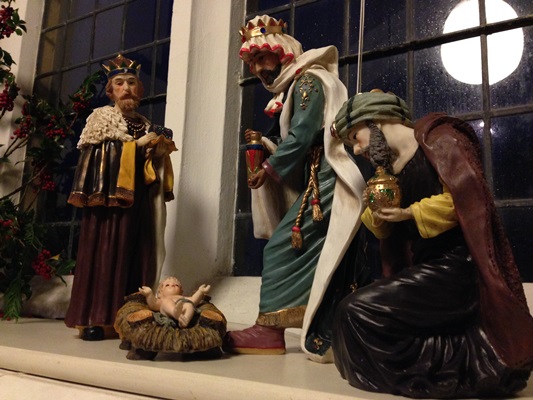
Some people called them wise men…but I’m not so sure they were very wise to consider going on such a journey …at least not at the start. Others call them kings… In fact only one of them was a king and his name was Balthazar. He was a very kind king and looked after his wives and servants very well. His life was extremely comfortable, because he could afford to buy anything he wanted. The trouble was he had bought everything that he wanted and now he was bored!

He was also very intelligent and liked to try and find out everything about the world around him. He read loads of books and his favourite subject was history. However, he was not as clever as his best friend Melchior, who was indeed a wise man. Melchior, was also very rich and so he could spend all of his time studying the stars. That is he looked up at them at night and watched them as they moved across the sky, and during the day when the sun hid the stars he plotted their movements on his charts. Whenever Balthazar went to visit his friend he had to try and find him behind a mountain of papyrus rolls

Also living in the city was another man called Caspar, who was also a friend of the king. He was a man who thought a lot about the world – about how it was created; about who created it; about why it was created; about why he had been created! He had read all of the ancient scriptures of lots of different faiths and had come to the conclusion that there must have been a very powerful God who had done all of these things

One day Melchior, rushed into the palace when Caspar was visiting Balthazar. He was very excited and told them both to come and see what he had discovered. He spread out a large chart on the table in front of them and pointed to a small object that was separate from all of the other stars.

“I noticed it the other night…I’m sure it wasn’t there the night before! Come and see it for yourselves.

They all went back to Melchior’s house and waited…..and waited….and waited. Actually they had to wait for quite some time as it had been lunch time when Melchior had rushed to the palace and the sun needed to set before the stars would be visible…

Eventually though, when the night was very dark, they saw an incredible sight…. on the skyline a bright light was shining… it was brighter than all the other stars and seemed to twinkle and sparkle as if it was waiting for them to make a decision.

“I think I know what this means,” said Caspar, “I read about a star appearing in the sky when God wants to send a message to the world”

Balthazar and Melchior wondered how a star was going to tell them a message. Stars can’t talk after all.  But they did notice that the way the star hovered over them it seemed to be saying ‘Follow me’ before it disappeared as the sun rose. Over the next few days they kept on seeing the star and each night it seemed to flicker more brightly and urgently.

Eventually they came to a decision. Caspar had reread one of the ancient books and declared that the stars appearance was because a very, very special person had been born…a prince or a king!

Melchior said that the star was moving very slowly westward, so perhaps that was where it had happened. Balthazar just thought it was the chance for a great adventure and began making plans for a journey…. and because he wasn’t sure how long that journey was going to be he packed lots of things, including gifts for whoever they were going to meet…after all it’s only polite to take a present when you go visiting.

The three men travelled for many months and days through the desert. They tended to sleep during the day when the sun was at its hottest and then set out again as the sun set and the stars began to appear; and every night the brightest star in the sky seemed to lead them onward into new lands, never stopping. Even when it was a cloudy night the light seems to glow through the clouds so that they could see where it was.

Then one day they were sleeping in their tents when some men entered their camp. They told Balthazar, Melchior and Caspar that they were King Herod’s guards and that their master would like to welcome them to his country, so they were escorted to the palace of King Herod

Now King Herod wasn’t a very nice king. He was greedy and cruel and extremely jealous of anyone who threatened his power. None of his own people were ever allowed to see him. Only the important people were allowed into his palace. So we’ve got to stay outside…

…However, Balthazar, Melchior and Caspar were allowed in. King Herod seemed very friendly to his three visitors. Apparently he asked them lots of questions about their journey, about how they had got there and where they were going. Melchior, who was very excited about how the star had led them on their journey, told Herod about his discovery and Caspar tried to explain that they were looking for a very important person, possibly a new king… Balthazar just felt uneasy.

After a while, despite all the splendour and luxury of the palace, the three men thought it would be wise to continue on their way. Especially as the star had moved on – and they had to spend three or four nights travelling very swiftly to catch up with it. King Herod had made them promise to let him know when they found the new king, so that he could come to welcome him. Balthazar thought that was one promise he really didn’t want to keep, and had kept his fingers crossed behind his back when he said they would!

After a few more days they approached the town of Bethlehem. They were only expecting to top up their food supplies and allow their camels some rest, as the city was not very grand – there were no majestic palaces, or magnificent houses within its walls; only ordinary houses, in ordinary streets. Yet the star seems to be hovering right over the town, as if it had come to a stop.

As they made their way through the twisting and winding streets, they kept asking themselves was this the place? Surely not! Yet the star was right there in the sky above them and was shedding its light onto a particularly small, very plain looking house. The three men stood in front of the wooden door

“You knock,” said Caspar

“No, you knock,” replied Melchior

“Oh for goodness sake, I’ll knock,” sighed Balthazar, as he rapped very smartly on the door. At the sound of the knock, a woman’s voice from within the house bid them to come in and so they entered the house.

At first it seemed very gloomy, then they made out a young woman sitting on a stool, with a child on her knee. Maybe it was the light from the star, or maybe it was the candle but the room seemed to glow with light and all three men fell down on their knees as they felt the presence of someone very special. It may not have been a palace, there may not have been hundreds of servants or furniture of gold and silver, but there was definitely someone royal there – a future king.

Balthazar then remembered the presents that they had brought and he laid down his gift of gold – certainly fit for a king! Melchior had some frankincense, which would be useful if he turned out to be a great priest and teacher. When Caspar hesitantly laid his gift of myrrh in front of the cradle the others were a bit confused. Surely myrrh was used when people had died.

“He may need it later on,” explained Caspar

Mary, the child’s mother, just smiled and thanked them for their gifts.

“His name’s Jesus, and Joseph, my husband and I, are very grateful. He is truly a gift from God.”

The three men bowed again and each thought that they would remember this journey and this night and this child for a very long time. As they left they knew that were all leaving wiser than when they had arrived.

Oh, and by the way – they never did tell King Herod where they had found the child. Which was just a well, as Herod did turn out to be a very, very nasty man!

Wise Men Came Travelling

Wise Men Came Travelling

The visit of the Wise Men or Magi to the Holy Family is celebrated in the Church of England as Epiphany on Twelfth Night (6th January). An epiphany is a moment of sudden and great revelation, which the wise men experienced on seeing the Christ child. Despite their names not being recorded, some traditions believe they may all have been Eastern kings –  and of the three Balthazar is an alternate form of the Babylonian king Belshazzar, mentioned in the Book of Daniel.

As to whether there were only three of them, this may be an assumption from the fact that there were just three gifts mentioned in Matthew’s Gospel (Chapter 2:1-12); in the East, the Magi traditionally number twelve,

However many there were, they certainly didn’t arrive on the night of Jesus’ birth, as the family had relocated from a stable to a house (Matthew 2:11). It would also seem that only Mary was there at the time of the visit to her child, who was likely to have been several months old but no more than two years old (Matthew 2:16)

And the star that they followed? Now known as the Star of Bethlehem or the Christmas star, and which astronomers throughout the ages have attempted to link to unusual astronomical events, such as a conjunction of Jupiter and Saturn, a comet or a supernova. Whatever it was it led them to the correct place.

May Christ’s love be revealed in and through you this Christmastide!

Go back

Your message has been sent

Warning
Warning
Warning
Warning

Warning.

It’s Called Christmas For A Reason – The Shepherd’s Story

A Thousand Angels

A Thousand, Thousand Angels

Jonathan shivered and pulled the camel hair aba more tightly around his shoulders. It was still fairly mild for the time of year, but he knew that these clear skies would soon bring bitter, frosty nights. Tonight though, the stars seemed to be vying to outshine each other as they twinkled brightly overhead and the moon, a silver crescent, hung low in the sky westward.

They had been gradually leading the sheep down from the hills into the valley’s pasture, and the limestone cliffs at their back were providing some welcome relief from the dusty winds that had been blowing hard. He was grateful in some ways that the size of the flock meant that they could not all be gathered into the sheepfold around the Migdal Edar* but had instead been allowed to graze the cleared harvest fields; nibbling a few remnants that the gleaners had missed.

Anyway, he didn’t really like going into the town; they were forbidden from going into the synagogue and the people in the streets stared at them and often moved aside as if they were unclean – like lepers! No doubt they did smell a bit, but who wouldn’t after being surrounded by sheep all day. But it was more than that – they wanted to keep him out of God’s house, but he was pretty certain that God heard his prayers anyway.

Still, the town looked very peaceful and it’s residents no doubt dreaming as they slept in their comfortable beds. He looked over at his younger brother Caleb, laid on his back with his eyes closed, gently snoring… some shepherd he was at keeping watch! Yet he knew that at the first sign of danger he’d be up and ready to use his sling to defend the sheep. He’d let him sleep for a while longer as it had been a hard couple of days for his new apprentice.

Jonathan shifted his body slightly to look down the hill. It was uncomfortable sitting on the hard ground; maybe he’d take a stroll in a minute to talk to some of the other shepherds he could see sitting in small groups. He was just about to rise when the whole world disappeared – his eyes were open but a blinding flash had taken away his night vision. Then a clear melodic voice spoke somewhere above his head telling him not to be afraid. Without seeing him, he could feel Caleb clutching his arm.

The voice continued to speak, and by shielding his eyes he could just make out the hazy shape of a man surrounded by a halo of light, who seemed to be hovering above the field. The few words he caught were of ‘good news’ and of ‘a Saviour being born in David’s town’…… Bethlehem!  After he had spoken, the angel, for Jonathan was certain that’s who the figure was, appeared to expand, but then he realised that he had been joined by a whole host and that the entire sky was lit up as if it was daylight. Their ethereal song was full of praise and glory to God; of peace and goodwill.

As the last heavenly notes faded into the air, Jonathan realised that dawn was breaking and he got up and hurried with Caleb over to the other shepherds who were equally amazed. Wordlessly, they all made their way into the town, a few of the sheep and lambs bleating as they followed their shepherds. Without obvious direction, they found the open door of what appeared to be an animal enclosure, from which the faint glow of an oil lamp could be seen.

Looking inside they could see two people bending over what appeared to be a hay manger. The man looked up, slightly startled; then beckoned them to enter. Humbly, they made their way in and in the makeshift crib, Jonathan could see a baby wrapped in swaddling clothes, he gazed down at the child, still speechless. Meanwhile Caleb had squirmed his way through to the front and now put his hand out to touch the baby. Jonathan went to stop him, but the child’s mother nodded and smiled, and the infant reached out to grasp Caleb’s proffered finger.

The older shepherds began to tell the story of what had happened in the fields and why they had come. The man seemed to think it incredulous, but the baby’s mother, perhaps already aware of how special this child was, listened to all they had to say and pondered their words.

Afterwards, Jonathan and the others made their way back to their temporarily abandoned flocks, but what to do with the news of all that had happened that night? Who could they tell and who would believe them? Certainly not the rabbis or synagogue leaders. He, stood still for a moment to think, ‘We may be the despised guardians of the Pascal lambs but maybe we have just seen a new kind of shepherd who will lead us beyond the Temple sacrifices – a true shepherd of the sheep’

Then he turned  and ran to catch up with Caleb, who was already striding across the field. Right now these sheep needed him, and as he called out to them they answered with baas and mehs as they recognised his voice.

Agnus Dei (Lamb of God) by  Francisco de Zurbaran

Agnus Dei (Lamb of God) by Francisco de Zurbaran (1598-1664)

While shepherds watched their flocks by night, all seated on the ground; the angel of the Lord came down, and glory shone around. “Fear not!” said he, for mighty dread had seized their troubled minds, “Glad tidings of great joy I bring to all of humankind. To you, in David’s town, this day is born of David’s line a Saviour, who is Christ the Lord, and this shall be the sign. The heavenly babe you there shall find to human view displayed, all meanly wrapped in swathing bands, and in a manger laid.” Thus spake the seraph and forthwith appeared a shining throng of angels praising God on high, who thus addressed their song, “All glory be to God on high, and to the earth be peace; goodwill henceforth from heaven to earth begin and never cease!” Nahum Tate (1652-1715) based on Luke 2:8-14

Share the Good News!

*Migdal Edar literally means ‘Tower of Eder’ or ‘Tower of the Flock’ in Hebrew. Biblical records locate it near to the present day city of Bethlehem. It is mentioned in Genesis 35:21 and scholars interpret a passage in Micah 4:8 as a prophecy indicating that the Messiah would be revealed from the ‘tower of the flock’

Go back

Your message has been sent

Warning
Warning
Warning
Warning

Warning.