Tag Archives: God

It’s Called Christmas For A Reason – Mary’s Story

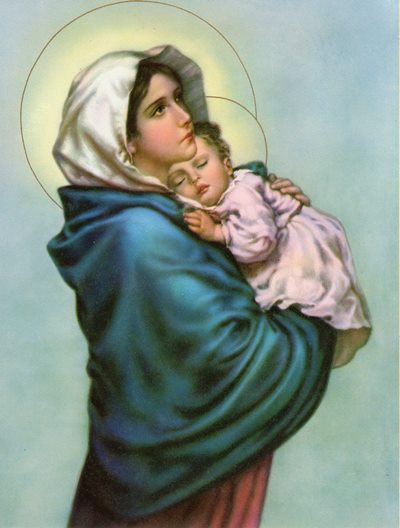
Mary and Child

Mary and Child

The day had been long and arduous, whether walking slowly along the dusty, gritty road or bumping along on the ass’ back; each step jolting the baby she carried inside her, as she gripped tightly onto the beast’s mane.

The town had looked such a welcome relief as they’d approached it, but it had soon become evident as they pushed and jostled their way through the narrow streets that they had arrived too late to find the comfortable guest house with its cool whitewashed walls and decent bed on which to rest.

Instead, “No vacancies, we’re full up!”

She had tried to smile as her husband looked apologetic, but he was determined to find them somewhere to stay. The last place they tried looked less appealing, a little shabby, but by then they were desperate; the baby was stirring inside her. The owner, must have sensed their anxiety as he led them down to the only room he had for them….among the animal stalls! Still there was plenty of clean straw and hay, and when her husband lit the oil lamp its glow had seemed to bring a tiny feeling of warmth to the room.

As darkness fell, she had tried to get some sleep, but it seemed to elude her tonight. She lay listening to the snuffling and soft breathing of the animals; a shaft of moonlight fell onto the earthen floor through a chink in the roof, and tiny motes of dust made it seem alive in the otherwise still air – there was a feeling of expectancy, not least from the child that moved more urgently in her womb. Through the open door she could see what seemed a million stars in the heavens, under which the rest of the world slept in deep oblivion of the future.

She felt the first sharp pain, but waited to wake her sleeping husband until she knew the birth rhythms were regularly and imminent. “The baby’s coming…”

Afterwards, as she wrapped the child in the swaddling cloths she had brought with them, she gazed down at him, cradled in her arms, and felt such an overwhelming sensation of love, that it made her whole body tingle, dissipating completely the few lingering pains of childbirth. She looked up to her husband, wondering what his thoughts were now that the child was here, but she saw only love and an unconditional acceptance, that here was a son; whom he would nurture and raise as best he could, A carpenter’s son or maybe he would choose another calling?

The baby, now content with a breastful of milk, lay quietly. He too held his mother regard as she scrutinized her perfect new-born infant and as their eyes met, she gasped slightly as she glimpsed briefly within them an ancient wisdom that spoke of creation and new worlds. Rocking him gently, she sang a lullaby “Let all creation join my song, for peace and love are born…” which stilled not only her own mind but that of the creatures around her.

“A virgin will have a baby boy, and he will be called Emmanuel,” which means “God is with us.” Matthew 1:23

Outside, Bethlehem and the rest of the world was beginning to awake as the dawn broke. As she laid him in a manger of sweet smelling hay she spent a while pondering the future, wanting this hushed moment of peace to last for ever, but somehow knowing that it would not last…

… at least not in her or perhaps her son’s lifetime. Maybe eventually though it just might….

Bethlehem Wall Graffiti by Pawel Rzyzawa

Bethlehem Wall Graffiti by Pawel Rzyzawa

With every blessing for peace this Christmas!

Go back

Your message has been sent

Warning
Warning
Warning
Warning

Warning.

“Let all creation join my song, for peace and love are born” are lyrics from ‘Mary’s Lullaby’ by Jan Underwood Pinborough

Madiba – A Light For The World

African Trinity

African Trinity

Nelson Mandela 1918 – 2013

This small tribute that I wish to pay to Nelson Mandela will without doubt be just one amongst millions. Unlike the news of his passing it will probably only reach a handful of people; but somehow a man that few of us have met or claim to have known personally, except through the media, became part of our lives and his loss means we are the poorer for it.

His is a rare breed, a true child of God, whose faith was the bedrock on which he based his life. Who saw ways of dealing with the world, not with hatred and a desire to extract maximum retribution for the events in his life, but who took love and made it the measure by which he weighed up his actions both on the personal and political stage.

He undoubtedly prevented a bloody civil war from breaking out in South Africa in the 1990’s with his message of truth and reconciliation, which paved the way for a far-reaching constitution that dismantled apartheid and guaranteed freedom for all; regardless of whether your skin was black or white or any hue in between. He valued the person not the persona; the genuine not the gender; the true of heart not the heartless.

The journey of a thousand miles must begin with a small step.” —Chinese Proverb.

As his book title ‘Long Walk to Freedom‘ suggests, his journey was long and arduous at times. The fact that he continued to do all he could to bring about freedom for the people of South Africa, even whilst imprisoned for many years, shows that his vision was not diminished and his first step back into the outside world turned that walk into a joyful race in which the prize was not only won for Africa, but for the whole world.

You know that many runners enter a race, and only one of them wins the prize. So run to win!
1 Corinthians 9:24

We are called to be lights to the world, and with the passing of Nelson Mandela many may say that a light has gone and the world is a darker place for it. I believe that his light has ignited a flame that will shine in the lives of millions of people now and for eternity. God speed Madiba and rest now in glory.

Go back

Your message has been sent

Warning
Warning
Warning
Warning

Warning.

A Bible Is For Life, Not Just For Sundays?

Read the bible in whatever way possible

Read the bible in whatever way possible

At church recently we took the opportunity to think about the place that God’s word, in the form of the bible, takes in our worship and daily lives. Appropriately, it was on Bible Sunday*

It would be silly to ask you to put your hands up or answer out loud, but I’d like you to think what your answers might be to these questions…

I read the bible……

I read the bible every day……

I read the bible every day and then reflect on what I have read…

I read the bible every day and then reflect on what on what I have read and then try to apply it to my life…

The questions are not intended to be accusatory …. that you really should choose the last one in order to be deemed ‘saintly’. The most important thing is whether you actually read the bible!

At college we may not be required to bring our bibles to each lesson or lecture, where we talk about theology, liturgy and formation, but what has become obvious is just how vital Holy Scripture is to our faith. I don’t mean learning huge chunks of it off by heart or being able to recite whole gospels from memory, although it would be handy knowing exactly who said what, where and when sometimes… No, I mean looking to the bible to provide some guidance and answers to the many questions we have, not only about our faith, but about life in general. In the Book, or books to be more precise, lie all those answers. The problem so often is how we understand or interpret them – whether we accept them as instructions or guidance only.

Some people like to look up passages which have been selected as being particularly helpful for the different emotions we may be experiencing. When we’re worried, it might be calming to read, “Therefore I tell you, do not be anxious about your life” or when facing bereavement to be comforted by “Blessed are those who mourn, for they shall be comforted”, both from Matthew’s gospel or when showing gratitude and thanksgiving to proclaim from the psalms “Let us come before him with thanksgiving.”

Even here though we have to be careful that this is not the only way we experience and use God’s word. There is always the danger that these become our preferred readings, to the exclusion of other, perhaps more difficult passages… and are they simply sentences in isolation whereas the whole verse or chapter may actually have more to tell us?

We also have to be aware of bias. So often nowadays we hear people asserting that their stand on different issues is fully justified because of specific passages in the bible. They trot out verse after verse of carefully selected scripture and vehemently declare this is the truth of the matter because it’s written in the bible and that the bible is the Word of God and you don’t argue with God!

All the while they either consciously or unconsciously blatantly ignore other scripture that might contradict their point of view… just think back to how the ordination of women was debated in the Church or how homosexuality is viewed in general. Surely these contradictory passages too are written in the bible and inarguably the Word of God?

What is does show is that it certainly isn’t easy. This book is not really a teaching manual – but it still does contain all the answers. Whenever we think or talk about God we are allowed to do so using all of our previous knowledge and information, but very much aware of the context in which we do so. What have been our examples, our own life experiences? What have we absorbed though our families, our education, our culture? All of these will give us a unique and corporate vision of what God is about, how he moves in our lives and how he moves us to be in his world. Yet we can’t truly be so individualistic without referring it back to and centring on the Scriptures.

Some people might nowadays treat as laughable the simplistic motto from the 80’s and 90’s of WWJD – What Would Jesus Do, but the basic premise makes perfect sense. When we find ourselves in situations where we have to make decisions it might not be a bad thing to simply ask… if I am trying to be more Christlike in my attitude and behaviour then I really need to understand what examples Jesus has given us… and where do I find that out… in the pages of the Bible.

Whether we’re reading about what Jesus was doing or where he was pointing us to what God was doing through him, fulfilling the prophecies; embodying the word that had gone forth or bringing us hope for the future, if we want to get the truest picture, not just some intellectual theologian’s take on it or an experienced commentator’s exegesis or the humble preacher’s attempt at exposition, then we have to go back to the source.

All those other things are subjective and come with lots of layers of opinion and interpretation. Not that I am saying that any or all of them are incorrect, but we need to peel back those layers and expose the heart of the matter, whether you believe it is the word of God to inspire or the inspired word of  God.  “For whatever was written in former days was written for our instruction, so that by steadfastness and by the encouragement of the scriptures we might have hope.Romans 15:4

'Go back to the source'

‘Go back to the source’

My original question emphasised the fact that the bible is a book that needs to be read. We need to make sure it’s not sitting as a pristine but dusty tome in our bookcases, but that it’s placed where it can naturally come to hand. Why not see it as your bedside table book, full of ripping yarns and adventures. Or put it with your dog-eared and food-specked cook books – using it to create delicious recipes for life or maybe in the glove compartment of your car – a combined road atlas and ‘Haynes’ manual to keep you going straight on the journey?

Wherever you keep it don’t forget that unlike a library book there’s no restriction on who could borrow it, it doesn’t have a return by date and each and every copy, whether it’s an original or translation will only ever be a first edition. Happy reading!

Go back

Your message has been sent

Warning
Warning
Warning
Warning

Warning.

*Bible Sunday was celebrated on Sunday 23rd October 2013. It is an annual part of the Church of England’s calendar and resources each year are produced by the Bible Society. Follow this link for more information http://www.biblesociety.org.uk/about-bible-society/our-work/bible-sunday/

Oh For A Quiet Day!

Psalm 46:10

Psalm 46:10

Most of us long for a few moments of quiet in our lives, when the constant noisy demands of work and family fade away into the background and we can fall into silence; silence that may last for a few minutes or a few hours if we are lucky; silence in which we can hear ourselves think.

This might not be at a time we choose; it might just be a few snatched moments. It might not even be a true silence, as our thoughts whirr and chatter away in our head still. So what might it be like to voluntarily place ourselves into silence for a longer period of time – say a whole day – the whole 24 hours?

For some that could be scary and unsettling. What are we not going to say? Who are we not going to talk to? Why would we want to spend a whole day with our own thoughts?

Last week the college at Cuddesdon ran a quiet day, which was a day to momentarily put aside our studies, and spend time in rest and reflection, under the guidance of the college chaplain, Father Raymond Tomkinson. For some this was a very new unknown experience, for others a real chance to take time to recharge the batteries. No doubt all who took part got a lot out of having a day like this in many different ways, and these are just my reflections on some of the inputs that we were given to consider

Falling into silence

David J Evans’ hymn ‘Be Still For The Presence of the Lord’ contains the lines “How awesome is the sight – our radiant King of light!”. As a writer, I am always searching for just the right words to describe things, but the awesomeness of God somehow eventually leaves us clutching a redundant thesaurus and we can do nothing but lapse into silence thereby allowing ourselves to be fully in the presence of God

Listening with our hearts

Without living in a complete vacuum, it is almost impossible to place yourself in complete and utter silence. Yet by slowing and becoming aware of our breathing; by acknowledging the sounds that still intrude – the click of a door shutting, the rhythmic ticking of a clock, the muted sounds outside our windows – and putting them to one side, we can concentrate on allowing ourselves to listen with our hearts.

Incline your ear, and hear the words of the wise,
    and apply your heart to my knowledge,
                                                      Proverbs 22:17

Where God is concerned, our hearts and not our minds are to be the centre of our listening.

With sighs too deep for words

For we do not know how to pray as we ought,
but that very Spirit intercedes with sighs too deep for words.
Romans 8:26

If a picture paints a thousand words, then a sigh ‘speaks’ more words than are contained in God’s Encylopædia Cosmou! We do not always have to approach God with words, and it may not be through words that God speaks to us. He knows what is on our hearts and minds, he is aware of what we long for and he will provide answers for us. I cannot say what shape or form those answers might take, but I do know that any time spent getting to know God a little bit more, just as he knows you, can only be worthwhile.

Perhaps twenty four hours is a luxury that some of us cannot manage to set aside, but I would urge everyone to just try and break away from their busy lives to make more time for silence – and if you think you’ve never spent any reasonable amount of time in silence, as Father Raymond pointed out, you spent the first nine months of your existence in relative silence, being formed and created to then come kicking and screaming into the world!

~~~~~~~~~~

As a post script to this blog – what does a silent community do when the fire alarm goes off whilst you are at breakfast? it would appear that you sit quite still for a time, looking at each other and wondering if it actually is a fire alarm. Then when the bell doesn’t stop, you all very calmly pick up the important things to hand that you wish to save from the imagined inferno – namely your cup of tea or piece of toast and calmly leave the building in complete silence by the nearest exit, gathering in a light drizzle outside (without your coat obviously!) and hoping that by the time you are let back in that your sausages and egg won’t have gone too cold. Maybe someone could keep an eye on the toaster timer next time?

Go back

Your message has been sent

Warning
Warning
Warning
Warning

Warning.

It’s All Greek To Me!

It's All Greek To Me

It’s All Greek To Me

So apart from introducing the world to democracy, realising that the earth was round and working out some very difficult mathematical calculations… what have the Greeks ever done for us? Well one thing that they’ve done is give me a headache! What shame they didn’t invent analgesics (although they did give us its name from the Greek words ‘without+pain’

Languages can be fascinating – discovering that our everyday words have their origins in Latin, French or Anglo-Saxon with a smattering of Viking thrown in for good measure. The roots of words give us a hint of what they might mean in hundreds of languages

Most modern languages use the classical Latin or Roman alphabet with its 26 letters. So what happens when the letters themselves are unrecognisable? Now I’m not so naive to forget that there are a great many other languages that use scripts and hieroglyphics to enable billions of people to happily produce both beautiful and outstanding literature

This is what the Lord, the God of Israel, says: “Write in a book all the words I have spoken to you” Jeremiah 30:2

It’s possible that Jesus would have spoken and understood Aramaic and read Hebrew scripts – if not understanding a smattering of Latin and Greek. However, it is the Greek that is of interest to me as we undertake a Greek-lite course at college

First there is the basic alphabet with only 24 letters (25 if you double up on the ‘s’ sound). At first it lulls you into a sense of security as you recognise letters that seem familiar…. then you find out out that they say something different! A capital H (eta) says ‘ay’ and P (rho) becomes an R sound. Then there are the impressive squiggles that send your pen backwards and forwards in unnatural directions –

The Greek Letter xi

The Greek Letter xi

I do get the point that some words are masculine and some are feminine… and that just like French there’s no rhyme or reason as to which should be which – but then there’s also 2nd Masculine Declensions and definitive articles….and this is only in the 3rd lesson!

So why subject myself to such apparent torture? Well you have to remember that the Greek speaking world was a hotbed of philosophy and classical thinking and when St Paul chose to take his message to the Gentiles it was into this world that he made such inroads in spreading the Gospel – to the people’s of Corinth, Phillippi and Thessalonica amongst others; and Luke’s Gospel and Acts were almost certainly written with a Greek audience in mind

How wonderful then to make at least a small attempt to read some of the bible in an original language….. And the passage we are starting with – what else but John 1:1

John 1:1

John 1:1

Go back

Your message has been sent

Warning
Warning
Warning
Warning

Warning.

Sacred Space

Bishop Edward King Chapel, Cuddesdon

Bishop Edward King Chapel, Cuddesdon

In my experience, there are often places that you come across that give you an inexplicable sense of holiness. Whether it is on a wind-swept hermit’s island off of Lindisfarne or a grandiose cathedral with its intricate arches and gilded altars. These are places that faithful people over many years have gathered and worshipped in. These are sacred spaces.

Often these places resonate with something deep within our souls. The Celtic people would have identified them as ‘thin places’ – where you could imagine the thinnest of veils between heaven and earth. Where connections could be felt most keenly between God and his people

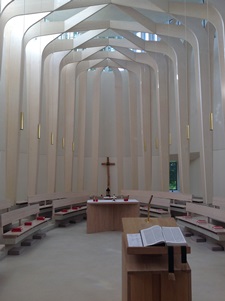
During my recent ‘Worship Weekend’ at Cuddesdon, when we learnt amongst other things about worship, liturgy and church paraphernalia, our worship itself was held in the Bishop Edward King Chapel. This building is new. Its footfall so far light in numbers, its interior still pristine and its audacious appearance still startling on entry. Yet it feels immediately like a sacred place

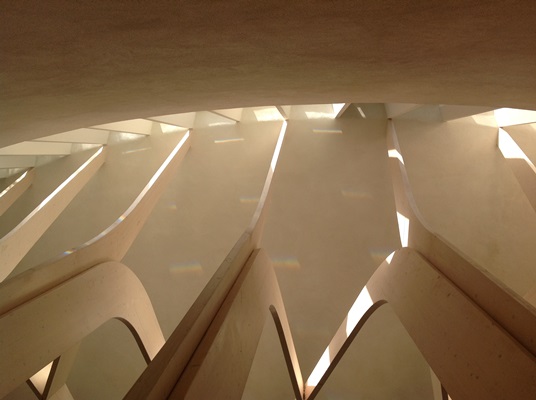
The Chapel Interior, BEK Chapel,Cuddesdon

The Chapel Interior

The architect of this incredible building, Niall McLaughlin, talks about creating something from an image of a buoyant, tethered boat, with its elliptical shape resembling the nave of a boat with “Jesus asleep resting on a cushion in the prow… and the community gathering within mirroring the expectant disciples’ or of ‘ people collecting together around a hollow in ground [there is a natural hollow on the site of the chapel] ‘This hollow would represent the still place of origin. The tethered boat above would float above it, pulling up as if at sea…. you are drawn upwards yet your feet pull down to ground you. It is this dual motion of cleaving to the earth and being lifted that we want the building to communicate.”

Exterior View of the Chapel

Exterior View of the Chapel

And communicate it did… celebrating Communion, as rainbow patterns chase each other across the nave floor and flickering sunlight bounces off the walls, as the trees that surround the chapel move in rhythm of hymns and breeze, leaves you feeling that God is not only filling this space with his presence, but that the space the building occupies has become part of his creation

The Natural Lights of the Chapel

The Natural Lights of the Chapel

“As the priests were leaving the Temple, it was suddenly filled with a cloud shining with the dazzling light of the Lord’s presence” 2 Chronicles 5:13-14

Hopefully, the pictures give you some sense of the college and architect’s vision, but if you do every get a chance to visit maybe you will discover it for yourself

God cannot be contained in one place….. but containers can be a place to meet him!

The Chapel's Soaring Beams

The Chapel’s Soaring Beams

Go back

Your message has been sent

Warning
Warning
Warning
Warning

Warning.

Follow this link to find out more about the Bishop Edward King Chapel and the vision behind it http://www.rcc.ac.uk/downloads/Edward%20King%20Chapel%20Description.pdf

A Place to Study!

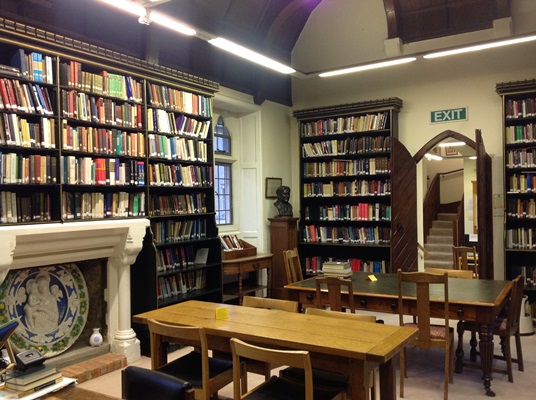
Cuddesdon Library

Cuddesdon Library

‘But as for you, continue in what you have learned and have become convinced of, because you know those from whom you learned it, and how from infancy you have known the Holy Scriptures, which are able to make you wise for salvation through faith in Christ Jesus.  All Scripture is God-breathed and is useful for teaching, rebuking, correcting and training in righteousness, so that the servant of God may be thoroughly equipped for every good work.’ 2Timothy 3:14-17

I LOVE LIBRARIES!… Shh….. Sorry, I think I said that a bit loud! I’ve mentioned before about how much I love books – so a room (or rooms) that are stacked from floor to ceiling with them is equally as exciting. There’s that unique smell of printed paper and leather; the burnished gold lettering on some of the oldest books and the fact that the books on the top shelves, whose titles you can’t quite make out, could be reached by climbing up the librarian’s special step ladder!

A cosy study corner

A cosy study corner

Added to all that is the fact that I get to set up my own little workspace right there in the room itself – I have officially died and gone to bibliotheque heaven!

Knowing that I simply have to walk over and pick the book I need off of the shelf makes studying so much easier – it’s all there at my fingertips, although to be honest it wasn’t that easy the first time……I went in, clutching my list of suggested books and tried to find out where they might be.  I was quite familiar with the Dewey system that most libraries use, but then this system covers vast ranges of topics.

Here, it is more specialised – broken down into various religious and theological categories. Each of these categories is labelled A-Z and then further broken down into even more specific grouping before being alphabetised by author. No wonder I was confused. Added to that is the fact that Cuddesdon library is also not just in one room, or indeed several rooms, but is also on various levels – involving walking along corridors and climbing different flights of stairs!

Cuddesdon library skylight

Cuddesdon library skylight

But when you got this as one of the skylights it doesn’t seem such a problem!

Thank goodness for the librarian whose kindness and patience got me started and pointed in the right direction, because no doubt in the future this will become a haven into which I can tuck myself away as essay deadlines loom.

What I am very much aware of is just how lucky I am to be in this situation and I certainly don’t want to take it for granted. There are many millions of children and adults around the world who not only don’t have access to libraries, but who don’t even have the facilities or the option to an education.

As Malala Yousafzai pointed out in her speech to the United Nations, books and pens are the most powerful weapons we can equip people with, they are the basic tools of education that can begin to eradicate poverty and provide opportunities for better job prospects and life goals.

Perhaps I will do well to remember that, especially when I’m feeling a little stressed and anxious about how I’m doing, and instead look to the fact that part of what my training will be about doing whatever is in my power to seek relative fairness and social justice for those in need. Therefore, when I stop for a moment and glance out of the window it will be a good reminder not to be complacent, because there’s a whole other world out there beyond the tranquil fields, hungry for knowledge and education as well

Tranquil views from Cuddesdon library

Tranquil views from Cuddesdon library

Go back

Your message has been sent

Warning
Warning
Warning
Warning

Warning.


Pearls of Wisdom

Pearls of Wisdom

Pearls of Wisdom

During my recent course on Leading God’s People Today (LGPT) we had the opportunity to create an Open Space in which a question of our choice could be asked by two or three of us, who then proceeded to set up ‘market-stalls’ in different venues, where the only thing on offer was the question and a request for thoughts or answers. The other participants could then choose to come and browse your ‘stall’ for a long or as short a time as they wished, drift off to another stall and return again if they wanted

I felt this was too good an opportunity to miss! Here were about a dozen ‘leaders’ of various types. Some with vast knowledge in their particular field, some who were still learning as they went along and others with lots of concrete life experiences. The majority of them were clergy with a sprinkling of lay people thrown into the mix.

My question?…… What advice would you give to a new Ordinand? Subtext – Spill the beans on all of those things that your training establishment might neglect to tell you

Their answers turned out to be not unsurprisingly good and honest. In fact they were not only valid points for a clergy person but could also be useful to anyone whose life involves meeting, caring for and engaging with other people. I share them with you here:

On finding one pearl of great value, he went and sold all that he had and bought it’ Matthew 13:46

Value Friendships – Remember friendship like any other relationships needs time and effort on both sides. Hold on to those who have travelled longest with you, don’t leave them out of your lives even though your job may mean that you are having to meet lots of new people. There will probably be many who will want to know you simply because of your position; some of them will turn out to be true friends others pastoral  acquaintances.

Take care of yourself – You’re of no use to anyone else if you end up being the one who needs looking after. Give yourself time off and don’t feel guilty. If you’re feeling stressed recognise that it’s time you found a safety valve in order to let off steam. Find a hobby that’s completely away from your line of work – collect orchids, take up tap dancing, play online computer games with the pseudonym Daft Vacar

You’re in it for the long haul – Things may be new and exciting at first and you might be buzzing with ideas, but you have to pace yourself. You are not going to change the world overnight or the choir’s penchant for repeatedly singing the Wesley brothers 18th century top twenty hits. These things take time… make the most of making memories for the future.

However – Be aware that change is inevitable – You may think after a few years that you’ve got it just right and it will be all plain sailing from now on; but there’s no time for complacency. You only have to look back over the last ten years and realise how much things have already changed, not only in your life but in the world around you. So be flexible and accepting of change – it might not be as bad as you or those around you think

You won’t get it right all the time – so be prepared to admit it was all your fault and ask for forgiveness. Sometimes it may be easier to take the blame anyway as this will allow things to move forward. Moreover, on those occasions where you so very clearly were right, suppress the urge to do a victory dance up and down the aisle shouting ‘Go me, go me!’* and instead be gracious and forgiving yourself. After all we all make mistakes!

Don’t forget to laugh a lot – We know that Jesus wept, and no doubt there will be plenty to be sorrowful about over the years. There are also bound to be days when you want to scream at the world to sort itself out. However, maintaining a sense of humour should be a priority. Laugh at the absurdity of life, laugh with your friends, laugh out loud – it really is still the best medicine. Be mindful though that not everyone is going to be appreciative of your sense of comedy – they may not laugh at your jokes…. or if they do it might be out of pity!

Remember to laugh a lot

Remember to laugh a lot

Some really valuable advice then to hold on to – genuine pearls of wisdom

*This apparently is particularly unhelpful during the Sunday morning Eucharist service

Go back

Your message has been sent

Warning
Warning
Warning
Warning

Warning.

Follow the Leader!

What Style of Leadership Do You Have?

What Style of Leadership Do You Have?

Over the last six months, I have taken part in a course entitled ‘Leading God’s People Today’ (LGPT). Over the ten sessions we worked on developing collaborative leadership skills, and learning all sorts of management techniques. A lot of these were not specifically for church leaders but could be thought of as tools that may be useful in our ministry.

As well as our personality types being revealed (one for a whole other blog!) we role-played group discussions using Appreciative Inquiry – ‘I have a problem’ …. Action Learning – ‘What you could do is’…. and Open Space – ‘Well, what do you think?’ …. all of which will be great when I get to chair PCC meetings!*

Now before you leave this ‘marketplace’ – sorry blog, thinking that you’ve stumbled on a Richard Branson type guide to ‘Running a Successful Business‘ let me share with you one other thing that I found particularly interesting.

Over thousands of years there has been much discussion about whether leaders are born or created. Consider the likes of Mahatma Ghandi and Nelson Mandela, born into humble beginnings yet rising to become two of the greatest leaders of the last century or Horatio Nelson and Winston Churchill, both from prosperous backgrounds, whose superb grasp of strategy and unconventional tactics saw them become inspirational leaders. What is clear is that all leaders have a particular style to their leadership

How then is a humble vicar-to-be to compete and what might be their leadership style? Well Keith Lamdin’s book, ‘Finding Your Leadership Style‘ breaks this down into six different styles which I have precised. Read through them and decide what YOUR style of leadership might be – then read my take on ‘How to Become a Great Leader’

  • The Monarch: His or her word is law and because they don’t have to waste time on consultation they are often able to get things done quickly with little fuss. People look up to them because of their desire to feel safe and protected, however they may also feel unable to challenge this type of leader
  • The Warrior: This type of leader frequently performs exceptional deeds. They have a deep desire to bring about changes in social welfare and are energised by charitable work. With charismatic personalities they lead by pursuing a clear direction and have a certain knowledge of what is right and wrong. Their devoted followers live by a simple mantra, but what happens if the leader turns out not to be right? Do they recognise their own flaws?
  • The Servant: Their belief is that humans function best when they are part of a community. They are good listeners and are skilled at identifying people’s needs. There is a great acceptance of others with whom they seek to empathise and build up a relationships. They do, however, need to be aware that people may try and take advantage of their loving nature
  • The Elder: One who is perceived to be wise; who will invite you to talk with them about what needs doing but will leave you to reflect and then make up your own mind. They place great importance on listening and their life experiences often enable them to discuss things as broadly as possible. Their leadership can be liberating to their followers but frustrating when clear, decisive direction is needed
  • The Contemplative: There is no attempt to overtly lead you, believing that it is God’s job to bring about the work of mission. They call on people to hold God in their heart’s, recognising that we are not necessarily called to be successful but to be faithful. Therefore, prayer is an important tool and they will encourage people to pray into situations. To some people though, this may look like a lack of initiative and purpose.
  • The Prophet: Their success as a leader is not measured by numbers, despite the modern obsession with numerical growth. They are closely in touch with local issues and take a prayerful and meditative approach, preferring to wait on God

So which style do you fit into? On a personal level which style do I fit into? What I do know is that ‘Great leaders rally people to a better future’ (Marcus Buckingham, ‘The One Thing You Need To Know‘) so here is my own guide to how to be a great leader

How to Be a Great Leader

Choose your team carefully. Having a team with a range of skills will give you more flexibility. It is important to check people’s availability; if they are able to come together fairly quickly then they will be able to bond together and identify themselves more easily as part of the team.

Get to know your team on a social as well as professional level, showing a interest in their home lives, perhaps visiting them or their relatives or attending conventional social occasions such as weddings and funerals. This will not only give you an insight as to what makes them tick but will show them that you are interested in them as whole people

Share your knowledge with your team: there are many ways this can be done and you should be aware of the different learning styles of the group, whether they are auditory, visual or kinaesthetic learners. Some will learn best through question and answer sessions; others by seeing you demonstrate these skills, and then having a go themselves. It is important for you to be able to assess their progress from time to time by setting them specific targets and providing opportunities for reflection afterwards.

You will soon find that one or more of your team will clearly show potential to take on more of a leadership role themselves. Build up their confidence with positive encouragement at the same time being prepared to provide a safe environment in which to allow them to make mistakes. Make it clear of your expectations for them as individuals, whilst being fair but firm about the standards you require

Eventually there will come a time when members of the team will decide to leave, perhaps after being head hunted for a new career; often it will be you. It would be good therefore that you prepare your team for this eventuality. You may have to deal with their feelings of fear, resentment and abandonment, as the team adjusts to your absence and reorganises itself. A testament of your leadership skills will be how the remaining members of the team pull together and go on to continue and expand the work you started.

Reunions can be tricky things as people will often have moved on emotionally. However these can be joyous occasions, seeing how people have changed and sharing fond memories. In years to come you may be proud to know that they still hold you in high regard and have remained true to the basic tenets that brought the team together in the first place. Surely the marks of a great leader!

Now I wonder…  just who might fulfil that description?

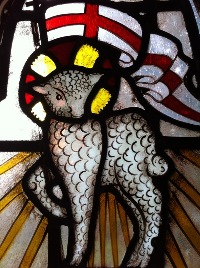
The Holy Lamb of God detail in stained glass window, St John the Evangelist, Hedge End

The Holy Lamb of God detail in stained glass window, St John the Evangelist, Hedge End

*PCC = Parochial Church Council meetings. These are notorious (although not in all instances I hasten to add) for being very long and micro-focused on the minutiae of church management such as whether custard cream biscuits are too extravagant for after church service refreshments – I kid you not!

Go back

Your message has been sent

Warning
Warning
Warning
Warning

Warning.

http://www.spckpublishing.co.uk/shop/finding-your-leadership-style/
http://www.goodreads.com/book/show/255520.The_One_Thing_You_Need_to_Know

We Need To Get Out More!

Break Out!

Do not be frightened or dismayed, for the Lord your God is with you wherever you go – Joshua 1:9

Talking to a bright, shiny new ordinand the other day*, I listened as he told me all the wonderful things he’d been up to over the summer break. He’d spent a couple of weeks overseas working with Youth for Christ…. He’d visited his prospective parish and been welcomed during the Sunday services…He’d spent a long weekend at Greenbelt taking part in many worship events and engaging with interesting discussion sessions …. he’d met regularly with his ‘cell’ group and his only regret was that he hadn’t been able to organise a trip to Taizé. Blimey I thought, you’ve managed to pack a lot into your ‘leisure’ time, but I wonder how much time he’d spent just being ‘ordinary’

“If you spend too long in prison you can become institutionalised, and it can be difficult to make that leap of faith over the wall to freedom. This applies to being caught up in church culture too”  Milton Jones ’10 Second Sermons’

Now this wasn’t meant to be a criticism, because dedicating your life to your faith is a noble and sacred thing, but our ministerial and social skills also need to be honed in the ‘real world’ as well. As Christians we can spend a lot of our time being reluctant and occasionally downright scared to talk about our faith with our ‘non-Christian’ friends and acquaintances for fear of being thought obsessive, fanatical and maybe even a little bit weird. We worry that we’ll suddenly become a pariah in the workplace or family.

Greenbelt 2013

Greenbelt 2013

So when opportunities come up to join together with like-minded people, we often jump at the chance to spend more and more time in their company. These are the type of people who will understand us, to whom we feel we can speak openly, whom we are sure will make us feel good.

Of course it’s vital that we do get together to learn and equip ourselves.  It’s great to build each other up by sharing knowledge and wisdom, as it helps us become more able to share that with others; people who may be unaware of what makes us tick or who may be beginning to search for meaning in their lives… or asking what is it all about. In addition we also need to engage more with those who appear to have no intention of listening to our ‘news’ however good we present it. We even need to be prepared to engage with outright hostility

The great thing is that all these engagements can often be achieved without the need for words or at least very few words. One of the turning points in my faith journey was the conscious decision to speak openly about my faith to whoever asked. Note the ‘asked’ not ‘I’ll slip the Jesus word in whether it’s appropriate or not’. Not simply to pontificate on the state of their souls,  but  to say that actually  last Sunday I was in church; to talk about the perceived  ‘absurd’  politics of church organisations; to let people know the underlying reasons why I think what I do

‘Preach the Gospel at all times and when necessary use words’ St Francis of Assisi

I’m pretty certain that I’ve never ‘converted’ anybody in my whole life…in fact I wouldn’t want to claim that at all. What I do hope I’ve done along the way is spoken honestly, acted compassionately and served humbly to enable others to catch a glimpse of why I believe what I believe and maybe then explore it for themselves – if not immediately then at some point in their lives.

Spending a lot of time practicing can make us an ‘expert’ in our subject, but it can also make us very one-dimensional. Of course I can choose to participate in lots of extra-curricular activities like roaring from the terraces of Twickenham, rocking at a Coldplay concert or simply going out for meals with ex-work colleagues. However, the simplest thing is to engage in ordinary conversation with whomever I happen to meet – about the weather; what they’re up to at the moment; what’s important to them right now. This exchange of information gives me an insight into other people’s lives and them an insight into mine

As part of bringing about God’s kingdom our task is to come alongside people – that is ALL people – not just that lovely group of fellow Christians who make us feel warm and fuzzy – but the ones who makes us feel prickly and uncomfortable too. Sometimes we just need to get out more!

*To my fellow trainees at Cuddesdon – he is not one of you!

Go back

Your message has been sent

Warning
Warning
Warning
Warning

Warning.