Tag Archives: Holy Spirit

Letting Go And Moving On

Butterfly transformation

Therefore, if anyone is in Christ, he is a new creation. The old has passed away; behold, the new has come. 2 Corinthians 5:17

The last few weeks have been a series of consciously starting to let go, as I, and many of my fellow final year ordinands, come to the end of our formal training. I suspect that this process has been happening over a much longer period, but our final weekend at college brought us together as we ‘prepared for ministry’.

As part of that we were asked to plan a creative act of worship, and under the leadership of Sue (Smith), we, that is Ruth (Peet), Jenny (Tebboth) and I, worked collaboratively to do just that. What we produced turned out to be a powerful release as we thought about how we were continuously being transformed. That enabled us to let go of those things that may still be causing us to worry, to hesitate, to hold us back; which we could lay down at the foot of the cross and then to commit ourselves to moving out toward our new or existing ministries.

We wanted to share some of the ideas that went into creating this service as they might be helpful to others who are also on this pathway or who may be in need of laying something down before moving on.

A weighty pebble to hold

A weighty pebble to hold

Gathering
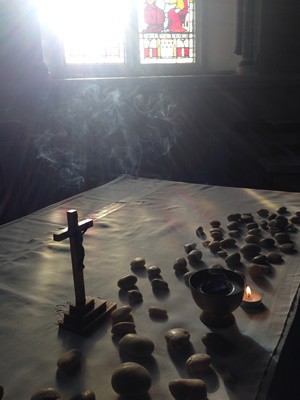
On entering the room we were each given a weighty pebble which we were asked to hold on to at all times if possible until later. These were to represent the worries and burdens that we might consciously or unconsciously be carrying with us at this time. By keeping hold of the pebble we became aware of their weight. Sue then introduced our service.


Transformation

Our training has been all about formation; however, over the last two or three years we can now see how our lives have also been transformed. Taking the example of the life cycle of the butterfly, we took a moment to think we are now in that process

For many people this proved to be a trigger to simply sit and consider just how far they had travelled and to realise that it would soon be time to emerge from the chrysalis – scary prospect but one that we didn’t do on our own, as the words of The Butterfly by Margaret Orford reminded us

My hands are warm to the butterfly
I am trying to set free.
Delicate, frail creature of beauty,
what can it know of me?
I am outside its comprehension.
It knows sunshine and showers,
darkness and the feel of flowers.
We do not ask it to do the impossible
and know Man.
So we with God,
who looks with tenderness on our frailty,
trying to guide us.
Trust him!
He knows the way and if we let him,
will open windows,
and cradling us gently in hands we cannot comprehend.
will lift us up and set us free.

These rocks have let go...

These rocks have let go…

Release
Ruth then led us in a meditation which culminated with us placing our pebbles around the foot of a cross.

(Holding our rock …) God is always leading us to new places on our journey through this life towards the kingdom, and sometimes that means letting go of people, places and things that are familiar to us. For some of us this experience is particularly acute right now.

We may be moving to a new home in a new community; we may be finding a new way of being in a familiar community; both these transitions mean letting go of an old way of being … and beginning a new journey, finding out who we are in a profoundly different role.

For all of us, as God calls us forward, inevitably there are people and places and things and aspects of life we need to let go. The rock we are holding represents all this. These rocks have let go of their original place, hewn by wind and rain, and buffeted by storms and sand and sea, they are all the more beautiful for that. And the new rock face revealed creates the potential for other unique and beautiful new creations.

The rocks are heavy, not necessarily because the things we need to let go are heavy, but because the knowledge that we need to let go and the act of doing so may weigh on us so heavily. We may have been carrying this weight for a while, and we have represented this by holding onto the rock this evening.

We follow in the footsteps of many: Abraham let go of his home and moved to a new land.The Jews left the familiarity of Egypt to journey through the desert. The apostles gave up their means of living to follow Jesus. Jesus … gave up life itself for us. Now … it’s our turn. Still holding the rock … let’s think now about the things we are letting go … think about all that has been good in them … all the experiences that have taught us and shaped us … and we thank God for them now ……

Now we focus on one aspect … it may be the thing that we have to let go that is weighing on us most heavily … and in it let us find something good … an experience, a lesson, or an act of kindness we can cherish and take with us … and let us thank God for that now ……

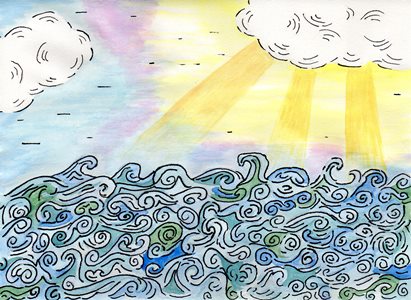
Looking at the rock, we can imagine it laying on a beach. Now we ask God to show us a new thing that he wishes to grow in us, when the warmth of his love hits us like the sun bursting through clouds onto the surface of the rock. May the tiny sparkles the sun reveals on the rocks surface, represent the beginnings of new joys for us in the service of God ……

Then, when you are ready, and only if you feel that you can … take your rock and let go of it at the foot of the cross as a sign that you are letting go of the past and moving on … not forgetting … remaining grateful for all that we have received … but simply giving it to God and letting it go ……

Jesus said … ‘Truly I tell you, there is no one who has left house or wife or brothers or parents or children, for the sake of the kingdom of God, who will not get back very much more in this age, and in the age to come eternal life.’ (Luke 18:29-30)

Moving Onwards
For many of us this was a significant moment as we realised that what was happening to us was very much real; but we were not left to dwell too long before the tension was broken by the song ‘Be who you were born to be’ by Bliss which encouraged us to look forward instead

Gotta jump off that cliff and be who you were born to be

Gotta jump off that cliff and be who you were born to be


Stepping out...

Stepping out…

Getting ready to step out
Just before we took those first steps to go out though we were encouraged by Jenny’s prayers:

Lord God, you are the one who makes all things new. Not discarding the past but redeeming it for a richer way forward. Thank-you for all we have been learning and for the way you have been forming us. Thank-you for this place and for the care and teaching we have received. We pray for the work and development of this college and for all the staff and students here

Lord in your mercy….hear our prayer

As we have released those things which we hold close but need to surrender we have empty hands to receive all that you will give. Help us to fix our eyes on Jesus the author and perfecter of our faith who we follow and whose Spirit is our companion and helper so that we can go forwards confident that the way ahead is known to you and that you will equip us for every work that you have prepared.

Lord in your mercy…hear our prayer

We pray for your Spirit of wisdom and revelation so that we may know you better. Enlighten our hearts to know the hope to which you have called us…. And help us to know your incomparably great power. Fill us with hope and expectation, faith and especially with your love for people we will meet and reveal to us where you are at work already so that we may work in tune with you.

Lord in your mercy…hear our prayer

We pray for those communities where we will be working…….. We pray for those who will be training us………. We pray for our families as they adjust with us to our new situation…… We commit ourselves to your unfailing love

Let us say the Lord’s Prayer together:

Our father in heaven hallowed be your name, your kingdom come your will be done on earth as in heaven. Give us today our daily bread; forgive us our sins as we forgive those who sin against us. Lead us not into temptation but deliver us from evil. For the kingdom, the power and the Glory are yours now and forever, Amen

shutterstock_85086514Stepping Out
And so we were now ready to step out, hopefully a bit more confidently than before. Our final act was a commitment to hand everything over to God to whom we knew we could return whenever we needed to. Each person made this commitment by laying their ‘feet’ along a path, strewn with a few rocks on which we might stumble from time to time, but that led out towards the door and our new ventures… we were finally moving on!

Leavers Feet

Go back

Your message has been sent

Warning
Warning
Warning
Warning

Warning.


Ember Days

Ember DaysThen one of the seraphim flew to me, holding an ember which he had taken with tongs from the altar. He touched my mouth with it. ‘See,’ he said, ‘now that this has touched your lips, your guilt is taken away and your sin atoned for.’ Then I heard the voice of the Lord saying,
‘Whom shall I send? Who will go for us?’ ‘Here I am,’ I said; ‘send me!’
Isaiah 6:6-8

The days are passing quickly now, flurries of letters and documents are being exchanged to ensure that everything will be in place for my ordination. College work is being completed and deadlines met. It is now less than nine weeks before I stand before the bishop and make my vows that will admit me to holy orders and I when I will become a deacon.

Ordination traditionally takes place during Petertide or Michaelmas. In Winchester this happened at the former time on the Saturday and Sunday nearest to St Peter’s Day (29th June) and this year it will be over the weekend of the 5th-6th July. As the time approaches I become more aware that whilst this has been very much a personal journey I have been uplifted and supported by a whole host of others, not least through their prayers.

During the church year, there are special periods set aside for prayer and fasting, some of these are known as Ember Days or Weeks, when prayers are sought and offered for all those preparing for ordination and for the parishes and people that they are being sent to serve alongside. Often, these requests are in the form of Ember cards, that are made and given to friends, family and congregations – a handy aide-memoire.

It also seems appropriate to use the image of an ember for this part of the journey as well. After all an ember is a glowing, hot coal made of greatly heated wood, coal, or other carbon-based material [in the hothouse of a theological training college!] that remains after, or sometimes precede, a fire. Embers can glow very hot, sometimes as hot as the fire which created them [God and those who have led them to faith]. Although outdoor types are often careful to throw water over them or cover them with earth [the world that still doubts or does not know] because they radiate a substantial amount of heat long after the fire has been extinguished, and can rekindle a fire that is thought to be completely extinguished or which has new fuel added to it [our ministry to hearth and home, wayfarer and wanderer?]

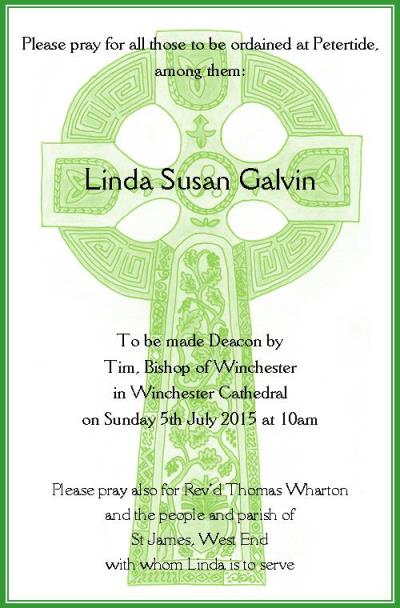
So here is my ember card featuring a design I created of a celtic cross:

You did not choose me but I chose you. And I appointed you to go and bear fruit. John 15:16

You did not choose me but I chose you. And I appointed you to go and bear fruit. John 15:16

and if you are the praying type then here is a prayer you might like to use:

Dear Lord,
You call us all into fellowship
both within and without your church:
hear our prayer that those who are called
to be your faithful people,
through their vocation and ministry,
and who are soon to be ordained,
may each be an instrument of your love;
and grant that they may receive
the necessary gifts of grace
in order to do your work;
we ask this through our Lord and Saviour,
Jesus Christ, who is alive and reigns with you,
in the unity of the Holy Spirit,
one God, now and for ever.
Amen.

Go back

Your message has been sent

Warning
Warning
Warning
Warning

Warning.

As Our Prayers Rise Before You

As our prayers rise before you

The smoke of the burning incense went up with the prayers of God’s people – Revelation 8:4

Prayer is a powerful tool; it’s a tool that enables us to communicate with God either directly or through the advocacy of Christ, more often than not in the power of the Holy Spirit. If you were to dip your hand into your prayer toolbox you should not be surprised that at different times and in different circumstances you would find a diverse range of tools that you could draw out; yet each one of them would fit your purpose.

Throughout my training I have had opportunities to experience different forms of prayer; from the strict, traditional Prayer Book style to free-flowing extemporary prayer. However, the one constant is the discipline of saying Morning, Evening  and Night Prayer (Compline), although I have to confess that  the first of these has been more faithfully undertaken as against the occasional imperceptible mutterings as I drift off to sleep.

Morning Prayer, like most church liturgy changes with the seasons. There are moments throughout the year when certain phrases cause one to catch your breath or make your heart sing; in fact in Epiphany season I been known to break into song when reading the Jubilate – A Song of Joy; but just about all of them are preceded by an opening prayer that sets the right tone for the day ahead:

The night has passed, and the day lies open before us;
let us pray with one heart and mind.

Silence is kept.

As we rejoice in the gift of this new day,
so may the light of your presence, O God,
set our hearts on fire with love for you;
Amen

prayersrising2 blog

… so may the light of your presence…

Each morning and evening we are also given one or more of the Psalms to read. However, these too are prayers and throughout the Psalms, David and the other writers poured out their hearts to God in prayer, expressing honest feelings of anguish and desperate pleas for protection. They grieved painful confessions of sin, confidently expressed their hope and trust in God, and joyfully lifted praises to God.

In the same way they enable us to give voice to our feelings, whether of despair when we are at a low point in our lives or sheer exuberance at the scope and majesty of creation. They bring us into contact with the ancient people and places of our history – some long-lost civilizations; but they can also speak into current situations.

I suspect that we all have our favourites but for me Psalm 104 ranks high on my list as it sweeps through the beauty of creation; from the heavens spread out like a curtain to the deeps in which the Leviathan play; the springs and brooks that quench the thirst of the wild donkeys to the cypress trees where storks dwell and the conies and wild goats taking refuge on the stony cliffs. How food is brought forth from the earth with wine to gladden hearts, oil to soothe and bread for strength. A true prayer of thanksgiving!

May God hold you in the palm of his hand

Christ, as a light illume and guide me

Sometimes though prayer can be difficult; when we are tempted to ask, ‘Why me?’ So often we seek responses to our prayers in very exact ways, and when they don’t appear to be answered ‘just so’ we may become disillusioned and distrusting. As part of a sermon recently we were asked to look at it in a slightly different way. Instead of asking. ‘Why has this happened to me?’ try removing the ‘Why’. Suddenly it becomes, ‘This has happened to me.’ Now our prayer can be for strength and guidance on how we are going to deal with the situation and thus be able to move forward, even if we need to take it day by day.

Which leads us to the evening of the day, when with that same one heart and mind that we started the day with we ask that the end of the day may be holy, good and peaceful, as our prayers rise before God; before finally, looking for a quiet night and perfect end to our day in a responsory prayer:

In peace we will lie down and sleep:
for you alone, Lord, make us dwell in safety.
Abide with us, Lord Jesus,
for the night is at hand and the day is now past.
As the night watch looks for the morning,
so do we look for you, O Christ.
The Lord bless us and watch over us;
the Lord make his face shine upon us and be gracious to us;
the Lord look kindly on us and give us peace
Amen


Heights & Depths blog

And for those who are still out there seeking, this beautiful prayer is taken from Celtic Daily Prayer, Morning Prayer from the Northumbrian Community:

May the peace of the Lord Christ go with you,
wherever He may send you.
May He guide you through the wilderness,
protect you through the storm.
May He bring you home rejoicing
at the wonder He has shown you.
May He bring you home rejoicing
once again into our doors.

Prayer, as I said at the beginning is as different and individual as we are, and whether our prayers are whispered in the dark or shouted from the rooftops, whether they come in fancy words or stuttering sobs, know that each and every one of them is heard. So never feel that your prayer time is wasted or that you don’t have time to pray. Those few precious moments could make all the difference to your day. Amen

Prayers have been reproduced from Daily Prayer ©The Archbishops’ Council 2005 and Celtic Daily Prayer ©2000, 2005 The Northumbria Community Trust

Go back

Your message has been sent

Warning
Warning
Warning
Warning

Warning.

What Does It Take For Us To Believe?

'This is impossible' said Alice

‘This is impossible’ said Alice

Readings for the Second Sunday of Easter: Acts 4:32-35; 1 John 1:1 – 2:2; John 20:19 – end

On the second Sunday of Easter we find out that not everyone was yet ready to believe the incredible Easter news that Jesus was alive. Some people still had their doubts, including the apostle Thomas. We also hear how another apostle, John, was persuading a group of Christians that what he had witnessed first hand was the truth. Put that alongside the growing number of believers who were learning a new way of living as a community and suddenly the question of what it would take to enable us to believe is one that we might ask; which is exactly what I did in my sermon this morning

May I speak and may you hear through the grace of our Lord; Father, Son and Holy Spirit. Amen

If you don’t mind I’d like to start by conducting a straw poll with a show of hands. There are two main choices, but possibly an infinite number of circumstances and experiences that could fall into either of those categories.

I want you to think about your journey to faith, from when you first took an interest in Christianity to a point when you knew you believed. I wonder whether this was a sudden and datable experience or whether it was more of a gradual process, where you can perhaps remember a time when you didn’t believe and now you do but you don’t know exactly when that happened. Perhaps you’ve always believed or maybe you’re still on that journey.

None of these choices are better than the other, but it would be interesting to know, if you’re willing to share. Put your hands up [Reader, you too can join in, although remember that statistically the result will be 100% for whichever choice you raise your hand to] if your belief followed a sudden, ‘Damascus road’ type experience…… and now if your belief has been more gradual…… We’re actually quite representative of the average, which is about three-quarters describing it as gradual and a quarter as sudden.

I’d actually quite like to stop and hear from some of you about your journeys but I suppose I better carry on… because the really interesting bit might not be when it happened for those already there, but what it takes for us to believe.

The Incredulity of St Thomas blog

The Incredulity of St Thomas, Benjamin West (1738 -1820)

For Thomas it was the sheer physical proof of placing his hands on a man with whom he had spent the best part of the last three years and who he knew had been crucified, had died and had been shut up in a rock tomb and was now according to his friends and fellow disciples very much alive again; a man who was speaking to him and asking him not to doubt but to believe. This apparently indisputable proof led Thomas to publicly declare that Jesus was indeed ‘My Lord and my God’.

Where then does it leave those of us who will probably never have the opportunity to physically encounter Christ, at least not in the same way that those first disciples did? We are told that we are blessed more if we come to believe without seeing. Do we, therefore, come to belief because there are first-hand witness statements available to this event?

The First Letter of John

The First Letter of John

We don’t know for sure who the author of the first letter of John was, but from the very earliest of times it was believed to have been written by John, the fisherman and apostle of Jesus and bears striking similarities to the Gospel of John. Here is someone writing to one of the first group of Christians, who are somewhat unsure as their faith is being tested by spurious claims about whom Jesus really was; that he wasn’t actually human and didn’t really suffer on the cross; that he only ‘seemed’ human.

John writes to reassure these believers, that as a first-hand witness of Jesus’ ministry he and his friends saw and heard and touched Jesus when they became his disciples and shared his life. In this way their testimony is very convincing – they believed that Jesus was none other than the ‘Word’ of God – the source and meaning and purpose of life.

Even so, an eyewitness account is not quite the same as having concrete facts and figures, to inform our belief. Now before you get too excited I am not going to pull the ‘white rabbit’ of incontrovertible evidence out of my theological training ‘top hat’ but in amongst the minutia of historical data plenty of scholars and historian have investigated what might be myth and what could be reality.

WDITFUTB_Lament over the Dead Christ blog

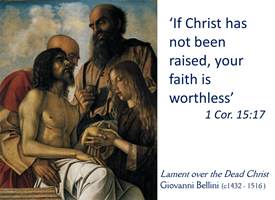
Lament over the Dead Christ, Giovanni Bellini (c1432 – 1516)

We know that without a resurrection Christianity is counterfeit. As the apostle Paul tells the Corinthians, ‘If Christ has not been raised, your faith is worthless’ 1 Corinthians 15:17. Accordingly, since a resurrection requires death, Jesus’ death by crucifixion has to be regarded as true. This ‘fact’ is attested to by a number of ancient sources, including the non-Christian historians, Josephus and Tacitus, who were therefore not biased toward a Christian interpretation of events.

We know that the chances of surviving crucifixion were very bleak and no evidence exists that Jesus was removed whilst still alive. The unanimous professional medical opinion is that Jesus certainly died due to the rigours of crucifixion, and even if he had somehow managed to survive, it would not have resulted in the disciples’ belief that he had been resurrected.

Il Precusore,

Il Precusore, Giulio Aristide Sartorio (1860 – 1932)

What about the empty tomb? Well its location was known to Christians and non-Christians alike. So if it hadn’t been empty, why would the chief priest have devised a plan to give a large sum of hush money to the guards, telling them to say that ‘His disciples came by night and stole him away while we were asleep’ Matthew 28:12-13. It would also have been pretty impossible for the large group of believers to have suddenly sprung up in the same city where Jesus had been publicly executed just a few weeks before and for those same believers to have been willing to die brutal martyr’s deaths if they knew this was all a lie.

Were people hallucinating when they encountered the risen Christ? Well, usually hallucinations are something that happens in an individual’s brain and not repeatedly on separate occasions and certainly not to groups of up to 500 people! 1 Corinthians 15:6 Even if they were visions, brought on by the apostle’s grief over the death of their leader, surely the body would have still been in the tomb.

Pascal's Wager

Pascal’s Wager

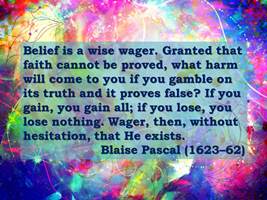
Convincing facts and figures? Well maybe. Or perhaps Pascal’s Wager might be the reason why people believe. Pascal was a seventeenth-century philosopher who theorised that humans live their lives by wagering that believing in God is a good bet because if when they die he does exist then they have gained the best of everything, on the other hand if they don’t believe and then find out he does exist then they made the worst choice and will have lost everything. However if they were to discover after death that God never existed then it didn’t matter what you believed.

So by believing, you are in a win-win situation. This sort of hedging my bets is just one accusation made against Christians who assume that because they believe in the right God, they are automatically good and have a one-way ticket to everlasting life. However, it also assumes that God would always reward blind faith above living a conscious Christ-centred life and all of the obligations that that might bring.

WDITFUTB_Belief is truth blogPerhaps belief and faith are different then… that belief is something that our logical, human minds hold to be true whilst faith is something that is felt deep within our hearts. Or could it be that faith is based on belief and that is why faith alone is not possible because belief always brings about actions and reactions?

Some people might even say that faith is truth held in the mind and that belief is a fire in the heart. Perhaps we just can’t separate the mind and heart, because as we heard ‘The community of believers were of one heart and one mind’ Acts 4:32

I hope you’ve been aware that I’ve been careful to never actually define what it is exactly that we understand and count as belief. Some might say that’s a cop-out; that the church is forever allowing so much laissez-faire around declaring what it believes and stands for that it nullifies any claims it might have to the truth. Well, I’m sure that for the majority of us it will include the belief that Jesus died and was resurrected in order that we might ‘have life in his name’, but that for each of us that might mean something slightly different depending where we are on our journey of faith.

As we walk together in fellowship with each other and with God, let’s make sure that we’re not only helping each other to increase in faith, but that we are sharing our beliefs with others so that God’s joy may be complete. After all didn’t Jesus say ‘Blessed are those who have not seen and yet have come to believe’. So let’s go and open a few more eyes to the truth of what we believe.

Amen

John 20:29

John 20:29

Go back

Your message has been sent

Warning
Warning
Warning
Warning

Warning.

The Beehive Church

Collaborative Honey Bees

Collaborative Honey Bees

Having just finished and handed in one of my final portfolios, it has given me an opportunity to reflect on the sort of ministry I would hope to engage with in the future – and it’s all to do with bees! Now before you succumb to an image of a wild apiarist reverend roaming the parish bedecked in a wide-brimmed veil touting honey as a cure-all, think instead about collaboration.

We have much to learn about working together collaboratively, and by that I don’t mean working well as a team under the authority and  expertise of a ‘good’ leader. No indeed, because for so long we have had a hierarchical model of leadership in the Church, where decisions are filtered downwards and authority is shared amongst those deemed to be ‘worthy’ or competent; but it doesn’t have to be like that.

The fact is we already have the ultimate authority in God, and collaborative ministry is nowhere better demonstrated than through the Holy Trinity, which acts as an example of synergy, the whole being greater than the parts and yet each part is distinctive and committed to working together both internally as well as externally

One true leader

One true leader

True collaboration can only take place when we place God at the pinnacle of the leadership tree, and when every ministry that is revealed through the gifts or charisms imparted by the Holy Spirit to each person are equally esteemed and valued. These gifts are all undoubtedly diverse, but the leader that facilitates opportunities for all to be heard, establishes lines of communications between different groups and safeguards accountability, while at the same time recognising that others may be better equipped to undertake various tasks is surely one that will succeed in fulfilling their primary role of reminding the community whose initiative they need to follow and who the source of their mission and unity is.

Not an easy task for someone whose personality tends towards natural introversion, who will often carry out a task independently to simply get it done quickly. However, over the last few years I have been introduced to more and more examples of collaborative ministry and have come to realise just how important it is; and above all I truly believe that in order to progress the work that God asks us to undertake, we need to use Christ as our example and the Holy Spirit as our guide,

What then has this to do with bees? Well the writer Tolstoy spent a lot of time musing philosophically about the collaborative nature of bees within a beehive, often comparing it to the Christian church, not always in a kind way. However, what we can learn from honeybees is that they collaborate together almost unconsciously to ensure that the colony not only survives but thrives.

The fruits of the hive

The fruits of the hive

Foraging bees will continuously collect nectar, often being led to new sources by any one of its apparent insignificant members, whose dance can influence the rest of the hive to venture to new and plentiful supplies, whilst the worker bees use this raw material to construct complex precise honeycombs all without the need for supervisors, each contributing a small piece of beeswax before moving aside to allow a co-worker to add their contribution. At the same time the bees respect nature by giving back to their habitat the gift of pollination.

Admittedly the drone bees could be considered the lotharios of the bee world, but hey-ho it takes all sorts; and at the very centre of the hive is the queen bee, without whom the colony would not survive and yet who selflessly gives herself to ensure the next generation of bees is produced and nurtured*.

What then of the product of this collaboration – surely there is nothing sweeter than being prepared to share with others the glorious fruits of all this shared ministry.  It’s just a thought, but maybe the ‘beehive church’ is one that we could all be striving toward. Why not let me know what you think?

The collaborative church

The collaborative church

*Within this analogy, God the creator is wholly represented through all of his creation, whilst the Holy Spirit provides the wisdom, energy and drive. At the centre is Christ, the selfless example of whom the minister is called to represent and emulate.

Go back

Your message has been sent

Warning
Warning
Warning
Warning

Warning.

Within and Without

St Paul Outside of the Walls

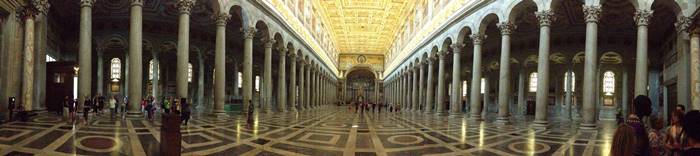
The interior of St Paul Without the Walls, Rome

The third in a series of reflections following a visit to Rome to discover its links with the early Christian church and the church as it is today

I suppose I have a kind of ‘love-hate’ relationship with St Paul… actually hate would be much too strong a word. In my Norfolk ancestor’s parlance, he ‘crazes’ me or even more accurately, he agitates me. Which is actually no bad thing, as it leads me to have to really think about what the reasons were behind what he said and did.

Peter may be predominately remembered within the very centre of the Vatican City State, but it is without the walls of Rome that Paul has his resting place. I wrote in my first reflection about the grandiosity of St Peter’s Basilica, and approaching the Basilica of St Paul Without the Walls after a short train journey, did nothing to dispel my sense that here was yet another ‘cathedral on steroids’, as one member of our group put it.

St Paul Outside of the Walls Exterior

Even so, the majestic colonnaded entrance, over which glowed the breathtakingly beautiful facade, seemed like a peaceful place to sit in that in-between space; with the world rushing by outside and a promise of something extra special to come on the inside. Even the arrival of a couple of noisy excited school groups couldn’t quite  break into the moment; but it was time to move on.

St Paul's martyrdom on the Papal door at St Paul without the Walls

St Paul’s martyrdom on the Papal door at St Paul without the Walls

Entering by the newest papal door, of which there are three, we were reminded that Paul is said to have been martyred by having his head struck off – and this was rather graphically portrayed in one of the door panel. Knelt before a Roman executioner; his hands in chains; the person who through his fragmentary unilateral correspondence has possibly done more to shape our understanding of the Early Church was swiftly silenced – although one could imagine that he was probably still evangelising even as the blade swished through the air.

One night the Lord said to Paul in a vision, ‘Do not be afraid, but speak and do not be silent – Acts 18:9

The interior of the church, as the panoramic view above suggests, seemed vast and uncrowded, and yet still conveyed an air of intimacy – although there was some undignified jostling in front of his tomb, where those who knelt in prayer suddenly became aware of cameras by the side of their heads as other desperately tried to ensure they had ‘captured’ the exact record of where his bones lay.

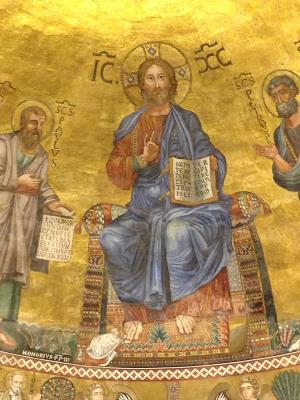
Commercialism was also alive and well, in that for €1 you could light up the apse for a short period of time – enough for all to take advantage of another’s generosity, as evidenced by the rush as the light flicked on to stand as central as you could to it and the flashes and clicks of numerous cameras!

The illuminated painting of the Apse, St Paul Without the Walls

The illuminated painting of the Apse, St Paul Without the Walls

For all its beauty though, it was another place that has become associated with St Paul that had a much more profound effect on me and helped me to reconcile some of my thoughts about Paul’s discipleship.

A simple, now below street level house in the centre of Rome, is said to be the place where Paul was held, in chains, under house arrest. Standing in that bare cell of a room, and listening to Paul speak through the words of what was probably his last recorded letter before his death, the presence of the Holy Spirit was palpable.

Remember Jesus Christ, raised from the dead, a descendant of David—that is my gospel, for which I suffer hardship, even to the point of being chained like a criminal. But the word of God is not chained – 2 Timothy 2:8-9

'The Word of God is not chained'

‘The Word of God is not chained’

Here was a man who at every point following his dramatic conversion, tried to emulate to the nth degree the life of Jesus; a man who held stong views on how the Gospel was to be interpreted; a man, who to our 21st century eyes may appear at times misogynistic, fanatical and arrogant; a man who was not afraid to play the Roman citizen trump card from time to time, and yet through his sheer determination, unwavering belief and absolute trust in the Truth, demonstrated powerfully what it means to live and die for Christ.

I suspect that I will continue to wrestle with my views on St Paul, but meeting him in the places where he dared to follow God’s will for his life can only lead to a greater understanding of his place in God’s mission

For I am the least of the apostles, unfit to be called an apostle, because I persecuted the church of God. But by the grace of God I am what I am, and his grace towards me has not been in vain. On the contrary, I worked harder than any of them—though it was not I, but the grace of God that is with me – 1 Corinthians 15:9-10

The life of St Paul depicted in carved wood panels, Vatican Museum, Rome

The life of St Paul depicted in carved wood panels, Vatican Museum, Rome

Go back

Your message has been sent

Warning
Warning
Warning
Warning

Warning.

On A Midnight Train From Georgia

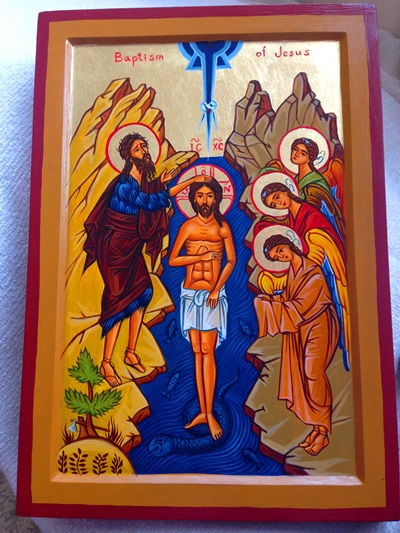
Baptism of Christ Icon - written by Tamara Rigishvili

Baptism of Christ Icon – written by Tamara Rigishvili

To be honest I don’t know if it really was put on the midnight train, or any train for that matter. Maybe it came by plane or postal van, but however it travelled, it arrived safely at my door last week.

The truth though is that it did come from Georgia – Tbilisi, Georgia to be exact – some 2,653 miles to the east of my home, where the very talented artist Tamara Rigishvili lives and works. However, the creation of this beautiful icon came about in what was for me an unusual series of events, which culminated in owning what has become to me a very important representation of the story of Jesus’ baptism.

In April of 2014, I wrote about using this icon to explain the actions performed while making the sign of the cross in Coming Into The Presence of God. Wanting to upload an image of the icon that has been used on that day, I googled several images and came up with one that was taken from Tamara’s website. However, I felt that I needed to get authority to do that, and so I e-mailed her and sought permission, asking her to check out the contents of my blog and with the promise of a link to her site.

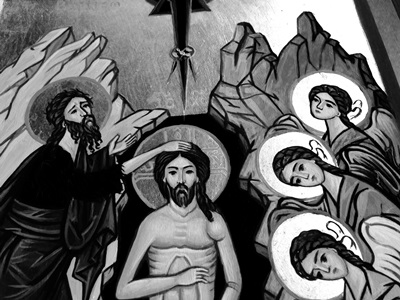
Christ submerged in the water of the Jordan

Christ submerged in the water of the Jordan

Thus a correspondence was begun between two people, thousands of miles apart, who did not know each other, did not necessarily speak the same language (although Tamara’s English is excellent, whilst my schoolgirl Russian is yet to be tested); connected by their common faith, and which resulted in my asking if she would ‘write’ a copy of the icon for me. True to her word, she completed the icon over a three month period and it was then carefully packaged and despatched…

… In the meanwhile, as part of my spiritual direction at college, it was suggested that I meditate on Matthew 3:13-17. This description of Jesus’ baptism is just one of the bible’s explicit passages where the Trinity appear together.

And when Jesus had been baptised, just as he came up from the water, suddenly the heavens were opened to him and he saw the Spirit of God descending like a dove and alighting on him. And a voice from heaven said, ‘This is my Son, the Beloved, with whom I am well pleased.’
Matthew 3:16-17

As a Trinitarian at heart, I have always found that the three-fold nature of God; Father, Son and Holy Spirit has both fascinated and frustrated me. On the one hand each has its own separate identity and characteristics, on the other they are all one and the same. I do not argue against this nor do I find it easy to explain – although traditionally in the Church of England, as a curate it usually falls to their lot to preach on Trinity Sunday each year – so I better get my thoughts in some order by then!

The passage itself presents a beautiful image of being submerged beneath water, and then a figure rising in a sparkling cascade to see the sky above suffused with a pure light that is concentrated in a shaft centred on their head and a clear voice filling the air with a confirmation of their worthiness. What, it was suggested, if that figure were you?

So often we can feel unworthy, and could not imagine such a thing, but we are invited to do so by God as he offers us his love and grace. ‘This is my daughter… this is Linda… this is [insert your name here]’.

I don’t believe that God arranges for these things to come together without a purpose, so as I spend time contemplating that passage alongside my beautiful icon, I hope and pray that you too will accept that grace, knowing that you ARE worthy to receive it.

Matthew 3:13-17

Matthew 3:13-17

For more details of Tamara Rigishvili artwork, please do visit her website

Go back

Your message has been sent

Warning
Warning
Warning
Warning

Warning.

A Chinese Legend


The Noble Bamboo

The Noble Bamboo

In the church, we have just celebrated Ascension, when the risen Christ traditionally ascends to heaven, having been crucified on the Easter cross. Ahead, we look forward to Pentecost; when the promised Advocate or Holy Spirit will be given to his followers. Without these things happening we would have nothing distinctive about our faith. 

If there is no resurrection of the dead, then Christ has not been raised;
and if Christ has not been raised, then our proclamation has been in vain
and your faith has been in vain.
1 Corinthians 15:13-14

So for his death not to have been in vain there had to have been a purpose. The son of God, who came to earth, and set aside his divinity to take on earthly flesh had to die in order that he and us might live and there is no doubt that giving your life for the greater good is the ultimate sacrifice anyone can make. Throughout history men and woman have made this sacrifice, as martyrs, as servicemen and women and civilians serving their country, as ordinary everyday people; in the hope that it helps others to live.

At Morning Prayer in college recently a fellow student read a beautiful story which illustrated this selflessness perfectly. However, it also made me think that God does not contain himself to our slightly arrogant assumption of exclusivity. For example, I have always been amazed at the fact that creation stories from around the world contain so many similar attributes. For those who believe in a creator God, this is not so strange, as we cannot be so precious that we think God only revealed the story of creation,  based on a Mesopotamic myth and passed down in verbal form, before being adapted to Israel’s belief in one God, by a group of Yahwehist writers in the late 7th or 6th century BC

God indeed reveals himself time and again in all of his creation, both physically and linguistically and so I hope you enjoy reading this legend from China and draw your own conclusions about where God could be working his purpose out in the world right now

A Chinese Legend

Once upon a time, in the heart of the Western Kingdom, lay a beautiful garden. And there in the cool of the day was the Master of the Garden wont to walk. Of all the denizens of the garden, the most beautiful and most beloved was a gracious and noble bamboo. Year after year, Bamboo grew yet more noble and gracious, conscious of his Master’s love and watchful delight, but modest, and gentle withal. And often, when Wind came to revel in the garden, Bamboo would cast aside his grave stateliness, to dance and play right merrily, tossing and swaying and leaping and bowing in joyous abandon, leading the Great Dance of the Garden which most delighted the Master’s heart.

Now upon a day, the Master himself drew near to contemplate his Bamboo with eyes of curious expectancy. And Bamboo, in a passion of adoration, bowed his great head to the ground in loving greeting. The Master spoke:

“Bamboo, Bamboo, I would use thee.”

Bamboo flung his head to the sky in utter delight. The day of days had come, the day for which he had been made, the day to which he had been growing hour by hour, the day in which he would find his completion and his destiny. His voice came low:

“Master, I am ready. Use me as thou wilt.”

“Bamboo ” — the Master ‘s voice was grave — “l would fain take thee and — cut thee down.”

A trembling of a great horror shook Bamboo. “Cut. . . me.. . down! Me… whom thou, Master, hast made the most beautiful in all thy garden. . . to cut me down! Ah, not that, not that. Use me for thy joy, 0 Master, but cut me not down. “

“Beloved Bamboo” — the Master’s voice grew graver still — “if I cut thee not down, I cannot use thee.”

The garden grew still. Wind held his breath. Bamboo slowly bent his proud and glorious head. There came a whisper:

“Master, if thou canst not use me but thou cut me down.. then… do thy will and cut.”

“Bamboo, beloved Bamboo, I would . . . cut thy leaves and branches from thee also.”

“Master, Master, spare me. Cut me down and lay my beauty in the dust; but wouldst thou take from me my leaves and branches also?”

“Bamboo, alas, if I cut them not away, I cannot use thee.” The sun hid his face. A listening butterfly glided fearfully away.

And Bamboo shivered in terrible expectancy, whispering low.

“Master, cut away.”

“Bamboo, Bamboo, I would yet… cleave thee in twain and cut out thine heart, for if I cut not so, I cannot use thee.”

Then was Bamboo bowed to the ground.

“Master, Master. . . then cut and cleave.”

So did the Master of the Garden take Bamboo and cut him down and hack off his branches and strip off his leaves and cleave him in twin and cut out his heart. And lifting him gently, carried him to where was a spring of fresh, sparkling water in the midst of his dry fields. Then pulling one end of broken Bamboo in the spring and the other end into the water channel in his field, the Master laid down gently his beloved Bamboo. And the spring sang welcome and the clear sparkling waters raced joyously down the channel of Bamboo’s torn body into the wailing fields. Then the rice was planted, and the days went by, and the shoots grew and the harvest came.

In that day was Bamboo, once so glorious in his stately beauty, yet more glorious in his brokenness and humility. For in his beauty he was life abundant, but in his brokenness he became a channel of abundant life to his Master’s world.

Living Water

Living Water

Go back

Your message has been sent

Warning
Warning
Warning
Warning

Warning.

Coming Into The Presence of God

Out of the Window blog2

Coming into the presence of God

Another weekend at Cuddesdon brings new insights and experiences. Whilst not my first choice, the title of the workshop ‘Embodied Prayer in Orthodox Spirituality’ filled me with a sense of intrigue.

I would class my churchmanship as neither high nor low, but rather open to a smorgasbord of traditions. I therefore, was quite receptive to finding out more about what some might class as the high end of the church where orthodoxy is concerned.

In fact where orthodoxy is concerned the Western church is somewhat of an upstart according to the Syriac Orthodox Church of Antioch, which claims to use the oldest surviving liturgy in Christianity. However, I digress…

Our main purpose of the day would be to explore contemplative or noetic prayer as well as embodiment prayer – the former both involves silence and stillness (hesychia) and monologistic prayer (i.e. repeating a word or phrase such as the Jesus Prayer) – whilst the latter included prostration and the sign of the cross.

Standing to pray

Standing to pray

As the latter was more unfamiliar to me I will mention that first. Embodiment prayer, as the name suggests involves using the body in prayer and there are many ways of doing this – whether standing or kneeling or prostrating yourself – all the while offering prayer either using a set form of words or your own words. Some of which postures may seem unfamiliar practices to your average Anglican!

The Sign of the Cross

The Sign of the Cross

When it comes to making the sign of the cross during worship, it is a gesture that very often gives an immediate clue as to people’s Anglican tradition – that is those of an Anglo-Catholic persuasion. Again, this was something that I was not used to doing either in worship or prayer. Nevertheless, when it was explained using an illustration of an icon based on the baptism of Christ I was able to better appreciate its meaning.

The Baptism of Christ

The Baptism of Christ hand written by Tamara Rigishvili *

This beautiful icon [which is written not painted] shows the Trinity as a straight line from the heights of heaven to the depths of the waters – we can therefore image our bodies when we are standing upright representing that line. Our heads are warm because of the activity of our brains, from which flows creative energy (the Father), our stomachs are the watery region (the Son submerged at his baptism) and our lungs breathing air in and out (the life giving Holy Spirit or Holy Ghost)

Imagine if you will then, your thumb and first two fingers, held together as a trinitarian symbol, tracing a line from your head to your stomach up to your right shoulder then across to your left and then resting in the middle by your heart – ‘In the name of the Father, of the Son and of the Holy Ghost, Amen.’ – its symbolism becomes clearer and more affective.

However, it was the practical session on contemplative prayer that was to prove the most rewarding. Noetic prayer, as it is also known, uses a form of silent prayer (hesychia) in which the body is stilled, the ‘chattering mind’ silenced, thus creating a space where you are open to receive God. Of course it’s never that easy to just switch off your thoughts, but it allows an awareness of both intrusions and physical discomforts and lets them be by bringing yourself back to the awareness of the sense of stillness within your whole body. External noises also become absorbed so that they don’t become a distraction. It is into this space that prayer subconsciously occurs.

Psalm 46:10

Psalm 46:10

There is plenty of biblical evidence of being called to stillness in order to hear God’s voice… within many of the Psalms for example – ‘Be still and know that I am God’ (Psalm 46:10) or ‘For God alone my soul waits in silence‘ (Psalm 62:1) – and Jesus takes time to be alone with his Father, no doubt in silence as well… whether in the desert or drawing apart from his followers on occasions.

Of course, I would not, after only a couple of sessions, claim in any way to be an expert, but the technique is basically to find a comfortable place to sit, with both your feet on the ground and to work your way up your body, recognising the sensations in each part as you still yourself, drawing back to your feet, your knees, your hands, etc., should thoughts intrude; all the while becoming aware of your breathing and its natural rhythm……

What was the prayer that formed inside me during this time? Well it actually turned out to be a piece of poetry… from out of the stillness and the silence by which I came into the presence of God

Coming Into the Presence of God

Warmth suffuses the window pane,
As sunshine splashes, in gold and yellow rays
on the cushioned sill;
Sharp shadows are softened and shimmer.
I draw my knees closer
and sink into silent stillness.
The world is on pause.

Invisible neurons continue to fire;
exposed in intermittent patches of tingling energy
through soles of feet and top of scalp.
Pain ebbs and flows,
absorbed in gentle eddies;
while breath synchronises
with the ticking of the mantel clock
and thus fades as if time is motionless…

Even so the heartbeat of the earth
still pulses in sounds it offers;
received in encoded messages,
yet unencrypted to the keen ear.
A solitary bird, unseen, chirrups its joy,
and wood pigeons coo in rhythmic metre,
unfazed by passing traffic’s intrusion.

A creak, a sigh,
the door and I hold our breath;
but the inevitable slam is muted;
fading away, as calmness interrupts
and a sense of presence grows.
Like a glimmer through closed eyelids;
which open as a breeze brushes my skin

Outside, the tender branches of the trees,
laden with buds and burgeoning leaves
ripple and vibrate, echoing the silent force
of life and spirit.
Springtime flowers bend to the earth,
then dip and bob like cheery marionettes;
all proclaiming divine mystery

Recalled back into the room
by gentle chink of plate and cup,
a signal of beckoning refreshment,
and congenial chatter….
Still hold the moment a little longer
to remember another meal
and revelation in broken bread,
gone and yet forever present

The day’s workshops were led by the Reverend Jim Barlow, presently the Assistant Curate at St Peters, Burnham, Buckinghamshire and previously a student at Ripon College, Cuddesdon

*Tamara very kindly gave me permission to use her beautiful artwork in this piece. To find out more about her work please look on her website http://www.tamarapaint.com/

Go back

Your message has been sent

Warning
Warning
Warning
Warning

Warning.

The Body of Christ

We are the body of Christ

We are the body of Christ

The New Testament module I have just completed was interesting in many ways. Its main focus was on several of the Pauline letters, including the epistles to the Galatians, Romans and Corinthians. New insights were gained into the background, setting and context of these letters as well as the character of Paul himself. This was particularly challenging as my natural tendency is to regard Paul with a small measure of annoyance and a gritting of teeth.

Don’t get me wrong, I have learned to love and admire St Paul; for his sheer hard work and determination in setting up the early churches, his zealousness for spreading the message of Christ and his genuineness in his beliefs. It’s just that sometimes I wonder, ‘Is that really what you meant Paul?’

One passage though, in which he explained the metaphor of ‘the body of Christ’ brooks no argument from me and we were asked to prepare a sermon on it as part of the course. Here then is a copy of that sermon, intended with my own church congregation in mind, but here delivered hopefully to an equally receptive, varied and open online congregation.

The passage it relates to is 1 Corinthians 12:12-26

As the writing on the barn wall stated, “All animals are equal…” This declaration by the animals in George Orwell’s novel Animal Farm laid down a rule which many democratic societies have upheld as a basic principle. However, if we are all equal doesn’t that mean that we all have to be the same? Not physically the same but doing the same thing, thinking the same thoughts, making everything neat and uniform, because in this way we will surely achieve unity. Won’t we? And isn’t uniformity the thing that we as a church strive for in our liturgy, church management and doctrine?

Well equality is not the same as uniformity and uniformity is actually not really helpful to true unity. As the animals later discovered when they added a codicil to the rule – “All animals are equal, but some are more equal than others.” There is something more that needs to happen and Paul points to it in one of his clearest and least controversial statements in his first letter to the church in Corinth, when he identifies what it means to be the body of Christ

We could so easily just look at the analogy of each of the members of the church being represented as different body parts. We all have different roles to play which could equate to a particular limb or organ within a body – the choir representing the harmonious vocal chords; the sidespeople as helpful hands; ‘Jonathan’ [in my own church], who likes to disagree with every sermon, as the grumbling appendix!… Each of us creating a complete and unified metaphorical human being that is wonderfully made, but which can occasionally stumble and fall, but invariably picks itself up again.

 Still is this what Paul really means and is this the only way we can think of being one body?

For a start we are all different, and that’s great; because it would be an odd shaped body if we were all the same part. After all, like a body, we need the unique gifts offered by all of the various members. These various gifts provide diversity, a diversity that is God-given; and coming as they do from such a source they need to be used for the good of all. Paul recognises that the thing that unites us is the Holy Spirit and it is through the work of the Holy Spirit that believers become bound together into one body.

However, our diversity needs to be based on interdependency rather than independence… Just as we use different parts of our bodies to perform different tasks, we all have particular talents which make us very good at the jobs we choose to do; and sometimes we can jealously guard those jobs that we like doing, thereby preventing others from a chance of receiving equal recognition. In addition, if we perceive that these are highly skilled tasks we can begin to give them a superior status, which often leads to pride. Yet the work we perform in God’s name cannot be based on a belief of self-sufficiency – our successes are built on the grace of God and the shoulders of those that support us –this sermon would be pretty pointless if the church and its people weren’t present – and a lot has happened in the past and behind the scenes to bring everybody to this particular point in time. Just take a moment to think why and how it is you are here today?

Moreover, who are we to judge the worthiness of each role played within the church? Just as our limbs depend on muscles, and tendons; nerves and microscopic synapses to function efficiently, and would be useless without them, so we have to ensure that every role a person has is equally valued. Furthermore, we need to realise that if we are working towards a common purpose – a united body – then we have to recognise that there will be some within that ‘body’ who may be vulnerable and therefore need to be nurtured and cared for.

Often, living in a society that prizes outward signs of power and achievement, we can despise weakness and vulnerability, but Paul turns this on its head, so that as Christians we should honour those ‘less respectable members’ and instead afford them mutual respect. It could be anyone of us that fluffs their lines in the readings, or takes a long time to get up to the altar rail or forgets the milk for refreshments…If we learn to be more accepting then the church will truly function as the body of Christ

Of course there are going to be time when we do disagree with each other, but it will be how we deal with this that counts. If our disagreements are forever aired publicly, rather than quietly and with concern for the other person, then we run the risk that we lower the respect that we need to have for each other as well as the respect that others have for us. We devalue the whole

What then should the shape of the whole look like? Well, in a world that is forever dieting and primping to maintain the body beautiful, we need to put that image aside. Our body should be fluid and growing, accepting new members so that every part of the body can grow stronger. We shouldn’t pick and choose what sort of parts or people we might need more of, or reject what might be to some insignificant or worthless. We have to allow people to be what they are; love each other unconditionally and rejoice in our unity – because if we don’t then we not acting as the body of Christ; and In the words of a song by the music group Casting Crowns – “Jesus paid much too high a price for us to pick and choose who should come… and we are the body of Christ”

Amen

Lyrics from If We Are The Body – Casting Crowns

It’s crowded in worship today
As she slips in trying to fade into the faces.
The girls’ teasing laughter is carrying farther than they know
Farther than they know

A traveller is far away from home
He sheds his coat and quietly sinks into the back row.
The weight of their judgemental glances
Tells him that his chances are better out on the road

But if we are the body
Why aren’t his arms reaching?
Why aren’t his hands healing?
Why aren’t his words teaching?
And if we are the body
Why aren’t his feet going?
Why is His love not showing them there is a way?
There is a way

Jesus paid much too high a price
For us to pick and choose who should come
And we are the body of Christ

Jesus is the way

© Casting Crowns 2003
https://www.castingcrowns.com/music/lyrics/if-we-are-body

Go back

Your message has been sent

Warning
Warning
Warning
Warning

Warning.

Disclaimer: Any names mentioned within this sermon have been changed to protect people’s anonymity and because I would still like to worship there. They know who they might be!