Tag Archives: Holy Spirit

Fear Of Failure

Compline - A quiet end to the day

Compline – A quiet end to the day

This week I had to do something really frightening. The sort of thing that makes your heart race and your knees tremble. It wasn’t quite the fear I feel when I am at a great height and not in control of my balance; nor was it the fear generated by an unseen but threatening presence – the sort that made me hide behind the sofa whilst watching Dr Who as a child. No, this was the fear of failure.

The cause of this fear? Well, you could say it was self-inflicted; but for various reasons I had offered to be one of the ordinands that ‘sang’ Compline in the college chapel!

Compline is the final service or ‘office’ at the end of the day. This quiet and peaceful worship, stills the mind and allows you to hand over to God all of those things that have happened during the day before retiring for the night. At Cuddesdon, the practice is then to maintain silence until the next morning

The service is taken from the Book of Common Prayer, and can be said, but is more often than not sung. However, this ‘singing’ is done in Plainsong – a sort of medieval chanting style. The notes are written on a stave [a set of five parallel lines on any one or between any adjacent two of which a note is written to indicate its pitch] in the form of dots (see picture below)
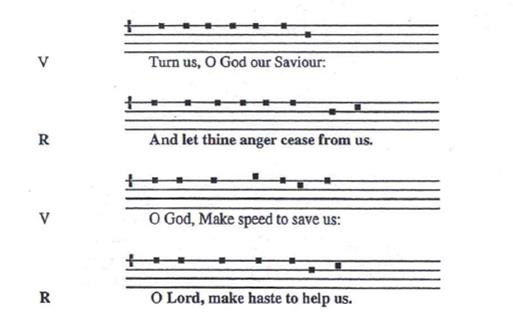
Compline is sung in plainsong

Compline is sung in plainsong

And there’s the rub – the fact that I had to google what the name of those lines were called tells you that my musical knowledge is limited. I understand that each note has a different sound depending on where it sits on those lines, I even know the names of some of the notes in those positions; but my problem is that I can not link in my head the name of the note with the sound that is supposed to come out of my mouth! Still, I wanted to give it a go.

I’ve written previously about having the courage to do something in Getting Out Of The Boat but inherent in all of these types of challenges is the fear of failure; that you’ll make a mess of it; that people will laugh; that you’ll feel a fool. So probably best not to do it…

As the time got nearer, the natural introvert in me kept questioning why I had ever thought it was a good idea and what had possessed me to volunteer. However, I knew that I’d been pushing myself lately to do things that stretched me; that exhausted me, but which were beginning to give me more confidence

I have to admit that even after a brief lunch-time rehearsal, right up to the moment that I sat in the chapel itself, that I wanted so much to say ‘I’m sorry, I really can’t do this’, hoping that like Zechariah I’d be struck dumb and have a legitimate excuse to save face; but a quick arrow prayer to say ‘Here goes God’ and the barely audible note hummed by my wonderful fellow ordinand, Jane*, sitting right next to me, found me launching into the first versicle

Did I sing like Katherine Jenkins? – No!

Did I hit a few ‘bum’ notes? – Yes!

Did I worship the Lord in word and song – Yes!

God gave us a spirit not of fear but of power and love and self-control
2 Timothy 1:7

Having done it I can’t say that I won’t feel that nervousness again, but if we attempt to do things in good faith the Holy Spirit  will invariably pitch in there with us [musical pun intended]

So don’t fear failure, and don’t let fear stop you from giving things a go. As it says in one of my favourite prayers:

Lord help me to remember
that nothing is going

to happen today that
you and I together
can’t Handle
Amen

Go back

Your message has been sent

Warning
Warning
Warning
Warning

Warning.

*Huge thanks must go to Jane Winter, whose infinite patience and kind encouragement played a large part in enabling me to not give in to my fears and for the support of all my fellow Ordinands who sang the responses impeccably and who didn’t laugh but gave me silent hugs afterwards!

The Public Face of Christian Conflict

Heart blog

‘Love at the heart of faith is visible’

On Monday (20th January 2014) I came up to Ripon College, Cuddesdon to hear Christopher Landau speak on “Who cares what the church is saying? Christian disagreement and the credibility of public theology.”  Christopher is a former student of the college and is presently a curate at St Luke’s, West Kilburn. This interesting lecture was part of the OxCEPT series and gave me pause to reflect further. The following is based on some of the points and ideas that Christopher put forward

Sometimes it’s hard being a Christian. Not because of my beliefs or the way we are called to live our lives (although I so often fall short in many ways). Not because it can feel that what I understand as basic common standards of respect for self and others appear to be being been gradually eroded in our society. Not because I expect anyone to listen to me and instantly recognise that I have all the answers – I don’t!

What is really hard is the ‘face’ of Christianity that the general public gets to see nowadays

By this everyone will know that you are my disciples, if you love one another
John 13:35

If, as a voice in the public domain, we are to be more and more portrayed as nonsensical, irrelevant fools, then maybe we need to consider not only what is being said, but how it is being said. How many times do we cringe when the press pick up the views of individuals with ‘extreme’ theologies and opinions; when they misquote or home in on the more sensational expressions of people’s religion, ignoring the mundane yet essential work carried out by millions of Christians each day in the name of their faith? Yet our own worst enemies may just be ourselves.

I think I should make it clear from the start that we should always be prepared to speak out loudly and clearly against injustices; that we have a duty to expose falsehoods and to stand firm on undeniable principles, but the tone and the way in which we do so needs to come from a deep-rooted love and regard for all those involved – to exercise ‘gracious restraint’ as advocated by the former Archbishop of Canterbury, Rowan Williams.

Where better then, to start showing that respect and restraint, but among fellow Christians. I am sure we have all come across situations in our churches where the love of God seems to have been divorced from hearts and minds; being swept aside by petty arguments and disagreements; where it appears acceptable to snipe and carp against our brothers and sisters in Christ; to turn a deaf ear to anything that doesn’t resonate with our personal views. If this is what the outside world sees is happening, then why should they think we have anything relevant to say?

‘Gracious restraint’ should mean that we must not only be prepared to share our own views with each other, but that we should also be prepared to listen; though certainly not to remain silent so that we give the impression that we unquestionably concur, yet all the while dismissing the other as misguided. We need to find arenas where these conversations can take place; to provide room for mutual disagreement; for them to be undertaken using gentleness in speech and manner and to leave space for the Holy Spirit to guide us.

As Christopher pointed out, if we can achieve this at personal and parish levels then we can create a ‘trickle up’ effect and honestly speak as the body of Christ. Perhaps then our words and actions will become more relevant and our public theology more engaging and news-worthy. In this way we will also ensure that ‘love at the heart of faith is visible’

Christian Conflict

Christian Conflict

Go back

Your message has been sent

Warning
Warning
Warning
Warning

Warning.

Watching and Waiting

Signs of Advent

Signs of Advent

At this time of year, in the lead up to the Christmas celebrations, we spend a great deal of time watching and waiting. What is it though that we are watching and waiting for? Is it for the first sign that Christmas is coming? In that case our watching should have started in September, when the first packs of mince pies appeared in the shops! Maybe the earliest sign that we’re watching for is when, what has become an iconic Coca Cola advert, ‘Holidays are coming, holidays are coming….‘ appears on our television, as the twinkling lorry wends it’s merry way to bring cheer and healthy profits for its stockholders – perhaps the waiting is over when we’ve seen that?

On the other hand we might be watching our credit card groaning under the increase in spending as we are tempted to celebrate the season by purchasing an excessive amount of presents to show our friends and relatives just how much we really love them…… Maybe though, we won’t be waiting for the bill to flop onto our doormat and realise that it will probably take a whole year, if not more to make the repayments – if only we hadn’t bought that one extra present that got put in the cupboard last year and might just do as a raffle prize next time someone asks for one!

Indulging in luxuries, wine, and rich food will never make you wealthy
Proverbs 21:7

What is it we are watching and waiting for? Are we watching our weight as the pounds pile on as we tuck into several Christmas party dinners and surreptitiously open the big box of chocolates that we were saving for Christmas – we can always get a replacement before the day. Or are we waiting for the sales that will start on Boxing Day, so that we can go and hunt out all those bargains… the credit card should just last till then… or maybe we could return that ‘delightful’ jumper that Auntie May bought us, then we can buy what we really want!!

Am I being a bit cynical, a bit ‘bah humbug’. I probably am, but I’m certainly not being holier than thou, because at some point or other I have done all of those things – except for returning the jumper Auntie May! For many people the real joy of Christmas will be doing all or some of these things – and there is love and joy and happiness in coming together, sharing, and giving and receiving gifts. For many of us though there will be a little bit of sadness that people won’t watch and wait for something considerably more important and certainly longer lasting than the use by date on the egg nog.

At church we have started a new year, with the season of Advent, The word Advent is an anglicised version of the Latin word adventus – meaning ‘coming’ – what then or who is coming? Well Christmas is coming (regardless of whether the geese are any fatter) and we will spend these next few weeks preparing to celebrate the coming of Jesus to earth over 2000 years ago. But we’re not really watching and waiting for his birth – that’s already happened; and his resurrection means that we will not really be watching and waiting for his coming among us, because he’s already here in the gift of the Holy Spirit.

What the watching and waiting will involve is a retelling of the ancient stories of a long awaited Messiah, through the visions of the prophets, the blessing of Mary who carried the Christ-child in her womb and the messengers, like John the Baptist, who prepared the way for Jesus’ earthly mission. Perhaps more importantly we will once again be watching and waiting expectantly in preparation for Jesus’ Second Coming, as we put aside some of the excitement and spend some time being penitent and a little more thoughtful.

“So you, too, must keep watch! For you do not know the day or hour of my return”
Matthew 25:13

In the meantime, we can also spend time doing some more watching and waiting…. Watching and waiting for opportunities, whether it’s time or money, to bring to all those around us, who for one reason or another may not have the same chances or opportunities to join in our celebrations, a feeling of hope for the future; and to show once again that Jesus really is the reason for the season!

May God bless us all this Advent

Watching and Waiting

Watching and Waiting

Go back

Your message has been sent

Warning
Warning
Warning
Warning

Warning.

A Bible Is For Life, Not Just For Sundays?

Read the bible in whatever way possible

Read the bible in whatever way possible

At church recently we took the opportunity to think about the place that God’s word, in the form of the bible, takes in our worship and daily lives. Appropriately, it was on Bible Sunday*

It would be silly to ask you to put your hands up or answer out loud, but I’d like you to think what your answers might be to these questions…

I read the bible……

I read the bible every day……

I read the bible every day and then reflect on what I have read…

I read the bible every day and then reflect on what on what I have read and then try to apply it to my life…

The questions are not intended to be accusatory …. that you really should choose the last one in order to be deemed ‘saintly’. The most important thing is whether you actually read the bible!

At college we may not be required to bring our bibles to each lesson or lecture, where we talk about theology, liturgy and formation, but what has become obvious is just how vital Holy Scripture is to our faith. I don’t mean learning huge chunks of it off by heart or being able to recite whole gospels from memory, although it would be handy knowing exactly who said what, where and when sometimes… No, I mean looking to the bible to provide some guidance and answers to the many questions we have, not only about our faith, but about life in general. In the Book, or books to be more precise, lie all those answers. The problem so often is how we understand or interpret them – whether we accept them as instructions or guidance only.

Some people like to look up passages which have been selected as being particularly helpful for the different emotions we may be experiencing. When we’re worried, it might be calming to read, “Therefore I tell you, do not be anxious about your life” or when facing bereavement to be comforted by “Blessed are those who mourn, for they shall be comforted”, both from Matthew’s gospel or when showing gratitude and thanksgiving to proclaim from the psalms “Let us come before him with thanksgiving.”

Even here though we have to be careful that this is not the only way we experience and use God’s word. There is always the danger that these become our preferred readings, to the exclusion of other, perhaps more difficult passages… and are they simply sentences in isolation whereas the whole verse or chapter may actually have more to tell us?

We also have to be aware of bias. So often nowadays we hear people asserting that their stand on different issues is fully justified because of specific passages in the bible. They trot out verse after verse of carefully selected scripture and vehemently declare this is the truth of the matter because it’s written in the bible and that the bible is the Word of God and you don’t argue with God!

All the while they either consciously or unconsciously blatantly ignore other scripture that might contradict their point of view… just think back to how the ordination of women was debated in the Church or how homosexuality is viewed in general. Surely these contradictory passages too are written in the bible and inarguably the Word of God?

What is does show is that it certainly isn’t easy. This book is not really a teaching manual – but it still does contain all the answers. Whenever we think or talk about God we are allowed to do so using all of our previous knowledge and information, but very much aware of the context in which we do so. What have been our examples, our own life experiences? What have we absorbed though our families, our education, our culture? All of these will give us a unique and corporate vision of what God is about, how he moves in our lives and how he moves us to be in his world. Yet we can’t truly be so individualistic without referring it back to and centring on the Scriptures.

Some people might nowadays treat as laughable the simplistic motto from the 80’s and 90’s of WWJD – What Would Jesus Do, but the basic premise makes perfect sense. When we find ourselves in situations where we have to make decisions it might not be a bad thing to simply ask… if I am trying to be more Christlike in my attitude and behaviour then I really need to understand what examples Jesus has given us… and where do I find that out… in the pages of the Bible.

Whether we’re reading about what Jesus was doing or where he was pointing us to what God was doing through him, fulfilling the prophecies; embodying the word that had gone forth or bringing us hope for the future, if we want to get the truest picture, not just some intellectual theologian’s take on it or an experienced commentator’s exegesis or the humble preacher’s attempt at exposition, then we have to go back to the source.

All those other things are subjective and come with lots of layers of opinion and interpretation. Not that I am saying that any or all of them are incorrect, but we need to peel back those layers and expose the heart of the matter, whether you believe it is the word of God to inspire or the inspired word of  God.  “For whatever was written in former days was written for our instruction, so that by steadfastness and by the encouragement of the scriptures we might have hope.Romans 15:4

'Go back to the source'

‘Go back to the source’

My original question emphasised the fact that the bible is a book that needs to be read. We need to make sure it’s not sitting as a pristine but dusty tome in our bookcases, but that it’s placed where it can naturally come to hand. Why not see it as your bedside table book, full of ripping yarns and adventures. Or put it with your dog-eared and food-specked cook books – using it to create delicious recipes for life or maybe in the glove compartment of your car – a combined road atlas and ‘Haynes’ manual to keep you going straight on the journey?

Wherever you keep it don’t forget that unlike a library book there’s no restriction on who could borrow it, it doesn’t have a return by date and each and every copy, whether it’s an original or translation will only ever be a first edition. Happy reading!

Go back

Your message has been sent

Warning
Warning
Warning
Warning

Warning.

*Bible Sunday was celebrated on Sunday 23rd October 2013. It is an annual part of the Church of England’s calendar and resources each year are produced by the Bible Society. Follow this link for more information http://www.biblesociety.org.uk/about-bible-society/our-work/bible-sunday/

Holy Hogwarts!… An Induction!

/View, Ripon College, Cuddesdon

Window View, Ripon College, Cuddesdon

Saturday, September the 14th 2013 dawned with a glorious sunrise in what would soon become the 34°C shimmering heat of Seville Airport. The evening would find me in a cooler 11°C, singing a beautiful service of Compline.

What happened inbetween involved a plane, a car, a traffic jam, a large group of strangers and a few reams of paper.

This was to be the official start of my training as an Ordinand and it was exciting – despite even the traffic jam!

The Induction Weekend had arrived….

When I consulted the dictionary it actually gave me five senses in which the verb ‘to induct’ could be used [Other dictionaries are available and may give more]. Did they all apply to this rite of passage?

1. To officially give someone a new job or position

I think we all arrived feeling a little aware that we would no longer be the ‘ordinary’ people who worshipped in our local churches, worked in our everyday jobs, were husbands, wives, mums, dads etc.  We were now to be officially know by the title ‘Ordinand’ – each one of us a candidate for ordination. Even so, I still felt quite ordinary because that future occasion, the Ceremony of Induction, when a new Parish Priest is formally presented to their parish was still just a hazy marker somewhere in the distance.

2. To accept people into an exclusive society or group

walls blogLooking around my surroundings there was a perception that here was a place that had produced and nurtured a great many worthy theologians, with its mellow brick walls and quaint passages and stairways. At the same time there was a real sense of modernity and purpose. It may very well be an academic institution but this was to be no vicar sausage factory. ‘Holy Hogwarts‘, as Ripon College, Cuddesdon is affectionately known, demonstrated almost immediately the inclusivity it prides itself on by welcoming such a diverse group of people who will each be individually transformed over the next few years to serve in the Anglican church.

3. To admit as a member; to officially accept someone into a group

Perhaps this was to be the most important part of the induction process. Having arrived late I was unsure how I would fit in – the introductions and icebreaker moments having passed. Plonking down my overnight bag and then being whisked to see one tutor, then straight into a seminar that had already started, I literally only had time to remember to keep breathing! However, the overwhelming friendship shown during our refreshment break and over the rest of the weekend, was enough to make me feel blessed that here were a group of strangers that over our time together would become good companions on the journey

4. To teach someone about something

This is the scary bit! I was never very good at school… either in temperament or academically. I was intelligent, but never really discovered any reason to demonstrate that intelligence in the form of exam results! Now I am about to undertake a Masters Degree in Ministry. The reams of handouts pointed me towards the different modules or topics I could choose. There were options to learn Greek and Hebrew and opportunities for attending additional lectures. I hope that I am mature enough now to apply myself to this form of learning; but I also believe that alongside all I will be learning about ministry, I will also be learning a lot about myself over the next two years. Our formation will come about not only through our capacity to learn but through our ability to be broken open and fulfil the potential God has set aside for us.

5. To produce an electric current by electrostatic or magnetic processes

The Edward King Chapel, Cuddesdon

The Bishop Edward King Chapel, Cuddesdon

This fifth and final sense then is the most exciting! I am saving the interior shots from inside the Bishop Edward King Chapel, a modern architectural miracle, for another blog; suffice to say our Sunday morning Eucharist was electrified by being in such an innovative and uplifting worship space.

Our small congregation, including family and supporters sang and it was as if they had become a multitude. There was a palpable sense of the Holy Spirit moving among us.

The next stage of the journey has begun…..Alleluia!

For more information about the Bishop Edward King Chapel and why it is up for the RIBA Stirling Prize follow this link

Go back

Your message has been sent

Warning
Warning
Warning
Warning

Warning.