Tag Archives: love

Swords Into Ploughshares

Sermon preached for Advent Sunday 2025 based on Isaiah 2:1-5 and Matthew 24:36-44

The book of Isaiah is one of my go-to books in the bible when I want to think about hope and the future. It is traditionally attributed to Isaiah ben Amoz, who prophesied during the 8th century BC, primarily in Jerusalem, whose ministry occurred during a tumultuous period in the history of the Israelite kingdom of Judah, which was marked by political instability and threats from powerful empires like Assyria and Babylon. His prophecies addressed both the immediate concerns of his time and the future of Israel.

Now, the first thing to say is that when we talk about Israel in the bible, it is not the same thing as the modern- day Zionist state that was created in 1948 through the Balfour Declaration of 1917, and we shouldn’t equate one with the other. Biblical Israel, spoke about a covenant people of God, whose religion had ancient roots, based on the Torah and the worship of the God of Abraham, Isaac, and Jacob. Zionism, on the other hand, is a modern political ideology that seeks to establish and maintain a Jewish state, irrespective of religious beliefs.

However, these two factors played a part in making me initially feel saddened that Isaiah’s prophecy they ‘they shall beat their swords into ploughshares, and their spears into pruning-hooks; nation shall not lift up sword against nation, neither shall they learn war any more’ seems so remote today as it perhaps has throughout human history.

I would venture to say that every time each of us prays, we include a prayer for peace, it being one of the most longed for answers we seek, yet it never quite materialises in the way we hope. I think this feeling that I had was increased by having listened to a track that Elton John wrote on his album Blue Moves called “If There’s a God in Heaven (What’s He Waiting For?)”. The song is characterized by its powerful lyrics that address themes of societal breakdown, poverty, and the apparent indifference of a higher power to human suffering.

I then have to shake myself away from these thoughts and remember that God always hears our prayers, is aware of and is already dealing with these situations, by putting the right people in the right place to bring about peace, but that the gift of human free-will means that political and personal ambitions of some individuals and groups are deaf to the possibility that people could actually live in peace as a human race.

So, we look at global conflict, economic uncertainty, cultural turmoil, and natural disasters, and we wonder where history is heading and when things will finally be made right. Scripture does not shy away from that longing, and this morning’s readings speak directly to the tension of waiting, and the hope we have in God’s promises and the need to be prepared. As we enter the Advent season, we are called to prepare our hearts for the coming of Christ and the importance of being vigilant and ready for his return.

Isaiah presents a vision of the future where ‘the mountain of the Lord’s shall be established’, and ‘all the nations shall stream to it’. This powerful imagery symbolizes a time of peace and unity under God’s reign, and he encourages us to look beyond our current struggles and to envision a world transformed by God’s presence. Whilst Jesus is giving us a warning about the future – that we must be ready because the exact time of his second coming is unknown.

Isaiah sees something extraordinary: ‘In days to come’ he says, God’s mountain will be raised up, and all nations will stream to it. This is not just a picture of Israel’s hope—it’s a picture of the world’s hope. He describes a future where the desire of the nations is God Himself. This is truly remarkable because as I’ve just mentioned, our world today is drawn toward power, wealth, and conflict. But Isaiah sees a day when the gravitational pull of the world shifts—when people are attracted not by violence or self-interest, but by the wisdom, justice, and beauty of God.

Then we have that most beautiful promise of complete peace, because all thoughts and means of conflict will end. Isaiah is not offering a politician’s promise or a human dream. He is offering God’s future. A future where instruments of destruction become tools of cultivation. A future where military forces are no longer needed. A future where peace is not maintained by threat, but by transformation.

Isaiah’s vision doesn’t end simply with this poetic imagery, the following verse is a command to walk in the light now. ‘O house of Jacob, come, let us walk in the light of the Lord!’. In other words, live now as if that future is already coming, by letting the future shape the present.

So, if Isaiah is showing us the goal, Jesus shows us the urgency. Jesus says very clearly, ‘But about that day and hour no one knows…only the Father. He also uses a simple but sobering image: a homeowner who would have stayed awake if he knew when the thief was coming. This timing belongs to God alone; not to angels, nor prophets, not to the most educated believers, not even Jesus in his earthly humanity. We cannot predict the day, we can only prepare for it.

They shall beat their swords into ploughshares,
and their spears into pruning-hooks;
nation shall not lift up sword against nation,
neither shall they learn war any more’

Jesus compares his second coming to the days of Noah. People were eating, drinking, marrying—living ordinary lives—when suddenly everything changed in an instant. There will be no email alert, no breaking-news headline, no world calendar reminder. Life will be going on as usual when Christ returns, which is precisely why we must always be ready. A readiness born out of love, loyalty, and longing—not anxiety.

Isaiah says God’s future is glorious – walk toward it. Jesus says God’s coming is unexpected – stay awake for it. So how are we invited to live between these two messages? Well, Isaiah invites us to allow the future peace of God to shape the way we see today’s world. Christians are not naïve optimists who pretend evil doesn’t exist. We are hopeful realists who believe evil does not have the final word. When the world is filled with conflict, when nations threaten nations, when peace seems impossible – Isaiah reminds us that God has already declared the ending.

And Jesus says readiness is not about predicting the future – it’s about being faithful in the present. Being ready does not mean standing on a hilltop, staring up at the sky. It means doing the everyday work of discipleship: loving our neighbours, seeking justice, forgiving enemies, serving the poor, praying without ceasing, living with integrity, practicing mercy, following Jesus when no one else is watching; and that’s plenty to keep our thoughts and bodies occupied in doing what we are called to do.

Jesus’ words challenge us to examine our priorities and how we spend our time. Are we focused on the mundane aspects of life, or are we actively seeking to grow in our faith and relationship with God? It is a call to action, urging us to reflect on how we can contribute to this vision of peace and justice in our own lives and communities. It challenges us to be agents of change, promoting reconciliation and understanding among nations.

The world may look dark at times, but dawn always begins in the dark. And the church is called to be a people standing on the edge of morning – a people whose lives shine with the coming light of God.

So, this Advent let us commit to deepening our relationship with God, through prayer, reading the scriptures, and acts of service. These things help us stay focused on what truly matters and prepare our hearts for the coming of Christ. To be inspired to live out our faith actively, contributing to the vision of peace and justice that Isaiah proclaims.

This Advent season, let us prepare our hearts and lives for the arrival of our Saviour, who comes to bring light and hope to the world, to anticipate the celebration of Christ’s
birth but also prepare for his ultimate return, living each day in the light of His love and grace.

This Advent let us pray for peace and know that the Prince of Peace comes to show us the way.

Amen

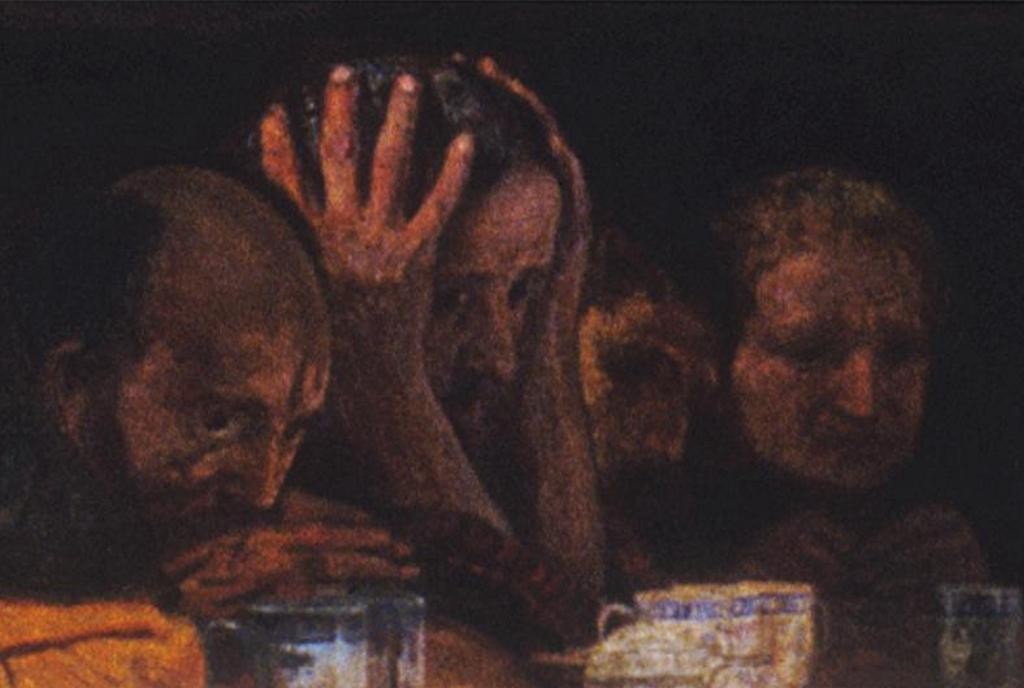
When looking for an image to go with this particular blog I came across this poignant painting. I would not dare to suggest what the artist, Michael Cook’s own thoughts were behind its composition, but it speaks to me of longing and hope, that in the midst of war there is a reason for fighting and a dream that new life will come, and that swords will truly be made into ploughshares. This beautiful piece of artwork was commissioned by Melbourne Parish Council to commemorate the centenary of the Armistice, and all money from sales goes back to the Parish Council. https://www.hallowed-art.co.uk/product/swords-into-ploughshares/

Agape

Two autumnal maple leaves held together to recognise differences in the church that we hope and pray will look for unity rather than division through the shedding of Christ’s blood.

My focus as an ally of LGBTQ+ fellow Christians and those of other faiths and none, was honed by several woefully inadequate letters of apology by the bishops and leaders of the Church of England over the last few years. Through prayer, study and listening, I have concluded that there is no reason, apart from historical conservative dogma, that I cannot afford to offer the same love and blessings to all who seek to celebrate that love within the church. However, I am currently prevented from doing so.

Slow progress has been made, and the Living in Love & Faith (LLF) process has given hope that things would change and that, whilst a singular marriage service for all couples was not yet available, there was the opportunity to offer a service of blessing using the Prayers of Love and Faith resources. Despite this, the House of Bishops have recently announced that further developments would be ‘subject to further synodical processes’. Without wishing to question the wisdom and faith that brought about this decision, like others, I recognised that this was no pastoral letter, as it appears God and his people did not get a mention.

Some have indicated this sounds the death knell to any chance of same sex marriages within the Church of England, but I do believe that God moves in mysterious ways and that their is always hope that His love will overcome.

Holy Saviour,
Agape instigator,
Sentinel of justice
and of peace.
You offered a sacrifice
so costly, we cannot repay.

Whose unconditional love
is poured out
like a mighty flood;
saturating each and every soul,
to overflow to others
regardless of attitude.

Flowing to those who believe,
and those still blind.
Poured equally on those
whose prayer is grace and mercy,
and those whose words
become a shibboleth
of division and disunity.

Showered down alike
on those who live your Word
each and every day,
and those who seek to
misinterpret and subvert
with hidden agendas.

Still that love is offered,
justly on those who witness
to the ends of the earth.
and to those who speak
only of process not people,
in pharisaical fashion.

Encompassing all,
this love is offered.
To be shared not denied,
to be lived not theorised.
to be available not withheld.
Regardless of cost.

This is a boundless love,
yet some would tarnish its name,
and constrict its power,
masking it as truth,
constructed of meanness and hate,
of abuse and wounding.

Let it be not so,
for the rock on which
your church was built is firm,
this present stumbling block
will be removed,
and love will conquer in the end.

If you want to see and hear what affect these decision have on people then the Dean of Southwark Cathedral recently gave an incredibly moving sermon based on his experiences https://www.youtube.com/watch?v=LLM_J8YH8Fk

The Inclusive Church network, of which my church is a member, is also asking Church of England members to sign an Open Letter to express our sadness and disappointment at the recent decisions taken by the House of Bishops. If you feel able, please do so here. No voice will go unheard https://www.inclusive-church.org/llf-open-letter/

The Perfect Time In The Perfect Way

Sermon preached on Holy Cross Day – 14th September 2025 based on Philippians 2:6-11, John 3:13-17

May I speak and may you hear through the Grace of God: Father, Son and Holy Spirit. Amen

This morning, I want to start with a series of question for you to think about. What if Jesus had never come 2000 years ago, and instead was born just before the beginning of the twenty first century, around 1992 say?  What would his birth, life and ministry have looked like in the present day, but more importantly, how would it end, in order to produce the same results of millions of people coming to believe in him and in God as part of a worldwide religion?

Would he have been shot with an assassin’s bullet? Both the good and the bad have died in this way. Would he have been caught up in some major disaster, helping others and dying? With all of the social media available today, would his death have been filmed and the world clicked more than a million times on the video, with sad, caring emojis, whilst the responses became full of condolences, tasteless humour and vitriolic comments?

The problem is – and it’s not one that I want to try and reconcile at the moment – is that being legally condemned and sentenced to death is no longer an option in our justice systems.

Which is why I believe that Jesus died at the perfect time and in the perfect way.

Whatever we might think of the Jewish or Roman systems of justice, the fact that it offered crucifixion as the ultimate punishment, has enabled us to use it as means to truly see the extent of God’s love for the world and us as individuals. Which is why today the church celebrates Holy Cross Day in its calendar of liturgical feast days for remembering and honouring saints and on this occasion holy objects.

From as early as the seventh century, the church celebrated this feast day to acknowledge a particular event. This was a discovery on the 14th of September around 326AD, by Helena, the mother of the Roman emperor Constantine, of what many believed to the empty tomb and true cross of Christ during a pilgrimage to Jerusalem.

She had ordered a pagan temple to be destroyed, which revealed, buried underneath, three crosses, which were assumed to be the crosses of Jesus and the two thieves. A painting by Agnolo Gaddi completed in 1380 in the choir of the Franciscan Basilica of the Holy Cross in Florence (see image above) depicts Helena making this discovery.

A first glance the painting presents six crosses, which makes it look a little like a builder’s yard in which Helena is trying to decide which cross is the real one. However, closer inspection reveals that the artist has joined two parts of the story together into one image, and on the left-hand side, in order to determine which one is that of Christ, Helena has a dying woman in a bed brought to the site, who was completely healed at the touch of the third cross. The right-hand side appears to be the cross being erected on the site of the church of the Holy Sepulchre that Emperor Constantine had built at a later date.

The story was also recorded by Jacobus de Voraigne in his book, The Golden Legend, which became an immensely popular and influential source of Christian lore during the Middle Ages, providing a convenient educational resource for clergy and laity alike, presented in an accessible, narrative style. It was one of the most widely read books of its time, second only to the Bible, and significantly influenced medieval art, poetry, and stained-glass windows, allowing ordinary, everyday people the chance to visualise the stories, many of which they were unable to read for themselves.

Helena’s ‘True Cross’ was subsequently brought back to Europe as a prize of the early church, and as news of it began to spread, countless pieces and splinters began showing up all over the continent.  The great majority, however, were forgeries (many made from wood that does not even exist in the Holy Land); and while Helena’s cross probably did come from Jerusalem, and while it almost certainly was a real cross in the sense that it was used for executions, there would have been hundreds, if not thousands of such crosses in Judea, to which we should add the likelihood that recycling, decomposition and the conversion to firewood after too many uses, makes its authenticity questionable.

Based on this, it is highly unlikely that the actual physical cross on which Jesus died would have been discovered. The fact is we don’t really need it to be so, because rather that seeing the cross as an object of worship in itself, it is better to recognise it as a symbol of Jesus’ sacrifice and salvation. It reminds us to boast in nothing, ‘except in the cross of our Lord Jesus Christ’.

We may regularly make the sign of the cross and many choose to bow to the cross in our liturgy, not as an idol to be prayed to, but a potent visual symbol that embodies the depth of God’s love and the height of Christ’s glory at the perfect time and in the perfect way.

The cross is both scandal and glory, weakness and power, shame and victory. When we look at the cross, we see the deepest mystery of our faith: the Son of God humbling himself to the lowest place in order to raise us up to life. The cross is not an accident of history, but the perfect plan of God’s redeeming love.

Paul tells us whilst Jesus had equality with God he does not cling to this glory. Instead, He empties himself, taking the form of a servant, entering our humanity, and embracing the frailty of flesh, which means he goes lower still, through obedience to God and to death, through the most shameful, agonizing death the world could imagine: the cross; …which was the lowest place imaginable. It was not only brutal but humiliating, reserved for criminals, designed to shame as well as kill. This shows us how far God was willing to go for our salvation. It strips away any illusion that we can earn God’s love.

As Jesus explains to Nicodemus, the Son of Man must be lifted up, which refers both to the cross and to his glory and exaltation. ‘For God so loved the world’ and the cross is the measure of that love. The cross is not about wrath unleashed but love poured out.

And we know that the story does not end in humiliation. The cross is not just a place of suffering. It is the turning point of history. It is the moment when the King is revealed at the perfect time and in the perfect way —not in worldly power, but in sacrificial love. His throne is a cross. His crown is of thorns, and he reigns forever.

The cross is our landmark, our anchor, our hope.

At the cross we see the depth of God’s love—so deep that He gave his only Son for us.

At the cross we see the height of Christ’s glory—so high that every knee will bow before him.

So let us look to the cross—not as spectators, but as believers.  We must allow it to shape how we live. We are called to humility, to self-giving love, to obedience to God’s will. The cross calls us to trust—not in our own strength, but in the love of God revealed in Jesus.

To take up our cross is to walk the path of humility, to put others before ourselves, to live in sacrificial love. The world may see that as weakness. But at the foot of the cross, we know it is the way of Christ, the way of true life, in fact the perfect life, to be lived at the perfect time and in the perfect way. Amen.

Do You Know How Much That Cost?

Sermon preached on Passion Sunday 6th April 2025 based on John 12:1-8 and Philippians 3:4b-14

‘Do you know how much that cost? I could have used that for a lifetime,’ was the heated response to discovering my best perfume bottle smashed on the bathroom floor and my two daughters looking guilty, but both ready to finger point the blame on the other. ‘But mummy, we were playing princesses and you always look like a princess when you go to one of daddy’s balls, and we wanted to smell the same’.

How could one carry on being angry, with that explanation, but I did try hard for a little while longer and there was no pudding at dinner time…

The fact is we make a lot of value judgements, about things that we think are precious, we sometimes even hoard things, thinking that one day we will benefit from being the only one that has a year’s supply of toilet paper, and we salt our money away forgetting that it will be of no value to us when the final curtain comes down, and we have not made any memories for those who come after us to share.

Now I’m not suggesting that we should waste these things, and we are not going to solve world hunger or provide for all those less fortunate than ourselves overnight, but knowing when to be generous, not only with your money or your time but your love is surely more important.

In our gospel reading today we find Jesus once more visiting the home of his dear friends, Mary, Martha and Lazarus. He is on his way to Jerusalem to face a fate that will ultimately prove all of the things that he has taught his followers and fulfil the prophetic messages that the Saviour of the World, the Messiah has lived among them. It’s a fate that he accepts willingly but which is much harder to accept for those who have loved and known him as a man living among them, a man which the words of one worship song describes as ‘way maker, miracle worker, promise keeper, light in the darkness’.

Of all the people surrounding Jesus that day in the house, it was Mary who realised that now was not the time to hoard her most precious possession, but to use it unstintingly to show her devotion to the person who had commended her choice to sit at his feet and had taught her everything she needed to know about how life should be lived.

Now it was her turn to offer a deep reverence and recognition of Jesus’ impending sacrifice. It also held a rich symbolic meaning, that through the act of anointing, an action usually reserved for the consecration of priests and kings, she recognised Jesus as the true Messiah. Where she once sat, she now anoints his feet with her hair, displaying humility and devotion.

Her use of pure nard, a valuable and aromatic oil, signifies the importance and sacredness of the moment, and its perfume was bittersweet, filling the house with its fragrance, but also a prophetic act foreshadowing Jesus’ death and burial. His acknowledgement that this was done ‘in advance of my burial’ also allows us, who already know what is to come, that there would be no need to follow the normal burial rituals as there would be no body in the tomb which to anoint!

Still, there has to be a killjoy to this incredible act of devotion, and here is where Judas steps in. I have to admit that having written a thesis on whether he might be identified as God’s scapegoat, I have own up to having a soft spot for the reviled figure of Judas.

Without Judas at this time there would have been no ‘betrayal’, no manipulated trial, no crucifixion and thereby no resurrection. Perhaps it was inevitable that someone amongst his followers would have eventually turned against him, with the promise of financial reward, but the poignancy that it was one of the disciples at this point in the story is both hard for us to comprehend as its consequences were to be for Judas.

Being a disciple meant having a unique and intimate relationship with Jesus, which makes Judas’s later actions even more significant and tragic. John’s stark statement, ‘the one who was about to betray him’ foreshadows the fulfilment of Old Testament prophecies, such as Psalm 41:9, which speaks of a close friend lifting his heel against the psalmist.

Even my close friend, someone I trusted, one who shared my bread, has turned against me.
Psalm 41:9

Moreover, Judas’ betrayal is a critical event in the Passion narrative, raising questions about predestination and human responsibility, as Judas’ action were foreknown by Jesus, yet he acted of his own volition. Here was someone who must have grown to know the true value of being one of Jesus’ disciples, but who wasn’t ready to give his all if it meant giving up what was precious to him, his life, which is ironic as his decision ended up with him doing just that.

Judas’s questioning attitude contrasts with the faith and devotion expected of a disciple and follower, highlighting his internal conflict and eventual betrayal. For John the Evangelist, who was writing his gospel some fifty years after the events of Jesus’ passion, his thoughts about why and what Judas had done had not improved with age. His scathing remarks about a thief, who stole from the common purse, does not speak of love and forgiveness, and by this time the name of Judas had become an idiom to mean someone whom you accused of being deceitful and a betrayer of friends or country.

And then there is Paul, persecutor turned zealot, but with good reason. As a 1st century Jew, he could claim to have attained a sufficient righteousness before God, exemplified by adhering to the Torah’s commandments and engaging in acts of loving-kindness, aiming to be a light unto the nations and fulfilling his purpose as one of God’s chosen people.

Yet this valuable store of righteousness, is being cast aside in exchange for what Christ is offering instead. Not a righteousness ‘that comes from the law, but one that comes through faith’. Everything is being swept aside as ‘rubbish’, of so little worth because of the value of the heavenly prize that Jesus offers, eventual resurrection from the dead.

So where do we see ourselves in all of this? Are we willing to give up everything? Do we give up those things that are precious to us to show how much faith we have?

The fact is each and everyone of us is seen by God as individuals, people who face daily decisions about how we live our lives. He knows the choices we have to make about how we spend our time and our money, but more importantly about how we share our love and our care for others. How we share the Good News that Jesus’ passion brings for all of us.

Perhaps this could be a new beginning as once more over the next couple of weeks we are going to hear the story of the greatest gift ever offered to us all. Let’s just make sure that we really hear the message and be prepared to accept and continue to generously share it each and every day going forward.

Amen

Keeping Faith

Sermon preached on Sunday 23rd February 2025 based on Luke 8:22-25

May I speak and may you hear through the Grace of our Lord; Father, Son and Holy Spirit

I wasn’t expecting to end up in A & E on Tuesday, I certainly hadn’t planned to be, and I didn’t know it was going to last a whole twelve hours. The day has been going so smoothly, car in the garage having new tyres fitted – tick. A pleasant visit exploring the many delights of the garden centre, including a delicious lunch in the company of two granddaughters – on their best behaviour – tick. Excited chatter in the kitchen as baking with granddad got underway and flour and eggs were beaten and cracked – tick. Just the dog to take for a walk, to get some chocolate buttons requested for decoration requested…

The thing about tripping over your own feet is that it is totally unexpected. One moment admiring the spring flowers in the gardens, the next lying prone on the pavement, having connected head with said surface with an almighty whack. Two passing motorists stopped to come to my aid, and an informal paramedic examination by my son-in-law advised me that it really was necessary to go to A&E and that I couldn’t just stick a plaster on it and carry on.

I have the say that the first three hours were somewhat unremarkable after the initial flurry of information exchanged with the admissions team as I watched a lot of people coming and not going, some in obvious pain and suffering, others beyond pretending it was all going to be fine because their bodies showed clearly their illness, and others more stoic, but nonetheless anxious because of the unknown.

At this stage I very tentatively asked the million-dollar question – and was told very politely, ‘how long is a piece of string’ and that I hadn’t been forgotten, I was moving up the list and patients were being seen in order of need. Everybody in that waiting room was in the middle of a storm, which for many had blown up out of nowhere. They were frightened and lost because there was no clear sense of when or how they would be able return to normality. A fear of not being in control to make their own decisions.

Which is exactly how the disciples were feeling. They had been with Jesus for only a short time but had already seen things that confirmed their belief in Jesus, but which were also beyond their natural comprehension, the raising of the widow’s son and healing through faith alone. One can imagine that sitting listening to Jesus preaching a series of parables from a little fishing boat, pushed out a few feet from the shore was thought provoking and challenging, as well as the crowds that were beginning to gather in their thousands to hear what he had to say on that shoreline in Galilee.

However, according to Mark’s gospel, the day is drawing to its close and Jesus wants to get to the other side of the lake, as the Sea of Galilee was also known. Saying farewell to the multitude of people, they push away from the shore to head out into the deeper water. Nothing about this is usual, this shoreline and particular body of water is home to several of the disciples; they know this lake like the back of their hand. Even sailing into the sunset would not have been unusual, as they were used to fishing through the night.

It had obviously been a long day for everyone, and so it was hardly surprising that ‘while they were sailing, he fell asleep’. Jesus is exhausted. There is no doubt that he is entirely divine and yet he is at the same time entirely human. He gets hungry and thirsty, and he suffers pain and weariness and the need for sleep. He was worn out and asleep.

However, Luke’s account is about to give us one of the most interesting displays of Jesus’ two natures: human and divine. His physical weariness as a man, and as we shall see, his divine influence over nature.

Suddenly, a gale swept down the lake. Again, nothing that may be considered unnatural. Every time a fisherman got into a boat on the Sea of Galilee, they knew the risk. This lake is nearly 700 feet below sea level, surrounded by mountains. Deep ravines coming down the mountains act like funnels for the wind, picking up incredible speed. And that cold air rushing downwards collides with the warm air on the lake and creates hurricane conditions and 20-foot waves without warning.

The boat was filling with water, and they were in danger. The boat they were in was no modern-day fishing trawler, it would have been no more than an oversized rowing boat, and in the midst of this storm, Jesus is sleeping. What to do then?

Our first question might be, how can he still be asleep, does he not know what is happening, what we are going through. I wonder if sometimes we think this when we’re in the middle of our own storm, although we might not say it out loud. Because surely, he knows everything. Maybe he does know, but he doesn’t care. One wonders why the disciples didn’t try and wake Jesus up at least ten minutes earlier, when the storm was developing, why wait till the boat was swamped? Again, many of them were fishermen, and here was a carpenter. They had seen this before and had lived through storms – just keep bailing water James and John, we can handle this!

It would be easy to criticise the disciples for failing to simply put their faith and trust in Jesus, but I wonder what our faith and trust is doing in unexpected, difficult, dangerous, painful, confusing, life-threatening situations?

Finally, in desperation, they wake him up, shouting, ‘Master, Master, we are perishing!’ And he awoke and rebuked the wind and the raging waves; they ceased, and there was a calm. The 20-foot wave heading their way, which sees them crouching down, arms covering their heads, never reaches them, instead the sea is like glass; everything is immediately still. I bet none of us has ever splashed or stirred water to find it completely motionless when we stop, but then which of US has a divine influence over nature.

He said to them, ‘Where is your faith?’. He isn’t saying ‘you have no faith’ but asking them, ‘Where did your faith go?’. Because the problem when we face unexpected tests in our life, it isn’t that Jesus isn’t there for us, it’s that our trust in Jesus goes missing. Again, the problem isn’t that Jesus stops looking after us, the problem is we stop looking to him.

In this and other similar situations, Jesus demonstrates his power and divinity, ‘Who then is this, that he commands even the winds and the water, and they obey him?’

But at the heart of everything is his love and care for each of us. Certainly, Jesus may not eliminate every storm, but he guarantees his presence in every storm. He might not calm the waves and the wind, but he is able to bring a calm to our troubled hearts. So that we too can be still and know that he is God.

Back to that waiting room, then, and please don’t think that this is in any way a complaint about the service that I received. The NHS is a megalithic machine but the cogs that keep the wheels turning couldn’t be praised more. From the nurse who walked an elderly gentleman to a nearby bus stop to make sure he could get home, to the young mum reassured that her young child was not causing a disturbance because she had had to bring her with her as she accompanied her own mother; to the cup of tea offered, unrequested just at the right moment when refreshment was needed. At each and every turn there was kindness and compassion, reassurance and a genuine desire to bring calm to troubled waters. It certainly restored my faith in the system.

Original artwork by Bernard Allen, The Calming of the Storm

Your God Is My God

Continuing our Old Testament series, a talk based on Ruth 1: 1-18, 22

May I speak and may you hear, through the Grace of our Lord; Father, Son and Holy Spirit. Amen.

Ruth – one of only two books of the Old Testament dedicated to the life story of a woman. So their place in the Jewish faith must warrant special consideration. Mild, obedient, and virtuous; or free-thinking, feisty and highly respected for their own worth? As always, their characters are a mixture of both. Bound by their culture, limited by circumstance, yet determined to make a distinct mark on history.

Culturally, Ruth was a Moabite; a point made clear in the opening verses, part of a group of West Semitic people who lived in the highlands east of the Dead Sea. The land of Moab had been established by its namesake, Moab the son of Lot and a nephew of Abraham. But his parentage was ill-desired being born of an incestuous relationship between his father and Lot’s daughters and God was not best pleased by this or their worship of foreign gods. Hence there was a history of condoned conflict between the Moabites and Israelites.

Yet our story begins with a family seeking respite from a time of famine in the land that last week we heard described as a land flowing with milk and honey, and a promise that God would be with them against anything they would face. The land though was under the control of the Judges. A people, who had trusted God to get them through the wilderness were now a people loosely connected within a judiciary system, but also a period when ‘everyone did what was right in their own eyes.’

Everyone did what was right in their own eyes
Judges 17:6

A lack of trust in God and sense of thinking that he knew best finds Elimelech uprooting his family and taking them to live in this neighbouring country, where they integrated themselves further after his death by his son taking Moabite wives. But this land, where the grass had seemed to be greener was about to become a place where three women were left in a place of real vulnerability.

Perhaps at this point though we should consider the thought of what it means to continue to place your trust in God in the difficult times. What it might have looked like if they had stayed in Bethlehem? What it means for us to trust God when our head and our heart are telling us different things, because as we will realise later, the move to Moab may have been hasty.

However, back to the situation in Moab. Three women widowed in a society that provided rules for what should happen to them – in fact it was a God given command to care for the widow and the orphan, and the consequences for not doing so were to incur God’s anger as expressed in Exodus (22:23-24), ‘If you do mistreat them, I will heed their cry out to me and my anger shall blaze forth.’

On a practical level, Naomi had some protection through her marriage – as when she had married Elimelech she became part of her husband’s household, and now without sons – who would have taken on this duty of care – she came under the protection of her former husband’s male relatives. Where did that leave her two daughter-in-laws though? In theory they could have married another of Naomi’s sons, which Naomi points out is likely to be a physical impossibility, and she is certain that the decisions made by her dead husband have brought about a loss of God’s blessing.

In addition, whilst she is returning to her own culture, the younger women would be abandoning their own. Hence Orpah decided to stay in Moab and return to her family. Ruth, however, sees an opportunity for a new and different life. Her genuine love and respect for Naomi is passionately declared, ‘where you go, I will go… Your people shall be my people, and your God my God.’

For Ruth, this meant forsaking her homeland to help provide for Naomi with no guarantee of security for herself. Ruth expressed her loyalty to Naomi in a solemn vow, calling judgment upon herself if she ever left her. More tellingly though, Ruth made a commitment to follow Naomi’s God as well. She would abandon the gods of Moab, and Ruth and Naomi would both be committed to the one true God of Israel. Significantly, when Ruth said, ‘May the Lord do thus and so to me… if even death parts me from you’ she uses the covenant name Yahweh, which convinces Naomi that Ruth was serious.

The story of Ruth and Naomi shows what true loyalty is like, but in addition to loyalty, Ruth exhibited respect, love, friendship, and humility. Just as she chose loyalty to Naomi and to Naomi’s God, it shows us how we should choose loyalty to God and to his people over any commitment to the world. To trust rather than to worry, as Jesus tells us in Matthew’s gospel (6:33), ‘but strive first for the kingdom of God and his righteousness, and all these things will be given to you as well…

Our thoughts can be deceptive, often strong and confusing, but we can always come to God and ask him for wisdom and insight whenever we need it. In the meantime, hang in there, and trust that he does know where he’s going and where he’s leading us! For Ruth, though, the risks were great and there were many unknowns, but like Jesus’ friend Mary, Ruth had chosen the most important thing. Her mind was made up, because she knew the person she was following, just as we can know the person of Jesus.

In Bethlehem, the harvest had begun, and Ruth’s loyalty was followed by the provision of many blessings. She was to remarry, to a man she truly loved and would give birth to a son named Obed, who would be the grandfather of King David, and provide a direct lineage to Jesus himself.

I found him whom my soul loves. I held him, and would not let him go.’
Song of Solomon 3:4

Despite Ruth’s non-Jewish, outsider status, God worked through her life to change the history of the world. In Song of Solomon, the bride, representing us, God’s beloved, clings to her bridegroom, ‘I found him whom my soul loves. I held him, and would not let him go.’ So, hold on tight, everyone, and don’t let go. The road ahead may be difficult, but there’s a great future to look forward to. Amen.

Go back

Your message has been sent

Warning
Warning
Warning
Warning.

Where Were You?

When they ask, ‘Where were you the day that Jesus died?’ What am I going to tell them?

That I was standing at the foot of the cross, comforting his mother? That I was berating the authorities and telling them what a mistake they were making? Or that I was locked in a room in full self-preservation mode?

What have these last three years taught me, if not to take chances, to shake a soft fist at those who misuse their transient powers and to trust that God has everything in hand. But now the man, who was showing us a new way of living, who was a true teacher of what it means to love God and to love one another; the man whom I was proud to declare as ‘the Messiah, the Son of the living God.’ My closest and most dearest friend, has gone, and perhaps with it all of our hopes and dreams.

Yes, there were signs and warnings, he’d tried to prepare us, but perhaps we were too slow or too dull to really understand what he was talking about. Why would he look at me, Simon, son of Jonah, simply a fisherman and see someone who would be a rock on which to build anything, let alone his church.

How could he trust me to do such a thing, when I couldn’t even trust in him, even though he showed me time after time that I should. That it was possible to step out of my comfort zone and achieve the impossible. How confident I had felt when he told me to do just that and step out of the boat onto those foam flecked waves, eyes set firmly on him, able to walk as he walked. Until my trust wavered and was replaced by this same fear. Even then he caught me, but who will be there now to catch me when I fail, as fail I surely will without him.

So many incredible things that I’ve witnessed, the things we couldn’t explain, miracle after miracle, yet he couldn’t have done any of them if he wasn’t truly God’s Son. Not only satisfying people’s bodies with such meagre portions, the five loaves and two fishes, but curing their ailments, restoring their dignity, giving them another chance in life.

And those whom he literally did give them another chance to live, raising the widow’s son and Jairus’ daughter, and his dear friend Lazarus. I remember Martha, so annoyed that we were delayed, yet still hoping for the impossible, and sweet Mary, whose tears moved him and all us to tears. His breathing life back into them all to show God’s glory, but where is His glory now?

So many people whose lives have been turned around simply because they believed in him. A man who broke the rules to show us what was really important and all I could do at the end was to deny I even knew him. Such shame I will carry deep in my heart all the days that I have left to me.

Indeed, this weight of sorrow bears me down, yet it is nothing compared to the agony he must have suffered. John, with the assurance of youth, was brave enough to be with him at the last and has told us of the cruel way that they treated him. His head already bleeding from the crudely fashioned crown of thorns, they made him carry is own cross, the sheer weight of it too much, that it caused him to stumble and a complete stranger from the coastal town of Cyrene was made to help him. How ironic that it was my namesake that did what I should have been brave enough to do.

And then the taunts and jeers; the deep sorrow of the women and the unconscionable behaviour of the guards, gambling for his clothes. Yet, all who witnessed it to the very end say that his thoughts were for others, asking that they be forgiven, with his talk of paradise and concern for others future well-being.

This human life, so precious to us, that we cling to it as if there is nothing else that matters, yet His has been taken away. Did he feel that he had been abandoned? Forsaken, by his friends, by God himself? Even the one who betrayed us all, Judas, is dead. His heart and mind so full of despair and darkness that he couldn’t bear what he had done.

And when the end came, the sheer dark void of the moment, the world plunged into night as the light of the world was extinguished by those whose power is fickle and fleeting. Surely, theirs is not to be the triumph.

As he died, so the earth trembled and shook so hard that it tore not only the temple curtain in two, but each of our hearts. We will wait until it settles again and use the tools he has given us to try and tell the world what he lived to show us. That we must turn once more to God, to trust in his goodness and mercy and live lives that reflect his love for us, for each other and for Him.  

His body is now sealed in the cold of the tomb and no doubt the women will honour it once the Sabbath is over. But our greatest gift will be to keep his memory alive. For there can be no more talk of abandonment. Our work is just beginning.

When they ask, ‘Where were you the day that Jesus died?’ What am I going to tell them?

Amen

Go back

Your message has been sent

Warning
Warning
Warning
Warning.

Children Of God Through Faith

Sermon preached on the 1st Sunday of Trinity based on the readings Galatians 3:23-end and Luke 8:26-39

May I speak and may you hear through the Grace of our Lord: Father, Son and Holy Spirit. Amen

The importance of being aware of our state of mental health is a topic that many of us have come to recognise over the last couple of years. For a long time this subject was hidden away like the people who were affected by it.

Prior to and including the 19th century the authorities thought they had the answer and gathered those afflicted (and sometimes those who were not) into asylums where they could be treated. Perhaps the most famous of these was the Bethlem Royal Hospital, known better by its synonymous name of Bedlam. The buildings of this psychiatric facility were dirty, dark, and cold, with no windows and no hot water. When a group of MPs visited the hospital for scrutiny in 1814, they were shocked at the sight of the small cells where people were chained to the beds or walls. Just one blanket was provided to each patient to protect them from rats and cold. The hospital was even once a popular tourist attraction in London, offering morbid entertainment to the curious.

The Victorians made more humane changes to the way that these patients were treated, but it was still an ‘illness’ that was managed rather than cured. Treatments were often brutal, though bloodletting, purging and electric shock treatment. For many years same-sex attraction was also regarded as a mental illness and right up until the late 1980’s people underwent electrical aversion therapy; who can forget the treatment of Alan Turing.

Of course, medical understanding has advanced enormously over the years, but in Jesus’ time people who were suffering mental illnesses would have invariably been described as being ‘demon possessed’ and this morning we meet one such man.

However, this is not a man who has been shut away, this is a man who has been shunned by society, homeless and alone. As a Street Pastor, I would meet many people living on the streets, and I mean literally living on the streets. No home comforts of three-square meals a day or a warm shower every evening. Their beds were the dark corners of a municipal car park on plastic and cardboard, surrounded by the smell of urine and narcotics. No wonder depression and psychiatric illnesses were common. Now that is not to imply that all homeless people will suffer from mental illness, but very often mental health is affected by homelessness.

There was always the need to see beyond the grime and dereliction of self-worth to the child, son, father, husband, mother that this person was before and still needed to be. When Jesus encounters the demoniac at Gerasene his desire was to restore the man, so that he could play his part in telling others what God could do for them.

The casting of the evil spirits into the swine may have produced a spectacle that amazed and terrified its onlookers, but its effect was to bring people running towards Jesus rather than away.

Jesus’ ‘treatment’ of the demoniac was one of love and caring. The people found him at Jesus’ feet, calm and restored, a world away from the human that they had bound in chains and shackles to protect themselves.

Was the demoniac cured? We would hope so. Would he suffer from future psychotic episodes? We would hope not. But what he would be as he returned to live in society, was released from feeling unloved and rejected. His encounter with Jesus had produced a purpose and a mission to tell his story in order that others might come to see for themselves what Jesus could offer them.

Setting aside his medical rehabilitation, this man had found faith. It had been revealed to him through Jesus’ actions, but what had brought Jesus, from the northern town of Capernaum to a place situated about thirty-five miles south east of the southern end of the Sea of Galilee, in a country that was at that time part of Syria, rather than Israel? This is indicated by the fact that a herd of swine was being kept nearby, which would have been forbidden by the Mosaic Law, since swine were unclean animals.

Paul may have been called the apostle to the Gentiles, but Jesus also extended God’s mercy to both people and locations that were outside of Israel, as he did for the Syrophoenician woman’s daughter and here in the Decapolis region. Both of which are an example and foreshadowing of the manner in which salvation through faith in Christ was later to be offered to Gentiles as well as Jews.

This morning the Galatians, in what is now modern-day Turkey were hearing the Good News that all are one in Christ, and that same promise is given to us right here in our church and community. There is no-one that God can’t use to get his message across, and no-one will be rejected if they have faith through Jesus

Within God’s kingdom there is no-one, male or female, sane or insane, gay or straight, believer or non-believer who is not a child of God through faith.

Amen

Go back

Your message has been sent

Warning
Warning
Warning
Warning.

Life In The Middle

Sermon preached on Sunday 15th May 2022 at the beginning of Christian Aid Week based on the readings, Acts 11: 1-18, John 13:31-35 and Revelation 21:1-6

May I speak and may you hear through the Grace of our Lord: Father, Son and Holy Spirit. Amen

Today marks the beginning of Christian Aid Week and later some of us will enjoy a meal designed to raise funds for the work that the charity carries out around the world. Their recently retired CEO, Amanda Khosi Mukwashi, whom some of us will recognise from our Lent Course1, has spoken about the work of Christian Aid being based on three pillars, poverty, prayer and prophetic voice.

As she has said, ‘extreme poverty robs people of their dignity and denies them their rights. It renders them powerless and unrepresented, and vulnerable to abuse.’

The charity works with the poorest of the poor in some of the hardest to reach places in the world. When natural disasters strikes they are almost always one of the first aid agencies to be on hand to assist and give relief. However, what they would rather see is the world free from poverty and need. Hence their slogan ‘Life before death.’

Those three pillars, poverty, prayer and prophetic voice are reflected in our three readings this morning, and I say three readings because although we haven’t heard one because of the necessity of hearing Acts as well as a Gospel reading; the missing one from Revelation is quite possibly one of the most beautiful and hope filled passages in the bible, which is why it is so often chosen as a funeral reading.

Paraphrased from Revelation 21:1-6 ‘Then I saw “a new heaven and a new earth,” for the first heaven and the first earth had passed away … And I heard a loud voice from the throne saying, “Look! God’s dwelling place is now among the people, and he will dwell with them… ‘He will wipe every tear from their eyes. There will be no more death’ or mourning or crying or pain, for the old order of things has passed away… I am making everything new!”

Here is life after death, a promise for all those who believe, brought about by the death and resurrection of Christ. But until that unknown future time, we are called to do all we can to make this current world a place where people have the opportunity of life before death.

34 I give you a new commandment, that you love one another. Just as I have loved you, you also should love one another. 35 By this everyone will know that you are my disciples,
if you have love for one another.’ John 13:34-35

Jesus tells his disciples that ‘where I am going you cannot come,’ which isn’t a final negative but a ‘not yet.’ Instead, he gives them a new command and direction that they are to use the love he has shown them to be reflected in what they do and say amongst themselves and towards others, so that through love others might be relieved of things that cause pain and sorrow; including the crushing pain caused by poverty.

We have so much that we take for granted in the developed, capitalist and also to a considerable extent communist, industrialised countries of this world, and democracies that give us what we see as inalienable rights. However, we should not forget that despite differing political systems or geographical climate, every person on this earth is deserving of a life to be lived in dignity and safety. If we are to be true disciples then we need to find ways to bring Christ’s love to all those in need wherever they are.

Sometimes, the only way we can show our support for others is through prayer. Prayer doesn’t make us lazy or inactive; prayer can be the most powerful weapon we have to change lives. Prayer connects us with God and can be an insight into what he is doing and calling us to do.

It also gives us an opportunity to hear his prophetic voice. For Peter, his experience literally changed the course of the early Christian movement. Now longer was this to be a Jewish Christian sect but was to be a way of life that was available to all people. God’s chosen people had actually been chosen to witness at first hand the power that could change people’s lives.

For Peter, the prophetic vision and subsequent meetings with the gentiles confirmed that God was the God of all peoples. It turned Peter’s world upside down, set aside life-long rituals and blessed him with the understanding that he was, ‘not to make a distinction between them and us.’

The giving of the Holy Spirit, in the same way as the disciple had received it, displayed the true nature of God, that love was the most powerful gift that could bring life to all.

Love can help us move mountains. It can make us generous with our wealth, our gifts, and our time. It can turn the world upside down so that everyone is given the opportunity to experience life in all its fullness before being called into what will become the glorious infinity of a new earth and heaven.

 Love will ultimately crush poverty; prayer will bring about change and God’s prophetic voice will be heard and seen. ‘I am the Alpha and the Omega, the Beginning and the End’ for now though it’s what we do in the middle that’s important.

Let’s then make sure that how we choose to fill that time is by doing everything we can to bring about life before death for all.

Amen

Go back

Your message has been sent

Warning
Warning
Warning
Warning.

1The Lent Course in which Amanda Mukwashi featured in was Embracing Justice by Isobelle Hamley

Listen… Learn… Love

Sermon preached on Sunday 5th September 2021, introducing the Pastoral Principles of Acknowledging Prejudice and Speaking Into Silence ahead of the Living in Love and Faith course to be run at St James’ Church, West End in October 2021. Using the lectionary readings of James 2:1-10, 14-17 and Mark 7:24-37

May I speak and may you hear through the Grace of our Loving God; creator Father, redeeming Son and sustaining Spirit. Amen

 On the bottom of my emails I have a quotation of Martin Luther King, which says, “Our lives begin to end the day we become silent about things that matter“. Of course, for King the silence was to do with the discrimination of black people, mainly in America, but also around the world, where people’s skin colour was deemed to be the only necessary indicator of sub-humanity and therefore gave others the right to mistreat, subjugate and even kill a black person with no recriminations or sense of guilt.

At some point, someone, somewhere must have pre-judged this human being who stood in front of them, a mirror of shape and form of themselves, but a different hue, and persuaded others that this was the case. They must have had power and authority that enabled them to do this, and took others silence as acquiescence and so it became accepted as the norm which people passively accepted and taught their children and children’s children that this was how it was. If anyone did protest, the power of common psyche overrode any objections, and silence was easier than speaking out. A silence that speaks volumes.

Some of you will have heard me quote the poem from Martin Niemöller about the Jewish Shoah in World War II, ‘First they came for the Jews’ in which a person remained silent whilst the Jews, the communists, the trade unionist were taken without anyone speaking out, until it came to their turn, and they realised that ‘there was no one left to speak out for me’. In many cases this silence was because of fear; fear of the Nazis and the power that they wielded, fear of being the one who spoke out; fear of going against the norm.

One question that is often asked is what were the Christian communities or individual doing whilst both of these unspeakable chapters of human history were taking place? For many Christians their position was actually dictated by scripture. They searched the bible and found passages that supported their stance, particularly when God made a covenant with Abraham in regard to circumcision, ‘Then Abraham took his son Ishmael and all the slaves born in his house or bought with his money… that very day Abraham and his son Ishmael were circumcised; and all the men of his house, slaves born in the house and those bought with money from a foreigner, were circumcised with him (Genesis 17:23, 26-27). Here was their evidence that God condoned slavery

Many Christians saw this as meaning that slavery was morally acceptable. In fact, a Methodist preacher George Whitfield said, ‘As for the lawfulness of keeping slaves, I have no doubt, since I hear of some that were bought with Abraham’s money, and some that were born in his house’. George Whitfield himself owned slaves and campaigned for slavery to be reinstated in the American state of Georgia after it was abolished there in 1751.

Maybe we consider it ironic or preordained that it was the Quakers who were early leaders in the campaign to ban slavery. The Quakers, whose worship of God involves sitting in silence, not to prevent anyone from speaking, but to listen, to hear more clearly God’s ‘still small voice’. And of course, Jesus himself exhorts people multiple times in the gospel to listen closely to his message, when he says, ‘He who has ears, let him hear’. It’s the listening to each other that helps us understand more

We know that you can’t claim justification of your actions using snippets of scripture, passages that reflect the context in which the people were living at the time, because you then fail to see the bigger picture and overarching message of God’s love for each and every individual, born and created in his own image. Moreover, prejudice comes when scripture is abused rather than used.

In his epistle, James is writing from a Jewish background at a time when most Christians came from a Jewish heritage. He was also writing in a very partial age, filled with prejudice and hatred based on class, ethnicity, nationality, and religious background. In the ancient world people were routinely and permanently categorized because they were Jew or Gentile, slave or free, rich or poor, Greek or barbarian, or whatever. His message was that this kind of partiality has no place among Christians.

For whoever keeps the whole law but fails in one point
has become accountable for all of it
James 2:10

When we treat people differently because of their appearance, their background, their lifestyles and their sexuality, we are picking and choosing how we hear and interpret the message, creating prejudices that are taken as up and regarded as the only truth, and if we are perfectly honest with ourselves, many of us won’t even realise it because it has become our norm and excuse to remain silent about these things.

It’s then that we have to make a greater effort to listen to each other, to not make assumptions, but to welcome the opportunity to gain understanding. To apply that knowledge and change things where they need to be changed. Jesus demonstrates this simple fact when his assumptions were challenged. When what he considered the norm, that his mission was only to the chosen children of God, the Jewish people, was set aside when he heard what the Syrophoenician woman had to say. He listened and heard her faith and responded to show that no-one was to be excluded.

One thing that we are being asked to listen to and hear right now is how prejudice and silence have meant that another group of people have also been excluded and suffered at the hands of the church. The LGBTI+ community, and I’ll spell it out for you, the lesbian, gay, bisexual, transgender and intersex + community.

Central to our faith is a belief that each of us is unique and that we are fearfully and wonderfully made by God… but as a community and as individuals they have been abused by the church, denied inclusion, forced to deny their very individuality and identities, even forced to undergo therapy and medical interventions in silence and in fear… and few people have come forward to speak into that silence.

More often than not it is because people don’t know, don’t understand or don’t want to challenge what they believe is the norm. We mustn’t be those people. The norm is only the thing we want it to be. We need to hear their stories, we need to listen to their injustices, we need to take up the challenge of inclusion, we need to love each other in the same way that God loves us unconditionally.

For the Syrophoenician woman it was her faith that persuaded Jesus that things had to change, for the deaf man it was his inability to make himself clearly heard that persuaded Jesus to step forward and help him. For us it is the recognition that God doesn’t see the colour of our skin or our gender or our sexuality; what he sees is what is in our hearts; he sees us for ourselves and not how others want us to be; he sees us as individuals, his marvellous creation, beloved and precious in his sight.

As an individual I have, over many years, made a conscious effort to listen to LGBTI+ people, to hear their stories, to reflect on my own upbringing, to read the bible, to pray, in order to discern what my response should be, trying to be as faithful to God’s Word as I can. It wasn’t always straightforward; it took time, and I did have to consider the views of others. However, I’m now comfortable with trying to help others to take that same journey.

And so, this October, I urge you to join in the conversations through the Living in Love and Faith course we are running, to understand more, to put aside assumptions and prejudice, to have the courage to start the process of breaking up the silence.

To listen…to learn… to love one another… just as God loves us, wholeheartedly and unashamedly.

Amen

The Living in Love and Faith course will run at St James’ Church, West End, starting on Thursday 7th, and continuing on 14th, 28th October and 4th, 11th November between 7.30pm and 9pm. Each session has short videos and there will be break-out groups for discussion and Bible study. You are welcome to join us.

Go back

Your message has been sent

Warning
Warning
Warning
Warning.