Tag Archives: Peace

Swords Into Ploughshares

Sermon preached for Advent Sunday 2025 based on Isaiah 2:1-5 and Matthew 24:36-44

The book of Isaiah is one of my go-to books in the bible when I want to think about hope and the future. It is traditionally attributed to Isaiah ben Amoz, who prophesied during the 8th century BC, primarily in Jerusalem, whose ministry occurred during a tumultuous period in the history of the Israelite kingdom of Judah, which was marked by political instability and threats from powerful empires like Assyria and Babylon. His prophecies addressed both the immediate concerns of his time and the future of Israel.

Now, the first thing to say is that when we talk about Israel in the bible, it is not the same thing as the modern- day Zionist state that was created in 1948 through the Balfour Declaration of 1917, and we shouldn’t equate one with the other. Biblical Israel, spoke about a covenant people of God, whose religion had ancient roots, based on the Torah and the worship of the God of Abraham, Isaac, and Jacob. Zionism, on the other hand, is a modern political ideology that seeks to establish and maintain a Jewish state, irrespective of religious beliefs.

However, these two factors played a part in making me initially feel saddened that Isaiah’s prophecy they ‘they shall beat their swords into ploughshares, and their spears into pruning-hooks; nation shall not lift up sword against nation, neither shall they learn war any more’ seems so remote today as it perhaps has throughout human history.

I would venture to say that every time each of us prays, we include a prayer for peace, it being one of the most longed for answers we seek, yet it never quite materialises in the way we hope. I think this feeling that I had was increased by having listened to a track that Elton John wrote on his album Blue Moves called “If There’s a God in Heaven (What’s He Waiting For?)”. The song is characterized by its powerful lyrics that address themes of societal breakdown, poverty, and the apparent indifference of a higher power to human suffering.

I then have to shake myself away from these thoughts and remember that God always hears our prayers, is aware of and is already dealing with these situations, by putting the right people in the right place to bring about peace, but that the gift of human free-will means that political and personal ambitions of some individuals and groups are deaf to the possibility that people could actually live in peace as a human race.

So, we look at global conflict, economic uncertainty, cultural turmoil, and natural disasters, and we wonder where history is heading and when things will finally be made right. Scripture does not shy away from that longing, and this morning’s readings speak directly to the tension of waiting, and the hope we have in God’s promises and the need to be prepared. As we enter the Advent season, we are called to prepare our hearts for the coming of Christ and the importance of being vigilant and ready for his return.

Isaiah presents a vision of the future where ‘the mountain of the Lord’s shall be established’, and ‘all the nations shall stream to it’. This powerful imagery symbolizes a time of peace and unity under God’s reign, and he encourages us to look beyond our current struggles and to envision a world transformed by God’s presence. Whilst Jesus is giving us a warning about the future – that we must be ready because the exact time of his second coming is unknown.

Isaiah sees something extraordinary: ‘In days to come’ he says, God’s mountain will be raised up, and all nations will stream to it. This is not just a picture of Israel’s hope—it’s a picture of the world’s hope. He describes a future where the desire of the nations is God Himself. This is truly remarkable because as I’ve just mentioned, our world today is drawn toward power, wealth, and conflict. But Isaiah sees a day when the gravitational pull of the world shifts—when people are attracted not by violence or self-interest, but by the wisdom, justice, and beauty of God.

Then we have that most beautiful promise of complete peace, because all thoughts and means of conflict will end. Isaiah is not offering a politician’s promise or a human dream. He is offering God’s future. A future where instruments of destruction become tools of cultivation. A future where military forces are no longer needed. A future where peace is not maintained by threat, but by transformation.

Isaiah’s vision doesn’t end simply with this poetic imagery, the following verse is a command to walk in the light now. ‘O house of Jacob, come, let us walk in the light of the Lord!’. In other words, live now as if that future is already coming, by letting the future shape the present.

So, if Isaiah is showing us the goal, Jesus shows us the urgency. Jesus says very clearly, ‘But about that day and hour no one knows…only the Father. He also uses a simple but sobering image: a homeowner who would have stayed awake if he knew when the thief was coming. This timing belongs to God alone; not to angels, nor prophets, not to the most educated believers, not even Jesus in his earthly humanity. We cannot predict the day, we can only prepare for it.

They shall beat their swords into ploughshares,
and their spears into pruning-hooks;
nation shall not lift up sword against nation,
neither shall they learn war any more’

Jesus compares his second coming to the days of Noah. People were eating, drinking, marrying—living ordinary lives—when suddenly everything changed in an instant. There will be no email alert, no breaking-news headline, no world calendar reminder. Life will be going on as usual when Christ returns, which is precisely why we must always be ready. A readiness born out of love, loyalty, and longing—not anxiety.

Isaiah says God’s future is glorious – walk toward it. Jesus says God’s coming is unexpected – stay awake for it. So how are we invited to live between these two messages? Well, Isaiah invites us to allow the future peace of God to shape the way we see today’s world. Christians are not naïve optimists who pretend evil doesn’t exist. We are hopeful realists who believe evil does not have the final word. When the world is filled with conflict, when nations threaten nations, when peace seems impossible – Isaiah reminds us that God has already declared the ending.

And Jesus says readiness is not about predicting the future – it’s about being faithful in the present. Being ready does not mean standing on a hilltop, staring up at the sky. It means doing the everyday work of discipleship: loving our neighbours, seeking justice, forgiving enemies, serving the poor, praying without ceasing, living with integrity, practicing mercy, following Jesus when no one else is watching; and that’s plenty to keep our thoughts and bodies occupied in doing what we are called to do.

Jesus’ words challenge us to examine our priorities and how we spend our time. Are we focused on the mundane aspects of life, or are we actively seeking to grow in our faith and relationship with God? It is a call to action, urging us to reflect on how we can contribute to this vision of peace and justice in our own lives and communities. It challenges us to be agents of change, promoting reconciliation and understanding among nations.

The world may look dark at times, but dawn always begins in the dark. And the church is called to be a people standing on the edge of morning – a people whose lives shine with the coming light of God.

So, this Advent let us commit to deepening our relationship with God, through prayer, reading the scriptures, and acts of service. These things help us stay focused on what truly matters and prepare our hearts for the coming of Christ. To be inspired to live out our faith actively, contributing to the vision of peace and justice that Isaiah proclaims.

This Advent season, let us prepare our hearts and lives for the arrival of our Saviour, who comes to bring light and hope to the world, to anticipate the celebration of Christ’s
birth but also prepare for his ultimate return, living each day in the light of His love and grace.

This Advent let us pray for peace and know that the Prince of Peace comes to show us the way.

Amen

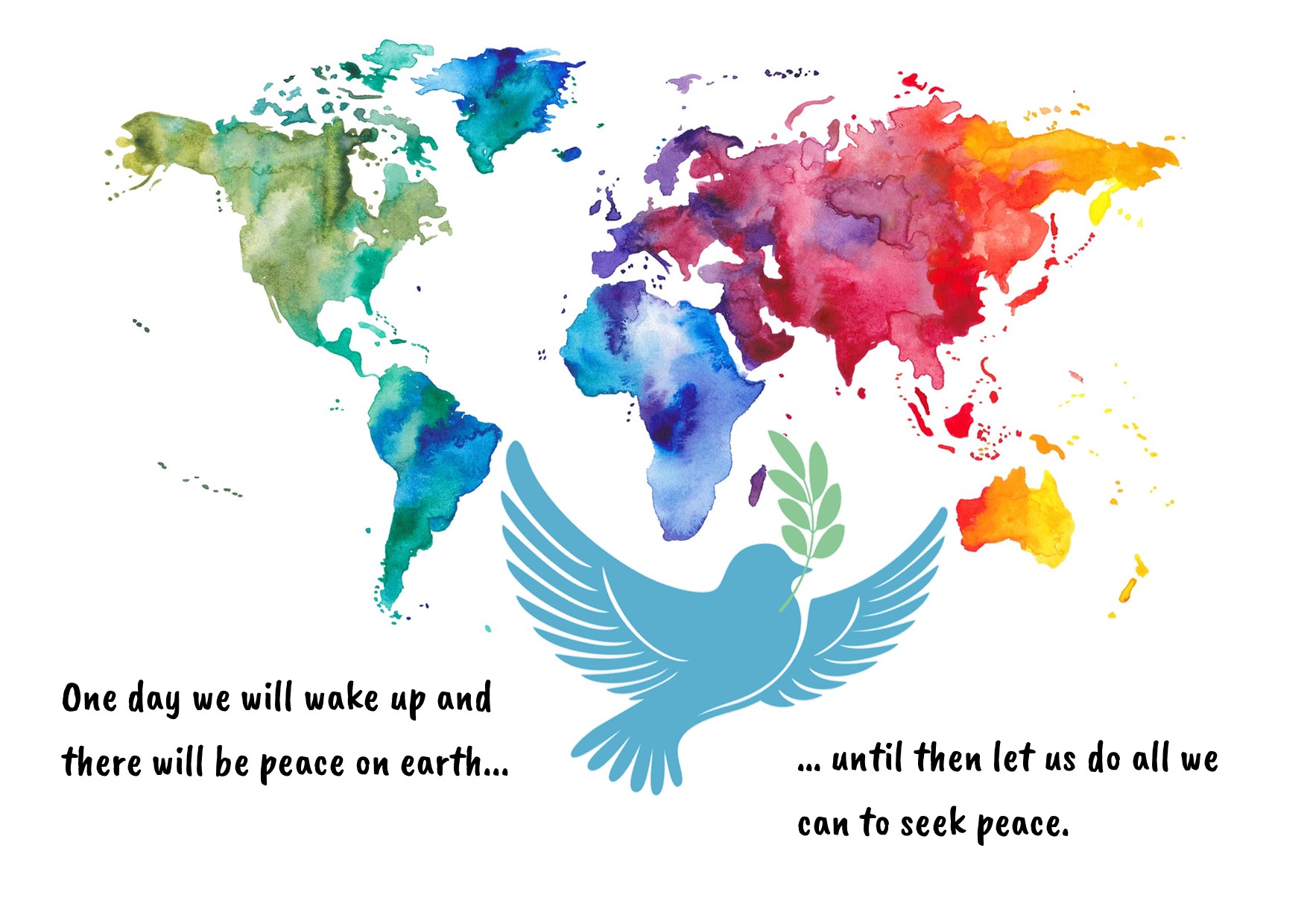
When looking for an image to go with this particular blog I came across this poignant painting. I would not dare to suggest what the artist, Michael Cook’s own thoughts were behind its composition, but it speaks to me of longing and hope, that in the midst of war there is a reason for fighting and a dream that new life will come, and that swords will truly be made into ploughshares. This beautiful piece of artwork was commissioned by Melbourne Parish Council to commemorate the centenary of the Armistice, and all money from sales goes back to the Parish Council. https://www.hallowed-art.co.uk/product/swords-into-ploughshares/

Follow Me…

Sermon preached on Remembrance Sunday 2024 based on Mark 1:14-20

Alfie Couzens was nineteen years old. He had been born within a couple of years of the ending of the Great War, the war to end all wars. Born, after his father, had marched back from France with the victorious troops to a hero’s welcome, but who had then quietly slipped back into the fishing community in the remote Scottish isles. Alfie was an only child for some six years before he was joined by two more brothers and a sister.

His father had been a sniper in the army and had faced some harrowing experiences that were never talked about, and his mother would often hush the children’s games of battles and combat, fought with stick guns and pinecone hand grenades if his father was at home.

Despite their remoteness on the island, the community was very much aware as they heard about the rise of Hitler in the 1930’s and knew what it implied.

So, in the summer of 1939, when Alfie got home one day, he asked his father directly, ‘Is there going to be a war?’ ‘Probably,’ his father replied. ‘And the sooner the better!’ There was no mistaking the horror on his mother’s face.

‘It’s true,’ his father continued. ‘Every extra day we give that madman, the more powerful he’ll become; and this damn government we’ve got, thinks it’ll buy him off with sweet and reasonable arguments. We’re always the same, hoping things will work out. We’re too used to winning, that’s our trouble; this time we might be in for a big surprise.’

It wasn’t long afterwards that Alfie received the call, and with a group of fellow islanders marched down to the jetty and sailed away, to become part of the 51st Highland Division, who were to see action at Dunkirk, the majority of whom would be taken prisoner.

Those who remained on the island did not delude themselves as to the probable goodwill that Hitler would have towards them, and yet those young men went to war; sacrificially for many, fatally for some. Their elder generation knew much about the hazards and horrors of the trenches, yet the young men joined up anyway and answered the call issued by their leaders to ‘follow me’ into the field of battle.

Going back in history, some two thousand years ago, and in a wholly different context, Jesus also issued a call, but this time to selected individuals, ‘Follow me’, and Peter, Andrew, James and John heard the call and heeded it, leaving all behind.

For them life would never be the same again, and they were indeed going into the unknown. They were people who had homes and livelihoods, a position in society. Who was to now meet the demand for fish or to pay the licence to fish the lake?

Where was the reassurance of the future that we all look for. We might ask how would this affect our lives or those of our children, our retirements and care in later life? Would we have been so willing to simply drop everything. Perhaps we would say there are too many unknowns.

The gospel does not provide a road map for this, yet Jesus asks that we follow him, to walk with him, in the same way he asked his disciples, and as he walks, he finds people where they are. ‘Follow me’ he says, ‘I will take what you know and transform it’.

Such walking demands a change of heart and commitment to self-giving love. The first disciples exchanged the familiar for an itinerant lifestyle. Most of us will be called to follow in the midst of our work, or family life. ‘Follow me’ is an fundamental requirement that challenges us at moments of decision and transition; it effects our material choices and our human interactions.

But equally we can place our trust in Jesus. We will make mistakes, misunderstand, and seek forgiveness. We are not simply re-enacting a back story, but instead we are being ourselves, bringing our own particular gifts to the work of compassion, reconciliation, and self-giving love.

Equally, as we place our trust in him, then no matter what the future holds for us, having given his life for us, he will never forsake or abandon or deny us. Yes, he may well lead us through the fields of Galilee, and into the waters of the River Jordan. He will undoubtedly take us across the Sea of Galilee and into the wildernesses of the Negev desert. He will lead us up the road from Jericho to Jerusalem and then along the Via Dolorosa until we come to our own personal Calvary.

But he will never fail us or forsake us; he will never let go of that hand which we place in his. We can trust Jesus with our lives, because knowing his story and living it changes us. We are called to share in a task, which for all its costliness brings hope.

Today on this Remembrance Sunday amongst other things we give thanks for the sacrifice of the millions who sacrificed their lives in two World Wars, and for those who are still caught up in war. For the men like Alfie and his father who answered a call to try and bring an end to hatred, greed and self-glorification and bring the world hope.

Sadly, the world is still in a state of flux but none the less without their sacrifice we would not be as we are now, living in freedom. The poppies that we shall soon set on the memorial, a memorial containing the names of those from this parish, are symbols of our thanks and tokens of our resolve to work for peace and to prevent any such need for sacrifice to be necessary again.

So may our prayers this morning, echo the words from a familiar hymn, ‘Make me a channel of your peace, where there is hatred let me bring your love, where there is despair in life let me bring hope and where there is doubt, true faith in you.’ Amen

Alfie Couzens is a fictional representation of the many who marched away to answer the call. His story is based on Findlay J Macdonald’s memoirs of his childhood in Harris in the Outer Hebrides called, Crowdie and Cream

Advent Waiting

Sermon given on Sunday 27th November 2022 on the 1st Sunday in Advent based on the following readings: Matthew 24:36-44 and Isaiah 2:1-5

May I speak and may you hear, through the Grace of our Lord; Father, Son and Holy Spirit. Amen

Today we enter a new season in the church calendar. Our old church year has ended and a new one has begun. The colours around us have also changed, there are purples and pinks and candles to light – one at a time – increasing light coming into a time of shortened days and winter darkness. A feeling of anticipation and rising excitement. Yet we have to wait!

Waiting… the action of staying where one is… time passing… expecting something to happen… until one day it does! Advent, a time of waiting, of hope, of anticipation. We hear in St Paul’s letter to the Galatians, ‘when the fullness of time had come, God sent his Son’

Advent is the church in waiting… the church’s annual reminder of what Christians worldwide anticipate in the days leading up to Christmas. We wait for Christmas as Israel waited centuries for a Saviour. Waiting for God to fulfil his covenant, for a virgin’s son of Abraham’s line, a descendant of Isaac, Jacob and David, for a branch from the root of Jesse, for a baby born in Bethlehem called Immanuel.

For generations, God’s people waited for the fulfilment of countless Old Testament prophecies of a Saviour, who would light up this world brighter than any Magi’s star. A Saviour, who was to be called Jesus, the long-awaited hope in a dark and sinful world. The true light, that gives light to every single human, was coming into the world.

As Christians wait for the light of Christmas, the four advent candles are lit with each week’s passing, but we know that our hoping and waiting doesn’t stop at Christmas, because he will return at the last day, a second advent.

Today, it is that second advent that we are thinking about. A time of waiting that equates with that of Israel. Waiting and not knowing when these prophetic events will take place. We can image that it is unlikely to happen in our lifetime, or without knowing it, it could happen before I get to the end of this sermon…. ‘Therefore, keep watch, because you do not know on what day your Lord will come.’ So, if you all disappear before my very eyes, I’ll know I wasn’t fully prepared!

It is from the Old Testament that we hear of what will happen in the last days, perhaps a more leisurely climax to the end of time and spoken in the beautiful prophetic language of Isaiah.

On a mountain higher than any we might have stood on and from which caught a glimpse of the awe and wonder of God. A mountain whose peak brushes against the thin veil of heaven, ready at any moment to tear a hole through which the Saviour can return.

From the very beginning of humankind there was but one nation, the nation of Eden. However, human rights, economic disparities and land disputes forced the people to spread to each and every corner of the world, creating nations that forgot the principle of working together for the common good or acknowledging their divine creator.

Then, on a mountain that will stand so prominently above all others, on which the gathering place of the people of God will be built, the nations will stream towards it. I was once given an image by one of my lecturers, Mark Chapman at Cuddesdon theological college, of a smooth sphere spinning in space out of which streams of people, like spumes of gas were escaping and forming new spheres, that bumped and grated against each other, but that how, at the end of time it would be as if the image was being rewound and those streams of people would be sucked back so that eventually the original sphere would take shape, not so smooth, but one single spinning object in infinity.

And the reason that people will want to climb the mountain and will encourage others to come with them, is so that the God of Adam, Noah, Abraham, Isaac, Jacob, David, Daniel, Peter, James, Paul, Augustine, Francis, Theresa, Luther, Sacks, Mohammed and of you and me, can teach us once more to walk in the ways that He intended us to.

A time of preparation, before Jesus, the Word of God, undertakes his role as the final judge of the people, settling disputes and bringing the nations back into harmony, so that there will be no need of wars, no need for the machinery and weaponry of conflict, no need for military tacticians or economic masters.

Instead, for those who have re-turned to, re-tuned into and re-stored the one true faith, the light of God will shine on them so that they will appear like beacons of hope in the darkness.

It’s a beautiful picture, and one we might dismiss as poetic licence, an Old Testament allegory designed to give hope to the peoples of Israel and Judah who were in dispute, and who had been subjugated by the Babylonians. Yet this same image of a gathering of the nations and the formation of a new earth and heaven is given to us by John in his vision in Revelation, ‘I did not see a temple in the city, because the Lord God Almighty and the Lamb are its temple… The nations will walk by its light and… the glory and honour of the nations will be brought into it,’ and for each and every person, ‘they will be his people, and God himself will be with them and be their God.’

Yet, none of this calls for complacency. Today, tomorrow, next year or whenever… we can’t just simply wait… the things that are foreseen are also the things that we should be striving for each and every day, to work together as individuals and as a global nation, to do all we can to bring about peace between the nations on earth, to teach people the way of God, so that all can be restored

So, this year during Advent, as we continue to watch and pray for our Saviour to come again let us also make plans, whether in the long term or short term… who knows… to prepare ourselves and our world for the smoothest transition and be truly ready, ‘because the Son of Man will come at an hour when you do not expect him’.

Amen.

Breathe Out… Breathe In

Sermon preached for Easter 2 on Sunday 11th April 2021 based on readings Acts 4:32-35 and John 20:19-end

May I speak and may you hear through the Grace of our Lord; Father, Son and Holy Spirit. Amen

Are you sitting comfortably…

Breathe in…breathe out…breathe in…breathe out.

I’ve recently started using an app on my phone which teaches basic meditation as a way of slowing down a little and making space for quietness from time to time.

Breathe in…breathe out…breathe in…breathe out.

The first thing it makes you do, apart from sitting comfortably is to focus on your breathing and suddenly you realise that you’re consciously thinking about something that you subconsciously have done all your life.

Breathe in…breathe out…breathe in…breathe out.

You find yourself with your hand on your diaphragm, trying to make sure that your stomach and abdominal muscles are fully engaged to make your lungs work more efficiently – and it’s then you begin to think that you’ve actually forgotten how to breathe…

Yet breathing is the thing that keeps us alive: it’s the reaction to the proverbial slap on the bottom by the midwife when we are born; it’s the air passing through our larynx to give us speech and laughter. It’s also the last thing we will do when we face the end of our mortal life. Breathing is a natural and necessary part of creation, but it is also a means by which God imparts his Spirit.

Throughout the bible we hear how the breath of God enlivens and invigorates. From the second account of creation in Genesis,

Then the Lord God formed man from the dust of the ground,
and breathed into his nostrils the breath of life; and the man became a living being’
Genesis 2:7

to the quickening of the dry bones and Ezekiel’s prophetic command to the four winds,

So I spoke the message as he commanded me, and breath came into their bodies.
They all came to life and stood up on their feet—a great army’
Ezekiel 37:10

However, in our gospel reading this morning we hear that the risen Christ comes and stands among his amazed and probably terrified disciples and breathes on them both as a soothing and galvanising action, ‘Peace be with you. As the Father has sent me, so I send you.’ When he had said this, he breathed on them and said to them, ‘Receive the Holy Spirit’.

He then says something that seems a little disjointed in verse 23, ‘If you forgive the sins of any, they are forgiven them; if you retain the sins of any, they are retained.’ However, there is a connection.

In Greek there are many different words for breathe, but two of them appear just four times in the gospels and all of them are an action of Jesus and all of them are connected to the Holy Spirit.

At the crucifixion scene, Mark tells us that Jesus uttered a loud cry and breathed his last, and that the Centurion witnessed that in this way he breathed his last; whilst Luke tells us that it was after committing himself into this Father’s hands, that Jesus breathed his last. In all of these verses the Greek work for breathed is ekpnéo meaning to expire, to breathe out, to exhale.

However, Matthew’s account doesn’t mention breathing, he has Jesus crying out with a loud voice before yielding up his spirit, using the Greek word aphiēmi, for yield, which has a number of meanings but most commonly means to forgive. Luke also uses this word just before Jesus’ last breath when he tells us that Jesus says,

“Father, forgive them, for they know not what they do.”
Luke 23:34

We could reasonably surmise that Luke and Matthew are connecting the breathing out of the Spirit with the forgiveness that Jesus gave. So, Jesus forgave us and breathed out the Holy Spirit on the cross.

But let’s go back to that locked room and the next time that breathed is mentioned in the gospels. And when he had said this, he breathed on them and said to them, ‘Receive the Holy Spirit.’ However, breathed here is a different Greek word emphysáō , which means to breathe into, breathe on, or blow in and echoes the action of God in the story of creation. Jesus breathed out his Spirit on the cross. But here he is breathing out his Spirit onto the disciples, because he is sending them as the Father sent him, to bring life and peace to everyone by forgiveness of their sins.

This then is the purpose of the Holy Spirit, to provide life, to energise and to activate. Just like those disciples gathered together, they had now received the Spirit and were being transformed into a people who sought to live and work for the common good, who valued forgiveness as an essential grace and who through the Spirit gave their testimony with great power, no longer afraid and no longer doubting.

What then of Thomas? The absentee disciple, whose doubt would not be satisfied unless he had physical proof and who did not at this time receive the breath of the Spirit. For him the sense of touch activated his belief, but he too would go on to receive the Spirit at Pentecost.

What then do we need to believe? There’s a wonderful verse in the Book of Job,

But there is a spirit within people,
the breath of the Almighty within them,
that makes them intelligent
Job 32:8

This does not necessarily mean academic or clever, but more intuitive. Life is breathed into us at the moment of conception but there is an unconscious desire to understand what it means to be fully human.

When we encounter Jesus, whether through our baptism, a gradual awareness or a seismic moment of conversion it is then that the Spirit within us is activated and becomes a living breathing force that blesses us and sends us out to bless and bring life, peace and forgiveness to others.

Jesus breathed out his Spirit on the cross. But, after the resurrection, Jesus breathes his Spirit into us. So, it’s worth getting that breathing correct

Breathe in…breathe out…breathe in…breathe out           

Amen

Go back

Your message has been sent

Warning
Warning
Warning
Warning

Warning.

Go back

Your message has been sent

Warning
Warning
Warning
Warning.

Stillness

Stillness in the Garden

As part of our offerings during the Coronavirus Pandemic the Ministry Team at St James’ Church, West End are each offering a Thought for the Week. Here is mine taking the theme of stillness and the need for a ‘me’ space

You can either watch the video or a transcript is below:

I wonder if you’ve managed to find your ‘me’ space yet?

At this time when we are all practising social distancing; being separated from our wider families and having to stay at home, it can be difficult to find a space in our homes in which we can just simply be still. A space in which you need do nothing but sit, not to feel the need to pray or to read or to do anything that involves taxing your brain. Perhaps you’ve found your ‘me’ space in a spare room, or a comfy corner or in a shed at the bottom of the garden. For me, it is a bench in front of my fishpond. It is a sunny spot, but also a peaceful one, with the sound of running water as background music and the graceful goldfish to watch gliding through the water. For me it is a perfect spot in which to be still.

For many of us that very element of stillness is one which has been conspicuously lacking in our lives up until now. We have been taught that we should be busy and productive, and we have all but lost the art of being still. Now it’s about listening; about compassion, and about faith; but mainly about stillness, because, so many of us have been forced to be still because of the Coronavirus Pandemic. The places where we worship are closed, the places where we work are shut and we are being asked to socially distance ourselves, to stay away from people and places other than our homes.

As we face this epidemic, the most important thing required of us is stillness. We have needed to stop going places–to church, to school, to work, to anywhere. We have needed to stop congregating. And that means that we have all had to slow down; because if we don’t, people will die. The logic of compassion and human connections demands that we do this one thing, and that one thing is nothing. And it is really hard.

What we can find though is that in this stillness comes faith and in faith comes stillness. Psalm 46 (v10) has that well-known verse calling us to do just that, ‘Be still, and know that I am God!‘ These lines connect stillness to faith, and this is what gives stillness its power. The Psalmist does not simply mean belief in God, or even a sure knowledge of God’s existence…faith in this context means trust – the knowledge that God is competent. Of course, it is very easy to be glib when giving advice like this – ‘Just let go and trust God’.

Nobody is telling us not to worry about Coronavirus. We should all worry about it because it threatens some of the most vulnerable people in our society. We should worry about it, and that worry should lead us to… stillness. Because being still is the best way to protect our loved ones–and to protect millions of people we do not know. So, we do the only thing we are required to do and that is to be still and listen.

The author Annie Dillard, has a wonderful quote from her book, ‘Teaching A Stone To Talk’ – ‘Whenever there is stillness there is the still small voice, God’s speaking from the whirlwind, nature’s old song, and dance…’ and it is these voices that we never hear except when everything is silent, they only reach us as a moment of revelation in the stillness. They are the voice of the Holy Spirit, who is never far away from any one of us, their voice as Psalm 19 tells us about the heavens, is that ‘they have no speech, they use no words; no sound is heard from them. Yet their voice goes out into all the earth, their words to the ends of the world.’ These ‘words’ that will come and go unnoticed unless we learn the grace of being still.

Whenever there is stillness there is the still small voice,
God’s speaking from the whirlwind, nature’s old song, and dance…’

And we shouldn’t feel uncomfortable about taking this time out. It’s so easy to be made to feel guilty that everyone else seems to be constantly involved in ‘good’ works. There is undoubtedly a great need for us all to look for ways of helping our friends and neighbours at every opportunity, but we can’t let that altruism overwhelm us. We only have to look to Jesus as an example of someone who gave all that he could to others, and yet frequently took time out to recharge his batteries – from Luke (5:16), ‘the news about him spread all the more, so that crowds of people came to hear him and to be healed of their illnesses. But Jesus often withdrew to lonely places and prayed’

Of course your ‘me’ space will get interrupted from time to time, the telephone rings, someone suddenly needs you to do something or the children start arguing, but those few precious moments of stillness should be enough to set you up with the strength to face whatever comes.

So, I hope you manage to find your ‘me’ space, whether indoors or outdoors. And if it rains… well there’s still the opportunity to stand looking out of the window and watch the rain fall, refreshing the earth.

So let us pray a prayer of St Benedict:

O Gracious and Holy Father,
Give us wisdom to perceive you,
Diligence to seek you,
Patience to wait for you,
Eyes to behold you,
A heart to mediate upon you,
And a life to proclaim you;
Through the power of the Holy Spirit Of Jesus Christ our Lord.
Amen.

So go well and God bless

Pooh’s Thotful Spot is interrupted

Go back

Your message has been sent

Warning
Warning
Warning

Warning.


The Best Laid Plans… On Being Prepared

Blake - The Angel Appearing to Zechariah

William Blake – The Angel Appearing to Zacharias (1799 -1800)

Sometimes you think you’ve got it all under control, the necessary preparations have been made, the last minute arrangements set up, and you’ve just celebrated with nearly 800 people the Nativity story and the symbolism of a red beribboned orange, pierced with a foil held candle, four cocktail sticks and various fruits and sweets (a Christingle), when someone leaves you a voicemail saying that the readings for this evening’s most important service, to which many will come for what might be their only visit to church in a year are incorrectly printed in the carefully prepared service sheet, not only incorrectly printed, but basically incorrect. Now what would you do?

Based on 2 Samuel 7:1-5, 8-11, 16 and  Luke 1:67-79
Actual readings heard Isaiah 52:7-10 and John 1:1-14

May I speak and may you hear through the grace of our Lord; Father, Son and Holy Spirit. Amen

It’s wonderful to see you all here tonight, on this most important of nights; this holy night; this night when we celebrate once more the coming of God in the person of his son, Jesus Christ to earth.

However, they say that you should be prepared for anything and at about 8 o’clock this evening, it was pointed out to me that the readings that are printed in your service sheet are actually the ones for Christmas Eve – Morning Eucharist. An easy mistake to make I keep trying to tell myself, as we start this service on Christmas Eve, but we end it on Christmas Morning. I suspect when I was preparing the Worship rota in October, this minor, but important fact escaped me – I should have turned the page in the Lectionary – and so when I came to prepare my talk earlier for this evening it was the these ones that I’d used on which to base it

But I couldn’t let you not hear those beautiful readings from Isaiah and John, otherwise for some it would just not be Christmas, and I wouldn’t have got to read one of my favourite gospel passages from the bible – ‘the world became flesh and dwelt among us, and we have seen his glory’ At least it also mentions John the Baptist…

It also wouldn’t be right to make you listen to both of the other readings as well, but please do glance through them so that you at least get an idea of where I’m coming from – the first one a message from God  through the prophet Nathan for King David and his kingship, and the second a song of thanksgiving, formally know as the Benedictus, and sung by Zechariah, the father of John the Baptist which prophecies about the coming saviour and the part that John will play in that.

The fact is nothing ever really happens without some preparation and for weeks (or months even) we have been preparing our workplaces, schools and homes to reflect this celebration. Or have we? Nowadays, we have to look hard amongst all the trivial fripperies, the giant inflatable Santas, the cheese advent calendars and unicorn reindeer to catch a glimpse of the real story of God coming among us.

But he is there, and your being here tonight is a sign that despite all the tinsel and the glitter, the message he came to fulfil still resonates at the deepest level with our needs as human beings.

The preparations for Jesus coming among us, probably started the moment that Adam and Eve stepped out of the Garden of Eden. God wanted us back, to heal the relationship that had broken down, to restore his trust in us.

Come forward several eons and we find ourselves in the presence of Nathan, a prophet in the time of King David, now only one thousand years before the birth of Jesus. Now at first there doesn’t seem to be any mention of a saviour, but again God is working on his preparations and it includes building a house – not a physical house – although the temple would be established by David’s son Solomon – but a dynastic house

To David, God has promised to ‘make for you a great name’. David, the unlikely king, a murderer, an adulterer, a drunken carouser – sounds a bit like he’d have fitted into the cast of Eastenders Christmas special, and yet a mighty warrior, a loving father and a great king. Originally a shepherd, one of the least amongst his society, yet an appropriate choice to be part of the lineage of Jesus.

Yet this was to be no ordinary royal dynasty – and if we want to be picky – the genealogical proof that both Luke and Matthew give us at the beginning of their gospels, that Jesus, in his humanity, was a direct descendant of Abraham and David through to Joseph, Jesus’ legally adoptive father and by birth, through Mary, is actually a messianic rather than a physical bloodline.

Come forward to another prophet, Isaiah, whose prophecy, ‘Unto us a Son is born, unto us a son is given….’ was a little premature – some seven hundred years premature to be exact, but it was further evidence of God’s preparations, before there began a silence…. A long silence… a very, very long silence…

Even at the next stage of preparations that silence was to continue as we now need to imagine we are in the temple, carrying out our priestly duties, we are called Zechariah and we have been drawn by lot to enter the sanctuary to offer incense. Zechariah probably wasn’t prepared for the sight of the angel that appeared to him, far less the news that his wife was about to embark on a geriatric pregnancy, hence why his incredulous questions rendered him unable to speak for the next nine or so months!

When he does regain his voice he uses it to confirm the child’s name and to break out into what we now call the Benedictus, his song of thanksgiving to God. It is this child that we hear about in his prophetic words, the child that will grow into the man John the Baptist, who will make the final preparations to announce Jesus’ ministry and the fulfilment of God’s promise.

And you, child, will be called the prophet of the Most High;
    for you will go before the Lord to prepare his ways
Luke 2:76

But we’ve jumped too far ahead, because tonight we have come prepared for the Christ-child’s birth, in a stable, in the night, as a helpless babe. We’ve also prepared for it during the season of Advent, where each week we’ve watched and waited and thought about the reasons for his coming. Reasons, as I said, that we all instinctively know make the most sense for our lives but seem so difficult to achieve both on a personal and global scale.

The reason that he came to bring joy. A joy that was shared in the songs of Zechariah, of Mary and the angels; a joy that is heard in words and the music of the carols and songs that we sing tonight.` The angels that bent near to the earth, to bring glad tidings of goodwill from God, tiding of joy and of reconciliation. A joy that can be shared among us, in friendship and fellowship to all, not just tonight but every day

The reason that he came to bring peace. An outward peace in a world where men and women need to hush the noise of strife and warfare and look for ways of working together for the common good; and an inner peace, through the message that John will share, that ‘the dawn from on high will break upon us to give light to those who sit in darkness and in the shadow of death, to guide our feet into the way of peace’.

The reason that he came to bring love. A love that is all encompassing, limitless and freely given. Which bears all things, believes all things, hopes all things, endures all things, as Paul tells us in his letter to the Corinthians. A love that brings its own peace from knowing that whatever situation we find ourselves in, whatever we might have done, there is forgiveness available to us, and because of that forgiveness we can be in a loving relationship with God again, and through our relationship with Jesus we can love one another better

Finally, the reason that he came to bring hope; the realization of the Messianic hopes of the Jewish nation as they impatiently borne the yoke of the Romans, and continually sighed for the time when someone from the House of David would be their deliverer and to whom Zechariah was pointing in his prophecy. That same hope that is offered to all of us, regardless of age, gender, sexuality or ability. A hope that is everlasting, because of what Jesus would go on to do through his death and resurrection in order to bring us back to him at the end of time.

Zechariah wasn’t initially prepared to trust what God was going to do through him, and too often we can be so distracted by the world around us that we find it difficult to just accept what God might be saying to us, how he calls us into a relationship that demands nothing of us but to simply be prepared to open ourselves up to the possibility that his joy, his peace, his love and his hope are all that we really need.

So tonight, be open to hear his invitation to come and be prepared to receive him into your heart. Tonight, be open to share with others the things that you discover about Christ and yourself and be prepared to be that herald of good tidings. Tonight, be open to having your life changed by the child in the manger and be prepared to be transformed. Tonight be prepared for anything and everything.

Amen

Starry Starry Night

O Holy Night – starry skies over Japan

Go back

Your message has been sent

Warning
Warning
Warning

Warning.

Making Space for Prayer


IMG_0432

Flowers for Peace

Last week we ran a series of School Prayer Spaces at Saint James’ Church of England Primary School, West End, Southampton. This involved creating interactive activities which the whole school, both children and adults could take part in and gave them a chance to explore life questions and experience a sense of spirituality and stillness in their busy lives.

These activities included:

IMG_0429

The Gathering

The Gathering – It was important that everyone was gathered both at the beginning and the end of the session. This helped as a reminder that it was important to move about the space in a quiet, thoughtful manner. The filmy voile also helped to create an air of mystery of what was to come.

IMG_0419Be Still Pods – Here was a reminder that God calls us to be still from time to time, to help us to learn more about ourselves and God. Simple pop up tents provided a space to do that, each furnished with a cushion, a focus lamp and ‘stillness’ image.
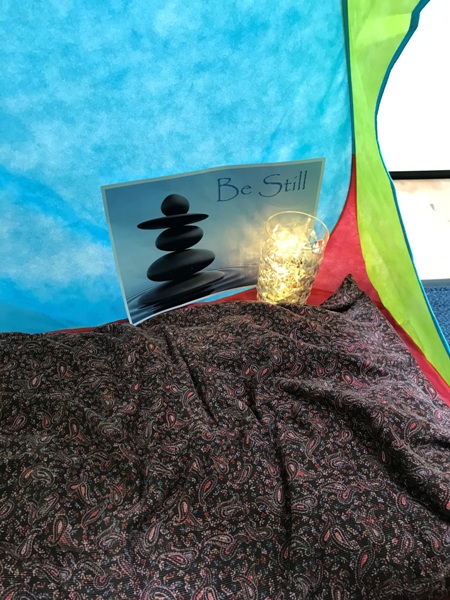
It’s amazing that even Reception class children (aged 4 to 5 years) could manage this brief time of stillness, and what was even more amazing was that the Year 6 children (aged 10 to 11 years), despite our concerns that they would be too tall or to ‘cool’ to give it a go, managed to squeeze themselves into the space willingly.

IMG_0420

Be still and know that I am God

Tardis Prayers – Here was an opportunity to think about the future. With a Tardis weIMG_0421 could travel forward and see ourselves in 10, 20, 40 years time. Some of the smaller children found the concept of forty years a little difficult to imagine, but they all came up with a suggestion of what they might be doing, what type of person they might be, expressing their hopes and dreams.



IMG_0422In amongst the usual ‘celebrity’ footballers, singers and dancers were the more traditional dreams of becoming a teacher, doctor, lawyer or policeman. The more altruistic souls saw themselves as solving world hunger and peace, as well as being kind and caring to those around them.
Certainly there was no limits to their ambitions with perhaps a future President of the United States or Queen of England here amongst us

Time Lord.png

My Time Lord is the Lord of Time

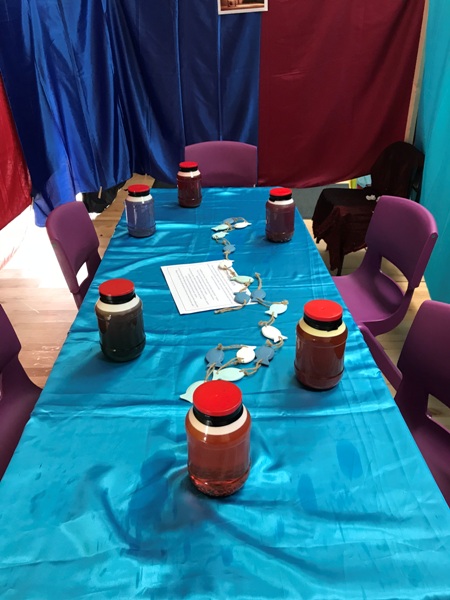
IMG_0423Calm Jars – We all know that life, including school, can be stressful. When we are trying to juggle the demands of people, relationships, expectations and pressures, our minds can feel busy and restless and then we start to worry. A Swedish proverbs puts this into perspective, ‘Worry gives small things a big shadow’. In the Bible, however, God often reminds people to be still, to wait and to stay calm whatever the situation.
By gently shaking the jars and watching the glitter swirl and settle they could think about those things in their lives settling down and becoming calmer.

Stress Less – In a similar vein, the ‘stress less’ activity helped to consider the things that stress us out and how to let them go.

IMG_0427

Brightly coloured aqua beads (or frogs’ spawn as some referred to it) were the perfect medium to allow everyone the sense of worries and stresses literally falling away or through our fingers.

Quoting from Peter’s first letter, ‘Cast all your worries on God, because he cares for you’ (1 Peter 5:7) helped with the concept that our worries may not automatically disappear, but by sharing them it can make them easier to deal with.


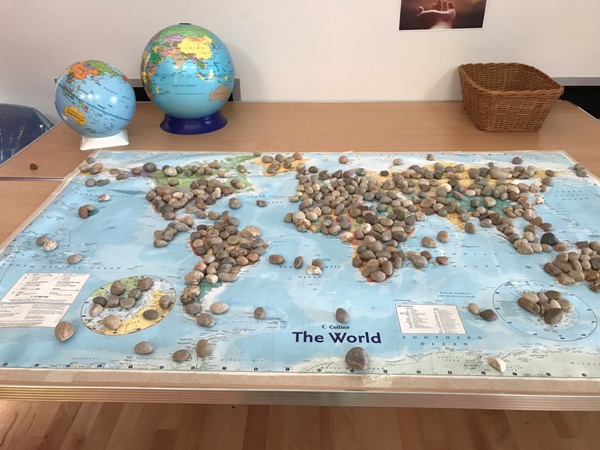
Pray for the World – Our final activity within the prayer space was a chance to think about praying for those people around the world who we were never likely to meet or know anything about, and yet they were undoubtedly just like us.

IMG_0417

Using a simple map of the world we explored the differences between people, such as languages, skin colours, religions and beliefs and cultures, but also the fact that we all had one thing in common – we were all human, and therefore had the same needs – the desire to be safe, cared for and loved.

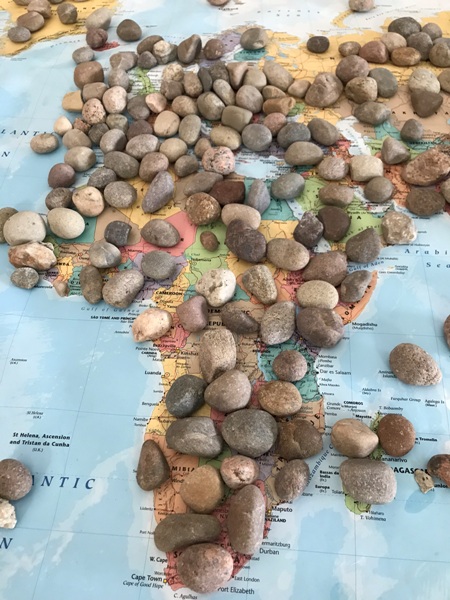
IMG_0418By the end of the week we had managed to cover almost every single country in the world in prayer pebbles, representing the simple prayer we said for the people living there.
If you look closely don’t be concerned that we might not have said a prayer for England – this did have pebbles placed on it, but I kept having to move them slightly so that we could compare the size of our country to others around the world.


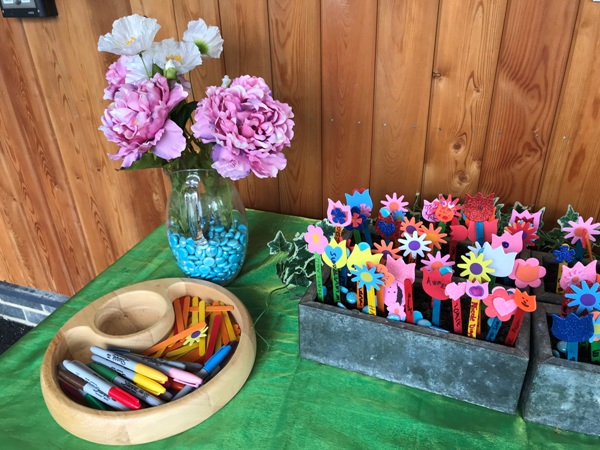
One additional activity was our Peace Flowers, which we invited everyone to come back to after school. Here people were invited to create a flower and on the stem write the name of a place, person or situation that they felt needed peace. As you can see it was very popular

IMG_0431

Altogether a very enjoyable week, with lots of positive feedback from both the participants and the helpers who led the activities. It’s incredible how spiritual young children can be when we give them the opportunity and space to express this – and it doesn’t do the adults any harm either to be able to do so.

If you want to find out more about Prayer Spaces in School you can visit their website or read more about the Research Project they carried out

IMG_0430

Go back

Your message has been sent

Warning
Warning
Warning

Warning.


A Glimpse of Heaven’s Glory

the-heavens-are-telling-the-glory-of-god

Based on the following readings: Luke 2:1-14 and Isaiah 9:2-7

Another Christmas and what a wonderful time this Advent and lead up to Christmas has been this year. Over the last few weeks at St James’ we have shared the nativity story with various groups of pre-school children; carolled our way through several nursing homes; taken part in a sheep-filled Knitivity before the culmination of Christmas Eve Crib and Christingle services and the pinnacle of Midnight Mass. It was my privilege to be able to preach at this first service of Christmas on what was a very special night…

Make I speak and may you hear through the grace of the Lord; Father, Son and Holy Spirit

How’s everyone’s Christmas going? Got everything prepared?  –  I hope so, because you know gentlemen, I think even the late night petrol stations are closed now… But, of course you’re all prepared, and what better way to begin our Christmas Day celebrations [looking at watch] – well it’s not quite morning yet but it will be by the time I stop talking – than to gather here together to hear again the timeless story of Jesus’ birth. And there is something rather special about being here, at this time and in this place, and you must admit that the church does look rather wonderful, full of light and mystery.

However busy we’ve been, all the rushing around trying to find the perfect presents; making sure we’ve stocked up on plenty of food and drink; and those little treats we can indulge ourselves with; despite all of that, something calls to us to take a moment, this moment, to remember what Christmas is really all about. We hear the story of a young teenage woman about to give birth; the reluctant fiancé whose done the right thing; the outcasts and rejected members of society in the persons of the shepherds privileged to hear the good news first… of a baby born in an animal shed, yet destined to change the world… all heralded by angelic messengers descending – to bring heaven so tantalising close to earth.

Tonight we’ve come together in what I believe the Celts would have called ‘a thin place’. They had a saying that ‘heaven and earth are only three feet apart, but in the thin places that distance is even smaller’. A thin place is where the veil that separates heaven and earth is lifted and one is able to receive a glimpse of the glory of God. Perhaps that’s why we’re here tonight, hoping to catch a glimpse of heaven’s glory

Indeed, there’s something about that story that seems to call to something deep within us, to draw us in so that just for a while we believe that all will be well with the world. A story that speaks of things so long ago and so far away and what wouldn’t we give for it to be happening right now; maybe like me you sometimes, just sometimes, wonder why it  doesn’t appear to be doing so nowadays. After all it’s good news of great joy for all people.

“”I am bringing you good news of great joy for all the people”

What then was that good news that the angels spoke of to the shepherds, and how is it good news for us today?  Because let’s be honest, the news that’s beamed into our homes and phones and splashed across the newspapers doesn’t exactly fill us with confidence and hope that humanity has a common goal of seeking respect, harmony and love.

Respect, harmony and love, three key element of Jesus’ message for the world into which he was born…  and the world in which we live today; a message that is good news for us but also requires us to be good news to others; a message that allows us to glimpse heaven’s glory.

For Mary and Joseph their lives had been turned upside down and the baby that was now sleeping in the manger brought them joy as any new-born child would, despite the distance they had travelled from Nazareth to Bethlehem and the circumstances they found themselves in. Yet the fact is within two years they would be fleeing for their lives, trying to keep one step ahead of Herod’s henchman who would indiscriminately slaughter thousands of innocent children and bring misery to countless families; families who likes Joseph’s were valuable member of society, and who now had to rely on the country to which they fled to offer them security and compassion, to recognise and respect who they were.

Sounds a bit like a scenario that’s been happening around the world more and more lately? That even today there are people having to flee from their homes, seeking that same sort of asylum, escaping from violence and conflict. Do we recognised their value and treat them with respect? How do we welcome the stranger and alien in our land or into our homes? Do they hear good news from us?

So tonight, on this special night, it would be good to remember all those who are far from the country of their birth, who are missing the comfort of their own home and their families, and pray that with our help they too can envisage a future that allows them and us to catch a glimpse of heaven’s glory

We hear too in the story that the birth of Jesus was a herald of peace on earth and our reading from Isaiah confirms that the one who was coming would be known as the Prince of Peace. It was a peace that would come about not only through meekness and tolerance but through seeking justice and reconciliation in a land dominated by a foreign power and then through the ultimate sacrifice.

“Wonderful Counsellor, Mighty God,
    Everlasting Father, Prince of Peace”

Most recently I believe we too are weary of a world in which violence and hatred seems to dominate, where mistrust and selfish power struggles offers discord rather than harmony, where acts of violence leave men, women and children in fear for their lives. How it jars with Jesus’ message of peace and how we so often feel powerless to do anything to bring about that peace?

Surely though it just needs to start with us, to be at peace with ourselves, our families and our neighbours, to reject hatred and discrimination and to stamp on injustice. So tonight, on this special night, let us be resolved to seek everything that speaks of harmony rather than conflict, not just in words, but in actions, so that we and the whole world might catch a glimpse of heaven’s glory.

Back to the story then; those shepherds were just the first example of Jesus’ determination that every single person would be valued, respected and loved. Throughout his ministry he actively sought out the poor, the homeless, the excluded – those rejected by a society that saw them as failures, inconveniences, worthless. He didn’t treat them as charity cases or patronise them in order to make himself feel better – he genuinely loved them. And he calls us to do the same.

Not just to love those who are lovable but those whom we consider unlovable. It’s too easy to create exclusive groups around us rather than to love inclusively. Perhaps though tonight, on this special night we can determine to open our hearts to love, to receive love and to give love so that all may catch a glimpse of heaven’s glory

As I said earlier, tonight we hear again in the Christmas story those three key elements of Jesus’ message for the world – respect, harmony and love, but there’s one more important thing that Jesus’ birth has to offer us – his death. It wasn’t until just over 300 year after his death that Christians began to remember and celebrate his birth. Up until then the good news had centred on the message of the cross.

A message of forgiveness, redemption and salvation for the world as a whole and for us as individuals; but we do recognise that as part of the Christmas message as well. When, later on we come to sing ‘Hark the Herald Angels Sing’ the last verse has these words, “Born that man no more may die, born to raise the sons (and daughters of cause) of earth, born to give them second birth”. So tonight, on this special night, we can believe that heaven really has come close to give us a glimpse of heaven’s glory.

“…born to give them second birth”


But the truth is we can’t just leave it there – the Christmas story cannot be just that, a story in history. You may have come this evening because it’s simply part of a family tradition, or maybe you’ve been coming for years, or perhaps you haven’t been for a while – and that’s okay, all are welcome here… or maybe something stirs deep within and calls to a discovery that his story is also your story, my story, our story.


Isaiah prophesied all those years ago that ‘the people who walked in darkness have seen a great light; those who lived in a land of deep darkness— on them light has shined.’ Tonight, on this special night, we can be certain that that light still shines brightly, dispelling the darkness and allowing us all a glimpse of heaven’s glory.


Love came down at Christmas, and may that same love come down and enter our hearts both tonight, this morning and for evermore. Amen

love-came-down


Go back

Your message has been sent

Warning
Warning

Warning.


Called to Love

Brussels_Love One Another

Love One Another, As I Have Loved You

 On Maundy Thursday we are explicitly called to love one another. Sometimes though it’s not as easy as you think. This reflection was preached as a sermon at St James’ Church at the Maundy Thursday evening service and is shared with you now.

Readings: 1 Corinthians 11:23-26 and John 13:1-17, 31b-35

‘That you love one another. Just as I have loved you, you also should love one another’

This week has for me been a week of great sorrow. In a week when we are following in the footsteps of Jesus to the cross, his words to his disciples have a great poignancy. A week in which we have once again witnessed the total disregard for the value of human life.

‘That you love one another’

On Monday we heard of the devastating effect that one person can have on one family, the Philip’s family, we heard of the anger and hatred that is justifiably felt as raw emotions are still very much on the surface.  Then on Tuesday, the indiscriminate attack on innocent victims in Brussels, as they went about their ordinary business; treated not as individual human beings but an in-distinguishable mass target.Still each of those who died or were wounded will be connected in a myriad of ways to others: wives, husbands, fathers, mothers , sons, daughters, friends. Connected to people who love them.

Brussels - Tintin

Herge’s Tintin weeps for Belgium

Far too frequently we think of ourselves as just individuals, separated from one another by race, culture and faith, yet we share a common humanity. Desmond Tutu and Nelson Mandela, when having to deal with the aftermath of apartheid in South Africa, choose to walk the way of love rather than retaliation. Tutu explained that one of the sayings in his country is Ubuntu – the essence of being human, and that it speaks particularly about the fact that you can’t exist as a human being in isolation. It speaks about our interconnectedness. You can’t be human all by yourself, and when you have this quality – Ubuntu – you are known for your generosity.

Our common connection means that what we do as individuals affects the whole world. When we love each other and recognise that common humanity and things go well, it spreads out and shows what the power of love can do; but when we disregard it we act in fear, creating hatred and violence.

 ‘That you love one another’

 That you love one another. Just as I have loved you’

If we want to know what that love should look like then we only have to look at Jesus. Love is never straightforward but he managed to show us the different sorts of love that are needed to unite us rather than divide us.

Love can be tough – we only have to think of the rich young man who when told that he had to give up all that he owned went away grieved.. Yet Jesus didn’t give him a get out clause. He looked at him and he loved him even though he knew how hard that would be

Love enables forgiveness as well as  demanding a change of heart. Like the woman caught in adultery, who was judged and condemned by those who were blinded to their own sinful natures. ‘Do not judge, and you will not be judged; do not condemn, and you will not be condemned. Forgive, and you will be forgiven. She was sent away with the instruction to sin no more, knowing that love enables us to forgive.

Love gives us a servant heart. What better demonstration of Jesus’ love for us that he stoops to wash our feet, not as master but as a servant and asks us to do the same. Amongst his disciple he was aware that one was going to hand him over, to be part of his inevitable death and yet he still washed his feet.

And that brings us to the greatest love of all, that he would offer up his own life in order to give us ours. A love that we celebrate each time we come to share at the communion table, and taste the bread and wine.  A sacrificial love that didn’t distinguish between the worthy and the unworthy but was poured out to encompass all of humanity.

Just as I have loved you, you also should love one another’

You also should love one another’

There is one more love that he calls us to emulate – to love our enemies. Jesus tells us that if we only love those who love us back then love has no real value. But to try and love those who perpetrate violence, surely this is the hardest love of all.

This isn’t to say that we shouldn’t hate the crime and that punishment must follow according to the agreed judicial system, and let’s be clear that in the case of the ISIS attacks in Belgium this has nothing to do with the Muslim faith in general, but is caused by a perverted religion of hate.

Even so we are called to show mercy and offer grace. We are called to look at each individual and imagine what has happened in their lives to make them turn to such hatred, to make them so blind that they forget their common humanity with their victims, to espouse causes that deny the power of love, and despite this to love them­­­­­­. How hard that is.

‘By this everyone will know that you are my disciples’

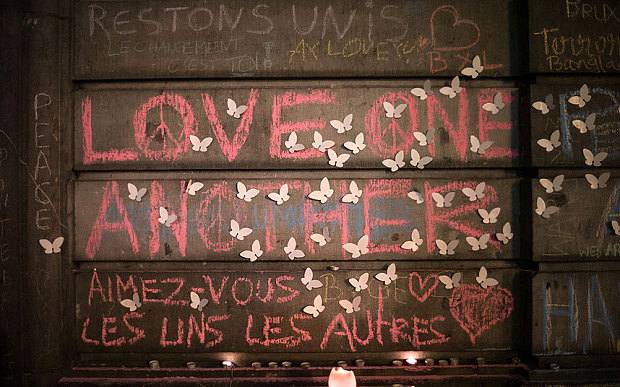
What has also been demonstrated, is that evil and hatred were not allowed to get the upper hand in Brussels, as Christian throughout the city offered practical help and prayers and the Belgian people rallied defiantly in the an open square to write chalk messages of love and hope.

The Archbishop of Brussels, Josef de Kesel, also announced that he had received messages from around the world, as signs of fraternity, and which he said, ‘let us feel how we are united in faith and humanity. He added that “We must stay faithful to our message of peace and go on promoting a discourse which appeals for acceptance, unity and coexistence’

So, as we continue to commemorate the passion, death, and resurrection of our Lord Jesus Christ this Holy Week, let us all remember that God is the source of love and life, and ask him to bring peace to our troubled world.

Amen

Servanthood image

© ‘Servanthood’ by Debbie Saenz.

Mother God – Prayers for Mothering Sunday

A posy for Mothering Sunday

A posy for Mothering Sunday

Traditionally, on the fourth Sunday of Lent. particularly during the sixteenth century, people would return to their ‘mother’ church on Laetare Sunday for a special service of rejoicing. It is also known as Rose Sunday or more commonly nowadays as Mothering Sunday. In times past, it was a rare day off for many domestic servants; it enabled them to gather with their whole family and many of these young people would pick wild flowers along the way to either place in the church or to give to their mothers as gifts.

My own church picks up this theme of offering flowers by handing out posies to all those who have ‘mothered us’ either to keep for ourselves or to take to those who have done just that for us. It is also a time to offer our thanks and prayers .

Prayers for Mothering Sunday

We pray for all who have mothered and nurtured us; those who have borne the pain and joys of childbirth. May they be blessed with love.

We pray for all who have become mothers through new relationships and who have welcomed these children into their hearts. May they know patience and understanding.

We pray for all new mothers, who may be struggling to cope, who seek assurance as they gain experience. May they be supported by the wisdom of those around them.

We pray for all who long to be mothers and for whom this is proving difficult or impossible. May they find a peace and resolution to their longing.

We pray for all whose mothers  or children have died and for those who continue to grieve their loss. May they find compassion and mercy in their sadness.

As a mother comforts her child, so I will comfort you.
Isaiah 66:13

We pray for all mothers for whom family life has been shattered through war and conflict. May they continue to receive the strength needed to endure these trials.

We pray for all those who become mothers through acts of rape or violence. May any shame they are made to feel be directed at the perpetrators and not within themselves

We pray for all widows, whose children are no longer close to them. May they find solace in their memories and hope of reconciliation

We pray for all who act as god-mothers; who offer faith and spirituality through their prayers and guidance. May they be encouraged in their duty

We pray for each and every person that has been a ‘mother’ to us regardless of nature, status or gender. May they receive the grace of God our Mother and our Father. Amen

Yet it was I who taught Ephraim to walk, I who took them up in my arms;
but they did not know that I healed them.
I led them with cords of human kindness, with bands of love.
I was to them like those who lift infants to their cheeks.
I bent down to them and fed them.
Hosea 11:3-4

Thank you to our 'mothers'

Thank you to all our ‘mothers’

Go back

Your message has been sent

Warning
Warning
Warning
Warning

Warning.