Sermon preached on Sunday 16th August 2026 based on Isaiah 56:1, 6-8 and Matthew 15:21-28
May I speak and may you hear through the Grace of our Lord; Father, Son and Holy Spirit. Amen
I was pulled up very sharply the other day on a trip to B & Q (other DIY stores are available). I had arrived early and waited for the shutters to open before dashing down to pick up some rolls of masking tape. Funnily enough the other customer who had walked in with me was doing exactly the same. So, we joked with the cashier that perhaps everyone was wanting to buy masking tape today. Of course, I’d overestimated how much I would need and decided that I would return the unused rolls, and was served by the same cashier. I explained what I’d been doing and showed the lady a picture I’d taken. She asked me to say again which church I was from and I told her St James.
She hesitated for a moment and then told me, that a while ago she’d visited St James for a few weeks, but that no-one had spoken to her and so she decided not to keep coming. It stopped me in my tracks, because the one thing that we pride ourselves on is that we are a welcoming church, and I felt desperately sad that she had had this experience. I apologised profusely, and invited her to give us another chance; she said she might, and I have looked out for her ever since…
The fact is that making someone welcome should be very simple. A smile at the door; someone remembering your name. Someone moving along the pew and making space for you. Someone saying, “Come and sit with us.” Someone noticing that you are new and taking the time to explain what is happening.
These things may seem small, but they can make an enormous difference, because most of us know what it feels like to be welcomed; and I’m sure that most of us also know what it feels like not to be welcomed. We know what it feels like to walk into a room and wonder: Do I belong here? Does anyone want me here? Am I going to be judged? Do I fit in? Will anyone notice me?
We so often subconsciously create boundaries, we create rules and regulations, we practise set theologies, that humans have determined are the ‘correct’ interpretations of scripture. You are welcome here, but you have to conform. It makes me so angry when I read and hear about churches that state specific doctrines within doctrines ‘this is what you have to believe to be part of this church’ There is no welcome and there is certainly no grace in those churches, none whatsoever, and today’s readings invite us to reflect on a God whose grace is wider than the boundaries we so often create.
Because every single person who walks through that door, comes as a mirror image of God. They might be a stranger, a foreigner, or an outsider to others, but God has called them here and it is our obligation to make them welcome.
The Church is called to be a welcoming place, it should be one of the places in the world where people can walk through the door and think: ‘I’m safe here, I’m accepted here, I don’t have to pretend here’. Which doesn’t mean that we have to agree about everything, or never challenge one another. We can’t ignore our Christian faith.
But it does mean that we need to recognise the dignity of every person who comes through our doors. Because some people arrive knowing exactly why they are here and others don’t. Some come because they have been Christians for decades and others may not even know whether they believe in God. Some come full of joy, whilst others come carrying grief that nobody else can see. Some come because they are celebrating, others because they are desperate. And our task is not to decide who is worthy of being here, but to make room.
Our two passages today, speak powerfully to us because they reveal something about the heart of God: God is continually gathering people whom others might exclude. In Isaiah, God declares that his house will be ‘a house of prayer for all peoples.’ In Matthew, Jesus encounters a Canaanite woman— an outsider, a foreigner, someone who would have been viewed with suspicion by many religious people of her day. Yet this woman comes to Jesus with courage, persistence, and faith.
Isaiah begins with a command to ‘maintain justice, and do what is right, ‘for soon my salvation will come.’ It goes on to speak about foreigners who join themselves to the Lord. This is pretty remarkable because Israel had strong ideas about who was inside and who was outside. There were religious, cultural, ethnic, and social boundaries. Yet God says that those who love him, serve him, keep his covenant, and worship him will be welcomed.
Sometimes we imagine that the church exists primarily for the people who are already here. But Isaiah reminds us that the church is also a place where God is gathering others. There are people outside our doors whom God has not forgotten.
Which brings us to the gospel. As Jesus enters the region of Tyre and Sidon, a Canaanite woman approaches him. Matthew makes sure we know that she is a Canaanite because that detail matters. She is not an Israelite, she is a foreigner, who comes from a people with a long and complicated history with Israel. The disciples might have expected her to remain at a distance, but she refuses to do so. She comes to Jesus with only one thing one her mind. Her daughter needs help. She doesn’t come with a theological argument or pretending to have everything together. There is desperation in her approach, but there is also faith.
Moreover, she recognises something that many others have not yet fully understood or failed to recognize. She calls Jesus, ‘Lord’ and ‘Son of David.’ She comes believing that Jesus can help her, and she does something that faith often requires, she refuses to give up.
This is where the story becomes uncomfortable because he doesn’t immediately answer her and the disciples become irritated and say, ‘Send her away’… they see her as an outsider and very inconvenient. The woman could have walked away at that point, with a sense of rejection. But she continues to cry out and kneeling before Jesus, simply says, ‘Lord help me.’
This is what faith can look like to us sometimes. Not having certainly or all the answers. Not feeling spiritually strong. but being able to stay turned towards Christ. Faith can sometimes be very quiet, sometimes it is simply saying, ‘“Lord, I’m still here.’
The conversation that follows is also difficult, as Jesus responds in a way that challenges us. ‘“I was sent only to the lost sheep of Israel’. Certainly, this reflects the particular mission of Jesus within the story of salvation. Matthew is presenting Jesus as the Messiah, fulfilling God’s promises to his covenant people. But we know that the gospel eventually moves outward to all nations when the risen Christ will command his disciples to ‘Go and make disciples of all nations’. The Canaanite woman is therefore, already giving us a glimpse of that wider mission.
Jesus also uses the image of children, bread and dogs, and we should be careful about not making the passage easier than it is. The exchange is deliberately challenging. The word that Matthew uses can carry the sense of household dogs, rather than wild street dogs, but the image still reflects the distinction between insiders and outsiders, with the children representing Israel and the dogs, the Gentiles.
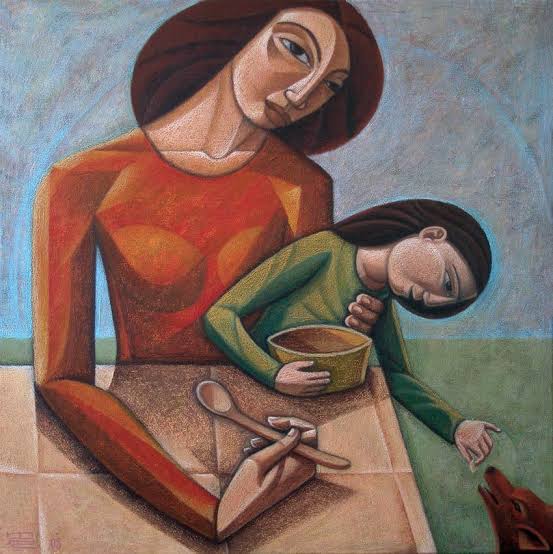
Her response, despite having been set this boundary is extraordinary. She takes the very image Jesus has used and turns it into an expression of faith. ‘Yes, Lord, yet even the dogs eat the crumbs that fall from their masters’ table,’ effectively saying that even within the boundaries you have described, there is enough mercy for me.’ That God’s mercy is inexhaustible. She trusts that the abundance of Jesus’ mercy cannot be exhausted, and Jesus confirms this, ‘Woman, great is your faith!
There is an important irony in this story. The disciples—the insiders—are ready to send the woman away, but the outsider becomes the example of great faith. Think about that for a moment. The person everyone expected to be distant from God becomes the person Jesus holds up as an example. Sometimes we assume that because we have been in church for years, we understand faith better than everyone else. But God may surprise us. We may encounter deep faith in someone who has only recently come to Christ. We may find extraordinary trust in someone whose background is completely different from ours.
We may discover that someone we have judged as an outsider is actually teaching us what it means to trust God. Sometimes the person we think needs to be welcomed into the Church turns out to be the person who helps us rediscover what the Church is for.
Which brings us back those two passages; Isaiah, with God’s announcement that, ‘My house shall be called a house of prayer for all peoples,’ giving us the image of him gathering people from every direction, alongside Matthew, who gives us the image of a woman who believes that even the crumbs from God’s table are enough. Together, these passages proclaim a beautiful truth, that here is room at God’s table for everyone. God’s grace is not diminished when it is shared, and his love is not a limited resource. When God welcomes another person, it does not mean there is less grace available for us. There is more than enough.
What we also need to remember is that welcome is more than just being friendly, which is an important distinction. Chrisian welcome is not simply saying that everyone here is lovely, although I know you all are. It’s much deeper than that. Christian welcome says, ‘there is room for you here because there is more than enough room around the table of Christ.
We don’t welcome people because we think we are better than they are, we welcome them because we know that we too live by grace. Everyone of us comes before God in need of mercy, we come with our own failures, fears and shortcoming, we come because we all depend on the grace of God.
This then becomes a challenge for the Church and for us, because perhaps the most uncomfortable feature of Matthew’s story is the disciples’ reaction: ‘Send her away’. Just sit with that for a moment…. Who are the people we would rather send away? Who makes us uncomfortable or requires extra patience? Who might disrupt the way we normally do things and require us to change?
The Church’s temptation is sometimes to make people fit the Church before we make room for them, but the Gospel points us in another direction. We make room because Christ has made room for us, because we are never the gatekeepers of God’s grace, only its recipients.
Amen
Image is by English artist, Michael Cook, ‘Crumbs of Love’ Hallowed Art

