Tag Archives: time

God’s Time Is In The Waiting

Sermon for the Second Sunday of Advent based on 2 Peter 3:8-15a and Mark 1:1-8

May I speak and may you hear through the Grace of our Lord; Father, Son and Holy Spirit. Amen

I hate waiting… I’m a completer / finisher and if something needs completing or finishing why wait around. Get on and do it straight away. Soonest done, soonest mended, soonest you can move on to the next thing. Yet haste is not always on the side accomplishing the best results. Yes, it creates a sense of achieving a lot in as little time as possible, but it’s also possible that things get missed, that plans change, that you have to go back and do it all again!

It’s taken me a long time to realise that time is not something to be got through as quickly as possible. Time is a precious commodity and the freedom of youth and endless days of pleasure give way to a sense of time passing too quickly towards its ultimate conclusion.

A recent spell of three hours in the waiting area of the Royal South Hants walk-in a few weeks ago, actually got me sitting and contemplating the nature of waiting. Situations such as this throw together a group of people each with different needs and attitudes, and I found myself noticing that the medical staff had perfected a list of priorities which was sensible and fair, however much everyone looked up each time hoping they were the next to be called through. The possible broken limbs, the youngest children, those who might be in immediate need of treatment to prevent further deterioration, and those who knew it wasn’t a matter of life and death but would really like some relief from their present condition.

The trouble with time is that it is a human concept, to be regulated and measured, and for those who believe a literal understanding of the beginning of time as described in the Genesis narrative it can seem that God ordained the hours, the days and the weeks to give us the rhythm of nature and seasons to measure our earthly existence.

It’s an interesting conundrum, and one which I recently spent discussing with some 8-year-olds at school the other day. I have to say that these are some of the best moments in my work as a school chaplain, when children divert me away from discussing how they might present a bible story in their Child-Led Collective Worship and morph into pondering the bigger questions in life. From annunciation to childbirth to creation in the space of two questions. From the miracle of Jesus’ conception to the lack of stories of his childhood to the question of how Adam and Eve’s son’s managed to find wives. Then back to the key question, but who created the creator and did he really do it all in six days.

Of course, the best way to answer these questions is to deflect it back to the questioner… What do you think? No, it’s not a get out clause, but it gives a chance for them to express what they might be thinking but not quite wanting to suggest in case it’s the worst answer ever and Reverend Linda will scoff at their ignorance and everyone else will laugh. To be honest you don’t get that sense of reticence with 8-year-olds, and they are actually very respectful and will listen to each other.

So, the response that God would have done it in God’s time and if he could create two people why could he not have gone on to create a few more. Nevertheless, it was the first statement that I heard so confidently expressed, and here this morning we hear the same point being made from the pen of St Peter, ‘do not ignore this one fact, beloved, that with the Lord one day is like a thousand years and thousand years are like one day.’

 Peter is noting that the completion of God’s plan for his creation should not be something we are concerned about on a human timeline, but how we spend that waiting time, so that when and if it should happen in our lifetime, we could stand before God with a clear conscious that we had striven for all that is demanded of us as followers of Christ.

The fact is God’s plan has never been set to a particular timescale. He has been one of those draughtspeople who will take things back to the drawing board, recalculate and adjust depending on what is now wanted and needed.

If we look back over the Old Testament stories, we can clearly see God making these adjustments. He’d tried ripping up the original blueprint and starting again with Noah and his family, he’d given detailed plans to various architects of faith, including Abraham and Moses and he’d sent engineers into the field with instructions of what needed doing such as his prophets, Elijah and Isaiah, but it would seem that the people didn’t grasp the vision or understand what sort of kingdom he was trying to build.

It seemed that the workers had downed tools and were taking a long vacation, and God was silent… Except he wasn’t, he was busy pulling together the next part of his plan, and it would be the greatest draft yet because it needed to be absolutely right, and it needed to be a one off. He had tried giving chance after chance, now he was doing something new, something amazing.

So, what sort of publicity campaign would he run. How many global publishers would he engage to follow up the big launch? As always God surprises us. No big fanfare, well apart from a host of angels in the middle of the night. A teenage girl, a reluctant fiancé, in a land under foreign rule, a rag-tag bunch of shepherds and a foreign diplomatic visit. An aged couple in the temple and a wild-haired man in the desert, not exactly front-page news.

But he was here, and the next part of the plan was about to begin; ‘the beginning of the good news of Jesus Christ, the Son of God’. Today we focus on that beginning as John announces that the time has come, to repent and turn back to God, because time is running out.

He speaks with urgency and recognises that he is merely the preliminary act. The messenger sent ahead to prepare the way. And Jesus was coming out of his own time of preparation, not just a mere 40 days in the desert, but thirty odd years of learning, observing, listening, and waiting and it was now his time.

For John his understanding was likely to be that this was it, this would change everything, the Messiah had come, and things would never be the same again, and of course they weren’t. However, God’s plan was still not marching in time with that of his people and we can see that some two thousand earthly years later that his plan is still being worked out.

Nonetheless, it’s sometimes hard to see amongst this world of increasing secularism and human conflict the bigger and brighter plan for us. Someone asked a question the other day as to whether we were really living in the end times at the moment, and that maybe we’d all be better off if God did bring these times to an end. It’s hard to deflect such a question because of course there is no answer to that. God’s time is not our time, so we just have to wait.

But it’s in the waiting that we can make a difference. We can still share the Good News, we can represent Christ in what we do and say, we can show people that there is always hope. However dark a tunnel is, it is just that a tunnel, a means to get from one place to another, and as we move through it there will always be that glimmer of hope and light that appears at the opening.

We have to be patient, yet active. To wait, but to do so with hope. To mark time but to make the most of it. To let God be the completer / finisher in his own time.

This Advent we wait once again to share the Good News, God is with us. Amen

Go back

Your message has been sent

Warning
Warning
Warning
Warning.

Matching God’s Generosity

Yesterday, in between showers, I took Molly dog for a walk in the park and I noticed these beautiful leaves that had fallen to the ground. When I found them they were still glossy and supple and felt full of life. But this morning they have begun to dry and fade and will eventually become lifeless.

Of course, whilst they were still part of the tree, they created and stored energy, from the water supplied by the tree, the carbon dioxide supplied by the air and sunlight – microscopic sugars. This energy was then shared with the tree to build up its branches and produce more growth and leaves – a perfect example of giving and receiving, of mutual generosity

However, once a leaf becomes separated from the tree, all of its stored energy is useless, its beauty begins to fade, and you are left with nothing except a mulch for the garden or crumbly dust.

We too can be full of energy and life, have more than enough reserves to sustain our way in the world, and plenty of opportunities to share what we have to make a difference, but if we keep these things to ourselves, storing up treasures in ever increasing amounts then we become like these leaves. We will have broken that connection to the source, and that mutually beneficial relationship that enables us to grow and flourish will have been severed; our riches will be worth nothing more than the likelihood of becoming someone else’s rich compost.

The saying, ‘you reap what you sow’ comes in many guises throughout the bible, from proverbs and psalms, prophets and parables, but the underlying message is clear, the amount you receive is equal to the amount you give and vice versa. In our New Testament reading, Paul is reminding the Corinthians about the principles of Christian giving. Giving is like sowing seed: what you get is linked to what you give. In Christian giving both the thought and the attitude count. We are reminded that God is the greatest giver. He provides in all kinds of ways – in crops and food and spiritual gifts. His greatest gift being to send his only Son, Jesus, to be the Saviour of the world

The Corinthians, like us, will discover that by changing their attitude to giving that they themselves will receive more. They, like us, will be enabled and encouraged to be generous, both now and in the future. This will be a harvest of praise to God when people see his grace in their lives. So, more than ever we need to give generously, willingly, and cheerfully, of our time, of our talents, of our resources; because what we will receive back will be so much more

But wait, haven’t we heard this exhortation to be more generous so many times before. Haven’t we for a moment taken stock and reviewed what we already give in time, talents and resources and decided that we can say we are giving in at least one of these ways very generously so surely that counts?

I wonder though if God takes stock and reviews his generosity or does he simply pour out more blessings in abundance hoping some will at least try to match him.

And God is able to provide you with every blessing in abundance,
so that by always having enough of everything,
you may share abundantly in every good work.
2 Corinthians 9:8

Time, talents, and resources, it should never be a case of which one should I choose to be generous in…

Generosity of time should not be counted in hours and minutes, but being willing to offer enough time and more, so that things can be accomplished that will benefit not only ourselves but others too.

Generosity of talents should not be scored by the ability to outshine everyone else as the star of the show, but by sharing those skills to enable everyone to rise to their full potential

And generosity of resources should never be about percentages. If you have sufficient then the rest is a surplus, which might just be the necessary amount to provide for those with little or nothing.

As Christians and church members, we carry within us the seeds of faith, seeds that are to be sown to enrich each and every life that comes into contact with our own, to make those connections. God generously supplies the water, the spirit and the light and we are called to convert that into a generous life-giving energy. This is grace and it is freely given, is inexhaustible and unextinguishable.

This is our generous God, let us be his generous people. Amen

A sermon for Harvest Festival based on 2 Corinthians 9: 6-15 and Luke 12:16-30

Go back

Your message has been sent

Warning
Warning
Warning
Warning.

Sabbath Rest

Sabbath Rest

It’s really hard when you want to write about something that you know is a good thing to do but you are not so good at actually doing it yourself. A someone commented yesterday when I delivered this sermon, ‘Physician, heal thyself’! Still, as I said, it acts as a good reminder to me as well as everyone else

Bible Reference: Luke 10:38-42

May I speak and may you hear through the Grace of our Lord; Father, Son and Holy Spirit

I had to think long and hard about what I wanted to say this morning, because I am sure that some people could so obviously accuse me of hypocrisy, quite possibly a case of ‘do as I say and not as I do!’ But I believe there is an important message that needs to be explored and undoubtedly, I need to hear it as much as others might.

But first let me ask a question for you to ponder… when was the last time that you actually spent time doing nothing? Not doing something that you wouldn’t consider work, nor doing something that involves you organising your leisure time, not even setting time aside for prayer or to read a book… but just simply doing nothing but resting.

I guess that this simple kind of resting could go one of two ways. You either fall asleep or you allow yourself to simply bring yourself for those few precious moments into God’s presence. I call them precious moments because so many people nowadays have lives that do not involve seeking any time of rest or relaxation. We are conditioned to wake up and immediately our brains are focussed on what we must achieve that day or over the coming week. We have to plan and organise every single minute of our time, whether that is doing work, or filling our leisure time with activities or for parents of young children making sure that they are involved in stimulating pursuits, because, heaven help us, that they should be bored or have nothing to do!

But what’s wrong with a bit of boredom every now and again? Yes, it can be a state of mind caused by a lack of stimulation that leaves us craving relief, but it’s also acknowledged that without boredom we couldn’t achieve our creative feats. It often gives us time to think, to explore and to rest awhile.

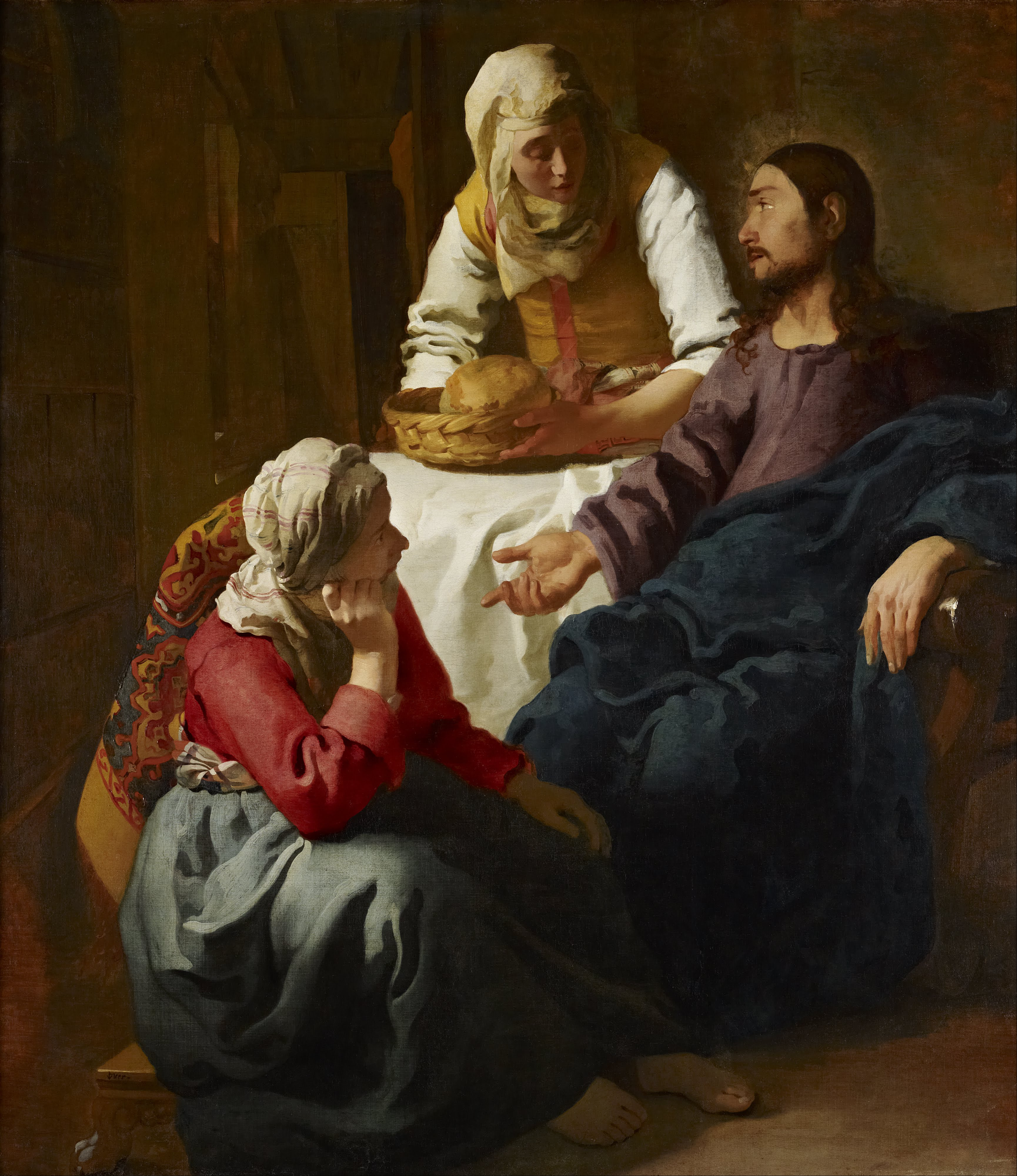
It’s the difference between being a Martha or a Mary… not that I’m suggesting that Mary was bored, having nothing to do… but the two women in our gospel are demonstrating the need to set aside time to simply be with God. It’s also not the case that we need to choose between being a Mary or a Martha, whether we should only be one or the other. Rather that it’s essential to be both. Like Martha we think that the important thing is doing, but Jesus teaches us through Mary’s example that we need to sit, to listen, to learn, to love.

For Mary and Martha, their friendship with Jesus meant that they would have been proud to have this popular man as a guest in their house, together with all of his entourage and followers, and Martha, as the principal hostess would have wanted to make sure that he was comfortable and that his needs were catered for. So she welcomed him into her home and went into the kitchen to prepare a meal for him.

However, her sister Mary did NOT go into the kitchen but instead ‘sat at Jesus feet’, and fair enough when you have guests you do not generally abandon them straight away and all disappear to do other things. But for Martha, it wasn’t okay that her presumably younger sister got to do nothing, while she had to organise and cater for so many.

Luke tells us that Martha ‘was distracted by her many tasks’ and I’m sure we all know how that feels, don’t we! The times when we’ve experience being ‘in over our heads’, when we’ve needed help, but didn’t know where to turn. The times perhaps when we’ve pitched up to help with something and end up doing everything, while others sit around chatting. So Martha’s anger at being abandoned in the kitchen was understandable, and the stress and anxiety spills over into calling out Mary in front of everyone. There was no subtle sidling up to Mary and saying, ‘Mary, I need some help’. instead she rebukes Jesus, her principle guest, whom she had acknowledged as ‘Lord’ and basically orders him to ‘Tell my lazy sister to get into the kitchen to give me a hand’ or words to that effect and meaning.

‘Lord, do you not care that my sister has left me to do all the work by myself?
Tell her then to help me.’
Luke 10:40

Now everyone is aware of the tension in the room, but we can still feel sympathy for Martha, and in some ways we want Jesus to appreciate and commend Martha for her hard work and suggest that they both go in there and give her a hand. However, Mary’s focus on her relationship with Jesus was also right and whereas Martha’s anger was disruptive, and Jesus acknowledges that she is ‘anxious and troubled about many things, he points out that Mary has chosen to the one thing that is needed

She had set aside time, in the busiest of situations to spend time with God. What we might call Sabbath rest, when we very deliberately take time to do nothing but make ourselves more aware of God with us. And don’t get confused, this is not just setting aside one day a week to abstain from work, because even that is no longer a day when we rest our minds and our bodies, instead filling it up with alternative tasks; but times, whether it’s a few hours or minutes that we switch off from the everyday normal.

This idea of taking time to step aside, is nothing new. From the very beginning we are given this example of Sabbath rest. After creating the heavens and earth, in whatever way or timescale you believe, God rested. It didn’t mean that God was tired and needed a rest, unlike most of us, because being omnipotent he never tires, but he simply stopped what he was doing, he ceased from his work. It was a message and example that he called the Israelites to follow when he handed down his commandments. They were to remember the Sabbath day and ‘keep it holy’. They were to lay down their work in order to spend time in worship and prayer.

For Jesus himself, there were times that he must have experienced the stress and anxiety caused by overwork. As more and more people came to seek him and listen to his teachings, so the time that he had to take that rest became more and more elusive. Still he recognised the importance of stepping aside if only for a short time. In Mark’s gospel we hear that ‘because so many people were coming and going that they did not even have a chance to eat, he said to them, ‘Come with me by yourselves to a quiet place and get some rest.

Who hasn’t skipped a meal because of the workload we’re experiencing, but after resting, it’s so much easier to exit that secret place, go back into the world, and feel re-energized, focused, encouraged and strengthened to continue doing what we’re called to do.

So many mental health problems, such as anxiety and depression can be caused as the saying goes, by ‘too much work and not enough play. And not taking time out may make any existing mental health issues worse. And what’s even more alarming is that even primary school children are showing signs of mental health problems – including anxiety, panic attacks and depression –caused mainly by family problems, pressures of exams and social media, which lead to problems such as self-harming, eating disorders and OCD.

So, when we find ourselves in stressful situations such as a difficult phone call, a crowded train journey home or a looming deadline, we need to give ourselves time to pause and calm down. Imagine what Martha could have done. Instead of stomping into the living room and having a go at Jesus and Mary, she could have gone into her bedroom and closed the door. Martha could have prayed ‘God, I’m so angry. It would be so tempting to take out this anger on Jesus and Mary – but I know that would be wrong. Please drain this anger out of my heart. Help me to feel love for Jesus, my guest, and Mary, my sister.

 Better still, Martha could have gone and joined her sister Mary at Jesus’ feet and listened to him speak and be in his presence for a while. Who would have worried that the meal was late when was it was Jesus that was with them

We are such busy people, and we live in such a busy world. It’s easy to miss the important things. The story of Martha and Mary tells us that there is value in sitting – in listening – in learning – in loving. Whether at home or work or school, take a moment to look around and find the blessings in your life. Take a moment to thank God for giving you another day to discover more. Sit at God’s feet for just a moment. Be quiet. Listen. Treasure the moment.

We all live in a Martha world, but take time to be Mary for just a bit. Jesus says that that’s the one thing that’s needed. He says that’s the good part that won’t be taken from us. Give it a try. You will find a blessing! You will find that Jesus was right.

Amen

‘Martha, Martha, you are worried and distracted by many things; there is need of only one thing. Mary has chosen the better part, which will not be taken away from her.’
Luke 10:41-42

Mary and Martha - Vermeer

Mary and Martha by Vermeer

Go back

Your message has been sent

Warning
Warning
Warning

Warning.