Tag Archives: worry

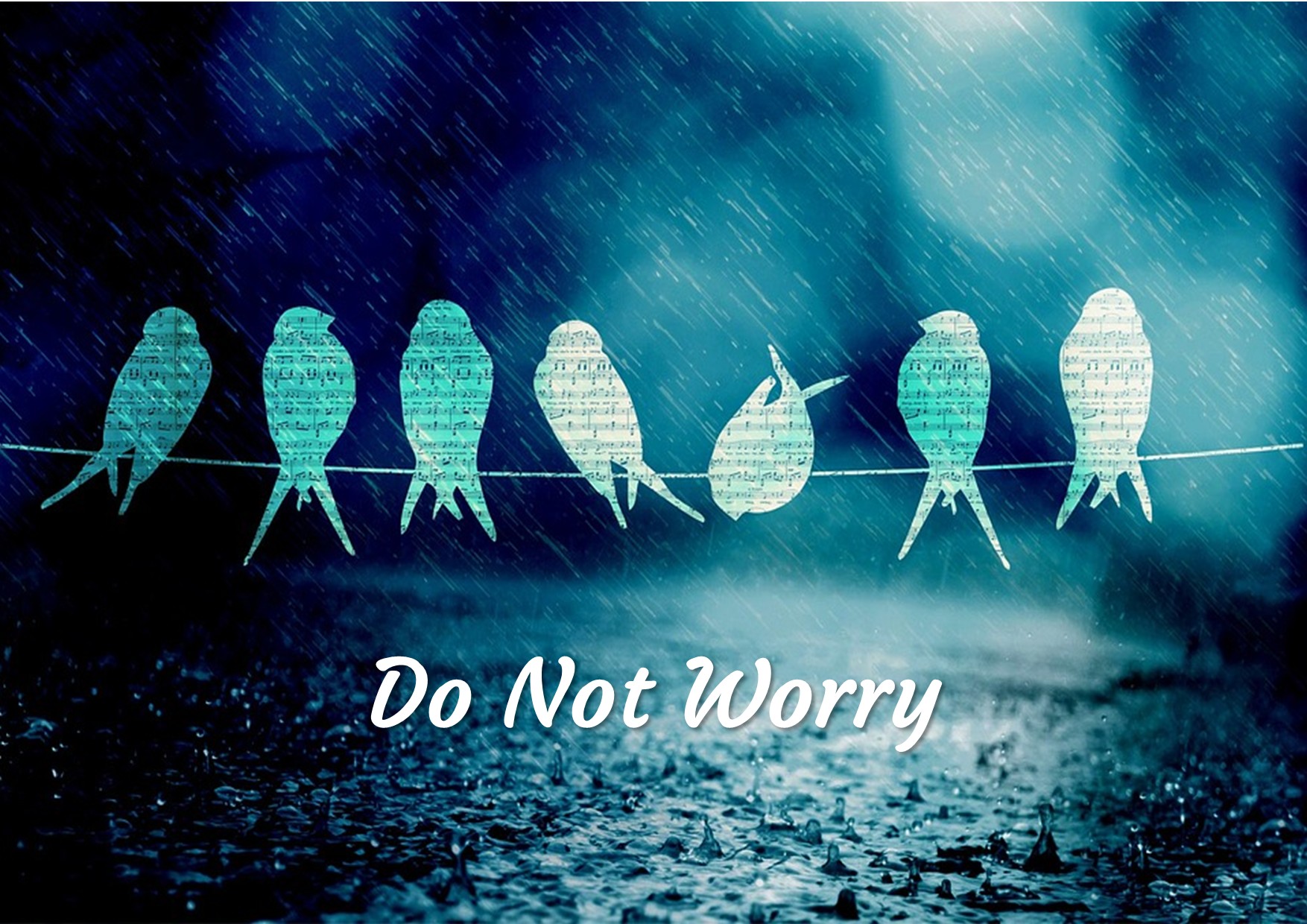
Feeling Anxious? Why Worry?

Sermon preached on Sunday 8th February 2026 based on Romans 8:18-25 and Matthew 6:25-34

May I speak and may you hear through the Grace of our Lord’ Father, Son and Holy Spirit. Amen

Everyone has anxieties or worries – everyone… I may be anxious about climbing up into this pulpit, in this robe without tripping up! I may be anxious about how, what I’ve written on these pages, may be heard or understood. I may be anxious that I won’t have time to have a coffee between this service and the next! Lots of anxieties and worries.

No doubt you too could make a list of the things you are anxious about at this time, and some of them will be fleeting moments of thoughts and desires for a positive outcome, whilst others may be deep-seated concerns around health issues or disquiet about events in our world and society.

Everyone has worries… The fact is we live in an anxious age. Alarming news headlines, mounting financial burdens, growing strains in our relationships, medical niggles and changes in our health. All of these often make the future seem very fragile, and in amongst it all anxiety whispers, ‘What if?’ – although more often it shouts!

Yet, into all that noise, Scripture speaks steady, countercultural, gracious words, ‘Do not worry.’ Both of our passages today do not deny suffering or dismiss our needs. What they actually do is locate our lives within the wider purposes of God, that draw us into a vocation of hope and trust; hope that is strong enough to hold our pain; and trust that can free us to live in today.

Even so, ‘Jesus’ and ‘anxiety’ do not sit easily together. What Jesus is trying to show us is that deep down as human beings we can be controlled, even dominated and bullied by our anxieties, but that these worries are futile because that don’t produce any real fruit.

The concerns he highlights are about eating, drinking and clothing. Certainly, in biblical times, where there were no welfare systems or charity safety nets, they were genuine worries about simply surviving, and yes, even today people have to make choices about whether they might put a meal on their table or provide basic needs for their families. So, for them, their worrying was very much justified, even sensible if it came up with a resolution.

And when we place it against our modern day lives, it can often mean our worries turn out to be more about the things we desire rather than things we need. However, I hope we would never tell anyone who was at risk of starving, that food is unimportant. Worrying is natural and reasonable, but each of us sits on a dividing line, that has positive anxiety on one side, which helps us to avoid making mistakes and negative anxiety on the other, that projects us into the not yet existent future rather than living in the present moment. So how can we manage it?

Paul tells us that creation itself is groaning as it waits for glory, whilst Jesus tells us not to worry about tomorrow, because God already knows what we need. Together these passages can teach us how to live faithfully between the ache of the present and the promise of the future.

Paul begins with realism. He does not pretend that faith removes suffering. “The sufferings of this present time,” he says, are real. Also, groaning is not the same as moaning or complaining. Complaining is saying that ‘This shouldn’t be happening’, whereas groaning says, ‘This hurts – yet I’m still holding on’. It is the sound of faith under pressure, the cry of someone who knows that the world is not as God intended it to be.

It also reminds us that anxiety is not a personal failure; it is a symptom of living in a fractured world, because we feel it in our bodies, our finances, our relationships, and our fears.

Paul also refuses to let suffering have the final word. “I consider that the sufferings of this present time are not worth comparing with the glory about to be revealed.” This is looking at it from the perspective of hope through the resurrection, and it’s not just wishful thinking. It is about having confidence in the faithfulness of God, as it looks forward to what we cannot yet see, because if we could already see it then it wouldn’t be hope.

The future glory of God does not erase today’s pain, but it re-frames it. This is the hope we confess in the Creed: “We look for the resurrection of the dead, and the life of the world to come.” Such hope teaches us patience. Not passive resignation, but a steady, prayerful waiting upon God.

So, if it is Paul that addresses the ache of the world, then it is Jesus who addresses the anxiety of the heart. Three times Jesus says, “Do not worry.” And then he speaks about the most ordinary things: food, drink, clothing. This is because Jesus knows our worries are generally practical. He points to birds who do not store grains, and to flowers that do not spin threads. These are not sentimental illustrations, but signs of God’s sustaining care. Our anxiety often arises when we live ahead of ourselves—when tomorrow’s uncertainties overwhelm today’s calling. Jesus gently calls us back to the present moment and reminds us that the same God who clothes the lilies and feeds the birds is attentive to our lives.

Jesus also doesn’t say that our needs don’t matter, just that they do not have to rule us. Instead, we should ‘Strive first for the kingdom of God […] and all these things will be given to you as well.’ Seeking the kingdom means orienting our lives around God’s values, God’s justice, God’s love. When we do, our priorities shift. Worry loosens its grip because our security is no longer tied to outcomes we cannot control.

And Jesus ends with words that are both compassionate and practical. “Do not worry about tomorrow, for tomorrow will bring worries of its own.” In other words, God gives grace in daily portions. Just think of the number of times we have prayed, ‘Give us today our daily bread’, not ‘oh and some for tomorrow as well, and if you can manage it a few fallback items in the larder’. Today’s grace is enough for today.

And whilst we are seeking the kingdom our calling is being reshaped, so that anxiety no longer governs it. It means that our daily work, our care for others, our stewardship of creation, and our commitment to justice and mercy are not distractions from the kingdom of God. They are ways in which the kingdom is being made visible here and now.

So, Jesus does not end this teaching by telling us to try harder not to worry. He ends it by inviting us to trust deeper. The birds still fly, the flowers still bloom, and God is still faithful. The same God who clothes the fields and feeds the sparrows knows each of our names, our needs and what our tomorrows hold. To worry about that suggests we are alone. To believe what Jesus tells us means that we are being held.

So, when we leave this place and tomorrow brings its own questions—about money, health, family, or the future, perhaps we could remember that God is already in our tomorrow, and that we do not need to carry anything that God has promised to provide.

Take today as the gift it is. Walk in trust, not in fear. Seek the kingdom, not control. And rest in the assurance that the God who calls us is more than enough—today, and every day.

Amen
Don’t Worry… Be Happy?

Sermon based on Matthew 6:25-34 and Romans 8:18-25

May I speak and may you hear through the grace of our Lord; Father, Son and Holy Spirit. Amen

I was listening to a radio interview the other day in which it was mentioned that one of the most played songs recorded as background music in shops and pubs and shopping centres was a certain record by Bobby McFerrin. It becomes a kind of earworm and I’m sure you know it, and as we’ve warmed ourselves up with a couple of hymns, so I’ll sing the first couple of lines and you see if you can sing the two lines that come next…. okay, don’t leave me hanging! Also you need to imagine me singing with a slight Jamaican accent!

Here’s a little song I wrote…. you might want to sing it note for note… don’t worry…. be happy! [If you wouldn’t have known the song then here is a version of it on YouTube]

Well done, and that’s one less thing for me to worry about, as to whether any actual notes would come out of my mouth or whether you’d even recognise the song. Because it’s a fact that we worry constantly about so many things.

As children we worry about friendships in the playground and at birthday parties whether there will be enough chocolate fingers to go round. As teenagers our worries increase about how our bodies are changing and the likelihood of passing our exams. Onto young adulthood as to whether we will ever be attractive enough to attract a partner or attract society’s criticism if we choose to stay single.

And the worries don’t stop there, add in mortgages, career advancement, starting a family, financial insecurities and it’s a wonder that any of us make it to our advanced years, when the worries return about our health, bereavement and loneliness.

This morning’s gospel passage is upfront with a command from Jesus to not worry about our lives, our physical and outward appearances and our reliance on ourselves. It comes towards the end of the Sermon on the Mount, and is part of a series of four passages that are all to do with earthly treasure, about not storing it up, about the need for generosity, looking to serve God instead of mammon and with not being anxious about material needs’

Matthew is talking about the focus of the heart, especially around service – but in doing so this naturally brings a sense of human insecurity; lots of buts and what ifs. We may have to work to earn money, but we don’t have to worry. How many of us today had to worry whether there was food in the cupboard for breakfast or didn’t have a choice of what they were going to wear. The frantic pursuit of food and drink and clothes is a sign of insecurity. It’s a lifestyle chosen by people who don’t really know God or who even want to.

For those who do want to know him better, Jesus says that we must learn to trust God and we are reminded that those who undertake the hard demands of the gospel have a Father in heaven who gives good gifts to his children. What really counts is God’s kingdom – if we put God and the kingdom first then everything will follow – and find its proper priority and place

As Paul recognises in his letter to the Romans, ‘that creation itself will be set free from its bondage to decay’, read self-destruction, ‘and will obtain the freedom of the glory of the children of God’ concluding with ‘if we hope for what we do not see, we wait for it with patience’ – patience bringing contentment – contentment bringing happiness.

So, the answers simple, right… stop worrying and we’ll all be happy; but as my mother would often remind me, that’s easier said than done. Perhaps then, its more about changing our attitude to worrying that will bring about a change in our state of mind, in which we are more able to understand better how to deal with those worries. Or perhaps true happiness lies in seeing those worries for what they are.

The primary cause of worry or anxiety is fear, whether it is real or perceived. Apparently, Winston Churchill once said, ‘I remember the story of the old man who said on his deathbed that he’d had a lot of trouble in his life, most of which had never happened.’ Therefore, we should be asking ourselves, are they worries or are they concerns? Because it’s okay to be concerned about your work, to buy insurance or to save for a rainy day, as long as you make time to enjoy simply being alive. It’s okay to be concerned about your cholesterol or blood pressure because you can do something about it such as watching your diet and exercising. It’s okay to be concerned about your child who is misbehaving because you can then take prudent action and administer discipline as necessary. There is a big difference between concern and worry… Concern focuses on probable events and takes action, whereas worry focuses on improbable events and doesn’t do anything productive.

In fact, it can be quite destructive.

Firstly, because worry cancels out faith and the message of the gospel. When we are obsessed with our worries, we are telling God that we don’t trust him. Instead, when we only trust ourselves, our hearts will turn away from God and we won’t see the good when it happens. Our choices will cause our hope to dry up; nothing will grow in our lives. The word worry itself comes from an old Anglo-Saxon word that means to choke or strangle, we only have to think about the parable of the sower when Jesus tells us about the seed that fell among the thorns which choked the plants to death. Having faith and trusting in God inevitably produces a positive attitude, when we have confidence in God we become firmly planted, thriving in life.

Secondly, worry itself causes health problems. It’s the kind of worry that makes you ill – physically and emotionally. It can paralyze us. It can cause an intense amount of fear and anxiety. It causes us to be less effective – more hesitant. It can be described as worrying about things we cannot change, about things we are not responsible for, things we are unable to control, things that frighten and torment us and keep us awake when we should be asleep, things that drain the joy out of our lives.

So often, we anticipate the negative so much that it destroys our peace and minimizes our effectiveness in the present. As someone once said, ‘If you’re tempted to worry, remember that a raisin was once a happy grape’… in the same way worry tends to shrivel us up and make us ineffective. Having faith instead gives us a positive outlook, a positive attitude that fills us with hope and allays our fears because it asks how are we to be defeated if we have God in our lives?

The final reason as to why we shouldn’t worry is because it accomplishes nothing. We can’t change a thing by worrying. In fact, Jesus says that it is a waste of our time, ‘Can any one of you by worrying add a single hour to your life?‘ He says that worry is futile; it’s pointless, it’s fruitless.

Accordingly, it’s all down to changing our attitude and outlook. Jesus tells us that the reason that we obsessively worry is because we are worldly-minded. We’re more concerned about the things of this world than we are with the things of God. When we change our perspective, the things of this world don’t seem so overwhelming. Why get so entangled and worked up with the things of this earth when they’re not going to last?

He also says that instead of struggling with obsessive worry we are to live one day at a time, ‘So do not worry about tomorrow, for tomorrow will bring worries of its own. Today’s trouble is enough for today.’ Notice that Jesus doesn’t say, ‘When you follow me, everything will suddenly be wonderful’. It’s a fact that we live in a fallen world. Our actions as humans effect the environment around us. There will still be natural disasters, there will still be diseases like cancer. We may still face financial hardships and people will disappoint you and even be disrespectful to you – even your children. But worrying about tomorrow only takes away from the energy that you need to live today.

We serve a God who spoke the universe into existence, who showed his love for us on the cross at Calvary, who proved his power over sin and death when he rose from the grave. So, I’m pretty certain that he can handle our worries and in doing so help us find the ultimate state of happiness.

Amen

Sermon on the Mount by Jorge Cocco Santangelo

← Back

Thank you for your response. ✨

Making Space for Prayer


IMG_0432

Flowers for Peace

Last week we ran a series of School Prayer Spaces at Saint James’ Church of England Primary School, West End, Southampton. This involved creating interactive activities which the whole school, both children and adults could take part in and gave them a chance to explore life questions and experience a sense of spirituality and stillness in their busy lives.

These activities included:

IMG_0429

The Gathering

The Gathering – It was important that everyone was gathered both at the beginning and the end of the session. This helped as a reminder that it was important to move about the space in a quiet, thoughtful manner. The filmy voile also helped to create an air of mystery of what was to come.

IMG_0419Be Still Pods – Here was a reminder that God calls us to be still from time to time, to help us to learn more about ourselves and God. Simple pop up tents provided a space to do that, each furnished with a cushion, a focus lamp and ‘stillness’ image.
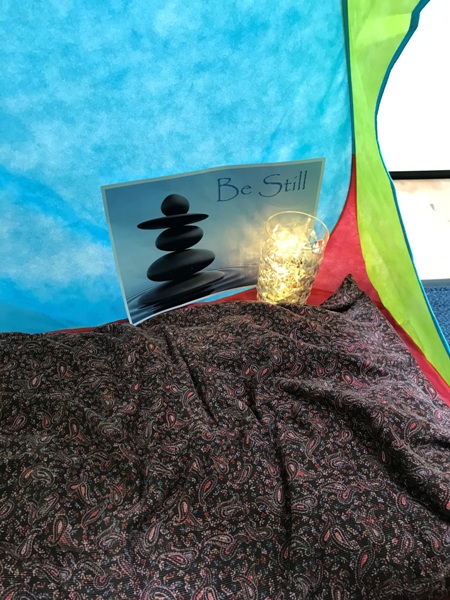
It’s amazing that even Reception class children (aged 4 to 5 years) could manage this brief time of stillness, and what was even more amazing was that the Year 6 children (aged 10 to 11 years), despite our concerns that they would be too tall or to ‘cool’ to give it a go, managed to squeeze themselves into the space willingly.

IMG_0420

Be still and know that I am God

Tardis Prayers – Here was an opportunity to think about the future. With a Tardis weIMG_0421 could travel forward and see ourselves in 10, 20, 40 years time. Some of the smaller children found the concept of forty years a little difficult to imagine, but they all came up with a suggestion of what they might be doing, what type of person they might be, expressing their hopes and dreams.



IMG_0422In amongst the usual ‘celebrity’ footballers, singers and dancers were the more traditional dreams of becoming a teacher, doctor, lawyer or policeman. The more altruistic souls saw themselves as solving world hunger and peace, as well as being kind and caring to those around them.
Certainly there was no limits to their ambitions with perhaps a future President of the United States or Queen of England here amongst us

Time Lord.png

My Time Lord is the Lord of Time

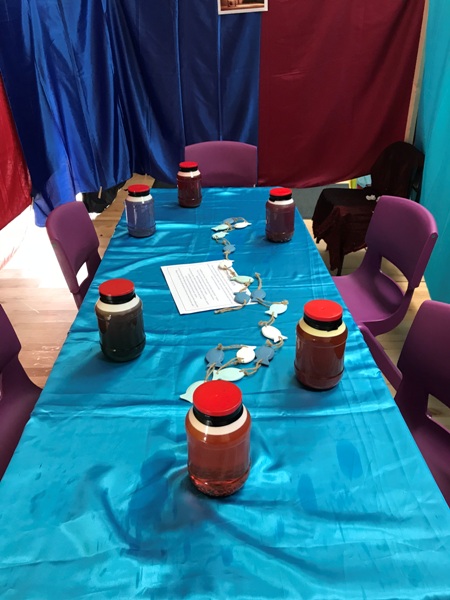
IMG_0423Calm Jars – We all know that life, including school, can be stressful. When we are trying to juggle the demands of people, relationships, expectations and pressures, our minds can feel busy and restless and then we start to worry. A Swedish proverbs puts this into perspective, ‘Worry gives small things a big shadow’. In the Bible, however, God often reminds people to be still, to wait and to stay calm whatever the situation.
By gently shaking the jars and watching the glitter swirl and settle they could think about those things in their lives settling down and becoming calmer.

Stress Less – In a similar vein, the ‘stress less’ activity helped to consider the things that stress us out and how to let them go.

IMG_0427

Brightly coloured aqua beads (or frogs’ spawn as some referred to it) were the perfect medium to allow everyone the sense of worries and stresses literally falling away or through our fingers.

Quoting from Peter’s first letter, ‘Cast all your worries on God, because he cares for you’ (1 Peter 5:7) helped with the concept that our worries may not automatically disappear, but by sharing them it can make them easier to deal with.


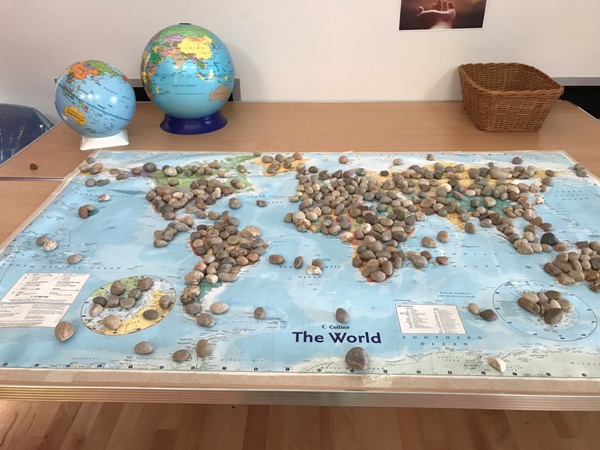
Pray for the World – Our final activity within the prayer space was a chance to think about praying for those people around the world who we were never likely to meet or know anything about, and yet they were undoubtedly just like us.

IMG_0417

Using a simple map of the world we explored the differences between people, such as languages, skin colours, religions and beliefs and cultures, but also the fact that we all had one thing in common – we were all human, and therefore had the same needs – the desire to be safe, cared for and loved.

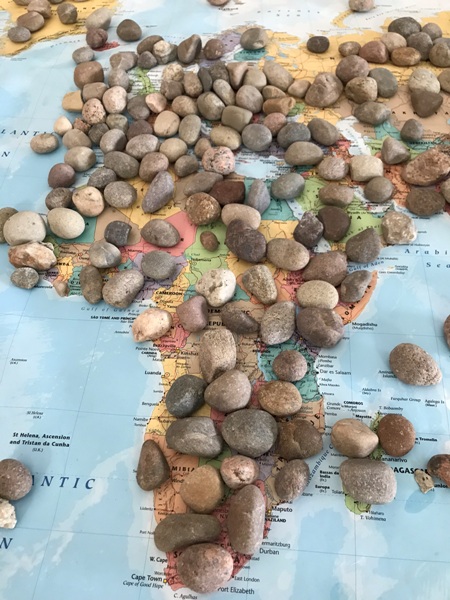
IMG_0418By the end of the week we had managed to cover almost every single country in the world in prayer pebbles, representing the simple prayer we said for the people living there.
If you look closely don’t be concerned that we might not have said a prayer for England – this did have pebbles placed on it, but I kept having to move them slightly so that we could compare the size of our country to others around the world.


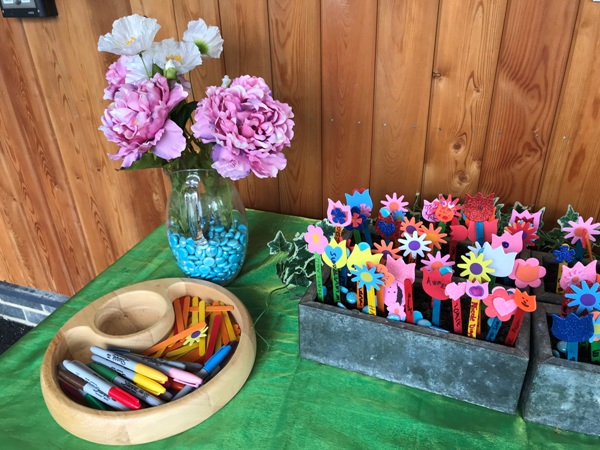
One additional activity was our Peace Flowers, which we invited everyone to come back to after school. Here people were invited to create a flower and on the stem write the name of a place, person or situation that they felt needed peace. As you can see it was very popular

IMG_0431

Altogether a very enjoyable week, with lots of positive feedback from both the participants and the helpers who led the activities. It’s incredible how spiritual young children can be when we give them the opportunity and space to express this – and it doesn’t do the adults any harm either to be able to do so.

If you want to find out more about Prayer Spaces in School you can visit their website or read more about the Research Project they carried out

IMG_0430

← Back

Thank you for your response. ✨