Author Archives: lindasgalvin

Day Three – Part 1 -From The Beginning

IMG_7379

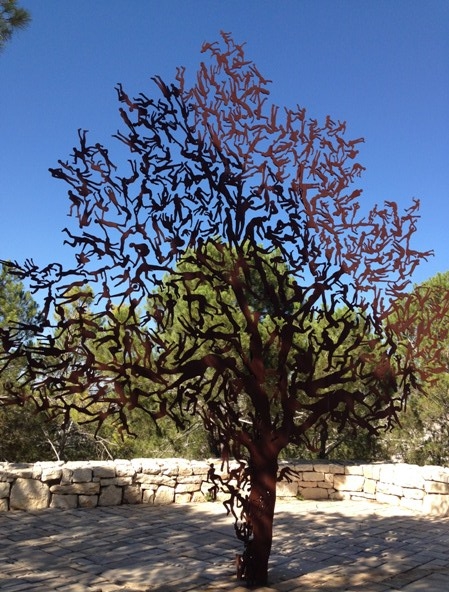
The Partisans Panorama includes a tree of people which pays tribute to the Jewish fighters who joined the partisans during the Holocaust. As the sun hits it it glows red.

Taking part in this series of seminars becomes a real privilege when you realise that you are listening to world experts in their field. You frantically scribble down your notes, trying to capture if not every word at least as many as you can (I am already up to 29 pages of foolscap notes). How then to share that without reducing it to unconnected bullet points? The beauty is that the lectures are presented in chronological order and so there is some logic in just taking what you consider to be interesting and informative it, because after all this is a blog and not an essay. So the next couple of days may appear to be more academic ponderings but hopefully they will be thought-provoking as well. So let’s start at the beginning:

Shoah and Genocide

genocide-iraqProfessor Yehuda Bauer* states that the main question we should be concerned with is how to prevent the mass murder of one group of humans by another because genocide ‘disfigures the world’. International law talks of genocide as the ‘crime of crimes’ against ethnic and national groups with the intent and action of annihilation.

Why then do human groups murder other groups? Perhaps we have to go to the very beginning. Human beings were and are inherently predator mammals; more specifically we are hunter predators, and although nowadays we don’t dash out to spear a passing hairy mammoth for supper we do, as a group, raise animals and farm fish specifically for our food. We are ‘programmed to be killers’ as well as collectors.

We are also members of a herd, a group, a nation, but ‘to kill inside the herd destroys the herd’, so to justify killing we have to turn to laws and principles in opposition to our predator instincts. But what about the fifth commandment I hear you say… what the commandments actually says if you accurately translate the Hebrew word is ‘You shall not murder’ not ‘you shall not kill’; therefore killing is permitted murder whilst murder is prohibited killing.

Acts committed with intent to destroy, in whole or in part, a national, ethnical, racial or religious group, as such: killing members of the group; causing serious bodily or mental harm to members of the group; deliberately inflicting on the group conditions of life calculated to bring about its physical destruction in whole or in part’
Article 2 of the United Nations Convention on the Prevention
and Punishment of the Crime of Genocide (1948)

The crux of the matter revolves around racism and religion, and yet there are no racial groups because we are one race – the human race. Nevertheless racism exists, although this wasn’t always the case. It wasn’t until Christians reconquered the Iberian peninsula and expelled the Jews and Moors (Arabs) in 1492 in Toledo that the first racial law was passed. Since then there have been many ‘racially’ motivated incidents that we can classify as genocide but there was something different about the Shoah or Holocaust

It has parallels with other genocides in that it was mass murder; it was committed by the best possible means at the disposal of the perpetrators (whether gas chambers or machetes) and it mirrors the suffering of victims which is unquantifiable. The difference, however, lies in the motivation. All other genocides were committed for pragmatic reasons, in that the perpetrators were seeking power, domination or revenge. Yet the Jews had no real political representation in any European countries, they had no army, they didn’t really control any large national companies and didn’t have control over the economy. They were therefore murdered for ideology.

It showed itself in anti-Semitism (which is a singular contradiction as you cannot have a positive, i.e. Semitism) which was happening even pre-Christian times as shown in the allegorical story of Esther (Chapter 5). By killing Jews you are attempting to eliminate cultures different to yourself, which explains the roots of anti-Semitism and it arises not at a biographical level but a cultural level


Anti-Semetic Cartoon

Illustration from a German textbook used by primary schools (c. 1934)


However, it then reaches a theological level beginning with St Augustine of Hippo’s tract of 429BC Adversus ludaeos, which eventually mutates into nationalism, so that by 1941 Nazi ideology has reached the stage that it is necessary to kill ALL the Jews in the world. This has a new global element in that by the twentieth century it was physically possible to reach all corners of the world. So despite being very clearly part of genocide it is also very different because it was so unprecedented.

Where then does this leave those of us who profess a Christian faith, because after all the Jewish culture is part of our inheritance, and a Jewish man is the Messiah

A Torah Scroll

The Torah and The Old Testament

← Back

Thank you for your response. ✨

Yehuda-Bauer

*Yehuda Bauer was born 1926 in Prague, Czechoslovakia. In the 1930’s his father tried to raise money to get his family to the British Mandate of Palestine. On 15th March 1939, the day that Nazi Germany annexed Czechoslovakia the family managed to get past Nazi officials onto a train that took them over the border to Poland and from there they moved to Palestine via Romania. He continued his studies, including studying history at Cardiff University in Wales on a British scholarship. He returned to Israel, completing his doctorate in 1960 and began teaching at the Avraham Harman Institute for Contemporary Jewry at the Hebrew University. He served on the central committee of Mapam, then the junior partner party of Israel’s ruling Mapai (Israel Labour Party), and was a visiting professor at Brandeis University, Yale University, Richard Stockton College, and Clark University. He was the founding editor of the journal Holocaust and Genocide Studies, and served on the editorial board of the Encyclopaedia of the Holocaust, published by Yad Vashem in 1990. He continues as a professor of Holocaust Studies at the University as well as travelling around the world talking out genocide and discussing ways to prevent it.


Day Two – Introductions

IMG_7351

Yad Vashem – Memorial of names –  ‘I will put my breath into you, and you shall live again, and I will set you upon on your own soil…’ (Ezekiel 37:14)

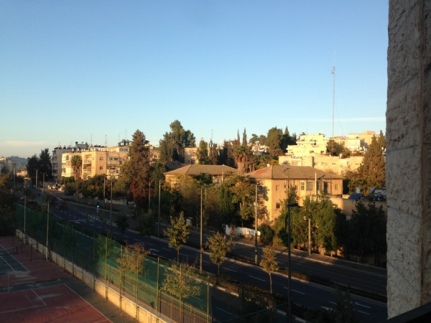
Morning brings with it new introductions, the first being the cityscape outside of our hotel window, which was in darkness when we arrived yesterday evening. An earlier decision to go for a morning swim in the pool was postponed (due to the towel situation) but breakfast was delicious and plentiful before we boarded the minibus to be taken to Yad Vashem where the seminars are to take place.

IMG_7350

Daylight brings a clearer view

Firstly an introduction to each other, including our host Yiftach Meiri, who is the Lead at Yad Vashem for groups from Denmark, Finland, Ireland, Norway, Sweden, and the United Kingdom, when we share a little bit about ourselves and why we have chosen to come on this series of seminars. An eclectic mixture of lay leaders, church ministers, priests, ordinands, church educators, cathedral deans and even a bishop, drawn from various church denominations as widespread as Edinburgh, Northern Ireland and deepest darkest Somerset.

Then the real learning begins with our first seminar – An Introduction to Judaism (On One Foot) given by Ophir Yarden. The origins of this unusual expression ‘on one foot’ actually  provides a very simple but effective answer. The story goes that a gentile wishing to convert to Judaism said he would do so only if a rabbi could teach him the entire Torah while he, the prospective candidate, stood on one foot. Most rabbi’s thought this was a ridiculous request, but Hillel, one of the most famous rabbis who lived at the end of the 1st Century BC and who is associated with developing the Mishnah and Talmud, gave this response:

What is hateful to you, do not do to your neighbour. That is the whole Torah;
the rest is the explanation of this–go and study it!”

Remind you of another famous saying?


IMG_7358

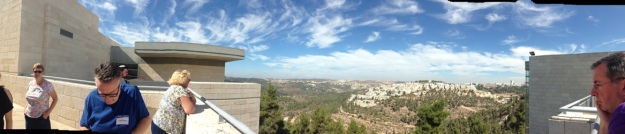
The view over one of the valleys at Yad Vashem toward an Ultra Orthodox Jew community where most of the men will spend up to 14 hours a day studying while the women go out to work

But of course there is more to Judaism, some of which is not so simple to explain and it has as many different hues and forms as most religious groups, from liberal Judaism to traditional Judaism; Zionist to Hasidic Judaism (colloquially known as the Men in Black). Still a useful exercise to get us started.

The afternoon brought us an introduction to teaching about the Holocaust and the first thing we learnt is that the preferred term is Shoah a word that appears in the bible several times, meaning ‘destruction’. This is not to deny the other victims of the genocide: the Roma people; homosexuals; the physically and mentally disabled; the Poles and other Slavic peoples, but it makes it more personal to the fate of the majority who were Jewish.

The Shoah as a story of mankind. It was done by humans and suffered by humans

Our lecturer Dr Noa Mkaton, spoke of the problems with telling history; the main concern being that as it was the Nazi’s intention to systematically destroy every single Jew the result would be that there would be no one to tell the story from any other angle other than the perpetrators. It became imperative therefore that ways were found to pass on the stories of not only the Jewish people but individual families histories as well. Hence Yad Vashem became a resource for the names and stories to be gathered together in one place. There were some six million stories to be gathered and work on this still continues today and for the foreseeable future.

But stories can be told not only in words but in pictures as well. Of the many photographs that we see of the holocaust or Shoah they are almost certainly of humiliated, browbeaten, tortured people; either political propaganda or physical evidence of murder and abuse. Yet, there are narratives to be told from photographs taken in happier times that can be more effective in telling what has happened and give us insights into Jewish identities both before, during and after.

Children of the Shoah

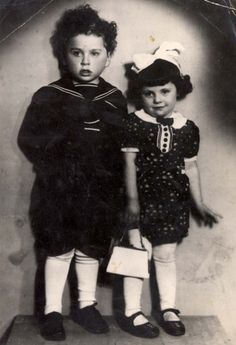
A Childhood Portrait

The ‘before’ picture is of a two children, dressed in their best clothes and probably taken by their proud parents to have their portraits done in a studio, creating a physical memento that could no doubt be looked at in later years to smile at the poses and the outfits, but nonetheless a pinpoint of what life was like at that moment. Would you be able to tell that the children were Jewish? Does it matter that you can’t tell?

Who knows if a picture of these children exists at the time of their incarceration in the ghetto or one of the concentration camps – most likely they were not even there long enough to ‘pose’ for a photograph, but perished almost immediately in one of the ‘gas showers’.

For one survivor of the holocaust a picture, such as this, was the only thing he had left, although he could never speak about  had happened, his story is ‘articulated so clearly by the words he wrote on the back of photograph in 1945 after he was ‘liberated’. He simply wrote ‘Paper Children’.

IMG_7364

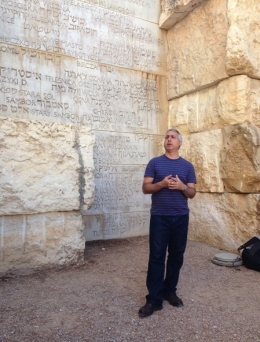
Yiftach explains the significance of the inscriptions in the Valley of the Communities

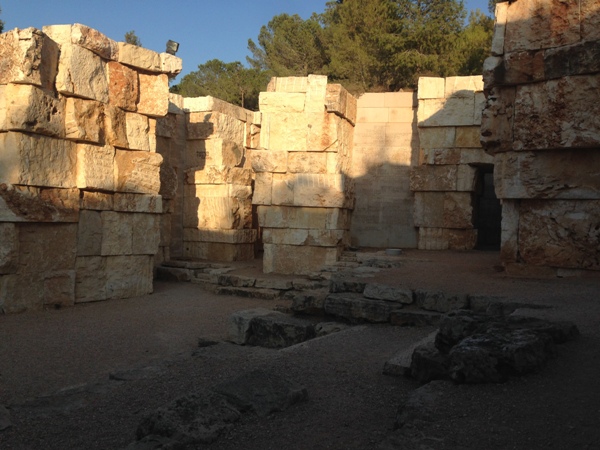
The day finished with a visit to ‘The Valley of the Communities’ This is a massive 2.5 acre monument literally dug out of natural bedrock. Over 5000 names of communities are engraved on the stone walls , each name recalling a Jewish community which existed for hundreds of years. Today, in most cases, nothing remains but the name.


Its symbolic connection to Ezekiel’s valley of dry bones is emphasised with no deliberate planting at ground level, but some growth at the top of the stones to represent new risen life; but its greatest impact is in the space in between – a deliberate void.

IMG_7365

A full and interesting day, laying out the groundwork for our seminars over the coming days – but maybe this evening there should be an introduction to the nightlife of the city as well!


Day One – One Place to Another

IMG_7347.JPG

From one airport in darkness to another in darkness – at 6.30am the Luton skyline was barely visible and yet hundreds of people were making their way into the departure lounge eager to set off on their journeys around the world.

Flying to Israel on El Al involves quite a rigorous security procedure and we were told in advance that there would be searching questions and that we were to answer them as honestly as possible… “How long have you known the people you are travelling with?” “Well actually I’ve only just met some of them about half an hour ago”. “Have you been given anything as a gift?” “No, but I do have a gift for someone I haven’t yet met”. Still I seem to have answered to their satisfaction and they stamped my card and let me through (although I later found out they had opened my suitcase as certain items were rearranged!)

The baggage check-in clerk seemed particular interested in why I wasn’t wearing my collar as I was a Reverend. I told her I didn’t have to wear it 24/7 but I did have a nice pair of pyjamas with a collar insert… I think she got the humour.

When we got to the boarding gate however, I was reminded of a joke… you’ve heard the one of the Jewish homeopathic doctor, the Methodist minister and the Anglican priest no doubt? Not really a joke but three woman chatting together about world attitudes, children’s education and the effect of social media on family life – interfaith and ecumenical discussions all at once!

IMG_7343

Cloud islands in the Mediterranean

The rain was beginning to smirr on the outside of the aircraft window as we took off, but a few hours later we were flying across fluffy cloud islands at the eastern end of the Mediterranean.

I also got the chance to taste a truly kosher airline inflight meal with its own certification – which included an unusual Swiss dough and cheese pancake, on which I wasn’t sure if I should use the proffered salt and pepper condiments

It’s always exciting to glimpse the first view of land as you get to end of your flight and as we approached the coastline of Israel the city of Tel Aviv lay below us… but let’s be honest one city from the air so often looks like every other one and it wasn’t until we could see the uninhabited land that lies in between that the landscape revealed we were not over the relatively lush green of southern England.

IMG_7344

Approaching Tel Aviv

Another lengthy one and half hours to get through passport control before we emerged out into the darkness and then a forty minute minibus ride to our hotel outside of the old city of Jerusalem.

IMG_7349

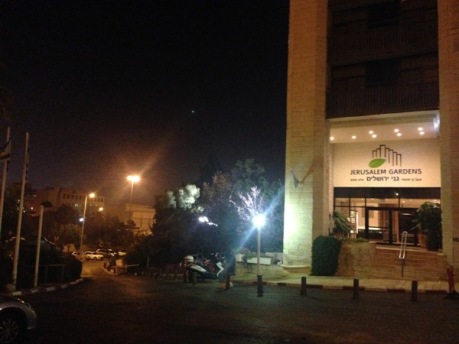
Jerusalem Gardens Hotel, Jerusalem

The Jerusalem Gardens hotel at first glance seemed a little tired, and we are room sharing, so the quirks of there being only one large towel in the bathroom and six hangers between us might be a challenge, but the evening meal was excellent and a glass of wine in the bar meant that we were ready for bed sooner than we thought.

Who knows what the view from our balcony will reveal in the morning, but to know that we are sleeping under the same moon and stars as our brothers and sisters around the world gave us pause to thank God for safe arrivals and new opportunities

IMG_7347

The view from the 4th floor

Please note that the internet connection in the hotel, whilst free, is intermittent and not very broad, so my hope of publishing each post in the evenings may not be possible. However, I am sure there are ways to overcome this small blogging problem.


And So It Begins…

Yad Vashem Intro

The beginning of a journey

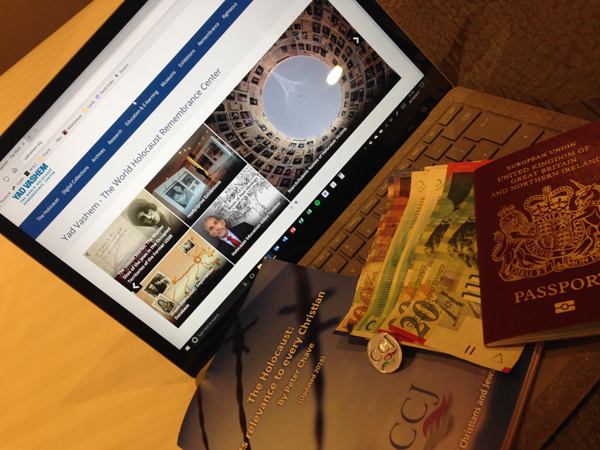
This evening I am sitting in a Holiday Inn near Luton airport in anticipation of the next few days being a mixture of education, enlightenment and another step on my journey of faith, as I prepare to take part in a ten day seminar at Yad Vashem, the World Holocaust Remembrance Centre in Jerusalem.

Yad Vashem exists as the ultimate source for Holocaust education, documentation and research, and as the Jewish people’s living memorial to the Holocaust, it safeguards its memory of the past and imparts its meaning for the future. As Christian Church leaders we are there to gain in-depth learning in the hope that we will take this learning home to our churches and communities.

Holocaust - Yad Vashem


‘And to them will I give
in my house and within my walls
a memorial and a name (Yad Vashem)
… that shall not be cut off.’
(Isaiah 56:5)


I, personally, have always been keen on studying the cause and effect that the Holocaust has had on history, particularly in relation to interfaith matters and I believe that ongoing dialogue between faiths is vital,  because without it there can surely be no understanding. Indeed, should not every Christian engage with the Holocaust in order to gain greater understanding of this complex period in history and the development of anti-Judaism in Christianity, and to consider how to stand up against prejudice in the world today?

So travel with me as I begin this journey, share in some of the sights and insights from the Holy Land as I encounter them, and no doubt weep with me as I face the past and the part that the Christian church and people played on that stage; and hopefully the part we can play in the future.

Shalom

Christian Jewish Relationships

Coming together as Christians and Jews


I am very grateful that this trip is being made possible through the generosity of the Council of Christians and Jews (CCJ), the Council on Jewish Material Claims Against Germany and the organisation of Rob Thompson, Programme Manager for CCJ

CCJ Logo

← Back

Thank you for your response. ✨


Challenging Hatred and Prejudice

Crumbs blog

‘Even the dogs are grateful for the crumbs from under the Master’s table’

It’s funny when certain things start to press into your consciousness and suddenly you see and hear it all around you. Over the last few weeks there has bubbled up so many events that have displayed hatred and prejudice among different groups of people and all of this fed into my wanting to say something. This week’s gospel of Jesus and his meeting with the Canaanite woman seemed to offer an opportunity to do so.

Based on Romans 11:1-2a, 29-32 and Matthew 15:21-28

May I speak and may you hear through the grace of our Lord; Father, Son and Holy Spirit. Amen

I was once asked by a bishop to think of a story where Jesus had had his mind changed… by a woman. At first my senses bristled slightly as the nuance that it might have been a more unusual moment because a woman had done so… but actually what I think he was trying to explore was my attitude to feminist theology.

Feminist theology, in case you’re wondering (and according to Wikipedia), includes goals of ‘increasing the role of women among the clergy and religious authorities; reinterpreting male-dominated imagery and language about God, determining women’s place in relation to career and motherhood, and studying images of women in the religion’s sacred texts and matriarchal religion.’

Feminists and women’s rights campaigners were very much part of the social history that surrounded me in my formative years – people like Germaine Greer, the Greenham common women protesters, being encourage to ‘burn your bra’ to make a stand for women’s rights. This was of course another stage on from the Suffragette movement and ranged from extreme hatred of anything masculine to fighting for equal opportunities in the workplace.

Alongside this were the big news stories of racial segregation, race riots in America, the assassination of Martin Luther King and apartheid in South Africa. Images and words that soak into your consciousness – to be absorbed and considered often subconsciously, but tempered with the opinion of your family and friends.

Nearer to home, and yet still not directly affecting my everyday life were the tensions in Northern Ireland, the segregation along faith lines – of roman catholic and protestant, the IRA bombing campaigns and the tragedies of Enniskillen and the killing of Airey Neave. Although no doubt my views were coloured to some extent by fear and shamefully a sense of annoyance,  when early on in our marriage my husband David was not able to openly wear his naval uniform outside of ship or barracks and had to have the subframe of his car checked with mirrors on sticks – just in case

Hate and prejudice between men and women… black and white… Christian and Christian… and they were just the big prejudice issues.

And this last week or so, that ugly prejudice has reared its head again in Charlottesville, USA. Where groups of people believed they were justified in chanting racial slogans and inciting violence against those who disagree with their points of view and lifestyle, a humourless parody of neo-nazism and white supremacy – a belief in one group of people being ‘the chosen ones’.

Charlottesville Riots 2017

Charlottesville, USA – where hatred and prejudice flared up

The shame is that these are often views that have been formulated and passed on using specific scriptures and texts to validate their attitudes – a real reminder to us that we should not cherry-pick individual verses and hold them up in isolation – better to see the bigger picture from Alpha to Omega

It’s true though that in the bible we can find it difficult to get away from the motif of certain people being ‘the chosen ones’. In the Old Testament how often do we hear of the Israelites being God’s own people, chosen and special, to the disadvantage of all other peoples. This week alone in readings from the lectionary, Ezekiel spelt out God’s wish that ‘no foreigner, uncircumcised in heart and flesh, of all the foreigners who are among the people of Israel, shall enter my sanctuary’ and Jesus himself in Matthew’s gospel, talking about reproving another who sins, used the phrase, ‘if the offender refuses to listen even to the church, let such a one be to you as a Gentile and a tax-collector.’

Even the verses that we don’t hear today in our New Testament reading, Paul talks to the Romans about the salvation of the gentiles only coming through the stumbling of God’s ‘own people’ and that although they have been ‘grafted in to the original branches and root’ they are not ‘to vaunt’ themselves over the branches’.

Subtle prejudice creeps in however hard we try and distance ourselves from it. I would count myself as very liberal-minded, open-hearted and very much against prejudice in all of its forms; willing to defend those views without compromising my faith, and yet I know that there are times when I can catch myself thinking of things I was taught and heard as a child, things that I spurn when I realise that it’s not appropriate or even Christian. The trouble is as a white, middle-class woman the only prejudice I have really suffered has been positive prejudice.

I can never feel what it must be like as a young black male driver being six times more likely to be pulled over by the police than my white contemporary; or a young male Muslim suffering discrimination because of the radicalisation of a small minority of my faith; or a young female Asian, subject to an arranged marriage, virtually imprisoned and sold as a chattel in twenty-first century Britain who doesn’t have a voice.

I could say ‘What do these things matter to me? They are not part of my life; these are not my experiences of prejudice’ – and yet it doesn’t stop me from empathising and feeling in my heart the injustice and wanting to speak out – to challenge those who hold these prejudicial viewpoints.

So what has that got to do with the gospel we heard this morning? Well, if you hadn’t already guessed this was the passage that the bishop wanted me to call to mind. A passage in which both the disciples and Jesus himself appear to display prejudice against both women and people of other races and faiths; and were challenged.

What of the Canaanite woman? The same story is told in Mark’s gospel, where she is called an Syrophoenician, and he very clearly identifies her as a Greek and a Gentile – a non-Jew. The place where she lived near Tyre and Sidon had traditionally been at the edge of the land of Canaan.  However, now this area was a prosperous Roman city port, but its people had already heard about the things that Jesus was doing and now he was coming to them. So when she comes running after him, she had already made up her mind that he was going to be the one who could help her.

A Gentile… a woman… begging insistently for him to help her, only for Jesus to turn around and tell her that he had only been sent to the lost sheep of the house of Israel – the Jews. You could almost imagine his friends nodding and exchanging superior glances. Then he adds possibly a rhetorical question, ‘Would it be fair to take food from the mouths of God’s chosen children and give it to anybody gathered around the table?’ Those with him were no doubt thinking, ‘No of course not – come on let’s move on and not waste any more time here’. She was dismissed!

Yet, she wasn’t going to be brushed aside and it must have taken a lot of courage speak out and challenge Jesus, and perhaps this was what he was waiting to hear. ‘Everyone who gathers around the Master’s table will be grateful, even if, like dogs, they only get the crumbs.’

No doubt there was a sharp intake of breath from Jesus’ followers, but Jesus would have looked at her and seen just much faith she really had because she believed in him. Was the Syrophoenician woman a Christian? Did it matter what she looked like? Did it matter where she came from?

When we believe in Jesus, when we believe in God, when we believe in the Holy Spirit, we confirm our faith……and it’s when we truly believe, that we begin to understand the importance of being ready to challenge prejudice and to be challenged.

Paul will go on to confirm to the Galatians that ‘there is no longer Jew or Greek, there is no longer slave or free, there is no longer male and female; for all of you are one in Christ Jesus. and last week, he confirmed that ‘the same Lord is Lord of all and is generous to all who call on him. For, ‘Everyone who calls on the name of the Lord shall be saved.’ We can therefore be very clear that at the heart of the gospel message, salvation and acceptance is open to all. Let me just emphasis that – to ALL. There is no room for hatred or prejudice of any kind

How great then is our faith?

Amen

The Syrophoenician Woman blog

‘Woman, great is your faith! Let it be done for you as you wish.’

← Back

Thank you for your response. ✨

Sermon preached on Sunday 20th August 2017


Not In Our Own Strength


The Promise of the Holy Spirit

An Advocate, a comforter, a helper, an assistant… the gift of the Holy Spirit means that we never have to rely solely on our own strength; and some days you need it more than others. After an exhausting few days, I explore this thought in my talk yesterday morning (6th Sunday of Easter John 14:15-21)

May I speak and may you hear through the grace of our Lord; Father, Son and Holy Spirit. Amen

The gospel passage we heard and read this morning is often subtitled the promise of the Holy Spirit. In this instance not as a rushing wind or tongues of flame that we will hear about in a couple of weeks, or the gentle dovelike descent that was seen at Jesus’ baptism; but a breath that we inhale and which resides deep within us.

Jesus is about to ascend from his earthly life and resurrection back to the Father. His disciples will doubtless be feeling even further bereft bearing in mind the great task that he is setting them up for. We could reason, and I’ve heard people say it, if only Jesus were here today he’d explain what we need to do – yet look at the time he did spend with his disciples and followers and how they themselves so often showed a complete lack of comprehension or understanding. But if we look closer at what he is saying he is not abandoning them or us; instead he is to send an advocate.

The word Advocate here is a translation of the Greek word parakletos or Paraclete which is often also translated as comforter or helper. For the disciples, and for us as well, the idea of a comforter is very apt. In the sense of bereavement or tragedy, which the disciples were facing, having someone with you and alongside you, giving you the odd hug or silent hand holding, gives strength to face the next moment – the death or tragedy is still a tragedy but having support and comfort enables you to cope with that moment.

Here though we have the word Advocate; a legalistic word as an advocate stands up in a court of law and explains to the judge or jury how things are from their clients perspective and pleads their case.  In the same way the Holy Spirit does this for us, but in ways that are more than just acting as an assistant, helper or comforter; more like bridging the gap between us and God.

As we get to know who Jesus is, so we find ourselves drawn into his life and love and sense of purpose – we are then able to see what needs doing and what resources we might need to do it – and to help us do this Jesus promises his own Spirit, his own breath, his own inner life – the Spirit of Truth.

You know him, because he abides with you, and he will be in you.
John 14:17

I must admit that I wrote this sermon yesterday when I was very tired. I’d been out on Friday evening with Southampton Street Pastors and hadn’t gone home until just before five o’clock on Saturday morning. By a quarter to ten I was out with the Love Harefield crew, including several others here, picking up litter around Harefield. By noon I was visiting my mum in Abbey House, Netley, where she is undergoing rehabilitation since having a fall in February when she broke her hip. By two o’clock I’d had a sandwich for lunch but knew that I still had this talk to write before I went out in the evening to hear my daughter, Lizzie, sing with the Singsational Voices choir at All Saints, Botley.

Now I don’t say all of that seeking sympathy or to be told that I’m over-stretching myself, because each of these things I felt were equally important to do. No doubt we’ve all had times when we’ve faced similar periods, when we feel that we’re running at full speed with our petrol gauges hovering over empty. Yet for all the physical tiredness there is joy to be discovered when we realise that we do not have to rely on our own strength or capabilities to engage in each task.

I can tell you at nine thirty on the Friday evening I could quite easily have remained sitting on the sofa and not got up and changed into my Street Pastor uniform and driven into Southampton. Yet the moment I did I began to feel energised as to what situations we might be called to during the patrol.

I could have stood back and simply poured out cups of hot chocolate to our homeless friends on the street, but then I wouldn’t have felt moved to bob down beside Mark, who told me his dyslexia was preventing him from filling out the necessary form in order for the council to provide accommodation for him, and having signposted him to a group that could help him with this, have him grasp my hand and bless me.

I could have hesitated to go over to assist a taxi driver who was dealing with a very drunk young man who had resolutely sat himself in his cab, despite having no money, and gently persuade him to dismount, very precariously I might add, so that we could sit him down on a wall and offer a bottle of water, sitting next to him and listening as he poured out his story of why he was in such a state, as he gradually sobered up enough to be able to start his long walk home instead

I could have ignored the high-heels-abandoned bare-footed girls, knowing that I’d already cleared up two areas of broken glass further down the road, instead of calling out whether they’d like some flip-flops and then explaining in response to their incredulity as to why we would be doing this in our own time and all for free

I could have stayed under the duvet instead of donning a hi-vis jacket and operating a pick-up stick, doing a menial task that would help bring the satisfaction of a job well done to improve our neighbourhood, and which was much appreciated by the people I spoke to as I walked around, and I would have missed the fun of working together and the doughnuts!

I could have been quite irritable with my mum, who nowadays asks me the same thing several times and whose memory means that a lot of the times we’ve shared in the past are often forgotten or denied. Rather than sitting and doing a crossword together and her telling me that she’ll know the answer as soon as I say it.

I could have missed the joy yesterday evening of being filled with the Spirit as I listened to nearly a hundred voices sing in harmony and rhythms that touched my innermost soul.

These are all things that I don’t always want to or feel comfortable doing in my own strength, but I am aware that it is the gift of the Holy Spirit that enables me to achieve so much more, to live for God and to witness to his love in the world, and it’s a gift that is offered to everyone.

Yet not everyone can receive it because they choose not to see or hear the message. There is a large part of the world that lives as if there were no God and a person who has eliminated God from their thoughts never listens for him. When we open ourselves up to receiving the Spirit we wait in expectation and prayer and in doing so will be joined to Jesus and God the Father by an unbreakable bond of love. We will recognise that Jesus never leaves us to struggle alone. As William Barclay puts it, ‘The Holy Spirit gate-crashes no-one’s heart – he waits to be received’

Jesus asks us to keep his commandments – a commandment that boils to down to just one thing – love one another as Jesus loves us. Jesus expressed his love in many different ways, the gospels show us his immense compassion for the suffering, his attentive listening presence, and his energetic celebration of the lives around him. He healed the sick, he fed the hungry, he released those held captive, he sought justice and invites us to do the same; all with the assistance of the Spirit that he sent in his place.

The Spirit that abides with us and in us. So maybe next time that we feel unsure, ill-prepared or uncertain of what we need to do or how we’re going to cope we can remember that invisible bridge bringing us closer into a relationship with Jesus and the Father so that they are revealed more clearly to us and in turn reveal God more clearly to others through us.

Amen


← Back

Thank you for your response. ✨

A Seed That Falls Into The Ground


Meditation on A Seed that Falls into the Ground

Very truly, I tell you, unless a grain of wheat falls into the earth and dies,
it remains just a single grain; but if it dies, it bears much fruit. John 12:24

Every seed created must yield,
in order to produce new life.
It breaks itself, releasing embryonic seedlings,
that bare these scars on tender tips.

Indeed the seed that falls on the good soil,
already at an advantage,
 is nurtured
and fed with loving care and attention,
producing glorious blooms to dazzle the eye
and be heavy with fruitfulness.
When God created these conditions
He saw that it was good.

But He also created those seeds
whose produce is not beautiful or wanted.
Maligned in name, the weeds, regardless,
release seeds that are fruitful and multiply.
Who blossom despite the poverty of the soil
bringing colour to a monochrome world;
and God sees that this also is good

For God provides for all,
requiring neither their labour nor toil.
Lilies and thistles alike;
unperturbed, they flourish
over wildernesses, pushing through fissures,
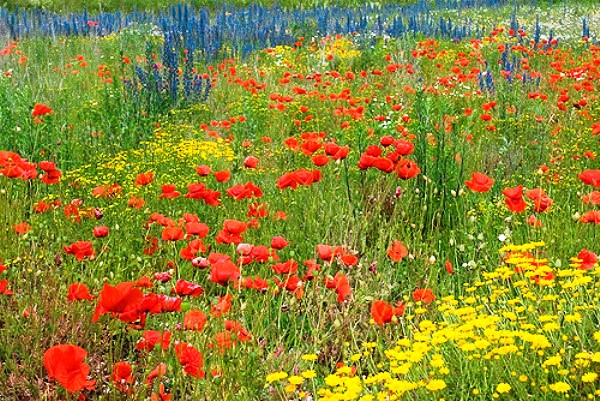
clothing battlefields and demolition sites in
velvet rich purples and glowing golden yellows.
Glorious treasure shining
to announce the presence of their creator

God, watches the downy seeds
carried aloft, drifting on breezes,
to settle in a new place
and proliferate a new harvest,
that declares the signs of the Kingdom,
with open-ended grace.

The secrets of life and death
are known to God,
who provides the refreshing rain
and balmy sunshine;
the winds that scatter
and insects that dance a pollination polka;
and the seed that falls to the ground
knows it must die to live.

The beautiful and the down to earth,
both speak of the wisdom and handiwork of God.

Inspired and adapted from Jan Sutch Pickard’s The Cheerful Unrepentant Weeds, published in Dandelions and Thistles: Biblical Meditations from the Iona Community by Wild Goose Publications

← Back

Thank you for your response. ✨

How Awesome Is The Sight

How awesome is the sight?

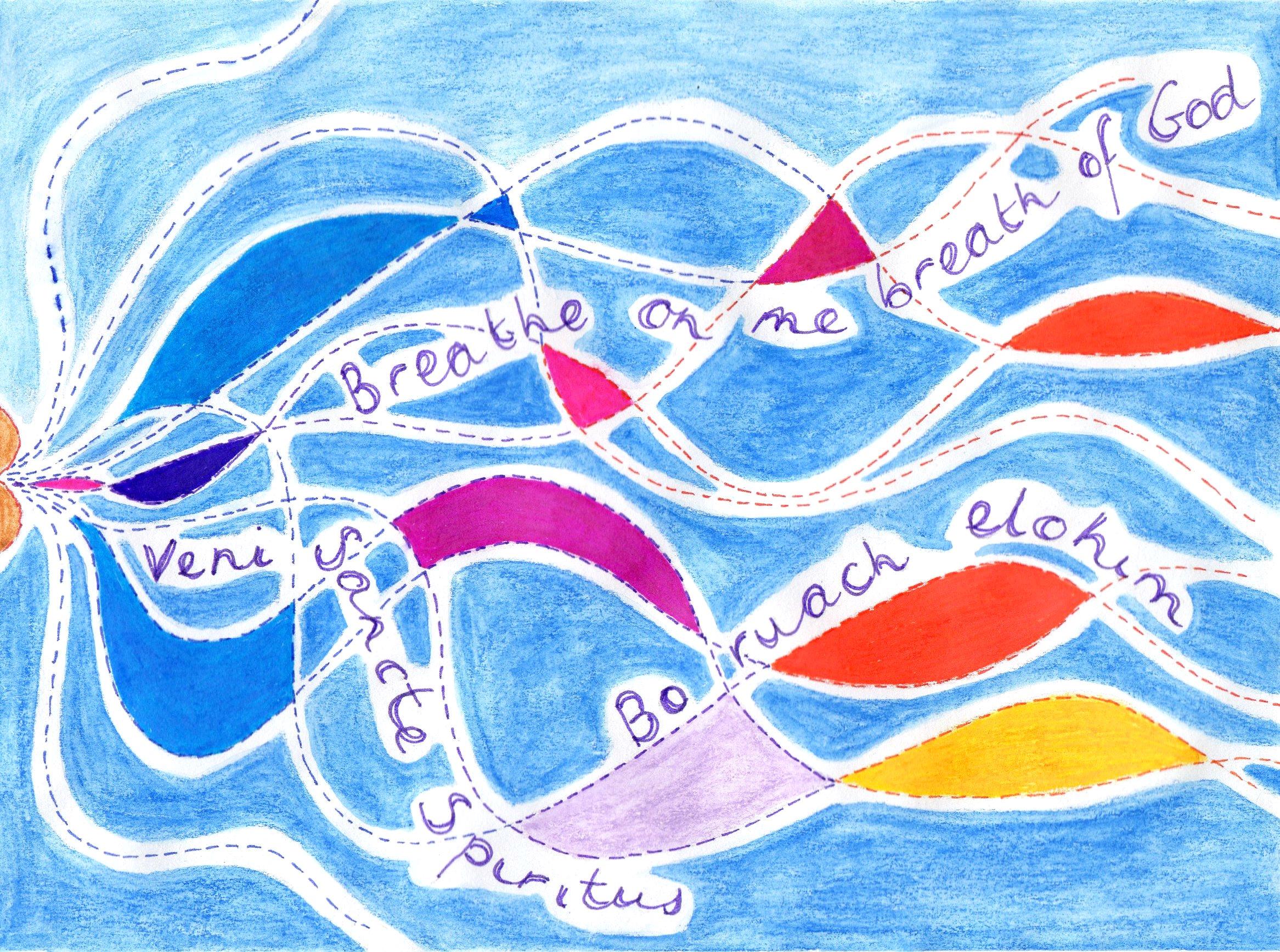
So often we can have a refrain or single phrase of a song running through our heads. When this happens we can often find that an idea comes of how we might represent those words. On a recent silent retreat at Mucknell Abbey, Worcestershire, the words ‘How awesome is the sight’ from the song ‘Be Still For the Presence of the Lord’ kept going round and round in my head. This piece of artwork is a result of that insistent prompt.

What is it that we create from those ideas in our heads, the symbolism we try to portray in the smallest of details and which we hope will be obvious to those who view the picture? I think that is the beauty of art, that we can all take from it what appeals to the eye and what thoughts it leaves us with within our own minds. Whatever that might be for you I hope at the very least it brings you joy

Who is like you, O Lord…majestic in holiness,
awesome in splendour, doing wonders?
Exodus 15:11

What I will say is that I don’t believe that the scan I made really does full justice to the vibrancy of the colours of the original, a first attempt to incorporate coloured pens (Stabilo pen 68) with watercolour pencils and ink


The Holy Family and the Mayfly

The Holy Family and the Mayfly by Albrecht Dürer

The month of May is with us and we continue to see signs of new growth and life all around. Not those first buds of spring, but the lush greenness of trees coming into full leaf, ferns unfurling themselves and the first swarm of midges over the pond in the early evening. Having celebrated Easter recently, the gift of new life is very much in our minds as we rejoice in the resurrection of Christ.

This new life we see around us never comes from nothing: the trees are producing new growth from existing branches; the bluebells filling the woods are from bulbs deep in the soil and even the bedding plants waiting to be nurtured for summer colour are from the seed of a plant that bloomed last year. As Jesus said ‘unless a grain of wheat falls into the earth and dies, it remains just a single grain; but if it dies, it bears much fruit’

This is true however brief that life is, and one of the briefest of lives is that of the mayfly, a primitive insect that the German engraver Albrecht Dürer included in his 1495 engraving sometimes known as ‘The Holy Family with the Mayfly’, suggesting a link between heaven and earth. However, Dürer may have intended it as a butterfly, a creature whose dramatically transformative life-cycle makes it a perfect symbol of resurrection and redemption. Whatever its identity, with inoperative mouthparts and digestive systems filled with air, this ephemeral creature, the mayfly, is destined to live only a few hours. It lives and dies purely in order to produce new life; a female typically laying between four hundred and three thousand eggs.  

Jesus’ life similarly could be considered all too brief, yet he tells us that he came that we ‘may have life, and have it abundantly’. We also recognise that the seasons change and all too soon spring will give way to summer with its abundant fruitfulness, before winter will see those fruits awaiting transformation. Through Jesus we are assured that for us this transformation will mean a new and everlasting life. His promise is not necessarily in longevity, but life in all its fullness – so let’s make the most of each and every day, finding in it God’s blessings and sharing them with those around us. 

Alleluia, Christ is risen!
He is risen indeed. Alleluia!

← Back

Thank you for your response. ✨