Category Archives: Ministry

Risky Business

Risky Business

Sermon based on 1 Thessalonians 5:1-11 and Matthew 25.14-30

How much of a risk are you willing to take on behalf of your faith? Have you ever considered that it’s necessary to take risks? Surely God doesn’t expect us to take risks! Or does he?

May I speak and may you hear through the grace of our Lord; Father, Son and Holy Spirit, Amen.

I wonder, what’s the biggest risk you’ve ever taken? I could throw in a few example to make you think, ooh yes that’s a risky thing to have done; you might say I took a real risk when I did that; or maybe you don’t take risks because you always weigh up the chances of failure and success and stick with the greater odds of success.

After all taking risks is a risky business – it can involve an exposure to danger, the possibility of something unpleasant or unwelcome happening; the probability of financial loss or the chance of incurring unfortunate consequences by engaging in that particular action. The fact is behaviour psychologists have proved that as human beings we are generally adverse to anything that involves a risk – people will prefer not to take a risk even at the cost of letting valuable opportunities pass by.

In today’s gospel we have the example of three slaves or servants and their attitudes to risk. The first two felt able to take a risk, but then it wasn’t their money they were taking a risk with but the third one started to analyse what the risks were and decided to do nothing, not even the soft option of putting it into no-risk low interest bank account. He calculated the possibility, the probability and chance and decided they were too great for him, and it seemed he made the wrong choice.

Our lives are full of opportunities to take risks, especially where our faith is concerned. I cannot speak for all of you whether you have taken risks on your journeys of faith. Maybe you’re like I was just beginning to dare to put your foot through the door because you want to find out what it is that’s calling you to be here. Or maybe you’ve accepted the invitation and want to know what God might be asking you to do next.

For me one of the risks was stepping into the unknown, with no church background or experience, a painful sense of not wanting to step into an arena in which I could be scrutinised and found to be wanting and yet a deep desire to put myself forward despite all of this. You may have heard me say before, but it was reading John Ortberg’s book, ‘If You Want To Walk On Water You Have To Get Out Of The Boat’, which was the catalyst that made me take a risk to get where I am today; and I would suggest that every Christian’s life is marked by windows of opportunity that demand a radical step of faith in order to follow Christ and fulfil his agenda for their lives.

What makes that step radical is that it always involves significant risk.  We know there are times where God will offer an opportunity and it may be in our relationships; in our career; in regard to our finances, when he says, ‘In order to obey me, in order to follow me, in order to do exactly what I want you to do, this is what you need to do in this situation’. And everything within us is fearful, ‘Really God, you want me to do that?’

The reason it’s radical is because you say to yourself, ‘If this doesn’t work out, this relationship could fall apart.  If I do that, I could be changing my family dynamics, it may ruin my career possibilities in the future, or what if I can’t pay my bills?’ When we are facing a challenge and the possibility of failing, our mind rationalises our fears by coming up with hundreds of logical reasons not to do it. But, where there is no risk, there is no faith. Just like the third servant had no faith in the master.

Without faith there is no power and where there is no faith, there is no joy, no reward, no pleasing of God.  In fact, where there is no faith, what you do get is hollow religious activity, moralistic rules, and dead orthodoxy.  We all know of churches where despite the God talk and the many programmes and course that are run, over time it becomes religious activity and the focus is on, ‘Do this but don’t do that’ Lots of rules and the wrong sort of power. Where though is the presence of God?

We know that when we have great faith we are able to do great things. We only have to think about all the people throughout the history of the bible such Moses, Esther, David, Peter or Paul, God brought windows of opportunity and each one of them took a radical step of faith.  And that radical step of faith meant that if God didn’t show up then Peter was going to fall through the waves or Paul, when he returned after persecuting the Church, was going to die.

Every person’s life that is greatly used by God, that experiences God in powerful ways, takes great risks. When we have great faith we are able to do great things. We can think great thoughts; we can pray great prayers and dream great dreams. We’re not just talking about calculated risks, because let’s face it we all like opportunities that come with the word ‘guarantee’ attached to them. That way we feel safe and satisfied with our decisions. I can think back to the time when I told people I was going to go skydiving and people were worried about the risks, but it was a calculated risk, the equipment was checked, the experts had done it thousands of times before, the step I took to allow myself the liberating and exciting feeling of flying into the vast chasm of the sky had been carefully weighed.

Sky Diving View

Not a bad view from up here!

However, one thing that risk takers have in common is fear; fear of what might happen.  Those emotions that you feel and think, risk takers all have as well, they fear what might happen.  I can tell you, at least my own personal experience, the greatest steps of faith I’ve ever taken I was scared to death, and it’s okay to be afraid.  It’s not okay to allow your fear to paralyze you from taking the step of faith. But you have to have faith to step out in spite of your fear.

God tells us time and time again, ‘Do not fear, do not be afraid, I am with you’, and he equips us as we heard today; ‘put on the breastplate of faith and love, and for a helmet the hope of salvation. For God has destined us not for wrath but for obtaining salvation through our Lord Jesus Christ, who died for us’.

The other day I came back from our study group quite buzzing. There had been a sense of excitement, a desire to engage with new ideas, of wanting to do something. We’ve been studying John Pritchard’s book, ‘Ten Reasons why Christianity makes Sense’ and we’ve talked about reasons why we should believe in God, the problems people have with faith, how to enliven our faith and the values we need for the church of today and tomorrow.  Above all the need to be communities where a holy fire and passion burns fiercely at its centre because this is what attracts people. We have to take risks, but as we’ve said risk looks very different in different people’s lives.  Often when we think of risk or faith, we always think it’s stepping out. Yes, sometimes we need to leave things behind and sometimes we need to remain and get stuck in to confront and change things, it’s still stepping out – of the security of our comfort zones.

Change is always a risk –  the risk of alienating people, driving them away, the risk of failure, not being able to deliver on the vision.  But not doing anything is like planting that talent into the ground. As Pritchard says, ‘Change is the way of institutions […], and we have to know when to let time-expired practices go. .. the human institutional life of this community has to be kept under constant review if it’s to be a travelling company of spiritual seekers rather than a secret society of defensive administrators.’

The good thing is sometimes even if you take a risk and fail, you end up winning anyway, because you learn valuable lessons in the process and stretch your abilities. There is a certain satisfaction in knowing that you dared and went for your dream against all odds, whether you succeeded or not. Regret of never trying is usually much harder to live with than failure.

Paul reminds us that we belong to the day – to things of light – We shouldn’t be afraid of sharing our faith, of talking about Jesus. After all ‘he was a man who inspired countless millions to change their lives and the lives of nations. His values were flawless; authority secure yet humble; judgement spot on. His teaching radical and enthralling; decisive, amusing, demanding and encouraging, filled with humanity yet left people aware they had spent time with God. Why wouldn’t we want to point people to this astonishing figure?’

And we need to continue to make links between Sunday and Monday. I could honestly say that 99.9% of the people who are part of this church, regularly make that link. But we’re going to need a robust, whole-life discipleship if we are to stand up to the secularizing pressures of the day. A Christian living his or her faith in an informed, open, clear-eyed way with wisdom and integrity is a hugely attractive witness to the King …  So let’s all take those risks and ‘encourage one another and build up each other, as indeed you are doing’

Amen

Peter takes a Risk

If you want to walk on water you have to get out of the boat – Peter takes a risk

Go back

Your message has been sent

Warning
Warning
Warning

Warning.

Day Seven – Antiquities and Art

IMG_7549

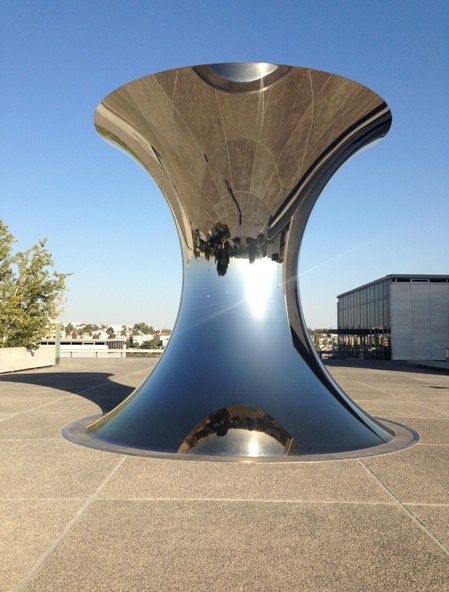
‘Turning the World Upside Down’ by Anish Kapoor, 2010


Any trip to a famous city would not be complete without a Sunday afternoon browse around a museum, especially if it houses particular treasures. Of course all art is subjective, but there are some things you really have to see and others that just catch your eye and imagination.

IMG_7541The Israeli Museum sits below the watchful eye of the Knesset, the Israeli Parliament and the site is spread over some 12 acres, so with limited time it was important to choose which exhibitions to visit.

But there was definitely one that I was not going to miss the chance of seeing – The Shrine of the Book


IMG_7543

The Shrine of the Book contains the Dead Sea Scrolls discovered at Qumran in 1947

The white domed building was originally built in 1967 to house the first seven scrolls discovered at Qumran in 1947. It shapes represents the shape of the lids of the jars in which they were found, and is constantly sprayed with water from the fountain to keep the dome and the rooms beneath it cool.


Inside the cave-like building, in dimmed light are examples of the texts dating from the third century BC to the first century AD, most of which are written in Hebrew, a few in Aramaic and Greek. Most of the texts were written on parchment and only survived as fragments, but despite this scholars have been able to reconstruct about 950 different manuscripts. One manuscript, the Isaiah Scroll (Manuscript A) written around 100BC  is the only biblical scroll from Qumran that has been preserved in its entirety – 734cm long, and a facsimile is displayed around the centre. Toward the end of the First Temple period, the Jewish people began to shape their ancient traditions into holy scriptures and thus became known as ‘the People of the Book’.

For out of Zion shall go forth instruction,
    and the word of the Lord from Jerusalem.
Isaiah 2:3

Outside is a model of Jerusalem recreating the city of 66AD, at the time of the Second Temple at the height of its glory, on the eve of the great revolt of the Jews against the Romans.

From antiquity to modern art, I made my way through some of the outdoor sculptures

IMG_7547


‘The strange loop you are’ by Mike and Doug Stern 2015

Created from bamboo poles and multi-coloured climbers ropes, in the Billy Rose Garden


IMG_7549However, I think my favourite piece is the sculpture that heads this blog. The piece was commissioned in memory of Theodor ‘Teddy’ Kollek, the founder and father of the Israeli Museum and Mayor of Jerusalem for 28 years, a tribute to his vision for the museum. Under his tenure as mayor, Jerusalem developed into a modern city, and he was once called ‘the greatest builder of Jerusalem since Herod’
Made out of stainless steel there is a warning not to touch the piece, indeed the heat could be felt just by standing near to it.

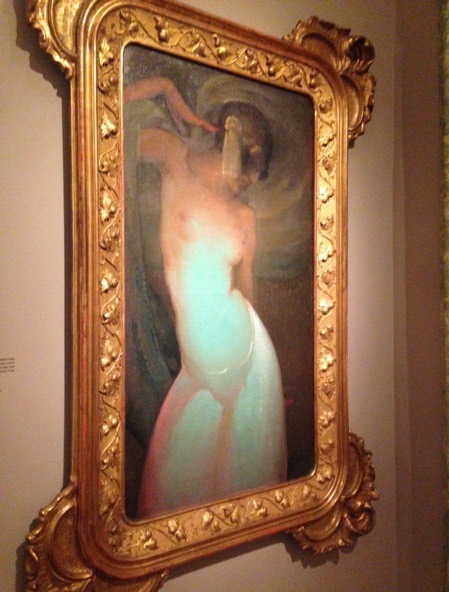
Inside the Fine Arts exhibition there was one picture that really caught my eye, not necessarily because of its content, but the amazing green sheen that the artist had created for the dancer’s dress.

IMG_7559

‘Salome’ by Egardo Sambo, 1920

Another favourite section was the Chinese contemporary artist Ai Weiwei’s ‘Maybe, Maybe Not’ exhibition. Weiwei was imprisoned without trial in his native China, and his movements were restricted by the government due to his political activism and outspoken stance on human rights and freedom of expression. Bearing this in mind, his decision to hold this exhibition in Israel caught many of his supporters by surprise. However, at its opening in June he told the crowds:

My voice should be heard. … I have to make the argument [and not say],
‘OK, let’s boycott it’ and ‘It’s nothing to do with me.’ I think that’s too easy.


I had already spotted one of his pieces outside, ‘Iron Tree’ which is a cast iron copy of the ‘Tree’ sculptures that are assembled from the dry, dead branches, roots and trunks of numerous species of tree, such as camphor, cedar and ginkgo, that Ai Weiwei gathered from across mountainous southern China. The sculpture mimics the form of a real tree, although the cuts and joins are left visible

Also inside is his infamous ‘Sunflower Seeds’ (2010). When it was originally exhibited at Tate Modern in 2010 you could walk across the 100 million porcelain sunflower seeds, each one painstakingly sculpted and painted by hand. However, this constant disturbance created a health risk from the dust that was kicked up. Here in the Israeli Museum the installation was still vast even just walking around the edge.

IMG_7552

 At the end of the room was the triptych ‘Dropping a Han Dynasty Urn’ (2016). In 1995 Weiwei took a 2,000 year old Han dynasty vase and dropped it deliberately, referring symbolically to Mao’s destruction of China’s historical traditions, when temples and antiquities were routinely destroyed during the Cultural Revolution

IMG_7553

 He burned the house of the Lord, the king’s house,
and all the houses of Jerusalem;
every great house he burned down.
2 Kings 25:9

The medium chosen for the image however was Lego Bricks. When Weiwei decided to use Lego bricks he received a letter from the company refusing to sell them to him because they were unwilling to collaborate in a political work, therein demonstrating that censorship was alive in the West as much as in China, through large corporations undermining individual freedoms. However, after posting their response on his Instagram thousands of people from all over the world send him small individual supplies.

Of course there were a million other things I could have taken pictures of but time was running out and a one point I did find myself walking in and out of so many different galleries trying to find the exit that they became a bit of a blur – such is art.

Go back

Your message has been sent

Warning
Warning
Warning

Warning.


Day Seven – A Day of Rest

IMG_7531

Sunday sees us dispersing ourselves to various churches in and around Jerusalem  After so many new sights and sounds over the last week it is nice to be doing something familiar, although not quite as familiar as it would seem. The group being made up of Anglicans, Methodists, Church of Scotland, Free Church and Salvation Army representatives we each choose different ways of celebrating our Sabbath.

Some go to St Andrew’s Memorial Church, some to the Lutheran Church of the Redeemer, one to the Armenian Cathedral of St James and one travels out on a bus to the Pat Ba’Melach Bakery at Gush Etzion, about 10 miles outside Jerusalem to bake bread.

IMG_7510

A Dean Sandwich (Wakefield & Lichfield). Can’t you just tell we are Anglicans

My choice is St George’s Cathedral, and a group of us take the Light Railway to the Damascus Gate, from there a five minute walk to the cathedral. We are running a little late and arrive just as the procession is forming at the back of the church, but are shown to the spare seats… at the front.

The service is led by the Dean, the Very Revd Hosam Naoum, the very first indigenous Dean of the Cathedral, having been born in Galilee. All around us I can hear American voices, but also Arabic, and we are told that the service will be in English and Arabic, sometimes spoken in one language and then translated into the other (the sermon); sometimes starting one response in one language and then finishing with the other; and sometimes using both languages at the same time (the hymns). It sounds like a bit of a nightmare to follow, but actually it works well and I am reminded of Pentecost.

The service finishes with a voluntary, Widor’s Toccata from his 5th Symphony in F, expertly played by the cathedral’s female organist and which drew a round of applause from the 200 congregants leaving the building, then out into the sunshine. Adrian Dorber, the current Dean of Lichfield spend one of his sabbaticals in Jerusalem and offered to show us one of the hidden gems in the Old City for an after service coffee.

IMG_7520I have to say that all the time I have been in Jerusalem I have felt completely safe, whether moving through the souks and different  quarters or riding on the Light Railways, rubbing shoulders literally with people ofIMG_7591 all faiths and none. You also become used to the presence of armed soldiers on entrances and corners throughout the city However, on the way back to the Damascus gate, we passed the American Consulate in Jerusalem, a heavily fortified entrance which brings back a reminder of the tensions that exist in this region.
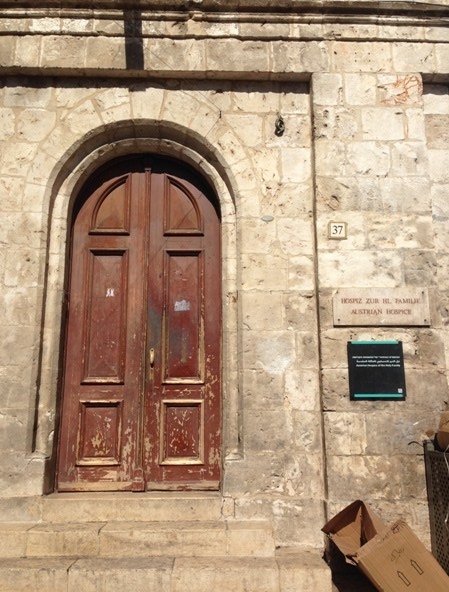
And then you find yourself in a complete oasis of peace and tranquillity.

IMG_7537
Behind this very unprepossessing door is the Austrian Hospice. A slice of European elegance, built in the style of Vienna’s Ringstrasse palaces it houses its own Viennese coffee-house and terrace. Here you can sit in lush gardens and sip coffee and sample delicious pastries. The busy city is hushed and almost hidden from view.

For five shekels more you can visit the rooftop with its incredible views over the whole of the city. On this day the city shimmers in the heat and you can almost believe that the world is at peace.

Pursue peace with everyone, and the holiness without which no one will see the Lord.
Hebrews 12:14

Go back

Your message has been sent

Warning
Warning
Warning

Warning.


Day Six – Pilgrim Footsteps

Nobody wants to be subjected to sitting down and looking at the holiday snaps album. However, if you would like to look at more images then do go to the Jerusalem Gallery to see the rest of the photos

IMG_7412

Looking toward the Old City of Jerusalem over the Kidron Valley

It is Shabbat and so one of the lifts in the hotel is automatically stopping at every floor so that you don’t have to push any buttons, and the coffee machines are covered up at breakfast. The coach easily travels along the road, which are clear of traffic – that is until we begin to climb up to the Mount of Olives. Here, as we enter the Arab neighbourhood of At-Tor the streets are busy as it is a normal working day and at least it stops raining as we get off of the coach.

The view is pretty spectacular up here, looking down over the Kidron Valley, with the whole of the Old Walled City of Jerusalem on the other side. Of course the golden Dome of the Rock (Qubbat as- Sakhrah) immediately stands out, especially when the sun starts to shine. However, looking down over the wall one is struck not by ancient monuments, but by rows and rows of graves.

IMG_7426

A prime, but expensive burial site, many Jews wished (and still do) to be buried on the Mount of Olives based on the Jewish tradition that when the Messiah comes, the resurrection of the dead will begin there.

On that day his feet shall stand
on the Mount of Olives,
which lies before Jerusalem on the east;
and the Mount of Olives shall be split in two
from east to west by a very wide valley;
so that half of the Mount shall withdraw
northwards, and the other half southwards.
Zechariah 14:4

The Mount of Olives is mentioned frequently in the New Testament, Jesus often going there to teach and prophesy, with his disciples. The Sanctuary of the Dominus Flevit is a little church half way down the rather steep incline that recalls the occasion that Jesus wept over Jerusalem, prophesying her destruction because they would not recognise the Messiah.

As he came near and saw the city, he wept over it
Luke 19:41 

IMG_7428

Mature Olive Trees in the Garden of Gethsemane

At the foot of the valley there is a small garden area of approximately 1200m², representative of the cultivated groves that once covered the Mount of Olives. It is within a railed area next to the busy Jericho Road, and any semblance of tranquillity is shattered by the honking of car horns. Here then is the place that constitutes the Sanctuary of Gethsemane.

On this site is also the Church of All Nations, also known as the Church or Basilica of the Agony. It was built in the 1920’s with donations from Christian communities all over the world. It is deliberately kept dark inside, but there is a beautiful piece of artistic fretwork on the entrance representing the tree of life and mosaics and stained glass windows inside.


IMG_7446

Two deer stand beside the cross on the tympanum of the Church of All Nations

A small service was being held inside and as the congregation started singing I realised it was Graham Kendrick’s The Servant King and several of us found ourselves joining in. Coming back out into the sunshine though I looked upwards at the tympanum (it’s always good to look up when you go around) and I noticed that there were two bronze deer either side of the cross. I discovered that these allude to the initial verse of Psalm 42.


As a deer longs for flowing streams,
    so my soul longs for you, O God
Psalm 42:1

IMG_7451

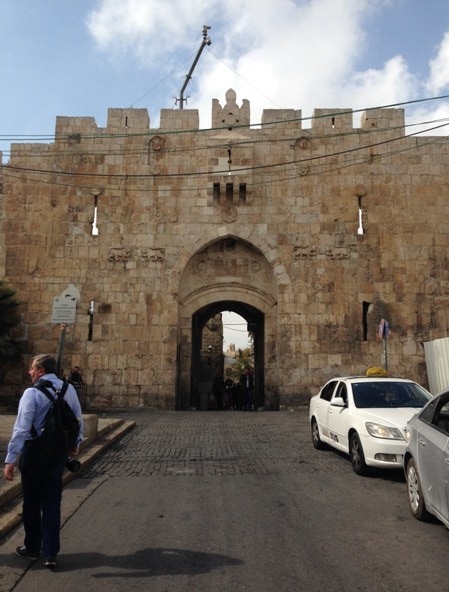
The Lions’ Gate or St Stephen’s Gate

IMG_7452

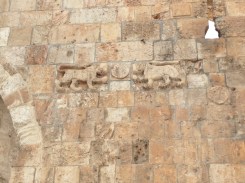
Lions or Panthers?

We walk along the Jericho Road to the east in order to enter the city through the Lions’ Gate. The gate is so called because on either side of the entrance there are four lions in bas-relief a reminder that the reason the wall were built was purportedly because of a dream that Suleiman the Magnificent had, in which failure to build the wall around Jerusalem resulted in him being devoured by lions. However, closer inspection reveals that they are probably panthers and not lions!

This is also known as St Stephen’s gate (his church standing nearby) and is the traditional start of the Via Dolorosa, the route believed to have been taken by Christ through Jerusalem to Calvary. For many Christian walking the Via Dolorosa is a significant part of their visit to the Holy Land and I would never deny their sincere devotion in doing so. My logical brain on the other hand tells me that it would be difficult to agree on the ‘exact’ route taken by Jesus as too many different churches and factions have been unable to do just that over the last two thousand years, each one trying to take the route closer to their own particular churches;

However, as in all things historical, there are some sites that can be pinpointed as archaeologically accurate and others that have gained acceptance by the majority of pilgrims. Visiting each of the stations certainly enables you to ‘experience’ the story in an authentic way just knowing that within this city Jesus walked.

IMG_7471

The handprint of Jesus?

There are two stations, however, that sparked my curiosity, both involving hands. The first was at the fifth station, where an unsuspecting bystander, Simon of Cyrene, was roped in to carry the cross. As Jesus stumbled he apparently rested his hand on the wall in order to keep his balance and an imprint was left. The touch of centuries of pilgrims has smoothed out the stone and made the depression deeper.

The second is at the eighth station where Jesus came upon a group of weeping women, and told them not to weep for him, but for themselves and their children. The station is marked by a stone embedded in the wall with the engraving IC-XC NI-KA , which translates as  ‘Jesus Christ conquers’.

IMG_7478

There is a large hole at the bottom of the cross, and as we stood looking and hearing about the station I noticed several women, who appeared to be local, deliberately going over to the stone and placing their fingers into the hole and making the sign of the cross themselves. Perhaps the women of Jerusalem still heed Jesus’ admonition.

The last few stations are actually situated within the Church of the Holy Sepulchre; a place where Christ’s crucifixion and burial is said to have taken place. I would think that it should be a place of utter reverence but as always it turns into an ‘unholy scrum’ of people, pushing and shoving, camera’s flashing and fleeting glimpses of these sacred spots. I must admit that this was the place I was most reluctant to visit, for those very same reasons (I had the same feeling about St Peter’s in Rome). However, I cannot be too ‘holier than thou’ as I did take a couple of photographs inside, and a person’s personal response should not be held up against our own reservations. Perhaps I might say that it should not be the commercialism of the sites, and the fact that these things are extravagantly venerated that bother me, but my own expectations of what I want to experience and which I didn’t encounter.

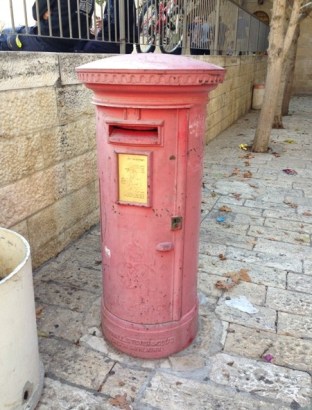
IMG_7496From there we made our way down and through the Jewish Quarter where we found a remnant of the British Mandate of Palestine from the early 20th century on to a remnant of even greater antiquity, the remains of a wall dating from the reign of King Hezekiah (late eighth century BC). It is called the Broad Wall because it is broad and it is a wall… it is a massive defensive structure, measuring some seven metres wide and was approximately eight metres high. No picture because I am sure you can imagine a broad wall.
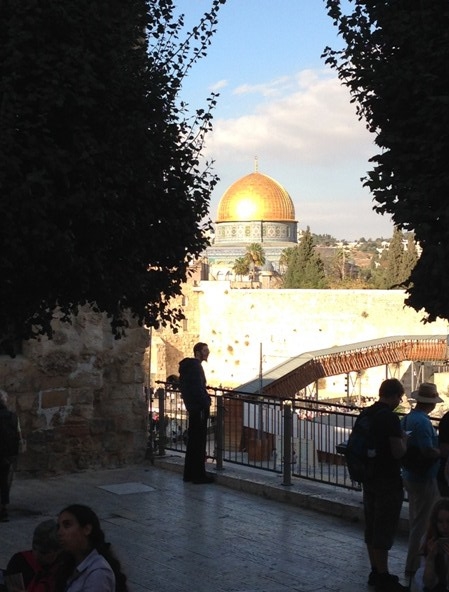


Finally, we move down and round to a viewpoint over the Western Wall. The sun is beginning to set and its rays once more hit the Dome of the Rock. They are also reflected off of the wall where prayers continue to ascend and the Jerusalem stone glows as if alive.

The view of Jerusalem is the history of the world;
it is more, it is the history of earth and of heaven.
Benjamin Disraeli

IMG_7501

Go back

Your message has been sent

Warning
Warning
Warning

Warning.


Jerusalem Gallery

Click on any of the photos to see an enlarged image and caption


Day Eight – Children of Darkness, Children of Light

stars of light

One of the most moving memorials at Yad Vashem is the Children’s Memorial. This is a  tribute to approximately 1.5 million Jewish children who perished during the Shoah. It has been created by hollowing out an under underground cavern, which has its own symbolism.

The memorial is entered by a descent that funnels you into a darkened room. The images of several unnamed children stare out from photographs which resonate with unfulfilled hope, as the sound of a mournful lament softly plays. Then further down, feeling your way into the darkness you enter what appears to be a room filled with stars. The effect is created by just five candles, that are replaced each day, being reflected by mirrors to produce an infinity of tiny lights.

In this twilight we listen to just a few of the names of some 1800 of the children, their ages and where they were from; a representation of stolen lives. It is very moving and I immediately think of my own children

Then we move up and out of cavern to the daylight outside. Today it has been raining and a light breeze seems to sigh as it stirs the leaves of the trees planted opposite, and the hills and valleys of Jerusalem are shrouded in a fine mist.

‘A voice was heard in Ramah,
    wailing and loud lamentation,
Rachel weeping for her children;
    she refused to be consoled,
because they are no more.’
Jeremiah 31:15
Matthew 2:18

IMG_7571

The entranced to the Children’s Memorial

Go back

Your message has been sent

Warning
Warning
Warning

Warning.


Day Five – Shabbat Shalom

Shabbat Meal

Coming from a country where the Sabbath is no longer really considered a day of rest, what with shops opening twenty-four hours a day, seven days a week, and sports events filling the whole weekend, it is strange to find myself in a country where it is almost a compulsory observance.

As part of our course we had been invited to join the Kehillat Yedidya (Friend of God) community in the Baka neighbourhood in Southern Jerusalem at their evening prayers and afterwards to join with members of the community in their homes to celebrate the Shabbat meal.

But the preparations for  Shabbat started a few hours before that with most workers finishing by 2pm. At Yad Vashem we packed up our notes and made our way with the stream of visitors and staff leaving the museum. It was already obvious that things were winding down as the traffic was flowing more freely as the roads emptied.

Yedidya Synagogue

Our arrival by coach was quite conspicuous as all around us people were walking in preparation for the fact that no vehicles are allowed to be driven during Shabbat. We were greeted and welcomed by Dr Ophir Yarden* who had lectured to us earlier in the week. Founded in 1980 The Modern Orthodox congregation of the synagogue is made up of 195 households comprised mainly of immigrants from English-speaking countries, including Britain and America; many European countries, and some native Israelis.

We were led into the main hall where the Qabbalat Shabbat (Welcoming the Sabbath) had already begun with the singing  of the Yedid Nefesh (Opening Hymn) and were divided into men and women’s sections. This gender differentiation is normal for orthodox Jews, however despite this practical inequality, this community do recognise the validity of women’s voices being heard, as the homily was delivered by a woman

I soon realised how very hard it is to follow a service not only in a foreign language but also trying to read the Hebrew Alphabet at speed – something I failed miserably to do with my limited knowledge. I, therefore, just let the melodic sounds and harmonies of the sung psalms wash over me – a real change from plainchant.

After the service we were walked to our hosts homes, about 15 minutes away off of the Hebron Road. Now shared out in pairs, Angie and I were welcomed by Elise and Moshe, both originally from American, and their sons Jacob, David and Noam. Two more friends of the family also joined us.

Shabbat_Candles.jpg

The Shabbat candles had already been lit (no later than 18 minutes before sundown) and as we sat down the family sang Shalom Aleichem (Peace be unto you), a welcome and offer of hospitality to the angels who they believe accompany us. Moshe also took the opportunity to bless his children, as he had been away on business overseas and had only arrived home that afternoon. The translated words he used were very familiar… it is the same blessing I would use for those coming up to the Communion rail.

The Lord bless you and keep you;
the Lord make his face to shine upon you,
and be gracious to you;
the Lord lift up his countenance upon you,
and give you peace
Numbers 6:24-26

The Kiddush was then recited over a large cup of organic grape juice, before being divided among us and then we were invited to wash our hands with a two-handled cup, once on the top and once on the bottom of each hand, after which we were to keep silent until the two loaves of Challah bread had also been cut and a piece given to everyone. Now the meal could begin.

Challah Bread.jpg

The Challah loaf was delicious, Elise having made it earlier in the day. A fish dish was followed by an orange and vegetable soup and then chicken with rice, prunes and beans. Clear tea (without milk) was then served with a short extemporisation by Moshe concerning his namesake Moses, before prayers ended the meal.

It was a real privilege to join in such an intimate meal with a Elise and Moshe’s family and after we had finished our conversations on the differences between Anglicanism and Methodism (Angie is a Methodist Minister) and the reasons why they chose to come and settle in Israel 29 years ago, the fact that Moshe could not set foot in Hebron or Bethlehem, and the surprise and delight Elise had when two women priests turned up (she was expecting men) we were walked to the Hebron Road to hail a taxi to take us back to the hotel (the taxi driver was non-Jewish).

Somehow these occasions help to break down barriers and mistrust between people of  faith, when people talk first as human beings and then as adherents of different religions with a common root.

Shabbat Shalom
Reflections.jpg

Go back

Your message has been sent

Warning
Warning
Warning

Warning.

Please note that none of the images used in this blog were taken on the evening as the use of mobile phones or indeed any technology is prohibited and it would have been considered bad manners to use it as a camera, so it remained off, in my bag.

Ophir Yarden.jpg
*Dr Ophir Yarden is the Director of Education at ADAShA (meaning ‘lens’ in Hebrew and Arabic) The Jerusalem Centre for Interreligious Encounter. He is active is Israeli-Palestinian dialogue.

Day Four – A Little Night Relief

IMG_7377

Twilight over Jerusalem at Yad Vashem

The last couple of blogs have been particularly heavy in content and theology, and there is more to come. However to bring a little bit of relief it was decided that we should venture out into the big, bright city and do a little exploration of our own.

IMG_7366

Kiryat Moshe Station

Over the last few days we have been leaving Yad Vashem as the sun is setting, the skies are still clear and the weather warm. The hotel is near to the Jerusalem Light Railway that stretches from Pisgat Ze’ev in the North to Mount Herzl in the West,. However, the first challenge is to cross the busy road. Yes, there are pedestrian crossing, but the traffic barely stops to pause and the language of the street is the honking of horns.

A ticket cost 5.90 NIS for a single trip (about £1.27) and the trains come along every ten minutes or so.

IMG_7367

We decided to alight at the Jaffa Road stop and spend some time looking around the gift and ‘tat’ shops. For those of you unfamiliar with the latter expression it refers to those tacky souvenirs that are mass-produced usually with words like ‘I love ….’ or ‘I visited… and only got this lousy t-shirt’ for example. However, they are great fun to browse around and I managed to come away with at least one piece to add to our ‘tat’ cabinet at home.

IMG_7370

There are some quirks in the shop signs that remind you that you are in a country that takes the Sabbath seriously, and as we were to find out later on in the week, it is indeed observed by the majority of Jews, whether orthodox, ultra-orthodox, liberal or secular

There is also some amazing street art

‘Jacob was left alone; and a man wrestled with him until daybreak’
Genesis 32:22-32

IMG_7373

‘God wrestling with Jacob’ – Jerusalem Street Art

This image painted on a door shutter depicts Jacob wrestling with a ‘man’ who appears to be in the guise of an angel but who later turns out to be God. The man is certainly depicted as an incredibly strong, muscular being, but Jacob, though the smaller opponent, seems to be giving as good as he gets and is even resorting to a spot of eye-gouging. There is no clear winner in this contest, although Jacob comes out of it with his hip bone out of joint and a new name – Israel

IMG_7371Like many cities around the world, in Jerusalem there are a lot of ice-cream and frozen yoghurt cafes and it’s certainly nice to sit outside enjoying the local ‘Ben and Jerry’s’ selection of ices,  as well as taking the time to get to know the others. Alex, Angie, Anna,  Fran and I certainly enjoyed doing both.

The following evening we decided that we would perhaps venture a little further and travelled to the Old Walled City of Jerusalem. We knew that when we went later in the week it would be completely different, but it would be a chance to at least orientate ourselves. Back on the train but this time we got off at the Damascus Gate.

IMG_7381

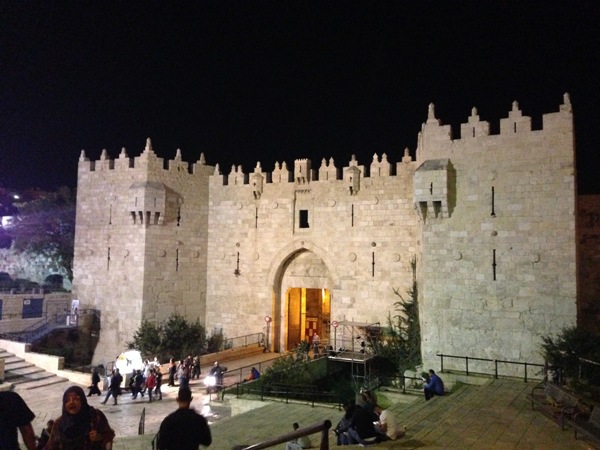
The Damascus Gate – one of the main entrances into the Old City of Jerusalem

IMG_7382

The entrance to the souk by the Damascus gate

The souks or marketplaces were nearly all closed or closing, but it made the narrow paved streets seem like a series of tunnels, twisting and turning one way and then another; dropping down one minute and then climbing the next.

IMG_7387
I can see the frankincense, but where’s the myrrh?


Even so there were some interesting shops still open, including a spice and incense shop selling, no doubt the obligatory, frankincense.

IMG_7386

Spices both colourful and pungent


Eventually, we found ourselves outside of the Church of the Holy Sepulchre, almost deserted, with the doors locked. The claim to this most holy of places is made by Greek Orthodox, Armenian Apostolic and Roman Catholic denominations, and to a lesser degree the Coptic Orthodox, Syriacs Orthodox and Ethiopians Tewahedo.

However, none of these groups appear to be able to trust the other as the keys to the church are held by their Muslim neighbours at the Mosque of Omar

IMG_7385

The Church of the Holy Sepulchre – closed and deserted

However, there were still plenty of devotees down by the Western Wall.  This remnant of the Second Temple, which was destroyed by the Romans around 70AD has become a sacred place where people can offer their prayers. Some people stand, gently rocking, with their faces or hands pressed against the wall, while others sit on chairs, with man and women separated. Whatever position you choose to take it is customary to walk backwards away from the wall, always facing it until you get to the exit – something that is trickier than you think

IMG_7392

The men’s section of the Western Wall

A walk back through the Jewish section of the Old City reveals its Roman history as well

IMG_7396

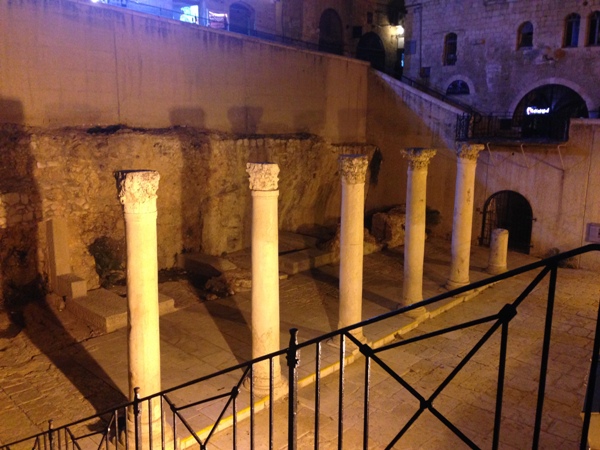
The Cardo in the Jewish quarter of the Old City

Finally, we caught the train back to the hotel. This time, however, we were packed liked sardines, and I found myself surrounded by young orthodox teenage boys returning from the synagogue, an Israeli solider including his gun, Muslim ladies in headscarves and Jewish families with babies in pushchairs and arms. It was to be remembered that Thursday night in Jerusalem is like our Friday night at home – everyone is out celebrating the weekend.

Go back

Your message has been sent

Warning
Warning
Warning

Warning.


Day Three – Part 2 – The Holocaust & The Christian World

IMG_7376

Street Art in the centre of Jerusalem

In Shoah and Genocide I wrote about Professor Yuhuda Bauer’s insights into why the Shoah or Holocaust was unprecedented. However, for any genocide to occur there has to be a history behind it. Dr Jesper Svartvik* suggests that however painful it might be we have to recognise the part that Christian anti-Semitism had to play in it. So what was the history of this anti-Semitism?

He suggests that this can be explained as a sevenfold process:

  1. SIBLINGS (Mark) In the beginning Judaism and Early Christianity had something in common. However, like most families where there are siblings, although they have a common origin that can be very different in character
  2. RIVALRY (Marcion) For more than 100 years, Christians had been using the Old Testament as Christian Scripture, and even the most sacred documents of Christians referred to and relied heavily on, the Old Testament. The solution for Marcion, a second century theologian, was to completely reject the Old Testament and establish a canon that de-emphasized Christianity’s Old Testament and Jewish roots as much as possible, to move from the LAW to GRACE. Although his solution was rejected it did cause the early Church Father to do some re-evaluation, after all they were reading it through Christian spectacles
  3. NECESSARY (Augustine) Despite speaking out against the Jews, he did not consider Judaism a problem, in fact he is quoted as saying that Jewish scripture was vital to the Christian faith, “If any adversary should say you have forged these prophecies, let the Jewish books be produced. They are our librarians.” But he did not consider the survival of Jews as necessary, after all they were the ones that had said ‘no’ to the Messiah and had therefore been relieved of God’s promises (replacement theology).
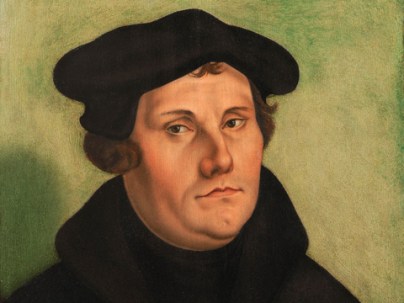
  4. OPPOSITE (Luther) Martin Luther believed that there is no valid way of being a Christian that will make you Jewish, it could be agreed that they had the right texts but they were doing the wrong thing with them. At first Luther wanted to convert the Jews to Christianity, it had been done before because Christ himself was a Jew, but when this failed he said ‘Away with them’. As he grew older this attitude became more and more polemic, using the rudest and vilest scatological language, perhaps the politest example being ‘throw sow dung at him . . . and chase him away’. The effect though of this is that defendants in the Nuremberg trials after the war were able to quote from his treatise, On the Jews and Their Lies, written in 1543, as justification
Martin Luther

Martin Luther

5. UNNECESSARY (Enlightenment). You would have thought that the Age of Enlightenment in the Eighteenth century, with its metaphorical image of light, would mean that these differences would disappear. However, when you become a minority, marked by your religious symbols and customs, these are seen as making you more religious, rather than part of the establishment . Therefore, religious attachment becomes a problem.
6. POISON (Nazi Germany) Christianity remained the dominant religion in Germany through the Nazi period. That Nazi ideology was able to come to the fore was due in part to the social and economic situation between 1918 and 1933. However, the Nazi’s didn’t even consider Jews as human and started talking about them as ‘rats’, a natural pest to be destroyed. Using a Christian perspective it was considered that there could be no salvation without the defeat of the Jews. The commandment to ‘love your neighbours’ was interpreted as ‘they live next door to us, but they are not my neighbours’.
7. SACRAMENTUM (Nostra Aetate) The Nosta Aetate is the Declaration on the Relation of the Church with Non-Christian Religions of the Second Vatican Council and repudiated anti-Semitism and the charge that Jews were collectively guilty for the crucifixion of Jesus Christ. It said that we were all children of Abraham and that Christians and Jews were a blessing to the world. It also drew on Romans 11, the fact that ‘they are our brothers’.

This seems to bring the seven points in full circle – from Siblings to Sacramentum because Early Christianity and Judaism were so similar, but that Christianity had stepped out of the ashes of the 2nd Temple’s destruction. Christianity being the word that became flesh whilst Judaism was the flesh that became Word.

Jewish and Christian Thinking

Go back

Your message has been sent

Warning
Warning
Warning

Warning.

Dr Jesper Svartvik
Dr Jesper Svartvik since 2009 is the holder of Krister Stendahl’s professor of religious theology at the Center for Theology and Religious Studies at Lund University and the Swedish Theological Institute in Jerusalem. Between 2005 and 2009, he was chairman of the Swedish Committee against Anti-Semitism


Day Three – Part 1 -From The Beginning

IMG_7379

The Partisans Panorama includes a tree of people which pays tribute to the Jewish fighters who joined the partisans during the Holocaust. As the sun hits it it glows red.

Taking part in this series of seminars becomes a real privilege when you realise that you are listening to world experts in their field. You frantically scribble down your notes, trying to capture if not every word at least as many as you can (I am already up to 29 pages of foolscap notes). How then to share that without reducing it to unconnected bullet points? The beauty is that the lectures are presented in chronological order and so there is some logic in just taking what you consider to be interesting and informative it, because after all this is a blog and not an essay. So the next couple of days may appear to be more academic ponderings but hopefully they will be thought-provoking as well. So let’s start at the beginning:

Shoah and Genocide

genocide-iraqProfessor Yehuda Bauer* states that the main question we should be concerned with is how to prevent the mass murder of one group of humans by another because genocide ‘disfigures the world’. International law talks of genocide as the ‘crime of crimes’ against ethnic and national groups with the intent and action of annihilation.

Why then do human groups murder other groups? Perhaps we have to go to the very beginning. Human beings were and are inherently predator mammals; more specifically we are hunter predators, and although nowadays we don’t dash out to spear a passing hairy mammoth for supper we do, as a group, raise animals and farm fish specifically for our food. We are ‘programmed to be killers’ as well as collectors.

We are also members of a herd, a group, a nation, but ‘to kill inside the herd destroys the herd’, so to justify killing we have to turn to laws and principles in opposition to our predator instincts. But what about the fifth commandment I hear you say… what the commandments actually says if you accurately translate the Hebrew word is ‘You shall not murder’ not ‘you shall not kill’; therefore killing is permitted murder whilst murder is prohibited killing.

Acts committed with intent to destroy, in whole or in part, a national, ethnical, racial or religious group, as such: killing members of the group; causing serious bodily or mental harm to members of the group; deliberately inflicting on the group conditions of life calculated to bring about its physical destruction in whole or in part’
Article 2 of the United Nations Convention on the Prevention
and Punishment of the Crime of Genocide (1948)

The crux of the matter revolves around racism and religion, and yet there are no racial groups because we are one race – the human race. Nevertheless racism exists, although this wasn’t always the case. It wasn’t until Christians reconquered the Iberian peninsula and expelled the Jews and Moors (Arabs) in 1492 in Toledo that the first racial law was passed. Since then there have been many ‘racially’ motivated incidents that we can classify as genocide but there was something different about the Shoah or Holocaust

It has parallels with other genocides in that it was mass murder; it was committed by the best possible means at the disposal of the perpetrators (whether gas chambers or machetes) and it mirrors the suffering of victims which is unquantifiable. The difference, however, lies in the motivation. All other genocides were committed for pragmatic reasons, in that the perpetrators were seeking power, domination or revenge. Yet the Jews had no real political representation in any European countries, they had no army, they didn’t really control any large national companies and didn’t have control over the economy. They were therefore murdered for ideology.

It showed itself in anti-Semitism (which is a singular contradiction as you cannot have a positive, i.e. Semitism) which was happening even pre-Christian times as shown in the allegorical story of Esther (Chapter 5). By killing Jews you are attempting to eliminate cultures different to yourself, which explains the roots of anti-Semitism and it arises not at a biographical level but a cultural level


Anti-Semetic Cartoon

Illustration from a German textbook used by primary schools (c. 1934)


However, it then reaches a theological level beginning with St Augustine of Hippo’s tract of 429BC Adversus ludaeos, which eventually mutates into nationalism, so that by 1941 Nazi ideology has reached the stage that it is necessary to kill ALL the Jews in the world. This has a new global element in that by the twentieth century it was physically possible to reach all corners of the world. So despite being very clearly part of genocide it is also very different because it was so unprecedented.

Where then does this leave those of us who profess a Christian faith, because after all the Jewish culture is part of our inheritance, and a Jewish man is the Messiah

A Torah Scroll

The Torah and The Old Testament

Go back

Your message has been sent

Warning
Warning
Warning

Warning.

Yehuda-Bauer

*Yehuda Bauer was born 1926 in Prague, Czechoslovakia. In the 1930’s his father tried to raise money to get his family to the British Mandate of Palestine. On 15th March 1939, the day that Nazi Germany annexed Czechoslovakia the family managed to get past Nazi officials onto a train that took them over the border to Poland and from there they moved to Palestine via Romania. He continued his studies, including studying history at Cardiff University in Wales on a British scholarship. He returned to Israel, completing his doctorate in 1960 and began teaching at the Avraham Harman Institute for Contemporary Jewry at the Hebrew University. He served on the central committee of Mapam, then the junior partner party of Israel’s ruling Mapai (Israel Labour Party), and was a visiting professor at Brandeis University, Yale University, Richard Stockton College, and Clark University. He was the founding editor of the journal Holocaust and Genocide Studies, and served on the editorial board of the Encyclopaedia of the Holocaust, published by Yad Vashem in 1990. He continues as a professor of Holocaust Studies at the University as well as travelling around the world talking out genocide and discussing ways to prevent it.