Tag Archives: bible

Keeping Faith

Sermon preached on Sunday 23rd February 2025 based on Luke 8:22-25

May I speak and may you hear through the Grace of our Lord; Father, Son and Holy Spirit

I wasn’t expecting to end up in A & E on Tuesday, I certainly hadn’t planned to be, and I didn’t know it was going to last a whole twelve hours. The day has been going so smoothly, car in the garage having new tyres fitted – tick. A pleasant visit exploring the many delights of the garden centre, including a delicious lunch in the company of two granddaughters – on their best behaviour – tick. Excited chatter in the kitchen as baking with granddad got underway and flour and eggs were beaten and cracked – tick. Just the dog to take for a walk, to get some chocolate buttons requested for decoration requested…

The thing about tripping over your own feet is that it is totally unexpected. One moment admiring the spring flowers in the gardens, the next lying prone on the pavement, having connected head with said surface with an almighty whack. Two passing motorists stopped to come to my aid, and an informal paramedic examination by my son-in-law advised me that it really was necessary to go to A&E and that I couldn’t just stick a plaster on it and carry on.

I have the say that the first three hours were somewhat unremarkable after the initial flurry of information exchanged with the admissions team as I watched a lot of people coming and not going, some in obvious pain and suffering, others beyond pretending it was all going to be fine because their bodies showed clearly their illness, and others more stoic, but nonetheless anxious because of the unknown.

At this stage I very tentatively asked the million-dollar question – and was told very politely, ‘how long is a piece of string’ and that I hadn’t been forgotten, I was moving up the list and patients were being seen in order of need. Everybody in that waiting room was in the middle of a storm, which for many had blown up out of nowhere. They were frightened and lost because there was no clear sense of when or how they would be able return to normality. A fear of not being in control to make their own decisions.

Which is exactly how the disciples were feeling. They had been with Jesus for only a short time but had already seen things that confirmed their belief in Jesus, but which were also beyond their natural comprehension, the raising of the widow’s son and healing through faith alone. One can imagine that sitting listening to Jesus preaching a series of parables from a little fishing boat, pushed out a few feet from the shore was thought provoking and challenging, as well as the crowds that were beginning to gather in their thousands to hear what he had to say on that shoreline in Galilee.

However, according to Mark’s gospel, the day is drawing to its close and Jesus wants to get to the other side of the lake, as the Sea of Galilee was also known. Saying farewell to the multitude of people, they push away from the shore to head out into the deeper water. Nothing about this is usual, this shoreline and particular body of water is home to several of the disciples; they know this lake like the back of their hand. Even sailing into the sunset would not have been unusual, as they were used to fishing through the night.

It had obviously been a long day for everyone, and so it was hardly surprising that ‘while they were sailing, he fell asleep’. Jesus is exhausted. There is no doubt that he is entirely divine and yet he is at the same time entirely human. He gets hungry and thirsty, and he suffers pain and weariness and the need for sleep. He was worn out and asleep.

However, Luke’s account is about to give us one of the most interesting displays of Jesus’ two natures: human and divine. His physical weariness as a man, and as we shall see, his divine influence over nature.

Suddenly, a gale swept down the lake. Again, nothing that may be considered unnatural. Every time a fisherman got into a boat on the Sea of Galilee, they knew the risk. This lake is nearly 700 feet below sea level, surrounded by mountains. Deep ravines coming down the mountains act like funnels for the wind, picking up incredible speed. And that cold air rushing downwards collides with the warm air on the lake and creates hurricane conditions and 20-foot waves without warning.

The boat was filling with water, and they were in danger. The boat they were in was no modern-day fishing trawler, it would have been no more than an oversized rowing boat, and in the midst of this storm, Jesus is sleeping. What to do then?

Our first question might be, how can he still be asleep, does he not know what is happening, what we are going through. I wonder if sometimes we think this when we’re in the middle of our own storm, although we might not say it out loud. Because surely, he knows everything. Maybe he does know, but he doesn’t care. One wonders why the disciples didn’t try and wake Jesus up at least ten minutes earlier, when the storm was developing, why wait till the boat was swamped? Again, many of them were fishermen, and here was a carpenter. They had seen this before and had lived through storms – just keep bailing water James and John, we can handle this!

It would be easy to criticise the disciples for failing to simply put their faith and trust in Jesus, but I wonder what our faith and trust is doing in unexpected, difficult, dangerous, painful, confusing, life-threatening situations?

Finally, in desperation, they wake him up, shouting, ‘Master, Master, we are perishing!’ And he awoke and rebuked the wind and the raging waves; they ceased, and there was a calm. The 20-foot wave heading their way, which sees them crouching down, arms covering their heads, never reaches them, instead the sea is like glass; everything is immediately still. I bet none of us has ever splashed or stirred water to find it completely motionless when we stop, but then which of US has a divine influence over nature.

He said to them, ‘Where is your faith?’. He isn’t saying ‘you have no faith’ but asking them, ‘Where did your faith go?’. Because the problem when we face unexpected tests in our life, it isn’t that Jesus isn’t there for us, it’s that our trust in Jesus goes missing. Again, the problem isn’t that Jesus stops looking after us, the problem is we stop looking to him.

In this and other similar situations, Jesus demonstrates his power and divinity, ‘Who then is this, that he commands even the winds and the water, and they obey him?’

But at the heart of everything is his love and care for each of us. Certainly, Jesus may not eliminate every storm, but he guarantees his presence in every storm. He might not calm the waves and the wind, but he is able to bring a calm to our troubled hearts. So that we too can be still and know that he is God.

Back to that waiting room, then, and please don’t think that this is in any way a complaint about the service that I received. The NHS is a megalithic machine but the cogs that keep the wheels turning couldn’t be praised more. From the nurse who walked an elderly gentleman to a nearby bus stop to make sure he could get home, to the young mum reassured that her young child was not causing a disturbance because she had had to bring her with her as she accompanied her own mother; to the cup of tea offered, unrequested just at the right moment when refreshment was needed. At each and every turn there was kindness and compassion, reassurance and a genuine desire to bring calm to troubled waters. It certainly restored my faith in the system.

Original artwork by Bernard Allen, The Calming of the Storm

Spiritual Gifts

Sermon preached on 19th January 2025 based on 1 Corinthians 12:1-11 and John 2:1-11

Receiving a gift can be very exciting. Maybe we only have to look back a few weeks to Christmas Day, or a Christmas Day from your childhood, and waking up to find all those presents under the tree. Wondering which ones might be yours.

When you opened them though, I wonder what your reaction was. The best ones drew amazement, that you’d received the very thing you’d wished for and had been thinking about since at least September!

Or maybe you were surprised and unsure about what the gift actually was or did, so you need time to think about it?

Or even opening it and immediately setting it aside, perhaps it would do as a donation for a raffle prize, or to a charity shop, but importantly to remember to say thank you to the person who gave it to you.

Now what if we were to do the same with the gifts that we receive from God through the Holy Spirit? Putting them to use straight away, setting them aside through fear and uncertainty or rejecting them all together.

Our passage today from Corinthians talks about us being pagans, people without God, easily led astray by worthless enticements and trickery. Like the magicians in the court of Pharoah we might have viewed our gospel reading concerning the turning of water into wine as a magic trick.

Until we realise that despite his reluctance to begin his ministry with a somewhat unusual miracle, Jesus was indeed ready to show us what gifts he possessed… and which his mother already knew about!

Perhaps also, the disciples, who had only just recently thrown everything over to follow this man were reassured that God was indeed with Jesus and that the Holy Spirit was a living gift to enable these things to happen and to reveal his glory in order to strengthen their belief in him.

What about ourselves then? Well, we know that God has known us since before we were in the womb, knitting us together to become the people we are. So, he would be very aware of the strength of our characters, and the abilities we have, even if we’re not quite aware of them always. He would know the inherent skills we display and the skills that lie in our sub-conscious, waiting to be activated.

Did you notice though that there is one gift of the Spirit that is given to everyone – the manifestation of the Spirit for the common good. This underpins the Christian faith and is the thing that unites not only Christians with a desire to serve others, and to insist on the dignity of every individual, but also can be found in many other faiths and religions around the world. Perhaps showing God’s ultimate sovereignty because he has ultimately activated them in everyone.

Then we come to individual gifts, those wise men and women among us who know how to act for the best and guide us to do good. A gift subtly different from having great knowledge as viewers of University Challenge and Only Connect will verify.

Those people who encourage us in our faith and our own sense of belief, whether we are able to work miracles or to speak out about choices being made on our behalf? The skills to communicate and teach or to solve problems that will benefit everyone.

And within each of these gifts there are subtleties – the gift of the surgeon’s skill to save lives, equally as valuable as the hand held in the act of friendship and love that can comfort and offer healing.

All of these are produced through the gift of the Spirit and may be given to us as and when they are needed in our lives.

So how do we respond? It is with great joy and excitement and an inner confidence that this is who we are meant to be. Or with uncertainty, unsure how to use the gift that you’ve been presented with something that you don’t believe you have the skills or capacity to be able to deal with. Or even that you dismiss the gift, certain that it’s not meant for you because you already know what’s what?

 What it all boils down to is ‘do you believe this?’ Is God through the Holy Spirit able to discern for us the paths we should take through life and equip us with the necessary skills to do so?

This very question is being asked in this year’s Week of Prayer for Christian Unity. The exact question that Jesus asked Martha before bring Lazarus out of the tomb alive again. ‘I am the resurrection and the life. Those who believe in me, even though they die, will live, and everyone who lives and believes in me will never die. Do you believe this?’ She said to him, ‘Yes, Lord, I believe that you are the Messiah, the Son of God, the one coming into the world.’

Or our signature doubter, Thomas, “Put your finger here and see my hands. Reach out your hand and put it in my side. Do not doubt but believe”. Thomas answered him, “My Lord and my God!

Recognising our common belief and the fact that God, though the Holy Spirit has given each and every person a gift that can be used to bring us together, is a challenge as well as an invitation to deepen connection and belonging and to live faithfully as disciples of Christ.

Perhaps then as we shortly share our common belief in the words of the Creed, we will remember that it comes from the Latin word credo, meaning ‘I believe and trust’.

And try to remember, as St. Jerome once said, ‘never look a gift horse in the mouth’. Amen

Who Is My Mother, Who Is My Brother…?

Sermon preached on Sunday 9th June 2024 – Trinity 2 – based on Mark 3:20 to end.

May I speak and may you hear through the Grace of our Lord: Father, Son and Holy Spirit. Amen.

Who is my mother? Well, if I was being asked to complete an official form to aid my family history I think I could answer that one correctly; Peggy Missin, born 12th September 1932 in Clenchwarton, Norfolk, died 8th February 2018. Who is my brother? Well, again that’s quite easy – no one, I was an only child.

Of course this wasn’t the answer that Jesus was looking for in today’s gospel. Indeed it wasn’t even the question, which was – Who are my mother and my brothers?

We are only three chapters into Mark’s gospel, which unlike Matthew, doesn’t start with a sixteen verse genealogical list of Jesus’ lineage. No, Mark starts simply with the lead up to the beginning of Jesus’ ministry.

From the other gospel’s we can piece together some ‘facts’ about Jesus’ early life. According to Luke, Jesus was born in Bethlehem, he was presented in the Temple as a baby and recognised by Simeon as the Messiah, but soon afterwards was taken into Egypt as a refugee from the genocide ordered by King Herod. When this danger had passed he returned with his family, not to Bethlehem, but his familial home town of Nazareth, about ninety miles to the north, where he grew up without much incident that we know of, apart from his theological debating skills at the age of twelve with the elders in Jerusalem on a Passover visit.

In Jesus’ day, Nazareth had a population of about a hundred and fifty, most of whom were interrelated. The Nazarites, were a small sect of Jews who believed they were the shoot – the “Netzer” – from the stump of Jesse, from whom according to Isaiah, the promised Messiah would come.  However, the negative references to Nazareth in the Gospel of John suggest that ancient Jews did not connect the town’s name to prophecy. They followed the teachings of Rabbi Shammai and were strictly orthodox and ultra-conservative.  They had as little to do with the outside world as possible, much like Hasidic Jews today.

Some thirty years later and further south, in the wilderness of Judea, a relative of Jesus appeared, namely John, who was preaching a baptism of repentance for the forgiveness of sins, with a view that the arrival of the Messiah was imminent, a prophecy fulfilled when Jesus presented himself for John’s baptism.

After John the Baptist was taken into custody by the authorities and imprisoned, Jesus now steps forward and announces his ministry, ‘The time is fulfilled, and the kingdom of God has come near; repent, and believe in the good news.’

His speech in the synagogue at Nazareth creates an uproar.  ‘“The Spirit of the Lord is on me, because he has anointed me to proclaim good news to the poor. He has sent me to proclaim freedom for the prisoners and recovery of sight for the blind, to set the oppressed free, to proclaim the year of the Lord’s favour.”

He then goes on to prophecy about God’s judgment upon Israel.  It was not what the elders wanted to hear.  They dragged him out of the synagogue, took him out to the edge of town and were prepared to stone him to death. But for some reason, they stopped short.  Jesus walked away and never looked back.  He left his home and his family and moved to the nearby city of Capernaum on the northern shore of the Sea of Galilee.

Things were different there. The synagogue was more open to his teaching, ‘They were astonished at his teaching, for he taught them as having authority, and not as the scribes.’

He won the loyalty of four local fishermen – Peter, Andrew, James and John; the local tax collector, Levi or Matthew; as well as seven more disciples and any number of followers.  As important as his teaching, he also had the power to heal the sick and perform all sorts of miracles.  People flocked to Capernaum to hear him teach and receive his healing touch.

But with rising popularity came criticism.  His teaching was unlike anything they’d ever heard before.  He broke the laws of ritual cleanliness, he violated the Sabbath, he spoke openly of a kingdom not of this world, he communicated directly and intimately with God.

His behaviour and his speech was so radical that they looked to label it as anti-social linking it to perceived mental health issues. He wasn’t conforming to the status quo. In a word, he didn’t fit the mode.  When it became clear that he had no intention of conforming to the expectations of the religious leaders, they began to say, ‘He is insane’

Apart from clinical diagnosis, people’s perception of mental health draws a thin line between sanity and insanity, and when it appeared, even to his friends, that he’d gone over the edge, they sent word to Nazareth for his family to come at once. So, it fell to his mother and his brothers to come to Capernaum and take him home.

When they got there, they found Jesus teaching in a home.  The place was packed.  People were standing in the doorway and spilling out into the courtyard straining to hear him.  Mary and her sons couldn’t get in, so they sent word, “Tell the teacher that his mother and brothers are outside.”  But when Jesus got the message, he said, “Who are my mother and my brothers?” 

And looking at those who sat around him, he said, ‘Here are my mother and my brothers! Whoever does the will of God is my brother and sister and mother.’

When Mary and the others were told what he’d said, what were they to do. On the surface it seems like a harsh thing to say. Was Jesus now rejecting his family altogether? The fact is, he wasn’t saying, ‘these people are not my mother and brothers, he wasn’t denying the relationship he had with his biological family; he merely expanded the conception of the family circle to include any number of others.  He pointed to a spiritual, rather than a physical, kinship as the basis for life in the kingdom of God. 

The Spirit of God unites us as family in a bond of love able to withstand the storms of life and last throughout all eternity.  It transcends the boundaries of age, race, nationality and gender.  It encompasses people from every station and walk of life.

Whilst we are children of our parents, we are also children of God, and, as we grow in our relationship to God, we’re called to seek God’s will for our lives and follow the leading of God’s Spirit, even when it means overriding the connections to our families.

It can be hard to break away from the authority of our parents, just as it’s hard, as parents, to cut the apron strings with our children. However, Jesus clearly defined the boundaries of parenthood when he asked the question, “Who are my mother and my brothers?”  There could be no mistake about it, his relationship to God came first and foremost, and so must ours.

The Good News is that Jesus’ relationship with his family did not end here; it moved to a new level.  Mary became one of Jesus’ most devout followers.  She stayed by his side, if at a distance, to the very foot of the Cross.  And his brother, James, while hardly mentioned in the gospels, shows up in the Book of Acts as the leader of the church in Jerusalem.

‘Here are my mother and my brothers! Whoever does the will of God is my brother and sister and mother.’ Take a look around you, we so often talk about our church family. These people who are sitting around you are our brothers and sisters in Christ.

Just like in every extended family, we may not know them that well, we may move in different social circles, we may hold different views and opinions and not agree with them all the time; but we are bound together in our love of God and Jesus’ command to love one another.

And the family ties don’t stop here in this building. Our fellow Christians are in the next town, the next city, in fact our family extends right around the world, wherever God’s name is proclaimed and honoured.

And the best thing we can do for this family is to grow it. I paid a visit to The Vyne, yesterday with my family. This beautiful house and estate was passed to the National Trust because the family lineage ran out with no more heirs to pass it on to. We can’t let this happen to our Christian family.

This afternoon I will baptise two young children, who are beginning their journey of faith, they will receive the sign of the cross on their foreheads, with the words, ‘Christ claims you for his own’ and an exhortation to ‘not be ashamed of Christ. You are his forever’

Today, two more young people being added to the family. What will you do to extend our family further…?

The Spirit of the Lord is on you, because he has anointed you to proclaim good news to the poor. He has sent you to proclaim freedom for the prisoners and recovery of sight for the blind, to set the oppressed free, to proclaim the year of the Lord’s favour.

Amen.

When You Come in Fourth

Sermon preached on Sunday 12th May – Easter 7 based on Acts 1:15-17, 21-end,

May I speak and may you hear through the Grace of our Lord; Father, Son and Holy Spirit. Amen

In one of the many art museums that I recently visited in Australia, there was a photographic exhibition of Olympians who came fourth. It portrayed them as they either crossed the line in a race or realised the final positionings of the medals. After all, those who come fourth have just missed out on receiving not only a tangible form of recognition, but whoever remembers who came fourth?

Today in our reading from Acts we have one such person, who came so close, but will forever be remembered, if we even remember his name, as the one that wasn’t chosen to join the most important and influential group within the Christian church.

Throughout this period, we are encouraged to look more closely at the Acts of the Apostles as the fledgling church emerges through the words and actions of those who had become disciples of Jesus. Many of those had become part of a group of people, who had witnessed not only his teaching first hand, but been with him since his baptism by John and had recently witnessed his crucifixion and subsequent predicted but still miraculous resurrection.

The group of the original eleven remaining disciples, who had been chosen by Jesus had now become apostles. As Vicky explained last week, a disciple is a student, a learner, a believer, whilst an apostle is a messenger, one who is sent to deliver those teachings to other.

These eleven, along with Judas had been the ones chosen to work closely with Jesus on a day to day basis for the last three years, gradually being changed from disciples, which all believers are, into apostles.

Now, following the death of Judas, they were feeling obliged to find a replacement, after all eleven is an uneven number, twelve is much more biblical. Had Jesus chosen twelve disciples to mirror the original twelve tribes of Israel, signifying the renewal of the covenant between God and humans.? Or was it because Jesus had chosen the twelve, that the remaining apostles felt a divine purpose that there should continue to be twelve of them.

It’s a shame that we miss out several verses around and within the scripture chosen for today as the answer to the above question was actually given by Peter, when he quotes the psalms not only about the fate of Judas, seen at that time as the betrayer or enemy of Jesus, but from Psalm 109:8 ‘May another take his place of leadership

So here we have a crowd of believers, numbering ‘about one hundred and twenty’. This group included men and women and it is likely that it also included Mary the mother of Jesus, and his brothers, as the apostles had been staying together in Jerusalem where they had been joined in constant prayer together.

We know this because when Peter stands up his opening words ‘Friends’ are translated from the Greek word adelphoi for brothers and sisters, referring to believers, both men and women, as part of God’s family, although the NRSV translation that the Church of England prefers, give the translation as men or brothers.

This gives us an indication that the replacement is not going to be a radical one for that time! Indeed, Peter confirms that it is to be ‘one of the men’ who had accompanied them throughout this whole time.

How to make that choice though? Even without it being a patriarchal society, it was highly implausible that they would have considered Mary, of Mary and Martha fame, despite her being one of the best students of Jesus, learning at his feet, she may not have qualified as having witnessed the baptism.

What of Jesus’ brothers, in particular James and Jude. There had been a time that they were very sceptical about Jesus’ claims as he went around preaching a different gospel. From within what would have been a devout Jewish family, this would have jarred with their beliefs about the Messiah, but we now realise that they had subsequently become believers with their presence among the group. In fact, James would go on to have a prominent role within the Jerusalem church and both would have books included in New Testament.

The decision then wasn’t to be taken directly by the apostles but handed over to God in prayer for them to then go on to cast lots, almost a game of chance, but a traditional Jewish way for making decisions, between two of the men who met the qualification, Joseph called Barsabbas (also known as Justus) and Matthias.

The holy dozen was therefore restored.

What about the one though who had not been chosen, who essentially came fourth? What was his reaction? Well, he could have had a silent hissy fit and feeling rejected left the group in a huff or been angry with the leaders.   

He might even have been angry with God. After all, it was God that had had a hand in this selection, as they had prayed, therefore it was God who decided to not pick Barsabbas. It’s one thing for a person to tell you ‘No,’ but for God to say ‘no’?

 Yet we don’t hear of him having any of these negative responses. We see no indication that he reacted with disappointment, because we don’t hear anything about him after this. However, Christian tradition being what it is, he was believed to be one of the seventy disciples sent out by Jesus in Luke’s gospel to the cities he was to visit and is possible that we do see that he stuck around and continued to make God his priority and focus, as with his plethora of names, he could be Judas called Barsabbas, who was chosen to be part of an important delegation sent to Antioch from the apostles and elders of the church.

And as for Matthias? Not another peep in the whole of the New Testament, but again Christian tradition suggests that he did fulfil his apostolic role, by taking the gospel to Aethiopia, not at that time the Ethiopia of the North African continent, but in a region called Colchis in modern day Georgia in Eastern Europe, where he was crucified.

What then does all of this tell us about being disciples and apostles in today’s world, because that is what we are called to be, students of Christ to be sent out as messengers to share that knowledge. How many of us will be remembered in the annals of Christian history? Not many of us I would say.

But we still undertake those roles, knowing that God is always with us. We know that prayer opens the door to a closer relationship with him and that anyone can be called by God, at any time, to further his kingdom and share his message, and also know that God will lead the conversation.

And if God can call us to serve him at any moment of life, then we are never too old or too young to share his love with others. We may be aware that God often chooses the weak and the humble to serve, but that he always equips those whom he calls.

We may not be famous, or need to be placed on a pedestal when we share his Word, because we know that the glory goes to him, not us, but that we are blessed and loved in doing so.

Put very simply, sharing the love of Christ and the message of God comes through our words and actions. It is these things that will be remembered long after we are gone.

Amen

Running The Race

Run in such a way that you may win the prize

Run in such a way that you may win the prize

Sometimes phrases just seem to get stuck in your head for no apparent reason. Over the last few days it has been a quote from Paul’s first letter to the Corinthians:

Do you not know that in a race all the runners run,
but only one receives the prize?
So run that you may obtain it.
1 Corinthians 9:24

For those whose know me well, they would agree that I have a very competitive streak – I play to win. Whether it is board games or quizzes I will look for strategies that will give me an advantage; but that doesn’t mean I cheat. On the contrary, I’m the one checking the rules to ensure that we are playing the game fairly. I suspect that can make me a bit of a pain to those who simply want to play the game for a bit of fun and even worse when I come up against another person whose aim is to do exactly the same. Self-control can sometimes go out of the window and the sulks can follow it!

The fact is that I was brought up to make sure that whatever I chose to do, it should be given the same amount of care and attention, so that you always do it to the best of your ability. As my father used to say, ‘If a thing’s worth doing, it’s worth doing well

The same should be true of our faith life. Over the last few weeks I have been learning and putting into practice new techniques for Christian meditation. I have been learning to control my breathing so that it falls into rhythm with a prayer mantra – Maranatha, Come Lord Jesus – at the same time trying to lay aside the thoughts that immediately fill your mind and run parallel to the prayer, such as ‘I don’t think I’m doing this right, because I’m thinking about the fact that I’m not doing this right!’. It has got better as I’ve practised more, but the problem is not the technique, it’s the discipline to make sure I do it at least once a day that is the hard part and ultimately the most important.

A person can’t watch the Olympics on television and suddenly get up and run a marathon in record-breaking time – It’s more likely that they’ll break themselves. Athletes require discipline to train their bodies so that they can achieve their personal best. In the same way we have to train our hearts and minds to have the strength and control to stay faithful to our beliefs – whether it’s in prayer, meditation, reading the bible or the way we live our everyday lives according to the rules

Being constant and always striving to do your best is never going to be easy, and there will be days when we just want to collapse in a heap by the side of the road and say ‘I give up,’ but failure is not falling down, but staying down. By keeping the prize in mind and reaching for our goals we can force ourselves to get up and carry on so that we might be the eventual winner of the race we have been set.

Every athlete exercises self-control in all things. They do it to receive a perishable wreath, but we an imperishable. So I do not run aimlessly; I do not box as one beating the air. But I discipline my body and keep it under control, lest after preaching to others I myself should be disqualified.
1 Corinthians 9:25-27

In the meantime, anyone for a game of Monopoly… but be aware I will be going for hotels on Mayfair and Park Lane!

Competitiveness in a box

Competitiveness in a box

Go back

Your message has been sent

Warning
Warning
Warning
Warning

Warning.

Let’s Talk About Money

Generous Giving

Generous Giving

I was recently asked to preach a sermon on giving. Not that our giving isn’t already generous in so many ways, but from time to time it’s useful to be reminded not only why we need to give as a response to a generous God, but also how we need to respond to requests to review our level of giving. This topic can be quite a tricky one for lots of churches and so I thought it would be good to share a slightly adapted version. The readings that informed these ideas were Deuteronomy 15:1-11; 2 Corinthians 8:1-3, 9:6-12 and Matthew 6:19-34.

May I speak and may you hear through the grace of our Lord; Father, Son and Holy Spirit

Today, on Bible Sunday, as on any day really, we are asked to think carefully about how important the bible is in helping to bring us closer to and to know God better; about his plans for us and for his world and just what our part in those plans might be, as followers of Christ… and it’s important to remember that ALL of us have a part to play.

The passages above all have a common theme running through them – they speak of the generosity of a God who knows no limit to his blessings for us, and they help us see the response that is expected on our part… to be equally generous in our giving, both of ourselves physically and our prosperity materially. So, I could say that I’m not going to ask you to give serious thought as to what and how you give – but quite honestly that would be as blatant a lie as those telephone calls you get from time to time….

‘Hello madam. How are you today…. now don’t worry, I’m not trying to sell you anything…..’

Now perhaps, like me, you occasionally want to slam the phone down immediately, because you know that that’s exactly what they do want to do, and it’s annoying that they don’t just say straight out what they want from you; so perhaps you will choose to stop reading at this point and click off of the page. But what I am asking you to do… in fact what I’d rather you did, is to carry on and discover some of the reasons, all revealed and supported within the bible, as to how and why each of us needs to be as generous as we are able, and afterwards to spend some time reflecting and praying about your levels of giving and what you might do about that.

We hate talking openly about money, it makes us feel uncomfortable, sometimes we feel a sense of indignation or even guilt but that doesn’t mean that it shouldn’t be talked about. As church members it can seem that the Church is always asking for more… more of our time, more of our money… so that we’re never left in peace. There’s always some job that needs paying for; the parish share to be met, the books to be balanced. So why then should we give?

For where your treasure is, there your heart will be also – Matthew 6:21

If we drive a car we know that we have to pay out to maintain it, if we don’t then eventually the car will stop working and it will be very expensive to repair or replace. If we have a hobby we have to invest a bit of money setting ourselves up with materials and equipment and as we get more proficient at it we may have to spent a bit more on different tools. The buildings in which we sit for church, have been dedicated and sanctified as a place where Christians can gather. If they fell down around our ears we could still gather there, because they’re not just buildings. They also aren’t buildings that should be preserved as pristine museums, so that people can drop in and visit it and say how wonderful it must have been to worship there; so it seems sensible that we try and ensure that we and future generations at least have a roof over our heads.

Therefore, our giving enables worship – whether we are giving of our time on Sunday to be with God, sing his praise, hear his word, share his sacraments, which is the first part of our giving. Or the second part, that our giving of money helps maintain the holy place where we worship, a place of history, a place of beauty, a place of peace and challenge, a place to glorify God.

Our giving of money also helps provide wages and resources for those who minister to us, who lead us in worship, for our music and others who enrich our worship. We need people leading us who are trained and knowledgeable and dedicated to helping us grow in our knowledge of Christ both in word and deed. If we are to sustain and enable that leadership we have to understand that it costs. The early church often paid its leaders in kind – in Matthew’s gospel for example:

Go and preach, ‘The Kingdom of heaven is near!’ … Do not carry any gold, silver, or copper money in your pockets; do not carry a beggar’s bag for the trip or an extra shirt or shoes or a walking stick. Workers should be given what they need – Matthew 10:7, 9-10

Likewise, the medieval church, who asked for donations of bread, wheat, mead and vegetables; although we’ve moved on from that now and use money instead, which is much better because quite frankly I don’t think our ministers or anyone else we have to support could cope with vast quantities of eggs and butter and pots of jam landing on their doorsteps and I’m pretty certain the gas board or the petrol station or the local council wouldn’t understand either when they tried a bit of bartering for their bills.

Our giving enables discipleship – Our giving of time and talent can help children and young people grow in the Christian faith and help those who study together to understand the gospel more fully, so that all can learn how to live faithfully. But it is our giving of money that can help provide resources for this learning, both in our own congregation and throughout our dioceses.

I wonder though how many of us use our own money to provide resources for the church? We think we are being generous… and we are, but we’re actually hiding the true cost of discipleship. We should be coming to the church and our treasurer and saying in order to do this it’s going to cost this, please can you reimburse me. Of course it may be that after having received the money you decide to offer it back as a donation, and you can say that that’s a load of faff, but it’s more valuable that we do realise the true cost. However, we don’t have a bottomless pit of money, but if we all become more aware then we can make sure that we can all contribute to that.

Our giving enables service – our giving of time and talent can assist our congregation in its service to the community, caring for some of those who are most vulnerable in our society. Every single church member can say that they give to the church, in so many different and diverse ways, you serve at his altar, you sing in the choir, you make cups of tea, you comfort the sick, the lonely and the bereaved, you clean, you organise, you lead, you turn up each week; and that’s absolutely wonderful and very sacrificial, but that can’t be treated wholly as a substitute for financial giving

One of the hardest passages in the bible to read is that of the young man who wants to follow Jesus, he knows exactly how he should behave and treat others, he does all those things that we can all do it without dipping our hands into our pockets, but Jesus says it’s not enough, you have to shed your reluctance and reliance on making sure that your nest egg is large enough and instead trust God that he will provide for you.

Therefore do not worry, saying, “What will we eat?” or “What will we drink?” or “What will we wear … your heavenly Father knows that you need all these things. But strive first for the kingdom of God and his righteousness, and all these things will be given to you as well – Matthew 6:31-33

I can almost hear you thinking, ‘Yes, but it would be super if we actually got to use the money that we give, on things that we want to happen and support,’ and it’s true that over the last few years I’ve got tired of thinking that every penny we give is often not quite sufficient to meet the demands of the diocesan Parish Share and has to be topped up by such hard work by the fundraising and social committees.

However, giving to an overarching hierarchy is nothing new either – the early churches were doing it when collecting for the church in Jerusalem, and they appears to do it with a spirit of generosity like the churches in Macedonia; but I believe things will change, particularly in the Winchester Diocese over the next few years, and that hopefully we might be in the more joyful position of deciding exactly what we want to spend our money on with the Parish Share review; which doesn’t mean that we have less to raise but it does mean that we can really get stuck into thinking of way in which the Good news can be brought to more people.

And there’s the nub… Our giving reflects our faith. We could say ‘why can’t the church do less, cut its cloth according to its means, and be content with what we already do, with what we already give’. Well, I suppose that’s one way to go – we could become more inclusive, look after our church; our people, but that would be like ‘storing up for ourselves, ‘treasures on earth, where moth and rust consume and where thieves break in and steal -Matthew 6:20

Surely, we have to realised what the real treasure is – that God has given us life and love, that he has shown us the extent of this love in the life and death of Jesus and that he has promised us new life through Jesus’ resurrection. Right now we can hear the good news of the gospel… and it certainly is good news for ourselves; it’s good news to know that we have personal salvation, it’s such good news that we almost what to hug it and keep it close to us. Yet, if it’s such good news for us why aren’t we bursting to share it with other – the gospel that we proclaim by word and example is a gospel for the world, a gospel for everyone. As Jesus said to his first disciples:

Go therefore and make disciples of all nations, baptizing them in the name of the Father and of the Son and of the Holy Spirit, and teaching them to obey everything that I have commanded you. And remember, I am with you always, to the end of the age – Matthew 28:19-20

I think sometimes we forget that each us of is individually called to proclaim the Gospel, not just a special few, but everyone. So our giving enables mission – our giving of time and talents assists in providing outreach to the community, providing a Christian presence in every part of life, while our giving of money helps to fund projects to bring the gospel to those who have yet to be challenged by it, and enabling the wider Church to comment on the social, moral and political issues of our time.

How more effective it is, when the world takes notice because it sees a group of people who are willing to make generous investment of their time, energy, gifts and money to share and spread the gospel…

The Widow's Mite by James C. Christensen

The Widow’s Mite by James C. Christensen

God calls us to be infinitely generous, like the widow and her mite in Luke’s gospel:

For the others offered their gifts from what they had to spare of their riches; but she, poor as she is, gave all she had to live on – Luke 21:4

That’s a really hard message to hear and live out, but what about making a start by at least considering what we have to spare…maybe we’re still reluctant sometimes to increase our giving because we honestly don’t think we have any money to spare

A Hotey Money Box

A Hotey Money Box

I actually surprised myself the other day when I looked at my ‘hotey’ money box. ‘Hotey’ – as in Don Quixote? Yes, I know he’s lost an ear, but it steadfastly refuses to stick back on… We made these at the beginning of Lent. So every time I come back from the shops and have those small coins that make your purse or wallet bulge I pop them in the box, and I also help my husband David prevent himself from wearing holes in his trouser pockets by relieving him of his pocket shrapnel as well…

As you can see it’s pretty full now, and looking at it I think there’s at least £50 in there – just made up of the small amounts of money that was spare and that we haven’t really missed – on average £3 a week … and it doesn’t have to be saved up to be given as a one off gift. Those are great for specific purposes, but it’s much more valuable knowing as a church that you are receiving a regular income, so that you can plan and budget for all the things you want to do and support. That’s not to say that we all have a lot to spare, all of our circumstances are different, but it was interesting to realise that perhaps if we do have some spare capacity to consider what we could do with it. Just imagine if everyone only had a spare 50p a week to increase their regular giving – an average congregation of 70 people could be equally sharing an increase of £1820 per year – a £1 would double that to £3640.

At the beginning, I said that I wanted this to be an opportunity to hear how and why each of us needs to be as generous as we are able, using the bible as our guide. It was not my aim to make anyone feel angry or guilty, but for you to go away prepared to review and reflect, and to then come to a decision, so that the next time you are approached to consider increasing your giving you know what your answer will be. At the end of the day, as Paul said to the Corinthians:

Each of you must give as you have made up your mind, not reluctantly or under compulsion, for God loves a cheerful giver – 2 Corinthians 9:7

Our giving of time, talent and money is a giving for the Gospel… for the Good News, and this fact was brought home to me the other day when I was privileged to be able to look through and choose some books that Sheila and Gordon Rose’s family had passed on to the church; among them were several bibles, and in many of them were personal greetings. One that stood out for me was this one in the front of  a Good News bible.

Gordon had written ‘To Sheila, hoping that it will always be “Good News”’

However on this Bible Sunday, I’m going to let Sheila have the last word, with a prayer that she had written and that was tucked into the front of her bible

A Prayer on Opening My Bible
As I settle for this time of quiet, O God, hush my heart and quicken my understanding.
I bless you for scribes, scholars and translators who have served your holy will.
I bless you for the great Bible Societies that have made this book available in my language.
I pray for a living expectancy, as I wait to learn what you will say to me as I read.
I pray for courage to face new challenges and to embrace new truth
For Christ’s son
Amen

Sermon delivered on Bible Sunday, 26th October 2014

Go back

Your message has been sent

Warning
Warning
Warning
Warning

Warning.

A Bible Is For Life, Not Just For Sundays?

Read the bible in whatever way possible

Read the bible in whatever way possible

At church recently we took the opportunity to think about the place that God’s word, in the form of the bible, takes in our worship and daily lives. Appropriately, it was on Bible Sunday*

It would be silly to ask you to put your hands up or answer out loud, but I’d like you to think what your answers might be to these questions…

I read the bible……

I read the bible every day……

I read the bible every day and then reflect on what I have read…

I read the bible every day and then reflect on what on what I have read and then try to apply it to my life…

The questions are not intended to be accusatory …. that you really should choose the last one in order to be deemed ‘saintly’. The most important thing is whether you actually read the bible!

At college we may not be required to bring our bibles to each lesson or lecture, where we talk about theology, liturgy and formation, but what has become obvious is just how vital Holy Scripture is to our faith. I don’t mean learning huge chunks of it off by heart or being able to recite whole gospels from memory, although it would be handy knowing exactly who said what, where and when sometimes… No, I mean looking to the bible to provide some guidance and answers to the many questions we have, not only about our faith, but about life in general. In the Book, or books to be more precise, lie all those answers. The problem so often is how we understand or interpret them – whether we accept them as instructions or guidance only.

Some people like to look up passages which have been selected as being particularly helpful for the different emotions we may be experiencing. When we’re worried, it might be calming to read, “Therefore I tell you, do not be anxious about your life” or when facing bereavement to be comforted by “Blessed are those who mourn, for they shall be comforted”, both from Matthew’s gospel or when showing gratitude and thanksgiving to proclaim from the psalms “Let us come before him with thanksgiving.”

Even here though we have to be careful that this is not the only way we experience and use God’s word. There is always the danger that these become our preferred readings, to the exclusion of other, perhaps more difficult passages… and are they simply sentences in isolation whereas the whole verse or chapter may actually have more to tell us?

We also have to be aware of bias. So often nowadays we hear people asserting that their stand on different issues is fully justified because of specific passages in the bible. They trot out verse after verse of carefully selected scripture and vehemently declare this is the truth of the matter because it’s written in the bible and that the bible is the Word of God and you don’t argue with God!

All the while they either consciously or unconsciously blatantly ignore other scripture that might contradict their point of view… just think back to how the ordination of women was debated in the Church or how homosexuality is viewed in general. Surely these contradictory passages too are written in the bible and inarguably the Word of God?

What is does show is that it certainly isn’t easy. This book is not really a teaching manual – but it still does contain all the answers. Whenever we think or talk about God we are allowed to do so using all of our previous knowledge and information, but very much aware of the context in which we do so. What have been our examples, our own life experiences? What have we absorbed though our families, our education, our culture? All of these will give us a unique and corporate vision of what God is about, how he moves in our lives and how he moves us to be in his world. Yet we can’t truly be so individualistic without referring it back to and centring on the Scriptures.

Some people might nowadays treat as laughable the simplistic motto from the 80’s and 90’s of WWJD – What Would Jesus Do, but the basic premise makes perfect sense. When we find ourselves in situations where we have to make decisions it might not be a bad thing to simply ask… if I am trying to be more Christlike in my attitude and behaviour then I really need to understand what examples Jesus has given us… and where do I find that out… in the pages of the Bible.

Whether we’re reading about what Jesus was doing or where he was pointing us to what God was doing through him, fulfilling the prophecies; embodying the word that had gone forth or bringing us hope for the future, if we want to get the truest picture, not just some intellectual theologian’s take on it or an experienced commentator’s exegesis or the humble preacher’s attempt at exposition, then we have to go back to the source.

All those other things are subjective and come with lots of layers of opinion and interpretation. Not that I am saying that any or all of them are incorrect, but we need to peel back those layers and expose the heart of the matter, whether you believe it is the word of God to inspire or the inspired word of  God.  “For whatever was written in former days was written for our instruction, so that by steadfastness and by the encouragement of the scriptures we might have hope.Romans 15:4

'Go back to the source'

‘Go back to the source’

My original question emphasised the fact that the bible is a book that needs to be read. We need to make sure it’s not sitting as a pristine but dusty tome in our bookcases, but that it’s placed where it can naturally come to hand. Why not see it as your bedside table book, full of ripping yarns and adventures. Or put it with your dog-eared and food-specked cook books – using it to create delicious recipes for life or maybe in the glove compartment of your car – a combined road atlas and ‘Haynes’ manual to keep you going straight on the journey?

Wherever you keep it don’t forget that unlike a library book there’s no restriction on who could borrow it, it doesn’t have a return by date and each and every copy, whether it’s an original or translation will only ever be a first edition. Happy reading!

Go back

Your message has been sent

Warning
Warning
Warning
Warning

Warning.

*Bible Sunday was celebrated on Sunday 23rd October 2013. It is an annual part of the Church of England’s calendar and resources each year are produced by the Bible Society. Follow this link for more information http://www.biblesociety.org.uk/about-bible-society/our-work/bible-sunday/

It’s All Greek To Me!

It's All Greek To Me

It’s All Greek To Me

So apart from introducing the world to democracy, realising that the earth was round and working out some very difficult mathematical calculations… what have the Greeks ever done for us? Well one thing that they’ve done is give me a headache! What shame they didn’t invent analgesics (although they did give us its name from the Greek words ‘without+pain’

Languages can be fascinating – discovering that our everyday words have their origins in Latin, French or Anglo-Saxon with a smattering of Viking thrown in for good measure. The roots of words give us a hint of what they might mean in hundreds of languages

Most modern languages use the classical Latin or Roman alphabet with its 26 letters. So what happens when the letters themselves are unrecognisable? Now I’m not so naive to forget that there are a great many other languages that use scripts and hieroglyphics to enable billions of people to happily produce both beautiful and outstanding literature

This is what the Lord, the God of Israel, says: “Write in a book all the words I have spoken to you” Jeremiah 30:2

It’s possible that Jesus would have spoken and understood Aramaic and read Hebrew scripts – if not understanding a smattering of Latin and Greek. However, it is the Greek that is of interest to me as we undertake a Greek-lite course at college

First there is the basic alphabet with only 24 letters (25 if you double up on the ‘s’ sound). At first it lulls you into a sense of security as you recognise letters that seem familiar…. then you find out out that they say something different! A capital H (eta) says ‘ay’ and P (rho) becomes an R sound. Then there are the impressive squiggles that send your pen backwards and forwards in unnatural directions –

The Greek Letter xi

The Greek Letter xi

I do get the point that some words are masculine and some are feminine… and that just like French there’s no rhyme or reason as to which should be which – but then there’s also 2nd Masculine Declensions and definitive articles….and this is only in the 3rd lesson!

So why subject myself to such apparent torture? Well you have to remember that the Greek speaking world was a hotbed of philosophy and classical thinking and when St Paul chose to take his message to the Gentiles it was into this world that he made such inroads in spreading the Gospel – to the people’s of Corinth, Phillippi and Thessalonica amongst others; and Luke’s Gospel and Acts were almost certainly written with a Greek audience in mind

How wonderful then to make at least a small attempt to read some of the bible in an original language….. And the passage we are starting with – what else but John 1:1

John 1:1

John 1:1

Go back

Your message has been sent

Warning
Warning
Warning
Warning

Warning.

A Place to Study!

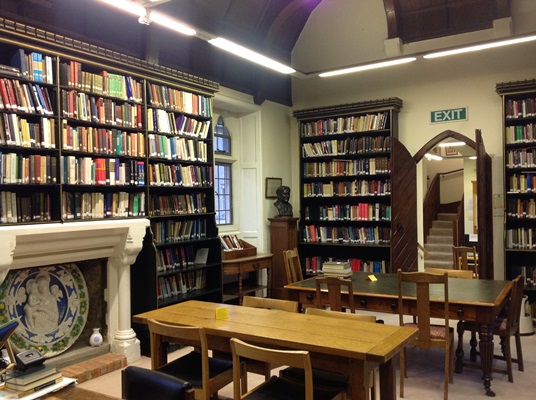
Cuddesdon Library

Cuddesdon Library

‘But as for you, continue in what you have learned and have become convinced of, because you know those from whom you learned it, and how from infancy you have known the Holy Scriptures, which are able to make you wise for salvation through faith in Christ Jesus.  All Scripture is God-breathed and is useful for teaching, rebuking, correcting and training in righteousness, so that the servant of God may be thoroughly equipped for every good work.’ 2Timothy 3:14-17

I LOVE LIBRARIES!… Shh….. Sorry, I think I said that a bit loud! I’ve mentioned before about how much I love books – so a room (or rooms) that are stacked from floor to ceiling with them is equally as exciting. There’s that unique smell of printed paper and leather; the burnished gold lettering on some of the oldest books and the fact that the books on the top shelves, whose titles you can’t quite make out, could be reached by climbing up the librarian’s special step ladder!

A cosy study corner

A cosy study corner

Added to all that is the fact that I get to set up my own little workspace right there in the room itself – I have officially died and gone to bibliotheque heaven!

Knowing that I simply have to walk over and pick the book I need off of the shelf makes studying so much easier – it’s all there at my fingertips, although to be honest it wasn’t that easy the first time……I went in, clutching my list of suggested books and tried to find out where they might be.  I was quite familiar with the Dewey system that most libraries use, but then this system covers vast ranges of topics.

Here, it is more specialised – broken down into various religious and theological categories. Each of these categories is labelled A-Z and then further broken down into even more specific grouping before being alphabetised by author. No wonder I was confused. Added to that is the fact that Cuddesdon library is also not just in one room, or indeed several rooms, but is also on various levels – involving walking along corridors and climbing different flights of stairs!

Cuddesdon library skylight

Cuddesdon library skylight

But when you got this as one of the skylights it doesn’t seem such a problem!

Thank goodness for the librarian whose kindness and patience got me started and pointed in the right direction, because no doubt in the future this will become a haven into which I can tuck myself away as essay deadlines loom.

What I am very much aware of is just how lucky I am to be in this situation and I certainly don’t want to take it for granted. There are many millions of children and adults around the world who not only don’t have access to libraries, but who don’t even have the facilities or the option to an education.

As Malala Yousafzai pointed out in her speech to the United Nations, books and pens are the most powerful weapons we can equip people with, they are the basic tools of education that can begin to eradicate poverty and provide opportunities for better job prospects and life goals.

Perhaps I will do well to remember that, especially when I’m feeling a little stressed and anxious about how I’m doing, and instead look to the fact that part of what my training will be about doing whatever is in my power to seek relative fairness and social justice for those in need. Therefore, when I stop for a moment and glance out of the window it will be a good reminder not to be complacent, because there’s a whole other world out there beyond the tranquil fields, hungry for knowledge and education as well

Tranquil views from Cuddesdon library

Tranquil views from Cuddesdon library

Go back

Your message has been sent

Warning
Warning
Warning
Warning

Warning.


Books, books, books

 “I have always imagined that Paradise will be a kind of library.”  ― Jorge Luis Borges


“I have always imagined that Paradise will be a kind of library.”
― Jorge Luis Borges 

I am sat here with a book list in front of me. It’s a fairly long list that was sent to me by the college. Not a list of the books that will be needed for the first term, instead a suggested pre- course reading list.

Of course, as is explained in the accompanying letter, you are not expected to read every single one, but for those of us who may never have undertaken or have been out of formal higher education for a long time it can help to ease us into the way of things to come… On the other hand it’s like a gauntlet has been thrown down!

The thing is I love books – I love the look of them, the feel of them, the smell of them. For me, entering a bookshop like Waterstones* is like letting Augustus Gloop loose in Willie Wonka’s chocolate factory! A well stocked library of books can be a work of art and a chance to scour the shelves can reveal the most unusual titles and topics. Even when a visit to the local bibliothèque is not possible, all I can say is thank goodness for Amazon’s penny booksellers!

There will, of course, be many different sorts of books that will need to be read and studied but one that will stay at the heart of all this literature will be the Bible. We will be required to perform exegesis (drawing the meaning out of a text) and hermeneutics (the science of interpretation) all without a safety net!

One might wonder how we are still trying to understand what the Bible is all about – after all theologians have spent thousands of years talking and arguing about it. This book, or more accurately 66 books in one volume, has led to the exile, to the persecution, even to the political execution of those who have strived to explain what it’s really saying to us

For some the very act of trying to make it available to a wider audience, to allow them to discover its meaning for themselves, has been  a selfless act of courage and determination. In the early 16th  century William Tyndale paid with his life in order to fulfil his mission statement that, “If God spare my life, ere many yeares I wyl cause a boy that driveth the plough to know more of the Scripture, than he doust”, referring to the Pope and clergy of his time, many of whom were probably not even skilled enough to read their own Latin bibles,  and which set him on translating the Bible into English and thus allowing ordinary men and women to be able to ask, ‘What does that mean?”

There are now over 50 different English translations of the bible and a quick count around the house reveals that I have a least a dozen of them. So we now have a choice of reading God’s word in a way that is in tune with our own ‘linguistic ear’

Hopefully, most people will hear or read a least a passage of the bible each day, whether in formal worship or daily devotions. If not there is always a chance to do so during the weekly church service. In the Church of England the lectionary runs on a three year cycle which is intended to cover a very large proportion of the bible, although not all as some people believe

What amazes me, as someone who has to prepare talks or sermons, is that after a few years you find the passages repeating themselves and there is always some concern that you won’t find anything different to say about them. What you actually find happening is that the passage can speak to you afresh and become appropriate to the present circumstances of both yourself and your congregations.

Perhaps then there is plenty more time and reason for us to continue studying God’s word. So if you see me with my nose in a book this summer it probably won’t be the latest Robert Galbraith novel but something much more thrilling!

*Other bookshops are available

Go back

Your message has been sent

Warning
Warning
Warning
Warning

Warning.