Tag Archives: God

Righteous Anger – A Necessary Emotion

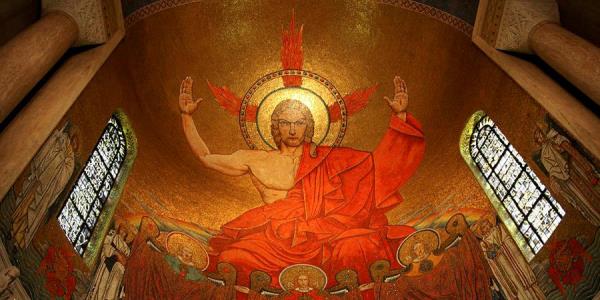
The righteous anger of Jesus, Basilica of the National Shrine of the Immaculate Conception, Washington DC

Mosaic of Christ in Majesty, Basilica of the National Shrine of the Immaculate Conception, Washington DC. Often known as ‘The Angry Jesus’

The third Sunday of Lent sees Jesus clearing the temple in Jerusalem. It is one of the few times that we see him displaying such raw emotion as he angrily removes the ‘thieves‘ from his Father’s ‘house of prayerMatthew 21:13. Often we consider anger as a negative emotion but there are undoubtedly times when it is right to be angry. It is how we use that feeling and who we direct that anger to that can be important.

The sermon I delivered this morning reflect some of the nuances that I had heard in an Oxcept Lecture by Diocesan Canon Angela Tilby entitled ‘Fragile Selves: Shame and Healing in an Age of Envy‘ and an informal talk given by Reverend Joseph John from St John’s Cathedral in Peshawar, Pakistan

May I speak and may you hear through the grace of our Lord; Father, Son and Holy Spirit. Amen

Let’s imagine I am driving down one of the side streets in Hedge End. There is a long row of parked cars on my side of the road, so glancing ahead, as it’s all clear, I pull over onto the other side of the road and start to overtake them. About fifty yards down the road another driver suddenly decides to pull out of their driveway and turn towards me. I can see they are determined to have their right of way. They gesticulate repeatedly that I should reverse back down the road, the whole fifty yards. I in turn glare and gesticulate that it would be easier for them to simply reverse back up their drive, but they are having none of it and start to shout something, which luckily is unheard through the windscreen; and which is also lucky because they can’t hear the words coming from my car either! Eventually, after what seems like several minutes of stalemate, I decide it is easier to simply reverse, and do so rather slowly and erratically as I can feel my heart beating rapidly and tears pricking at the corner of my eyes. The final hand gesture as the other car whooshes past, its driver’s eyes fixed straight ahead, was I feel unnecessary and I have to sit there for a few minutes to regain my composure and let the angry feelings subside.

I knew I’d ‘lost it’, rather like a toddler, kicking and screaming on a supermarket floor, and the whole incident served no real purpose other than to raise my blood pressure and make me feel slightly ashamed. The trouble is that when we ‘lose it’ then our anger, as an emotion, is selfish, destructive, and amoral… However, as Paul tells us in his letter to the Ephesians ‘Be angry but do not sin; do not let the sun go down on your anger’, which tells us that anger in itself is not an emotion we should avoid altogether

Be angry but do not sin; do not let the sun go down on your anger
Ephesians 4:26

This morning we heard of Jesus’ very vivid and public display of anger and it comes as something of a shock… although not as much of a shock as it must have been for the animal traders and money changers. We much prefer to think of Jesus as meek and mild, gentle and loving, but as with all of his actions, his anger had a purpose.

And it wasn’t the first time he had displayed this emotion. In Capernaum, with the Pharisees waiting to accuse him of breaking the Sabbath by healing the man with a withered hand, ‘He looked around at them with anger; deeply grieved at their hardness of hearts’. Even his own disciples came in for a tongue-lashing occasionally. When Peter rebukes him for foretelling his death and resurrection, Jesus then rebukes Peter, ‘Get behind me, Satan! For you are setting your mind not on divine things but on human things’; hardly said with a mild sigh of, ‘Oh Peter, Peter, Peter. Let me explain it one more time’

Get behind me, Satan! For you are setting your mind not on divine things but on human things
Matthew 16:23

When Jesus gets angry he is angry for the right reasons. It is not a selfish anger but focussed on the behaviour and injustice involved. He is not angry about the ‘weaknesses’ of others, but arises out of his concern for their spiritual well-being; they are defiling God’s holiness and in the case of the temple, God’s worship. It does not involve hatred or ill will. He is also fully in control and knew that when he had achieved the desired result of accomplishing God’s will that there was no need to become bitter or to hold grudges

Sometimes we need to become angry about things that are happening around us and in the wider world, at the injustices we see being inflicted on innocent victims, the abuse of children and violence against those who are defenceless, but we need to do so for the same reasons and in the same manner that Jesus has demonstrated. We need to make our voices heard in certain situations where no other voices are speaking up, in other words we need to raise awareness of situations. People are very quick to complain about the church and Christians in general when they ‘poke their noses’ into social situations, but at least it shows we care enough to state an opinion that might upset someone! And we shouldn’t underestimate the effect that holding regular prayer vigils, such the monthly ecumenical world-wide prayers for the Middle East or the annual Women’s World of Prayer can have on bringing issues to a wider audience.

However, should we not be in a position to interact with the public sphere then taking our concerns to God in private can create a safe space in which to express our anger about a situation. As the psalmist points out, ‘With my voice I cry to the Lord; with my voice I make supplication to the Lord. I pour out my complaint before him; I tell my trouble before him’. So there are occasions when we are justified in being angry and there are some things we are justified in being angry about. But what about when we are angry with God? What should we do then?

With my voice I cry to the Lord; with my voice I make supplication to the Lord.
I pour out my complaint before him; I tell my trouble before him
Psalm 142:1-2

Maybe we have to ask ourselves why we are angry with God. We often live our lives believing that life is supposed to be easy and that God should prevent tragedies from happening. When he doesn’t, we get angry with him. Sometimes we forget human involvement, with all its flaws and weaknesses and instead think that God has lost control of his creation and consequently our lives, so we blame God. It’s then that we realise our inability or unwillingness to acknowledge that in fact we are not always in control and that when things happen, it is then we have to trust that God understands the reason and that he will give us his peace and strength to get through any difficult situation. Trusting him in this way is an incredibly hard thing to do… but God is a God of compassion and hope, as well as being full of grace and love.

And God does understand when we get angry through frustration and disappointment. He knows our hearts and he knows how difficult and painful life can be in this world. Perhaps instead of being angry with God, we should pour out our hearts in prayer, and trust that he really is in control and that he already knows how these things fit into his ultimate plan for the world

Recently it was brought home to me how this trusting was more powerful than any acts of anger or retaliation could ever be. The Reverend Joseph John is currently on sabbatical at Cuddesdon College. He is a cathedral vicar at St John’s Cathedral in Peshawar, Pakistan. When Pakistan achieved independence in 1947 a lot of its schools and hospitals were Christian institutions and even after 1956 when it was declared an Islamic Republic, the Christian communities, which now make up only 3% of the population, were successfully integrated as freedom of religion and equal citizenship was guaranteed to all citizens.

However, on the 22nd September 2013 two Taliban suicide bombers killed over 147 of the congregation at All Saints Church, Peshawar; among several of Joseph John’s close relatives. There was a lot to be angry about

Nearly two years later, whilst still seeking justice from the government, the Christians there have a wish is to be recognised and supported as the church that God called them to be. They know that they cannot simply expect God to produce peace, but must pray and work for it. This means listening deeply and trying to understand people who are different and also seeking to resolve differences without conflict and violence. The work that the church undertakes is not exclusively with Christians, in fact 95 percent of those benefitting from their education, development work and health care are Muslims.

They know that it requires courage and humility, and that it often requires sacrifice; but they continue to serve their neighbours, as Joseph John puts it, ‘by washing their wounds’. Their anger has been channelled into seeking justice and continuing to act faithfully because they trust that God is with them in this work and has a plan for all the people of Pakistan, even if they don’t know exactly what it is at this moment in time.

When Jesus speaks of the temple being destroyed and rebuilt in 3 days, those with him are also unable to see the connections to the bigger picture until it is revealed through Christ’s resurrection; then the pieces fell into place. Their knowledge and wisdom is limited to what the human mind tells them is logical. So are we foolish to proclaim Christ crucified, in order to save all who would believe its message? Human wisdom appears weak because it requires proof and concrete knowledge, but God’s wisdom and power dwarfs our understanding and therefore we just have to hand over ourselves to him and trust that eventually that wider vision will be revealed in all its glory. Amen

Concrete things as against those only glimpsed dimly

Concrete things as against those only glimpsed dimly

Trust in the Lord with all your heart;
don’t rely on your own intelligence.
Proverbs 3:5

Go back

Your message has been sent

Warning
Warning
Warning
Warning

Warning.

Lent And How To Give It Up

The 40 Days of Lent

The 40 Days of Lent

This morning I finished my Parochial Placement with St Thomas’ church in Fair Oak and Horton Heath. It has been a useful and at times challenging experience with much to reflect on; but more of that in a later blog. However, today, Ash Wednesday, I was given the opportunity to preach at their 10am morning communion service and I took my reading from Matthew 6:1-6, 16-21

May I speak and may you hear through the grace of our Lord; Father, Son and Holy Spirit. Amen

Today sees the beginning of the Lenten season, when we concentrate our thoughts on the journey toward the cross. I would hope that our focus is always centred on the passion of Christ and ultimately his resurrection, but for the next few weeks we are asked to try to set aside and deny ourselves some of life’s worldly pleasures. But how might we do that?

Well I wonder how many of us have started the day having already been shriven? … In order to be shriven we need to have made a confession – a confession that we’ve not always got things right; that we’ve held back our love from those most in need of it; that we’ve failed to live up to what is expected of us as followers of Christ.

Do we need to shout out how sorry we are from the rooftops? No, our confession is to be done quietly, honestly and simply between God and ourselves and although he already knows everything we’ve done, by admitting it before him he will know just how repentant we are. We need to have done this so that we can approach Lent unburdened, forgiven and with open hearts and minds.

Of course a good many people have translated this unburdening to mean an emptying of the larder… To deny ourselves all the goodies such as sugars and fats in chocolates, biscuits, cakes, etc.  I suspect that fewer people would have known yesterday as Shrove Tuesday – rather it was Pancake Day – and jolly nice they were too!

But we shouldn’t feel smug that we know it more than as a chance to lose a few pounds in weight, because it is hard to give up things we love; and don’t you find that the more we deny ourselves the more the shops, magazines and television seems to be full of images and examples of our favourite treats – no wonder we might look dismal instead of joyful.

I wonder also if we don’t – and you’ll pardon the pun – ‘make a meal of it.’ How many times when we’ve been offered a forbidden treat have we answered ‘Oh I can’t eat … I’ve given it up for Lent’ thus declaring to the world how good we’re being, rather than a simple ‘No thank you.’

This period is also a time for considering offering financial support with a donation to a charity or cause – perhaps with the money we’ve saved on buying all those goodies?  Maybe there’s a special Lent appeal, or Lent programme that puts a cost against the many blessings we already receive – and there’s absolutely nothing wrong in doing something like that – in fact I would encourage us all to take this opportunity to review our sacrificial giving – but an anonymous donation will mean so much more than an official thank you note.

We undertake this journey with Christ just as his disciples did on that first Lenten journey and I don’t expect Jesus was worried about how much sugar the disciples were putting on their breakfast cornflakes. He was more concerned that they understood what was going to happen, what they needed to know about and how they were going to continue his work – because time was running out.

We also only have a limited time, and I don’t just mean these six weeks, the rest of the year or even our lifetime, in which to make a difference and to really appreciate what we are being called to do. That time starts right now when we need to draw closer to God and so begin to gather up those imperishable treasures of goodness, mercy and love. In that way we will not only discover our own hearts but God’s as well.

Amen

I would like to finish by reading you a poem called Lenten Days

Lentern Window

Lenten Window – from the old to the new – from death to life

Go back

Your message has been sent

Warning
Warning
Warning
Warning

Warning.

The Beehive Church

Collaborative Honey Bees

Collaborative Honey Bees

Having just finished and handed in one of my final portfolios, it has given me an opportunity to reflect on the sort of ministry I would hope to engage with in the future – and it’s all to do with bees! Now before you succumb to an image of a wild apiarist reverend roaming the parish bedecked in a wide-brimmed veil touting honey as a cure-all, think instead about collaboration.

We have much to learn about working together collaboratively, and by that I don’t mean working well as a team under the authority and  expertise of a ‘good’ leader. No indeed, because for so long we have had a hierarchical model of leadership in the Church, where decisions are filtered downwards and authority is shared amongst those deemed to be ‘worthy’ or competent; but it doesn’t have to be like that.

The fact is we already have the ultimate authority in God, and collaborative ministry is nowhere better demonstrated than through the Holy Trinity, which acts as an example of synergy, the whole being greater than the parts and yet each part is distinctive and committed to working together both internally as well as externally

One true leader

One true leader

True collaboration can only take place when we place God at the pinnacle of the leadership tree, and when every ministry that is revealed through the gifts or charisms imparted by the Holy Spirit to each person are equally esteemed and valued. These gifts are all undoubtedly diverse, but the leader that facilitates opportunities for all to be heard, establishes lines of communications between different groups and safeguards accountability, while at the same time recognising that others may be better equipped to undertake various tasks is surely one that will succeed in fulfilling their primary role of reminding the community whose initiative they need to follow and who the source of their mission and unity is.

Not an easy task for someone whose personality tends towards natural introversion, who will often carry out a task independently to simply get it done quickly. However, over the last few years I have been introduced to more and more examples of collaborative ministry and have come to realise just how important it is; and above all I truly believe that in order to progress the work that God asks us to undertake, we need to use Christ as our example and the Holy Spirit as our guide,

What then has this to do with bees? Well the writer Tolstoy spent a lot of time musing philosophically about the collaborative nature of bees within a beehive, often comparing it to the Christian church, not always in a kind way. However, what we can learn from honeybees is that they collaborate together almost unconsciously to ensure that the colony not only survives but thrives.

The fruits of the hive

The fruits of the hive

Foraging bees will continuously collect nectar, often being led to new sources by any one of its apparent insignificant members, whose dance can influence the rest of the hive to venture to new and plentiful supplies, whilst the worker bees use this raw material to construct complex precise honeycombs all without the need for supervisors, each contributing a small piece of beeswax before moving aside to allow a co-worker to add their contribution. At the same time the bees respect nature by giving back to their habitat the gift of pollination.

Admittedly the drone bees could be considered the lotharios of the bee world, but hey-ho it takes all sorts; and at the very centre of the hive is the queen bee, without whom the colony would not survive and yet who selflessly gives herself to ensure the next generation of bees is produced and nurtured*.

What then of the product of this collaboration – surely there is nothing sweeter than being prepared to share with others the glorious fruits of all this shared ministry.  It’s just a thought, but maybe the ‘beehive church’ is one that we could all be striving toward. Why not let me know what you think?

The collaborative church

The collaborative church

*Within this analogy, God the creator is wholly represented through all of his creation, whilst the Holy Spirit provides the wisdom, energy and drive. At the centre is Christ, the selfless example of whom the minister is called to represent and emulate.

Go back

Your message has been sent

Warning
Warning
Warning
Warning

Warning.

Let’s Talk About Money

Generous Giving

Generous Giving

I was recently asked to preach a sermon on giving. Not that our giving isn’t already generous in so many ways, but from time to time it’s useful to be reminded not only why we need to give as a response to a generous God, but also how we need to respond to requests to review our level of giving. This topic can be quite a tricky one for lots of churches and so I thought it would be good to share a slightly adapted version. The readings that informed these ideas were Deuteronomy 15:1-11; 2 Corinthians 8:1-3, 9:6-12 and Matthew 6:19-34.

May I speak and may you hear through the grace of our Lord; Father, Son and Holy Spirit

Today, on Bible Sunday, as on any day really, we are asked to think carefully about how important the bible is in helping to bring us closer to and to know God better; about his plans for us and for his world and just what our part in those plans might be, as followers of Christ… and it’s important to remember that ALL of us have a part to play.

The passages above all have a common theme running through them – they speak of the generosity of a God who knows no limit to his blessings for us, and they help us see the response that is expected on our part… to be equally generous in our giving, both of ourselves physically and our prosperity materially. So, I could say that I’m not going to ask you to give serious thought as to what and how you give – but quite honestly that would be as blatant a lie as those telephone calls you get from time to time….

‘Hello madam. How are you today…. now don’t worry, I’m not trying to sell you anything…..’

Now perhaps, like me, you occasionally want to slam the phone down immediately, because you know that that’s exactly what they do want to do, and it’s annoying that they don’t just say straight out what they want from you; so perhaps you will choose to stop reading at this point and click off of the page. But what I am asking you to do… in fact what I’d rather you did, is to carry on and discover some of the reasons, all revealed and supported within the bible, as to how and why each of us needs to be as generous as we are able, and afterwards to spend some time reflecting and praying about your levels of giving and what you might do about that.

We hate talking openly about money, it makes us feel uncomfortable, sometimes we feel a sense of indignation or even guilt but that doesn’t mean that it shouldn’t be talked about. As church members it can seem that the Church is always asking for more… more of our time, more of our money… so that we’re never left in peace. There’s always some job that needs paying for; the parish share to be met, the books to be balanced. So why then should we give?

For where your treasure is, there your heart will be also – Matthew 6:21

If we drive a car we know that we have to pay out to maintain it, if we don’t then eventually the car will stop working and it will be very expensive to repair or replace. If we have a hobby we have to invest a bit of money setting ourselves up with materials and equipment and as we get more proficient at it we may have to spent a bit more on different tools. The buildings in which we sit for church, have been dedicated and sanctified as a place where Christians can gather. If they fell down around our ears we could still gather there, because they’re not just buildings. They also aren’t buildings that should be preserved as pristine museums, so that people can drop in and visit it and say how wonderful it must have been to worship there; so it seems sensible that we try and ensure that we and future generations at least have a roof over our heads.

Therefore, our giving enables worship – whether we are giving of our time on Sunday to be with God, sing his praise, hear his word, share his sacraments, which is the first part of our giving. Or the second part, that our giving of money helps maintain the holy place where we worship, a place of history, a place of beauty, a place of peace and challenge, a place to glorify God.

Our giving of money also helps provide wages and resources for those who minister to us, who lead us in worship, for our music and others who enrich our worship. We need people leading us who are trained and knowledgeable and dedicated to helping us grow in our knowledge of Christ both in word and deed. If we are to sustain and enable that leadership we have to understand that it costs. The early church often paid its leaders in kind – in Matthew’s gospel for example:

Go and preach, ‘The Kingdom of heaven is near!’ … Do not carry any gold, silver, or copper money in your pockets; do not carry a beggar’s bag for the trip or an extra shirt or shoes or a walking stick. Workers should be given what they need – Matthew 10:7, 9-10

Likewise, the medieval church, who asked for donations of bread, wheat, mead and vegetables; although we’ve moved on from that now and use money instead, which is much better because quite frankly I don’t think our ministers or anyone else we have to support could cope with vast quantities of eggs and butter and pots of jam landing on their doorsteps and I’m pretty certain the gas board or the petrol station or the local council wouldn’t understand either when they tried a bit of bartering for their bills.

Our giving enables discipleship – Our giving of time and talent can help children and young people grow in the Christian faith and help those who study together to understand the gospel more fully, so that all can learn how to live faithfully. But it is our giving of money that can help provide resources for this learning, both in our own congregation and throughout our dioceses.

I wonder though how many of us use our own money to provide resources for the church? We think we are being generous… and we are, but we’re actually hiding the true cost of discipleship. We should be coming to the church and our treasurer and saying in order to do this it’s going to cost this, please can you reimburse me. Of course it may be that after having received the money you decide to offer it back as a donation, and you can say that that’s a load of faff, but it’s more valuable that we do realise the true cost. However, we don’t have a bottomless pit of money, but if we all become more aware then we can make sure that we can all contribute to that.

Our giving enables service – our giving of time and talent can assist our congregation in its service to the community, caring for some of those who are most vulnerable in our society. Every single church member can say that they give to the church, in so many different and diverse ways, you serve at his altar, you sing in the choir, you make cups of tea, you comfort the sick, the lonely and the bereaved, you clean, you organise, you lead, you turn up each week; and that’s absolutely wonderful and very sacrificial, but that can’t be treated wholly as a substitute for financial giving

One of the hardest passages in the bible to read is that of the young man who wants to follow Jesus, he knows exactly how he should behave and treat others, he does all those things that we can all do it without dipping our hands into our pockets, but Jesus says it’s not enough, you have to shed your reluctance and reliance on making sure that your nest egg is large enough and instead trust God that he will provide for you.

Therefore do not worry, saying, “What will we eat?” or “What will we drink?” or “What will we wear … your heavenly Father knows that you need all these things. But strive first for the kingdom of God and his righteousness, and all these things will be given to you as well – Matthew 6:31-33

I can almost hear you thinking, ‘Yes, but it would be super if we actually got to use the money that we give, on things that we want to happen and support,’ and it’s true that over the last few years I’ve got tired of thinking that every penny we give is often not quite sufficient to meet the demands of the diocesan Parish Share and has to be topped up by such hard work by the fundraising and social committees.

However, giving to an overarching hierarchy is nothing new either – the early churches were doing it when collecting for the church in Jerusalem, and they appears to do it with a spirit of generosity like the churches in Macedonia; but I believe things will change, particularly in the Winchester Diocese over the next few years, and that hopefully we might be in the more joyful position of deciding exactly what we want to spend our money on with the Parish Share review; which doesn’t mean that we have less to raise but it does mean that we can really get stuck into thinking of way in which the Good news can be brought to more people.

And there’s the nub… Our giving reflects our faith. We could say ‘why can’t the church do less, cut its cloth according to its means, and be content with what we already do, with what we already give’. Well, I suppose that’s one way to go – we could become more inclusive, look after our church; our people, but that would be like ‘storing up for ourselves, ‘treasures on earth, where moth and rust consume and where thieves break in and steal -Matthew 6:20

Surely, we have to realised what the real treasure is – that God has given us life and love, that he has shown us the extent of this love in the life and death of Jesus and that he has promised us new life through Jesus’ resurrection. Right now we can hear the good news of the gospel… and it certainly is good news for ourselves; it’s good news to know that we have personal salvation, it’s such good news that we almost what to hug it and keep it close to us. Yet, if it’s such good news for us why aren’t we bursting to share it with other – the gospel that we proclaim by word and example is a gospel for the world, a gospel for everyone. As Jesus said to his first disciples:

Go therefore and make disciples of all nations, baptizing them in the name of the Father and of the Son and of the Holy Spirit, and teaching them to obey everything that I have commanded you. And remember, I am with you always, to the end of the age – Matthew 28:19-20

I think sometimes we forget that each us of is individually called to proclaim the Gospel, not just a special few, but everyone. So our giving enables mission – our giving of time and talents assists in providing outreach to the community, providing a Christian presence in every part of life, while our giving of money helps to fund projects to bring the gospel to those who have yet to be challenged by it, and enabling the wider Church to comment on the social, moral and political issues of our time.

How more effective it is, when the world takes notice because it sees a group of people who are willing to make generous investment of their time, energy, gifts and money to share and spread the gospel…

The Widow's Mite by James C. Christensen

The Widow’s Mite by James C. Christensen

God calls us to be infinitely generous, like the widow and her mite in Luke’s gospel:

For the others offered their gifts from what they had to spare of their riches; but she, poor as she is, gave all she had to live on – Luke 21:4

That’s a really hard message to hear and live out, but what about making a start by at least considering what we have to spare…maybe we’re still reluctant sometimes to increase our giving because we honestly don’t think we have any money to spare

A Hotey Money Box

A Hotey Money Box

I actually surprised myself the other day when I looked at my ‘hotey’ money box. ‘Hotey’ – as in Don Quixote? Yes, I know he’s lost an ear, but it steadfastly refuses to stick back on… We made these at the beginning of Lent. So every time I come back from the shops and have those small coins that make your purse or wallet bulge I pop them in the box, and I also help my husband David prevent himself from wearing holes in his trouser pockets by relieving him of his pocket shrapnel as well…

As you can see it’s pretty full now, and looking at it I think there’s at least £50 in there – just made up of the small amounts of money that was spare and that we haven’t really missed – on average £3 a week … and it doesn’t have to be saved up to be given as a one off gift. Those are great for specific purposes, but it’s much more valuable knowing as a church that you are receiving a regular income, so that you can plan and budget for all the things you want to do and support. That’s not to say that we all have a lot to spare, all of our circumstances are different, but it was interesting to realise that perhaps if we do have some spare capacity to consider what we could do with it. Just imagine if everyone only had a spare 50p a week to increase their regular giving – an average congregation of 70 people could be equally sharing an increase of £1820 per year – a £1 would double that to £3640.

At the beginning, I said that I wanted this to be an opportunity to hear how and why each of us needs to be as generous as we are able, using the bible as our guide. It was not my aim to make anyone feel angry or guilty, but for you to go away prepared to review and reflect, and to then come to a decision, so that the next time you are approached to consider increasing your giving you know what your answer will be. At the end of the day, as Paul said to the Corinthians:

Each of you must give as you have made up your mind, not reluctantly or under compulsion, for God loves a cheerful giver – 2 Corinthians 9:7

Our giving of time, talent and money is a giving for the Gospel… for the Good News, and this fact was brought home to me the other day when I was privileged to be able to look through and choose some books that Sheila and Gordon Rose’s family had passed on to the church; among them were several bibles, and in many of them were personal greetings. One that stood out for me was this one in the front of  a Good News bible.

Gordon had written ‘To Sheila, hoping that it will always be “Good News”’

However on this Bible Sunday, I’m going to let Sheila have the last word, with a prayer that she had written and that was tucked into the front of her bible

A Prayer on Opening My Bible
As I settle for this time of quiet, O God, hush my heart and quicken my understanding.
I bless you for scribes, scholars and translators who have served your holy will.
I bless you for the great Bible Societies that have made this book available in my language.
I pray for a living expectancy, as I wait to learn what you will say to me as I read.
I pray for courage to face new challenges and to embrace new truth
For Christ’s son
Amen

Sermon delivered on Bible Sunday, 26th October 2014

Go back

Your message has been sent

Warning
Warning
Warning
Warning

Warning.

On A Midnight Train From Georgia

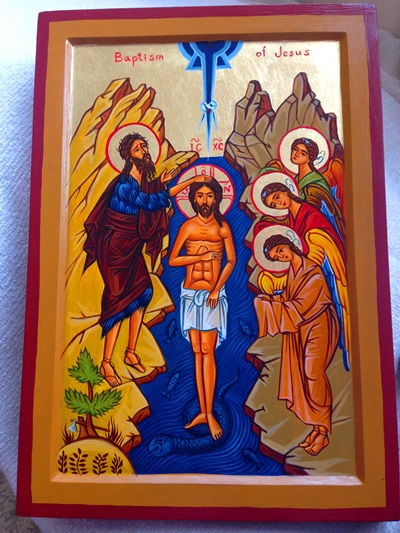
Baptism of Christ Icon - written by Tamara Rigishvili

Baptism of Christ Icon – written by Tamara Rigishvili

To be honest I don’t know if it really was put on the midnight train, or any train for that matter. Maybe it came by plane or postal van, but however it travelled, it arrived safely at my door last week.

The truth though is that it did come from Georgia – Tbilisi, Georgia to be exact – some 2,653 miles to the east of my home, where the very talented artist Tamara Rigishvili lives and works. However, the creation of this beautiful icon came about in what was for me an unusual series of events, which culminated in owning what has become to me a very important representation of the story of Jesus’ baptism.

In April of 2014, I wrote about using this icon to explain the actions performed while making the sign of the cross in Coming Into The Presence of God. Wanting to upload an image of the icon that has been used on that day, I googled several images and came up with one that was taken from Tamara’s website. However, I felt that I needed to get authority to do that, and so I e-mailed her and sought permission, asking her to check out the contents of my blog and with the promise of a link to her site.

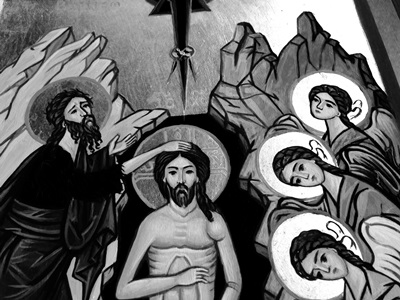
Christ submerged in the water of the Jordan

Christ submerged in the water of the Jordan

Thus a correspondence was begun between two people, thousands of miles apart, who did not know each other, did not necessarily speak the same language (although Tamara’s English is excellent, whilst my schoolgirl Russian is yet to be tested); connected by their common faith, and which resulted in my asking if she would ‘write’ a copy of the icon for me. True to her word, she completed the icon over a three month period and it was then carefully packaged and despatched…

… In the meanwhile, as part of my spiritual direction at college, it was suggested that I meditate on Matthew 3:13-17. This description of Jesus’ baptism is just one of the bible’s explicit passages where the Trinity appear together.

And when Jesus had been baptised, just as he came up from the water, suddenly the heavens were opened to him and he saw the Spirit of God descending like a dove and alighting on him. And a voice from heaven said, ‘This is my Son, the Beloved, with whom I am well pleased.’
Matthew 3:16-17

As a Trinitarian at heart, I have always found that the three-fold nature of God; Father, Son and Holy Spirit has both fascinated and frustrated me. On the one hand each has its own separate identity and characteristics, on the other they are all one and the same. I do not argue against this nor do I find it easy to explain – although traditionally in the Church of England, as a curate it usually falls to their lot to preach on Trinity Sunday each year – so I better get my thoughts in some order by then!

The passage itself presents a beautiful image of being submerged beneath water, and then a figure rising in a sparkling cascade to see the sky above suffused with a pure light that is concentrated in a shaft centred on their head and a clear voice filling the air with a confirmation of their worthiness. What, it was suggested, if that figure were you?

So often we can feel unworthy, and could not imagine such a thing, but we are invited to do so by God as he offers us his love and grace. ‘This is my daughter… this is Linda… this is [insert your name here]’.

I don’t believe that God arranges for these things to come together without a purpose, so as I spend time contemplating that passage alongside my beautiful icon, I hope and pray that you too will accept that grace, knowing that you ARE worthy to receive it.

Matthew 3:13-17

Matthew 3:13-17

For more details of Tamara Rigishvili artwork, please do visit her website

Go back

Your message has been sent

Warning
Warning
Warning
Warning

Warning.

Of Being Challenged

We are challenged to look beyond what we know

We are challenged to look beyond what we think we already know

The last few days have been particularly challenging, both in terms of my personal response to events that have happened and reflections on the responses of others to these situations. On the whole the outcome has been positive and hopeful, but this has been at the expense of other’s sorrow and suffering.

Harrowing pictures of the brutal treatment of Christians and Yazidis as they are persecuted for their faith, left me sobbing for the sheer inhumanity of the perpetrators of these violences. The incomprehension that once again genocide rears its ugly head in the name of religious intolerance and I feel powerless…

Yet, the response of many has been to speak out and simply say ‘It’s not right” and that we will do something about it. Whilst I am not in a position to honestly know whether military intervention is part of a solution; I do know that humanitarian airdrops of food and water were the correct immediate response to alleviate some of the suffering. I also know that the emergency appeals by charities such as Christian Aid for donations enable us all to ‘do’ something towards long-term solutions; and of course there is always prayer.

The outpouring of sorrow for all of the unknown and nameless victims of these atrocities has been matched this week by the sorrow and sadness of the passing of one whom we felt we really did know, the actor Robin Williams. His death has brought to our attention the devastating and often silent suffering of those for whom depression is the ‘black dog’ that they have to live with on a daily basis.

Social media sites and newspapers have been full of messages of condolences and self-identification and some, in their genuine sadness and sense of mourning have inadvertently used phrases and ideologies in their expressions of sympathy, that although well-meaning have highlighted a lack of understanding of suicide and depression. I have personally been humbled to reflect on things that are helpful to say and things that are not, and have learned immensely from those who have challenged these unintentional faux pas.

The fact is that sometimes we all need to challenge what isn’t right, and this Sunday I will be preaching on the story of the Syrophoenician woman who dared to speak out and challenge Jesus because she knew in her heart of hearts that he was the one who could heal her child whether she was Jew or a Gentile, simply because of her faith in him

Then Jesus said to her,“O woman, your faith is great – Matthew 15:28

So I will continue to hold all of these situations in my prayers and whenever possible look for ways to challenge both mine and other people’s assumptions, but hopefully to do so in love.

Have faith that all will be well

Have faith that all will be well

If you are living with depression or care for someone who does you may find this helpful – I Had A Black Dog

Go back

Your message has been sent

Warning
Warning
Warning
Warning

Warning.

V Is For Vulnerable

Detail from Gentle Spring by Frederick Sandys (1829-1904)

Detail from Gentle Spring by Frederick Sandys (1829-1904)

For someone who keeps a lot of their deepest emotions well hidden, I hesitate to write this. Yet, whilst I don’t believe it is my nature to be completely self-indulgent, I have a feeling that my experiences are not in any way unique, but that they may resonate with others and therefore be of some help.

It’s really hard when you’ve done your very best and it turns out that it’s not actually good enough. Some of which is down to your level of understanding and some of which is not having been given the proper blueprint and tools to complete the task in the first place.

When we set out to do something new we will have many things at our disposal. We will have some previous generic knowledge as to how we might approach the task; to which we will add new learning, from books or instructions and if possible from other people. We will take all of this and try to form it into a cohesive understanding of what we need to do and then attempt the task. Add into this a willingness and desire to do our very best and we open ourselves up to the vulnerability of being tested and tried and sometimes found wanting.

This is the most painful part of the whole process. It’s the tears at a drop of a hat time; when you feel vulnerable to any sense of judgement or act of kindness; when you want to withdraw even deeper into your shell….

Detail from Gentle Spring by Frederick Sandys (1829-1904)

Detail from Gentle Spring by Frederick Sandys (1829-1904)

… and it’s easy to stay there, and bemoan the situation, scrutinising your discomfort internally or if you’re lucky sharing it with your closest confidantes; and if this stage is the most painful, then the next stage is often the hardest.

It will come inevitably to a point though when you can no longer disguise what you’re feeling on the inside and then the dam will burst and you will find that all of your anxieties and fears are laid bare. In some ways your worst nightmare and in others a blessed relief.

For this is where the healing process can begin. Not some overnight miracle, but a gradual reflection on why what has happened has happened and how you can move forward from it. You will need to be honest with yourself and recognise what part your own desires and expectations have played in the situation; where things might have been done differently, both on yours and others parts.

You also have to be prepared to accept that the advice and encouragement you are being offered is genuine and that you are worthy to receive it; because we don’t always recognise ourselves when seen through the eyes of others, but they are so often the mirrors to our souls.

We can then be ready to move on. A little stronger, a little wiser

The Lord is close to the broken hearted and saves those who are crushed in spirit (Psalm 34:18)

Life itself is never easy, and our trials may be incomparable, even trivial, to those faced by others on a daily basis. Our greatest comfort though is knowing that if we can hold on to our faith then the bigger picture for us is already known by God, and that he will be beside us as we travel over the rough and the smooth paths to get there

So I would encourage you to be prepared to allow yourself to be vulnerable from time to time, to open yourself up emotionally and honestly; because in that way you may just find out where your strengths lay.

Detail from Gentle Spring by Frederick Sandys (1829-1904)

Detail from Gentle Spring by Frederick Sandys (1829-1904)

Go back

Your message has been sent

Warning
Warning
Warning
Warning

Warning.

The pictures that accompany this blog are details from the painting Gentle Spring by Frederick Sandys (1829-1904), a Victorian Pre-Raphaelite painter; which hangs in the Ashmolean museum in Oxford. It’s relevance is simply no more than that it is such a beautiful painting that draws my attention on each visit, and each time makes my heart soar.

Consolation and Desolation

Light and Shadow together

Light and Shadow together

Consolation and Desolation… two words that I came across during a Spirituality Day recently held in college. In relation to Ignatian Spirituality they are used to help us discern which direction our life is taking us – is it toward God (consolation) or away from him (desolation).

Consolation also brings us closer to people, so that we are aware of their joys and sorrows and shows us where God is active, both in our life and theirs. It charges us with energy, so that we become more creative and our focus is away from ourselves. Whereas desolation, cuts us off from people, so that we turn in on ourselves. We are bombarded by negative feelings and become withdrawn, totally drained of energy and unable to sustain an interest in those things that previously had meaning for us.

It’s deeper than just being aware of the things that make us happy and trying to do more of them and avoiding the things that make us sad.  It’s more about having an understanding that there will be both moments of consolation and desolation in our lives; but that in wishing to draw closer to God, even if negative doubts seem overwhelming, God’s will for us ensures that our hearts, both God’s and our own, continue to beat in harmony.

It is also possible that these moments will occur simultaneously. This fact was brought home to me as we listened to a piece of music. The choir were singing a psalm and the different voices oscillated between the clear high notes of the trebles and resonant, low tones of the baritones and basses as they exchanged verses. Yet even as the one range sang, the other did not remain silent, but was still audible if muted

As this thought occurred my eye was also caught by one of the trees outside, its leaves filling the frame of the window, as the wind shook them and light and shadow danced together. On a sunlit day this produced a feeling of warmth and happiness as the large leaves absorbed and reflected the light, but I could also imagine on a wet, winter day, the dark bare branches would be oppressive and shadowy. Yet in both scenarios neither light nor dark was completely absent

The light shines in the darkness, and the darkness did not overcome it
John 1:5

My mind then raced to think of other examples where the presence of ‘good’ and ‘bad’ might not only be present, but might be necessary for us to appreciate the need for both to exist concurrently. Things such as batteries, where positive and negative terminals have to be present in order for power to flow through it. Or when racing a car on a track, where the exhilaration of driving at high speeds needs to be tempered by a fear of the consequences of crashing and so teaches us to develop braking and manoeuvring skills. Of maybe even a margarita cocktail where the combination of saltiness and sourness adds to the whole experience!

The thrills of racing

The thrills of racing tempered by the need for safety

We only need to think of the disciples at Easter. Theirs was utter desolation as they abandoned Christ in the Garden of Gethsemane and had to deal with their fear and response to what they had done; yet just like Peter, they kept their focus on God,  so that their and our consolation came through the cross.

Yet even as we acknowledge that there will be consolation and desolation in our own lives, if we continue to maintain our focus on looking toward God then our consolation should never remain self-centred – there are many other directions in which God is trying to catch our eye!

Oh Master, grant that I may never seek,
So much to be consoled as to console,
To be understood, as to understand,
To be loved, as to love with all my soul

Make Me A Channel of Your Peace – Temple
© Copyright 1967 OCP Publications

Go back

Your message has been sent

Warning
Warning
Warning
Warning

Warning.

A Chinese Legend


The Noble Bamboo

The Noble Bamboo

In the church, we have just celebrated Ascension, when the risen Christ traditionally ascends to heaven, having been crucified on the Easter cross. Ahead, we look forward to Pentecost; when the promised Advocate or Holy Spirit will be given to his followers. Without these things happening we would have nothing distinctive about our faith. 

If there is no resurrection of the dead, then Christ has not been raised;
and if Christ has not been raised, then our proclamation has been in vain
and your faith has been in vain.
1 Corinthians 15:13-14

So for his death not to have been in vain there had to have been a purpose. The son of God, who came to earth, and set aside his divinity to take on earthly flesh had to die in order that he and us might live and there is no doubt that giving your life for the greater good is the ultimate sacrifice anyone can make. Throughout history men and woman have made this sacrifice, as martyrs, as servicemen and women and civilians serving their country, as ordinary everyday people; in the hope that it helps others to live.

At Morning Prayer in college recently a fellow student read a beautiful story which illustrated this selflessness perfectly. However, it also made me think that God does not contain himself to our slightly arrogant assumption of exclusivity. For example, I have always been amazed at the fact that creation stories from around the world contain so many similar attributes. For those who believe in a creator God, this is not so strange, as we cannot be so precious that we think God only revealed the story of creation,  based on a Mesopotamic myth and passed down in verbal form, before being adapted to Israel’s belief in one God, by a group of Yahwehist writers in the late 7th or 6th century BC

God indeed reveals himself time and again in all of his creation, both physically and linguistically and so I hope you enjoy reading this legend from China and draw your own conclusions about where God could be working his purpose out in the world right now

A Chinese Legend

Once upon a time, in the heart of the Western Kingdom, lay a beautiful garden. And there in the cool of the day was the Master of the Garden wont to walk. Of all the denizens of the garden, the most beautiful and most beloved was a gracious and noble bamboo. Year after year, Bamboo grew yet more noble and gracious, conscious of his Master’s love and watchful delight, but modest, and gentle withal. And often, when Wind came to revel in the garden, Bamboo would cast aside his grave stateliness, to dance and play right merrily, tossing and swaying and leaping and bowing in joyous abandon, leading the Great Dance of the Garden which most delighted the Master’s heart.

Now upon a day, the Master himself drew near to contemplate his Bamboo with eyes of curious expectancy. And Bamboo, in a passion of adoration, bowed his great head to the ground in loving greeting. The Master spoke:

“Bamboo, Bamboo, I would use thee.”

Bamboo flung his head to the sky in utter delight. The day of days had come, the day for which he had been made, the day to which he had been growing hour by hour, the day in which he would find his completion and his destiny. His voice came low:

“Master, I am ready. Use me as thou wilt.”

“Bamboo ” — the Master ‘s voice was grave — “l would fain take thee and — cut thee down.”

A trembling of a great horror shook Bamboo. “Cut. . . me.. . down! Me… whom thou, Master, hast made the most beautiful in all thy garden. . . to cut me down! Ah, not that, not that. Use me for thy joy, 0 Master, but cut me not down. “

“Beloved Bamboo” — the Master’s voice grew graver still — “if I cut thee not down, I cannot use thee.”

The garden grew still. Wind held his breath. Bamboo slowly bent his proud and glorious head. There came a whisper:

“Master, if thou canst not use me but thou cut me down.. then… do thy will and cut.”

“Bamboo, beloved Bamboo, I would . . . cut thy leaves and branches from thee also.”

“Master, Master, spare me. Cut me down and lay my beauty in the dust; but wouldst thou take from me my leaves and branches also?”

“Bamboo, alas, if I cut them not away, I cannot use thee.” The sun hid his face. A listening butterfly glided fearfully away.

And Bamboo shivered in terrible expectancy, whispering low.

“Master, cut away.”

“Bamboo, Bamboo, I would yet… cleave thee in twain and cut out thine heart, for if I cut not so, I cannot use thee.”

Then was Bamboo bowed to the ground.

“Master, Master. . . then cut and cleave.”

So did the Master of the Garden take Bamboo and cut him down and hack off his branches and strip off his leaves and cleave him in twin and cut out his heart. And lifting him gently, carried him to where was a spring of fresh, sparkling water in the midst of his dry fields. Then pulling one end of broken Bamboo in the spring and the other end into the water channel in his field, the Master laid down gently his beloved Bamboo. And the spring sang welcome and the clear sparkling waters raced joyously down the channel of Bamboo’s torn body into the wailing fields. Then the rice was planted, and the days went by, and the shoots grew and the harvest came.

In that day was Bamboo, once so glorious in his stately beauty, yet more glorious in his brokenness and humility. For in his beauty he was life abundant, but in his brokenness he became a channel of abundant life to his Master’s world.

Living Water

Living Water

Go back

Your message has been sent

Warning
Warning
Warning
Warning

Warning.

The Empty Tomb

The Empty Cross

The Empty Cross

Alleluia! Christ is risen
He is risen indeed. Alleluia!

It was with this greeting and response; as we sat down to share our evening meal that a new term began at college. It was only two days beforehand that I had sat next to the Easter cross in my home church, celebrating Easter Sunday and here I was, back to my studies but with new tasks to complete and new challenges. It seemed the same, but then again it also seemed different

I suspect it was the like that for the women, who approached the tomb on the first day of the week. Yes, a dreadful thing had happened and yes, they were probably a bit disorientated and shaken, but they were coming to do what they would always have done if someone died – that at least was normal, but what happened next was very different

Each Gospel gives a slightly different version of accounts. In Mark there are several women together to who arrive to anoint the body, only to find that the stone sealing the tomb had been rolled back and inside was a young white-robed man telling them not to be afraid, but that the body wasn’t there. Despite his call for calm, they are terrified and flee from the tomb, too afraid to tell anyone what they have seen

In Matthew, it is two Marys who go to look at the tomb, only to experience an earthquake, caused by an angel’s descent from heaven; who puts the guards into a stupor and then shows them that Jesus is not in the tomb. He sends them fearfully, yet joyfully, to deliver a message to the disciples that they are to return to Galilee, only for them to meet Jesus himself who confirms what they must do.

In Luke we again hear about a group of women, who meet two dazzlingly dressed men and after being reminded of what Jesus had previously told them, return to the disciples only to be accused of idle talk until Peter runs to look for himself.

Finally, in John, it is Mary Magdalene who, on seeing that the stone has been removed, runs back to tell this to Simon Peter and the beloved disciple, who both then set off towards the tomb, the latter outrunning Peter to reach the tomb, but respectfully waiting for Peter to enter it first, only to be met by discarded linen wrappings. However, it is after this that Mary in a bitter-sweet moment encounters Jesus and can report this back to all the disciples.

All of these accounts add to the story of what happened, but the one fact that they all substantiate is that the tomb was empty.

‘Do not be afraid; I know that you are looking for Jesus who was crucified.
He is not here; for he has been raised, as he said.’ Matthew 28:5-6

I often wonder if it shouldn’t be the tomb that is used more as an image of Christ’s resurrection, a permanent reminder of the defeat of death – but equally it is the empty cross that is a powerful and iconic symbol of transformation to which we are drawn.

This is his blood which he shed for you

This is his blood which he shed for you

The truth is that in a way this transformation is what was happening on Sunday, as I watched people, coming forward to place a flower around the cross. The blooms themselves were fresh and vibrant, and everyone placed them as carefully as they could, trying not to bruise the petals. However, some found it difficult to push  them into the ‘ground’, while others knew exactly the spot they wanted in relation to the position of the cross. One flower in particular caught my attention – a beautiful cream tulip, streaked with red, that was placed right in the centre  at the very foot – which looked this morning as if its cup had opened up to catch the blood that would have fallen from Jesus’ body

Yet, as beautiful as this display had become, each single representative bloom was already dying; just as we are called to die to Christ in order to be transformed and given new life. This truly is the joy of the Easter message and yet not everyone chooses to respond to it. That, no doubt, is the greatest regret as far as God is concerned as he tries, in love, to reconcile all of his creation. However, it still doesn’t mean that we shouldn’t try and do our part by sharing the Good News

Alleluia! Christ is risen
He is risen indeed. Alleluia!

He is risen as he said

He is risen as he said

Go back

Your message has been sent

Warning
Warning
Warning
Warning

Warning.