Tag Archives: Prayer

Agape

Two autumnal maple leaves held together to recognise differences in the church that we hope and pray will look for unity rather than division through the shedding of Christ’s blood.

My focus as an ally of LGBTQ+ fellow Christians and those of other faiths and none, was honed by several woefully inadequate letters of apology by the bishops and leaders of the Church of England over the last few years. Through prayer, study and listening, I have concluded that there is no reason, apart from historical conservative dogma, that I cannot afford to offer the same love and blessings to all who seek to celebrate that love within the church. However, I am currently prevented from doing so.

Slow progress has been made, and the Living in Love & Faith (LLF) process has given hope that things would change and that, whilst a singular marriage service for all couples was not yet available, there was the opportunity to offer a service of blessing using the Prayers of Love and Faith resources. Despite this, the House of Bishops have recently announced that further developments would be ‘subject to further synodical processes’. Without wishing to question the wisdom and faith that brought about this decision, like others, I recognised that this was no pastoral letter, as it appears God and his people did not get a mention.

Some have indicated this sounds the death knell to any chance of same sex marriages within the Church of England, but I do believe that God moves in mysterious ways and that their is always hope that His love will overcome.

Holy Saviour,
Agape instigator,
Sentinel of justice
and of peace.
You offered a sacrifice
so costly, we cannot repay.

Whose unconditional love
is poured out
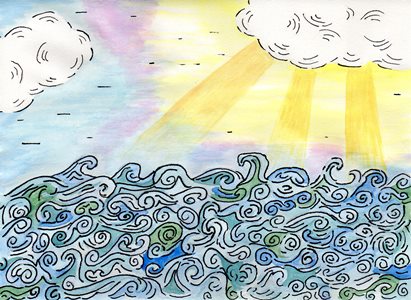
like a mighty flood;
saturating each and every soul,
to overflow to others
regardless of attitude.

Flowing to those who believe,
and those still blind.
Poured equally on those
whose prayer is grace and mercy,
and those whose words
become a shibboleth
of division and disunity.

Showered down alike
on those who live your Word
each and every day,
and those who seek to
misinterpret and subvert
with hidden agendas.

Still that love is offered,
justly on those who witness
to the ends of the earth.
and to those who speak
only of process not people,
in pharisaical fashion.

Encompassing all,
this love is offered.
To be shared not denied,
to be lived not theorised.
to be available not withheld.
Regardless of cost.

This is a boundless love,
yet some would tarnish its name,
and constrict its power,
masking it as truth,
constructed of meanness and hate,
of abuse and wounding.

Let it be not so,
for the rock on which
your church was built is firm,
this present stumbling block
will be removed,
and love will conquer in the end.

If you want to see and hear what affect these decision have on people then the Dean of Southwark Cathedral recently gave an incredibly moving sermon based on his experiences https://www.youtube.com/watch?v=LLM_J8YH8Fk

The Inclusive Church network, of which my church is a member, is also asking Church of England members to sign an Open Letter to express our sadness and disappointment at the recent decisions taken by the House of Bishops. If you feel able, please do so here. No voice will go unheard https://www.inclusive-church.org/llf-open-letter/

The Waiting Game

Sermon preached on the 7th Sunday of Easter based on Acts 16:16-34 and John 17:20-26

May I speak and may you hear through the Grace of our Lord; Father, Son and Holy Spirit. Amen

I’m not very good at waiting. If something needs doing, then I want to get it done as soon as possible; but sometimes waiting is the only thing to do.

So, what to do in this period of waiting? Well the first thing you could do is to do absolutely nothing. Time to catch your breath, to rest up and regain some energy; but also not conducive to being prepared when the waiting is over.

Or perhaps you could fret and pace continuously up and down, putting forward different conjectures and scenarios, trying to cover all eventualities. Surely one will turn out to be close to what is likely to happen.

Or maybe there is a third way to use this time of waiting. A time of waiting that we find ourselves in right now. A time of waiting between Ascension and Pentecost, which we know is just seven days away…

However, let’s think back to the those first disciples, still in hiding from the authorities, witnesses to some amazing events; the reappearance of their teacher after witnessing his death on the cross, satisfying themselves that this miraculous thing had happened and then watching as he ascended back to his Father, with a promise that they would not be left alone to continue the work he had prepared them for, but that a helper, the Holy Spirit would be sent.

But when? Waking up each morning wondering if this was the day, then retiring at night still fearful but hoping that tomorrow would be different. What could they do to fill this time? Do nothing; restlessly throw ideas backwards and forwards or do something else.

Yes, you’ve guessed it they went for the third option – prayer!

The disciples, after Jesus’ ascension, were instructed to wait in Jerusalem for the promised Holy Spirit. This waiting was not a passive activity, but a time of fervent prayer seeking guidance and power from the Holy Spirit. They recognized their dependence on God and understood that the Holy Spirit was essential for their mission and ministry. It also emphasized the importance of waiting with a purpose, trusting in God’s timing and anticipating the fulfilment of his promises. 

In the Old Testament, the Holy Spirit’s presence was known and experienced through God’s active involvement in the lives of individuals, particularly prophets, kings, and those called to specific ministries. The Spirit was seen as a powerful force of God, bringing about specific tasks, empowering individuals, and inspiring holiness as seen in the books of Moses, Judges and particularly Isaiah. 

From the very beginning the Holy Spirit represented God’s creative and sustaining presence, the very creator of life according to Psalm 104. The Old Testament prophets even spoke of the Holy Spirit’s role in the coming Messiah, as seen in Isaiah 42  – ‘Here is my servant, whom I uphold, my chosen, in whom my soul delights; I have put my spirit upon him’; and again in Isaiah 11 – ‘A shoot shall come out from the stock of Jesse, and a branch shall grow out of his roots. The spirit of the Lord shall rest on him.’

The Holy Spirit also inspired holiness in believers, as mentioned in Psalm 143:10 – ‘Teach me to do your will, for you are my God. Let your good spirit lead me on a level path’. However, they also knew that while the Holy Spirit’s presence was obvious, it was not poured out on everybody during the Old Covenant, but rather limited to specific individuals and occasions. So perhaps the disciples were wondering which one of them might be chosen to receive its power.

And so they continued to pray.

Now I’m not going to spoil how their waiting ended; you’ll have to come back next week to find that out, but I wanted to think more about their choice of activity in that waiting time – prayer.

In fact our reading from Acts emphasised that prayer was still the go to occupation when you were waiting to be shown where God wanted you to be. We heard that Paul and Silas, who had started their missionary journey in Antioch, now found themselves in Philippi, and were on their way ‘to the place of prayer’ when they were waylaid by a female divinator, whose powers they curtailed, thus leading to much annoyance by the girl’s owners and accusations of unlawful sedition.

Unbowed by their punishment and ill-treatment, they spend the night ‘praying and singing hymns to God’, waiting to see what how he would rescue them from this situation. The response was an earthquake and voluntary self-incarceration which proved to be the spark for the Holy Spirit to come into play and convinced the jailer and his family to seek salvation and become believers in God.

Just like the Holy Spirit, salvation can be seen as a gift from God, not something earned through good works. Yes, it involves turning away from sinful behaviour and acknowledging the need for God’s forgiveness, but it also signifies a new spiritual life and relationship with God.

It also provides hope for the future as believers are promised eternal life in heaven, wherever that is as Vicky told us on Thursday, but we know its a place of peace and joy where God dwells with his people. 

This is the prayer that Jesus was praying in our Gospel this morning. A prayer that included a request, ‘Father, I desire that those also, whom you have given me, may be with me where I am, to see my glory’, in order that we will all be united, ‘I in them and you in me, that they may become completely one.’ A prayer that shows that we will become an intrinsic part of the Trinity when the Holy Spirit resides within us.

An incredibly powerful prayer for us to look forward to being answered in time. But we are still here and we are still in that waiting room.

And this period of waiting provides a valuable lesson for those of us who believe. It highlights the importance of prayer when we are encouraged to engage in persistent and heartfelt prayer, seeking God’s guidance, strength, and power. And just as the disciples were anticipating the arrival of the Holy Spirit, we too can anticipate God’s presence and power in our lives, learning to trust God’s plan for our lives, so we can demonstrate our reliance on God’s power, rather than our own abilities. 

In this waiting time we should pray for God’s will to be done in our lives and in the world. ‘Our Father in heaven, hallowed be your name, your kingdom come, your will be done, on earth as it is in heaven… Amen

Letting Go

Talk based on John 17:11-19

I wonder how many of you, if you’ve ever been a parent, or have trained someone in an apprenticeship or simply have given some instructions and then had to leave someone to carry them out without supervision. Then we come a point that we all have to let someone go in order for them to flourish on their own. It can cause much heartache and a lot of prayer that they will remember everything you have taught them.

I can remember both of my girls leaving home and the feeling of helplessness that I wouldn’t be there to step in and protect them if they came up against some adversity, and over the years, like everyone I suspect, from time to time things have not always gone smoothly. but I have prayed to God that he would be there with them, and sure enough whether the outcome was what I would have wanted or not, he seems to have answered my prayers.

Of course, I haven’t had to face those times of feeling powerless to act alone, and reaching out for prayer from others and sharing my concerns has helped me see what is happening a little clearer and gain greater understanding that a mother cannot always make things better with a hug and a magic kiss – although it works with my grandchildren… but that prayer can be the most valuable thing I can do.

In today’s gospel, Jesus’ prayer for his disciples continues from that we heard on Sunday, and like a lot of John’s gospel it is full of theological toing and froing around the topic – but at its heart it is telling us that Jesus will be letting go of his earthly protection of the disciples and it handing them into the care of the Father. He has taught them how to live by God’s Word and has warned them of the dangers they will face as his followers in their lives on earth. He knows that this will set them at odds with a lot of people. He needs them now to take up the reins of his ministry and start to do things for themselves, however hard that might be to start with.

So how good a job did they do on their own?

For nearly 2000 years the Word of God has been lived by millions of people, from that small group of Jews become Christians to worldwide mission and founding principles of many democracies. Not everyone has agreed that it is linked to a higher power than that on earth. Its radical idea of living in a loving community, of showing vulnerability and forgiveness has caused many to decry its power. For the disciples themselves, not many lived to see old age but became matyrs. However, they remained true to their mission and set an example for others to follow. And follow they did, which is probably one of the reasons that we are here today.

How often though do we feel like giving up on this difficult world of ours, so resistant to the gospel and its values; when we look at our divided world, where not even those who believe in Christ are united. Yet Jesus, who is fully aware that we share his same lot of being hated by the world, does not ask the Father to remove us from the world, but to protect us, as we do our best to carry out our mission, and we must continue to pray for healing and the overcoming of division. For the disciples and for us, we shouldn’t ask to be taken out of the world with all its messiness. This is where we belong until the time comes for us to follow Jesus to the place he was going to. We can face all of the risks and the struggle that it sometimes is for survival because we can be assured of God’s protection.

Jesus tell us that we too are being ‘sent’ in his name to continue his mission. Our mission as his followers is in the midst of and in the depths of the world. He wants his love and message inserted in the centre of the world, the city, the neighbourhood. In following him in mission and love, we are ourselves blessed. Jesus’ love for the disciples didn’t fade because he wasn’t with them any longer, it endures eternally. When he asks God to protect and guide them this is a request that includes all those that have come after and are going forward today

The reality of the risen Christ is that, from now on, nothing and no one will ever be able to separate us from his love and the same is true for those we love. Parents and guardians spend their best years guiding children in life and in faith. Then there is a gradual letting go as they grow into adulthood.

Like Jesus we should pray for those who move beyond our active care. This morning, at this very moment, my daughter Ruth is in hospital undergoing a planned C-Section operation for the early arrival of my latest grandchild. She is beyond my physical reach, but I am praying for her and the doctors and nurses, for their skills and protection. But most of all I have placed them in God’s hands, because the Father’s arms are a safe place for them and for us.

Amen

Go back

Your message has been sent

Warning
Warning
Warning
Warning.

Life In The Middle

Sermon preached on Sunday 15th May 2022 at the beginning of Christian Aid Week based on the readings, Acts 11: 1-18, John 13:31-35 and Revelation 21:1-6

May I speak and may you hear through the Grace of our Lord: Father, Son and Holy Spirit. Amen

Today marks the beginning of Christian Aid Week and later some of us will enjoy a meal designed to raise funds for the work that the charity carries out around the world. Their recently retired CEO, Amanda Khosi Mukwashi, whom some of us will recognise from our Lent Course1, has spoken about the work of Christian Aid being based on three pillars, poverty, prayer and prophetic voice.

As she has said, ‘extreme poverty robs people of their dignity and denies them their rights. It renders them powerless and unrepresented, and vulnerable to abuse.’

The charity works with the poorest of the poor in some of the hardest to reach places in the world. When natural disasters strikes they are almost always one of the first aid agencies to be on hand to assist and give relief. However, what they would rather see is the world free from poverty and need. Hence their slogan ‘Life before death.’

Those three pillars, poverty, prayer and prophetic voice are reflected in our three readings this morning, and I say three readings because although we haven’t heard one because of the necessity of hearing Acts as well as a Gospel reading; the missing one from Revelation is quite possibly one of the most beautiful and hope filled passages in the bible, which is why it is so often chosen as a funeral reading.

Paraphrased from Revelation 21:1-6 ‘Then I saw “a new heaven and a new earth,” for the first heaven and the first earth had passed away … And I heard a loud voice from the throne saying, “Look! God’s dwelling place is now among the people, and he will dwell with them… ‘He will wipe every tear from their eyes. There will be no more death’ or mourning or crying or pain, for the old order of things has passed away… I am making everything new!”

Here is life after death, a promise for all those who believe, brought about by the death and resurrection of Christ. But until that unknown future time, we are called to do all we can to make this current world a place where people have the opportunity of life before death.

34 I give you a new commandment, that you love one another. Just as I have loved you, you also should love one another. 35 By this everyone will know that you are my disciples,
if you have love for one another.’ John 13:34-35

Jesus tells his disciples that ‘where I am going you cannot come,’ which isn’t a final negative but a ‘not yet.’ Instead, he gives them a new command and direction that they are to use the love he has shown them to be reflected in what they do and say amongst themselves and towards others, so that through love others might be relieved of things that cause pain and sorrow; including the crushing pain caused by poverty.

We have so much that we take for granted in the developed, capitalist and also to a considerable extent communist, industrialised countries of this world, and democracies that give us what we see as inalienable rights. However, we should not forget that despite differing political systems or geographical climate, every person on this earth is deserving of a life to be lived in dignity and safety. If we are to be true disciples then we need to find ways to bring Christ’s love to all those in need wherever they are.

Sometimes, the only way we can show our support for others is through prayer. Prayer doesn’t make us lazy or inactive; prayer can be the most powerful weapon we have to change lives. Prayer connects us with God and can be an insight into what he is doing and calling us to do.

It also gives us an opportunity to hear his prophetic voice. For Peter, his experience literally changed the course of the early Christian movement. Now longer was this to be a Jewish Christian sect but was to be a way of life that was available to all people. God’s chosen people had actually been chosen to witness at first hand the power that could change people’s lives.

For Peter, the prophetic vision and subsequent meetings with the gentiles confirmed that God was the God of all peoples. It turned Peter’s world upside down, set aside life-long rituals and blessed him with the understanding that he was, ‘not to make a distinction between them and us.’

The giving of the Holy Spirit, in the same way as the disciple had received it, displayed the true nature of God, that love was the most powerful gift that could bring life to all.

Love can help us move mountains. It can make us generous with our wealth, our gifts, and our time. It can turn the world upside down so that everyone is given the opportunity to experience life in all its fullness before being called into what will become the glorious infinity of a new earth and heaven.

 Love will ultimately crush poverty; prayer will bring about change and God’s prophetic voice will be heard and seen. ‘I am the Alpha and the Omega, the Beginning and the End’ for now though it’s what we do in the middle that’s important.

Let’s then make sure that how we choose to fill that time is by doing everything we can to bring about life before death for all.

Amen

Go back

Your message has been sent

Warning
Warning
Warning
Warning.

1The Lent Course in which Amanda Mukwashi featured in was Embracing Justice by Isobelle Hamley

Making Space for Prayer


IMG_0432

Flowers for Peace

Last week we ran a series of School Prayer Spaces at Saint James’ Church of England Primary School, West End, Southampton. This involved creating interactive activities which the whole school, both children and adults could take part in and gave them a chance to explore life questions and experience a sense of spirituality and stillness in their busy lives.

These activities included:

IMG_0429

The Gathering

The Gathering – It was important that everyone was gathered both at the beginning and the end of the session. This helped as a reminder that it was important to move about the space in a quiet, thoughtful manner. The filmy voile also helped to create an air of mystery of what was to come.

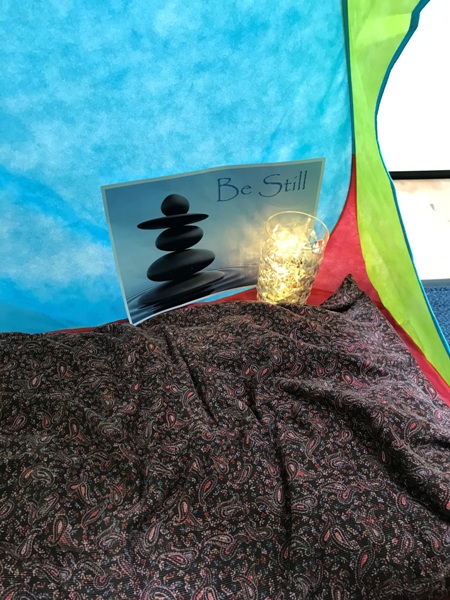
IMG_0419Be Still Pods – Here was a reminder that God calls us to be still from time to time, to help us to learn more about ourselves and God. Simple pop up tents provided a space to do that, each furnished with a cushion, a focus lamp and ‘stillness’ image.

It’s amazing that even Reception class children (aged 4 to 5 years) could manage this brief time of stillness, and what was even more amazing was that the Year 6 children (aged 10 to 11 years), despite our concerns that they would be too tall or to ‘cool’ to give it a go, managed to squeeze themselves into the space willingly.

IMG_0420

Be still and know that I am God

Tardis Prayers – Here was an opportunity to think about the future. With a Tardis weIMG_0421 could travel forward and see ourselves in 10, 20, 40 years time. Some of the smaller children found the concept of forty years a little difficult to imagine, but they all came up with a suggestion of what they might be doing, what type of person they might be, expressing their hopes and dreams.


IMG_0422In amongst the usual ‘celebrity’ footballers, singers and dancers were the more traditional dreams of becoming a teacher, doctor, lawyer or policeman. The more altruistic souls saw themselves as solving world hunger and peace, as well as being kind and caring to those around them.

Certainly there was no limits to their ambitions with perhaps a future President of the United States or Queen of England here amongst us

Time Lord.png

My Time Lord is the Lord of Time

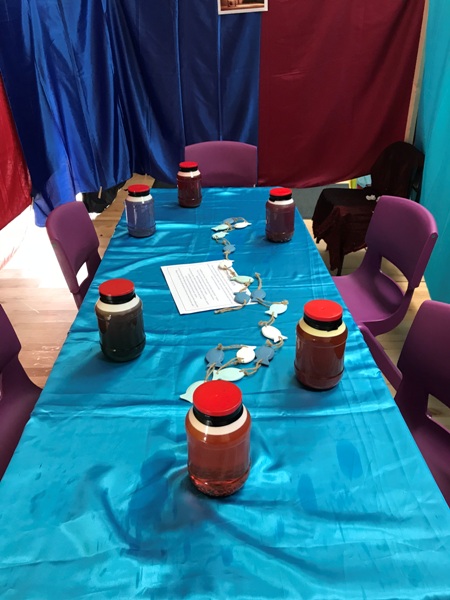
IMG_0423Calm Jars – We all know that life, including school, can be stressful. When we are trying to juggle the demands of people, relationships, expectations and pressures, our minds can feel busy and restless and then we start to worry. A Swedish proverbs puts this into perspective, ‘Worry gives small things a big shadow’. In the Bible, however, God often reminds people to be still, to wait and to stay calm whatever the situation.

By gently shaking the jars and watching the glitter swirl and settle they could think about those things in their lives settling down and becoming calmer.

Stress Less – In a similar vein, the ‘stress less’ activity helped to consider the things that stress us out and how to let them go.

IMG_0427

Brightly coloured aqua beads (or frogs’ spawn as some referred to it) were the perfect medium to allow everyone the sense of worries and stresses literally falling away or through our fingers.

Quoting from Peter’s first letter, ‘Cast all your worries on God, because he cares for you’ (1 Peter 5:7) helped with the concept that our worries may not automatically disappear, but by sharing them it can make them easier to deal with.


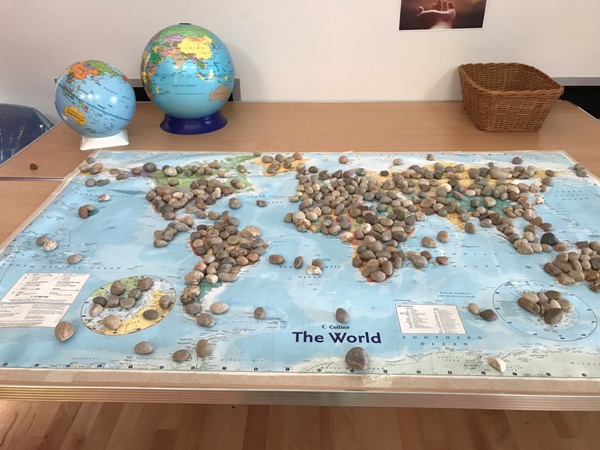
Pray for the World – Our final activity within the prayer space was a chance to think about praying for those people around the world who we were never likely to meet or know anything about, and yet they were undoubtedly just like us.

IMG_0417

Using a simple map of the world we explored the differences between people, such as languages, skin colours, religions and beliefs and cultures, but also the fact that we all had one thing in common – we were all human, and therefore had the same needs – the desire to be safe, cared for and loved.

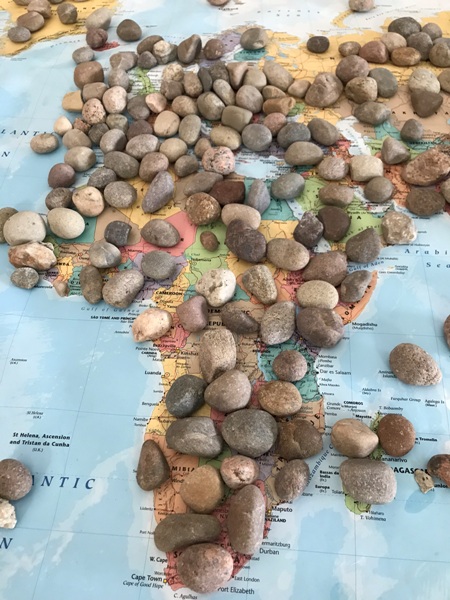
IMG_0418By the end of the week we had managed to cover almost every single country in the world in prayer pebbles, representing the simple prayer we said for the people living there.

If you look closely don’t be concerned that we might not have said a prayer for England – this did have pebbles placed on it, but I kept having to move them slightly so that we could compare the size of our country to others around the world.


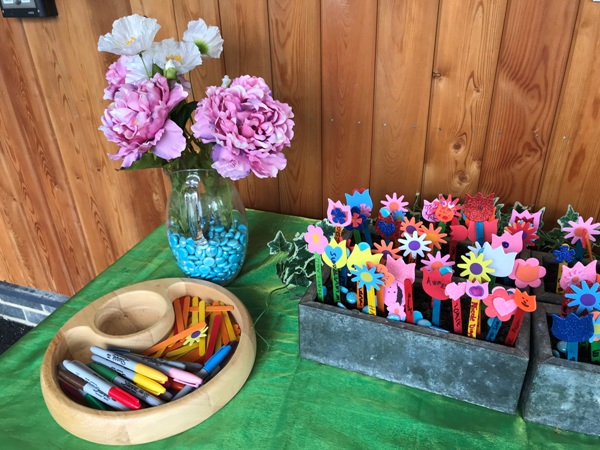
One additional activity was our Peace Flowers, which we invited everyone to come back to after school. Here people were invited to create a flower and on the stem write the name of a place, person or situation that they felt needed peace. As you can see it was very popular

IMG_0431

Altogether a very enjoyable week, with lots of positive feedback from both the participants and the helpers who led the activities. It’s incredible how spiritual young children can be when we give them the opportunity and space to express this – and it doesn’t do the adults any harm either to be able to do so.

If you want to find out more about Prayer Spaces in School you can visit their website or read more about the Research Project they carried out

IMG_0430

Go back

Your message has been sent

Warning
Warning
Warning

Warning.


Salt and Light

You are the salt of the earth... the light of the world

You are the salt of the earth… the light of the world

A fifth Sunday at St James, West End provided the opportunity to come together for evening worship in the style of Taizé. Prayer and silence are at the heart of Taizé worship along with the singing of repeated prayer chants, often highlighting simple phrases from the Psalms or other pieces of scripture, which are designed to help meditation and prayer.

A  candlelit San Damiano Cross, a large Romanesque rood cross, is usually the central focal point and is the cross that St. Francis of Assisi was praying before when he is said to have received the a divine commission to rebuild the Church. St James is lucky enough to have its own copy and was placed in the centre of the chancel steps for our service

Focusing on the San Damiano Cross

Focusing on the San Damiano Cross

What follows is excerpts from the evening service, including a meditation on Salt and Light.

Opening prayer (said together):

God our Father, be with us in our time of worship. When we pray, help us to concentrate our thoughts on you; when we listen to the reading of the Bible, help us to understand it; when we sing your praise help us to sing because we really love you: help us to worship you in spirit and in truth, through Jesus Christ our Lord. Amen.  

Opening Chant:
Confitemini Domino quoniam bonus.
Confitemini Domino. Alleluia!
(Give thanks to the Lord for he is good).

Psalm 27:1-6, 13-14 was read, with a special emphasis on verse 14

Wait for the Lordbe strong, and let your heart take courage; wait for the Lord!

Before the next chant:

Wait for the Lord, his day is near. Wait for the Lord: be strong, take heart!

Our reading Matthew 4:23 – 5:16 then led us into our meditation, that was in two parts. Firstly concerning salt

13 ‘You are the salt of the earth; but if salt has lost its taste, how can its saltiness be restored? It is no longer good for anything, but is thrown out and trampled underfoot.

 ‘You are the salt of the earth!’

Salt, that precious commodity that purifies, preserves and penetrates;
and we are called to be as salt into the world of human society
to purify, preserve, and penetrate that society for the kingdom of God

Who hasn’t felt the tiny flecks of salt on their skin when next to the ocean?
Or maybe you remember the jars packed with salt and green beans at harvest time
to provide a delicious treat in the depths of winter;
or licked your lips and tasted the saltiness after physical exertion?

Silence

Salt – as precious as gold
It paid the Roman soldier his salarium
and indicated your standing in society
as to whether you sat above or below the salt.

Salt – to purify and to heal
A gargle for sore throat, a soother of stings and burns,
a pain reliever for toothache and sore gums
a natural ‘miracle’ medicine

Salt – to preserve and penetrate
Adding flavour and preventing food from spoiling
and saving people from starvation
A symbol of fellowship and the common meal

Yet salt can become contaminated,
often burnt in ovens to increase the heat,
then no longer useful it is thrown out onto the ground
and mixes with the dirt and gets trampled underfoot

Silence

Therefore, God calls us, his precious creation,
to be like salt, to penetrate society
and show in our lives and our dealings with others
how in living differently and seeking purity
that we can bring healing and hope,
both now and for the future through Christ;
and to avoid those things that would contaminate us,
and seek ways of making life liveable, healthy and good

Silence

Taste and see...

Taste and see…

We are also blessed with special receptors on our tongues that can detect saltiness and know when things are good;
so take your pinch of salt, and if you want dip your finger in and taste and see that the Lord is good [small glasses with a pinch of salt had been given out to everyone at the beginning]

Our service continued by singing, as a chant, the chorus from the beautiful anthem ‘Taste and See the Goodness of the Lord’ by James Moore Jr. I am sure we didn’t do it as much justice as the soloist at the Washington National Cathedral*, but it provided a special moment in the midst of our worship.

Taste and see, taste and see the goodness of the Lord.
O taste and see, taste and see the goodness of the Lord, of the Lord.

Then concerning light:

14‘You are the light of the world. A city built on a hill cannot be hidden. 15 No one after lighting a lamp puts it under the bushel basket, but on the lampstand, and it gives light to all in the house. 16 In the same way, let your light shine before others, so that they may see your good works and give glory to your Father in heaven.

‘You are the light of the world’

Light is vital to enable us to see in the darkness
and to help us to avoid stumbling.
Light is also an expression of inner beauty,
truth and the goodness of God.

Who hasn’t stood under the night sky and gazed up at the infinity of space
and seen the pin pricks of light of a million stars?
Or been awakened by the sunlight creeping in through their curtains;
or come home on a winter’s evening to a darkened house and been grateful to flick on the light?

The psalmists tell us that ‘In [God’s] light we see light’ (Psalm 36:9) and that
‘[His] word is a lamp to my feet and a light to my path’ (Psalm 119:105)
Through God’s grace our darkness is illumined and banished
and we are filled with spiritual light, joy and peace.

Silence

Light dispels the darkness and nothing can be hidden;
From others, from ourselves, from God
Everything is known to God, who sees all.
Yet there is great freedom and joy for those
who live in God’s light and who seek his truth.

As believers that light shines in our hearts
and we are called to act as light-bearers of Christ
so that others may see the truth of the gospel
and be set free from those things that blind them

Silence

We should seek to show light and healing in every part of our lives
to every relationship, every activity, every word;
to bring Christ’s light and hope, joy and peace
to those who need it the most;
as well as discovering God’s light shining in unexpected places
revealing his glory.

Silence
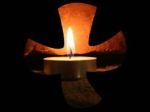
glory of god blogSo let us light our candles and place them at the foot of the cross
to better illuminate that glory.

During the following chant, we were invited light a candle and place it in the bowl of sand at the foot of the Taizé cross.

The Lord is my light, my light and salvation: in God I trust, in God I trust

There followed five minutes of silence, introduced by saying together:
Lord, you are living water, You are light and fire, You are love.
Come, O Holy Spirit! Come, O Holy Spirit

Our service concluded with intercessions and a final chant:

Within our darkest night, you kindle the fire that never dies away, that never dies away. (repeat)

 and a final prayer:

Be with us Lord as we go out into the world. May our lips that have sung your praises always speak the truth; may our ears which have heard your word listen only to what is good, and may our lives as well as our worship be always pleasing in your sight, for the glory of Jesus Christ our Lord. Amen.  

Before we departed, having said the Grace.

There are not many fifth Sundays during the year, so it was nice to be able to be part of something special , something that was beautiful as well as uplifting, exactly what worship should be like.

Salt and light reveal the glory of the Lord

Salt and light revealing the glory of the Lord

*YouTube link to a soloist singing Taste and See The Goodness of the Lord at the Washington National Cathedral © James Moore Jr.  

The Service was put together by David Forster and Linda Galvin using both resources from the Taizé community and original material.

As Our Prayers Rise Before You

As our prayers rise before you

The smoke of the burning incense went up with the prayers of God’s people – Revelation 8:4

Prayer is a powerful tool; it’s a tool that enables us to communicate with God either directly or through the advocacy of Christ, more often than not in the power of the Holy Spirit. If you were to dip your hand into your prayer toolbox you should not be surprised that at different times and in different circumstances you would find a diverse range of tools that you could draw out; yet each one of them would fit your purpose.

Throughout my training I have had opportunities to experience different forms of prayer; from the strict, traditional Prayer Book style to free-flowing extemporary prayer. However, the one constant is the discipline of saying Morning, Evening  and Night Prayer (Compline), although I have to confess that  the first of these has been more faithfully undertaken as against the occasional imperceptible mutterings as I drift off to sleep.

Morning Prayer, like most church liturgy changes with the seasons. There are moments throughout the year when certain phrases cause one to catch your breath or make your heart sing; in fact in Epiphany season I been known to break into song when reading the Jubilate – A Song of Joy; but just about all of them are preceded by an opening prayer that sets the right tone for the day ahead:

The night has passed, and the day lies open before us;
let us pray with one heart and mind.

Silence is kept.

As we rejoice in the gift of this new day,
so may the light of your presence, O God,
set our hearts on fire with love for you;
Amen

prayersrising2 blog

… so may the light of your presence…

Each morning and evening we are also given one or more of the Psalms to read. However, these too are prayers and throughout the Psalms, David and the other writers poured out their hearts to God in prayer, expressing honest feelings of anguish and desperate pleas for protection. They grieved painful confessions of sin, confidently expressed their hope and trust in God, and joyfully lifted praises to God.

In the same way they enable us to give voice to our feelings, whether of despair when we are at a low point in our lives or sheer exuberance at the scope and majesty of creation. They bring us into contact with the ancient people and places of our history – some long-lost civilizations; but they can also speak into current situations.

I suspect that we all have our favourites but for me Psalm 104 ranks high on my list as it sweeps through the beauty of creation; from the heavens spread out like a curtain to the deeps in which the Leviathan play; the springs and brooks that quench the thirst of the wild donkeys to the cypress trees where storks dwell and the conies and wild goats taking refuge on the stony cliffs. How food is brought forth from the earth with wine to gladden hearts, oil to soothe and bread for strength. A true prayer of thanksgiving!

May God hold you in the palm of his hand

Christ, as a light illume and guide me

Sometimes though prayer can be difficult; when we are tempted to ask, ‘Why me?’ So often we seek responses to our prayers in very exact ways, and when they don’t appear to be answered ‘just so’ we may become disillusioned and distrusting. As part of a sermon recently we were asked to look at it in a slightly different way. Instead of asking. ‘Why has this happened to me?’ try removing the ‘Why’. Suddenly it becomes, ‘This has happened to me.’ Now our prayer can be for strength and guidance on how we are going to deal with the situation and thus be able to move forward, even if we need to take it day by day.

Which leads us to the evening of the day, when with that same one heart and mind that we started the day with we ask that the end of the day may be holy, good and peaceful, as our prayers rise before God; before finally, looking for a quiet night and perfect end to our day in a responsory prayer:

In peace we will lie down and sleep:
for you alone, Lord, make us dwell in safety.
Abide with us, Lord Jesus,
for the night is at hand and the day is now past.
As the night watch looks for the morning,
so do we look for you, O Christ.
The Lord bless us and watch over us;
the Lord make his face shine upon us and be gracious to us;
the Lord look kindly on us and give us peace
Amen


Heights & Depths blog

And for those who are still out there seeking, this beautiful prayer is taken from Celtic Daily Prayer, Morning Prayer from the Northumbrian Community:

May the peace of the Lord Christ go with you,
wherever He may send you.
May He guide you through the wilderness,
protect you through the storm.
May He bring you home rejoicing
at the wonder He has shown you.
May He bring you home rejoicing
once again into our doors.

Prayer, as I said at the beginning is as different and individual as we are, and whether our prayers are whispered in the dark or shouted from the rooftops, whether they come in fancy words or stuttering sobs, know that each and every one of them is heard. So never feel that your prayer time is wasted or that you don’t have time to pray. Those few precious moments could make all the difference to your day. Amen

Prayers have been reproduced from Daily Prayer ©The Archbishops’ Council 2005 and Celtic Daily Prayer ©2000, 2005 The Northumbria Community Trust

Go back

Your message has been sent

Warning
Warning
Warning
Warning

Warning.

Prayers for Passiontide

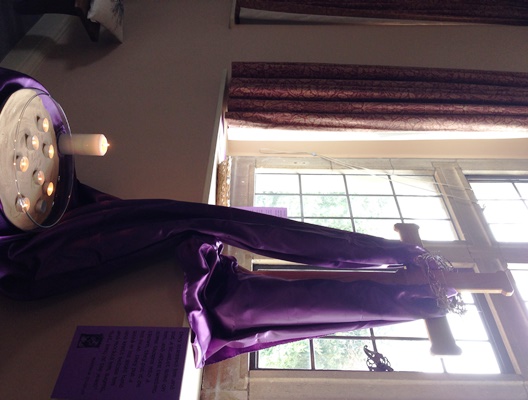
They stripped him and put a scarlet robe on him, and after twisting some thorns into a crown, they put it on his head

They stripped him and put a scarlet robe on him, and after twisting some thorns into a crown, they put it on his head

A weekend away at college brings lots of new insights and learning, and it also gives us time for reflection. In the midst of all the talk about mission and preparing for ministry we entered Holy Week with a day of silence which was to include an area set aside for prayer and contemplation. Several people brought with them some resources to set up separate prayer stations but it is amazing that what might be disjointed individual activities often come together beautifully to make a whole spiritual space. Here are just a few highlights and the ideas behind them.

Making Palm Crosses

They took palm branches and went out to meet him, shouting, “Hosanna!”  “Blessed is he who comes  in the name of the Lord!” John 12:13

They took palm branches and went out to meet him, shouting, “Hosanna!” “Blessed is he who comes in the name of the Lord!” John 12:13

Making palm crosses is not necessarily easy at the best of times but to have to give instructions without speaking  makes it even more interesting. These were used for the Palm Sunday procession later on in the morning

The station reminded us that Jesus knew he was on his way to the cross when he entered Jerusalem on that first Palm Sunday. Many of those who had been with him and who cheered him that day were soon to fall away, unable to follow his instructions.  Matthew 16:24-25 reminds us that if we want to become followers of Jesus that we are required to deny ourselves and to take up our crosses. We were therefore asked to think whether we were willing to do so.

Kneeling at the foot of the Cross

When I survey the wondrous cross

When I survey the wondrous cross

Kneeling down and looking up at the cross is a powerful image. It was an opportunity to lay down all the things that we had got wrong  and for which we asked forgiveness for.

Before the cross as we thought of these things we could write or draw them in the sand. As the prayer told us:

Know that God forgives you…
Forgive yourself

PS Foot of the Cross Sand Blog

Now smooth out the sand… You are forgiven

 Now smooth out the sand…
You are forgiven

The Stones Cry Out

if these were silent,  the very stones  would cry out.” Luke 19:40

if these were silent, the very stones would cry out.” Luke 19:40

The cheering that accompanied Jesus’ arrival in Jerusalem was upsetting the Pharisees and they ordered him to tell his disciples to keep quiet. His response that even if they were silent then the very stones that lined the roadside would cry out

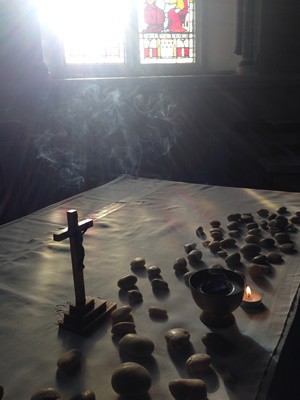
A reminder that we can not keep silent about injustices, and we were invited to think and pray about all those who are suffering at this moment in time and then to place a stone before the cross

The Crown of Thorns

I can do all things through him who strengthens me. Philippians 4:13

I can do all things through him who strengthens me. Philippians 4:13

At the hands of Pilate’s soldiers, Jesus was mocked, spat upon and struck. People of faith often suffer this humiliation at the hands and voices of those who do not understand, who belittle their beliefs and who do so out of hatred; the answer being to respond with love. Jesus predicted that this would happen (Matthew 10:22) but there was reassurance that God would provide the strength necessary to endure this. Lighting a candle was a way of giving thanks for this

I can do all things through him who strengthens me.
Philippians 4:13

 Consider the Lilies

Consider the Lilies - Stanley Spencer

Consider the Lilies – Stanley Spencer

A chance to contemplate one of Stanley Spencer’s beautiful painting that was produced as part of a series entitled Christ in the Wilderness (1939-54). Here we see Christ contemplating not the grand lilies but the humble daisy, whose faces are turned toward the absorbed attention of their creator. The reference is to Matthew 6:25-34 with its reminder of the futility of worrying. (Concept – Jenny Tebboth)

PS consider the lilies + flowers blog

 The Unity Cross and the Tree of Life

PS Unity Cross blog

The Unity Cross

Other things to contemplate were the Unity Cross and the Lindisfarne Scriptorium, Tree of Life. The cross had been especially commissioned  for our opening worship when as individuals we had each taken one of the small piece of coloured glass that were scattered on a table and placed them within the cross to symbolise our unity in Christ. (Concept Jenny Tebboth)

Likewise the drawing of the Tree of Life with Christ at the centre was used as an example of a powerful image for mission in one of the lectures

PS Unity Cross and Tree of Life blog

 Peg Prayers

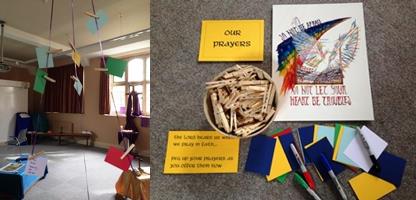
Pegging out our prayers

Pegging out our prayers

Our own prayers were important as well and we pegged them knowing that God has promised to hear our prayers when we pray to him in faith

Other Prayer Activities

PS Prayer Activities

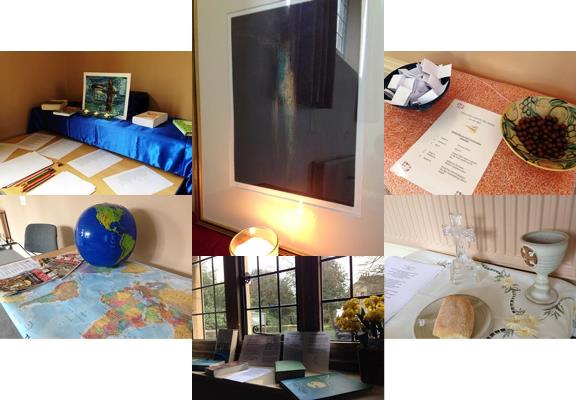
Also included were other prayer activities which included clockwise from top left above:

  • Poetry Corner – a chance to read and write our own poetry
  • Meditating on Christ on the cross
  • Tasting Scriptures
  • ‘Love Bade Me Welcome’ with its imagery of the Eucharist
  • Lectio Divina
  • Praying for the Nations
  • Stations of the Cross (not pictured)
  • The Potter and the Clay based on Jeremiah 18 (not pictured)

All in all a veritable plethora of activities and images to not only provide breathing spaces in a day of quiet contemplation but to help make us more imaginative in our prayer lives for the future

 And whatever you ask in prayer, you will receive, if you have faith.”
Matthew 21:22

Go back

Your message has been sent

Warning
Warning
Warning
Warning

Warning.


Righteous Anger – A Necessary Emotion

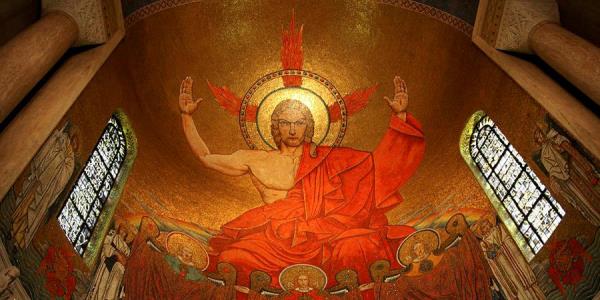
The righteous anger of Jesus, Basilica of the National Shrine of the Immaculate Conception, Washington DC

Mosaic of Christ in Majesty, Basilica of the National Shrine of the Immaculate Conception, Washington DC. Often known as ‘The Angry Jesus’

The third Sunday of Lent sees Jesus clearing the temple in Jerusalem. It is one of the few times that we see him displaying such raw emotion as he angrily removes the ‘thieves‘ from his Father’s ‘house of prayerMatthew 21:13. Often we consider anger as a negative emotion but there are undoubtedly times when it is right to be angry. It is how we use that feeling and who we direct that anger to that can be important.

The sermon I delivered this morning reflect some of the nuances that I had heard in an Oxcept Lecture by Diocesan Canon Angela Tilby entitled ‘Fragile Selves: Shame and Healing in an Age of Envy‘ and an informal talk given by Reverend Joseph John from St John’s Cathedral in Peshawar, Pakistan

May I speak and may you hear through the grace of our Lord; Father, Son and Holy Spirit. Amen

Let’s imagine I am driving down one of the side streets in Hedge End. There is a long row of parked cars on my side of the road, so glancing ahead, as it’s all clear, I pull over onto the other side of the road and start to overtake them. About fifty yards down the road another driver suddenly decides to pull out of their driveway and turn towards me. I can see they are determined to have their right of way. They gesticulate repeatedly that I should reverse back down the road, the whole fifty yards. I in turn glare and gesticulate that it would be easier for them to simply reverse back up their drive, but they are having none of it and start to shout something, which luckily is unheard through the windscreen; and which is also lucky because they can’t hear the words coming from my car either! Eventually, after what seems like several minutes of stalemate, I decide it is easier to simply reverse, and do so rather slowly and erratically as I can feel my heart beating rapidly and tears pricking at the corner of my eyes. The final hand gesture as the other car whooshes past, its driver’s eyes fixed straight ahead, was I feel unnecessary and I have to sit there for a few minutes to regain my composure and let the angry feelings subside.

I knew I’d ‘lost it’, rather like a toddler, kicking and screaming on a supermarket floor, and the whole incident served no real purpose other than to raise my blood pressure and make me feel slightly ashamed. The trouble is that when we ‘lose it’ then our anger, as an emotion, is selfish, destructive, and amoral… However, as Paul tells us in his letter to the Ephesians ‘Be angry but do not sin; do not let the sun go down on your anger’, which tells us that anger in itself is not an emotion we should avoid altogether

Be angry but do not sin; do not let the sun go down on your anger
Ephesians 4:26

This morning we heard of Jesus’ very vivid and public display of anger and it comes as something of a shock… although not as much of a shock as it must have been for the animal traders and money changers. We much prefer to think of Jesus as meek and mild, gentle and loving, but as with all of his actions, his anger had a purpose.

And it wasn’t the first time he had displayed this emotion. In Capernaum, with the Pharisees waiting to accuse him of breaking the Sabbath by healing the man with a withered hand, ‘He looked around at them with anger; deeply grieved at their hardness of hearts’. Even his own disciples came in for a tongue-lashing occasionally. When Peter rebukes him for foretelling his death and resurrection, Jesus then rebukes Peter, ‘Get behind me, Satan! For you are setting your mind not on divine things but on human things’; hardly said with a mild sigh of, ‘Oh Peter, Peter, Peter. Let me explain it one more time’

Get behind me, Satan! For you are setting your mind not on divine things but on human things
Matthew 16:23

When Jesus gets angry he is angry for the right reasons. It is not a selfish anger but focussed on the behaviour and injustice involved. He is not angry about the ‘weaknesses’ of others, but arises out of his concern for their spiritual well-being; they are defiling God’s holiness and in the case of the temple, God’s worship. It does not involve hatred or ill will. He is also fully in control and knew that when he had achieved the desired result of accomplishing God’s will that there was no need to become bitter or to hold grudges

Sometimes we need to become angry about things that are happening around us and in the wider world, at the injustices we see being inflicted on innocent victims, the abuse of children and violence against those who are defenceless, but we need to do so for the same reasons and in the same manner that Jesus has demonstrated. We need to make our voices heard in certain situations where no other voices are speaking up, in other words we need to raise awareness of situations. People are very quick to complain about the church and Christians in general when they ‘poke their noses’ into social situations, but at least it shows we care enough to state an opinion that might upset someone! And we shouldn’t underestimate the effect that holding regular prayer vigils, such the monthly ecumenical world-wide prayers for the Middle East or the annual Women’s World of Prayer can have on bringing issues to a wider audience.

However, should we not be in a position to interact with the public sphere then taking our concerns to God in private can create a safe space in which to express our anger about a situation. As the psalmist points out, ‘With my voice I cry to the Lord; with my voice I make supplication to the Lord. I pour out my complaint before him; I tell my trouble before him’. So there are occasions when we are justified in being angry and there are some things we are justified in being angry about. But what about when we are angry with God? What should we do then?

With my voice I cry to the Lord; with my voice I make supplication to the Lord.
I pour out my complaint before him; I tell my trouble before him
Psalm 142:1-2

Maybe we have to ask ourselves why we are angry with God. We often live our lives believing that life is supposed to be easy and that God should prevent tragedies from happening. When he doesn’t, we get angry with him. Sometimes we forget human involvement, with all its flaws and weaknesses and instead think that God has lost control of his creation and consequently our lives, so we blame God. It’s then that we realise our inability or unwillingness to acknowledge that in fact we are not always in control and that when things happen, it is then we have to trust that God understands the reason and that he will give us his peace and strength to get through any difficult situation. Trusting him in this way is an incredibly hard thing to do… but God is a God of compassion and hope, as well as being full of grace and love.

And God does understand when we get angry through frustration and disappointment. He knows our hearts and he knows how difficult and painful life can be in this world. Perhaps instead of being angry with God, we should pour out our hearts in prayer, and trust that he really is in control and that he already knows how these things fit into his ultimate plan for the world

Recently it was brought home to me how this trusting was more powerful than any acts of anger or retaliation could ever be. The Reverend Joseph John is currently on sabbatical at Cuddesdon College. He is a cathedral vicar at St John’s Cathedral in Peshawar, Pakistan. When Pakistan achieved independence in 1947 a lot of its schools and hospitals were Christian institutions and even after 1956 when it was declared an Islamic Republic, the Christian communities, which now make up only 3% of the population, were successfully integrated as freedom of religion and equal citizenship was guaranteed to all citizens.

However, on the 22nd September 2013 two Taliban suicide bombers killed over 147 of the congregation at All Saints Church, Peshawar; among several of Joseph John’s close relatives. There was a lot to be angry about

Nearly two years later, whilst still seeking justice from the government, the Christians there have a wish is to be recognised and supported as the church that God called them to be. They know that they cannot simply expect God to produce peace, but must pray and work for it. This means listening deeply and trying to understand people who are different and also seeking to resolve differences without conflict and violence. The work that the church undertakes is not exclusively with Christians, in fact 95 percent of those benefitting from their education, development work and health care are Muslims.

They know that it requires courage and humility, and that it often requires sacrifice; but they continue to serve their neighbours, as Joseph John puts it, ‘by washing their wounds’. Their anger has been channelled into seeking justice and continuing to act faithfully because they trust that God is with them in this work and has a plan for all the people of Pakistan, even if they don’t know exactly what it is at this moment in time.

When Jesus speaks of the temple being destroyed and rebuilt in 3 days, those with him are also unable to see the connections to the bigger picture until it is revealed through Christ’s resurrection; then the pieces fell into place. Their knowledge and wisdom is limited to what the human mind tells them is logical. So are we foolish to proclaim Christ crucified, in order to save all who would believe its message? Human wisdom appears weak because it requires proof and concrete knowledge, but God’s wisdom and power dwarfs our understanding and therefore we just have to hand over ourselves to him and trust that eventually that wider vision will be revealed in all its glory. Amen

Concrete things as against those only glimpsed dimly

Concrete things as against those only glimpsed dimly

Trust in the Lord with all your heart;
don’t rely on your own intelligence.
Proverbs 3:5

Go back

Your message has been sent

Warning
Warning
Warning
Warning

Warning.

Running The Race

Run in such a way that you may win the prize

Run in such a way that you may win the prize

Sometimes phrases just seem to get stuck in your head for no apparent reason. Over the last few days it has been a quote from Paul’s first letter to the Corinthians:

Do you not know that in a race all the runners run,
but only one receives the prize?
So run that you may obtain it.
1 Corinthians 9:24

For those whose know me well, they would agree that I have a very competitive streak – I play to win. Whether it is board games or quizzes I will look for strategies that will give me an advantage; but that doesn’t mean I cheat. On the contrary, I’m the one checking the rules to ensure that we are playing the game fairly. I suspect that can make me a bit of a pain to those who simply want to play the game for a bit of fun and even worse when I come up against another person whose aim is to do exactly the same. Self-control can sometimes go out of the window and the sulks can follow it!

The fact is that I was brought up to make sure that whatever I chose to do, it should be given the same amount of care and attention, so that you always do it to the best of your ability. As my father used to say, ‘If a thing’s worth doing, it’s worth doing well

The same should be true of our faith life. Over the last few weeks I have been learning and putting into practice new techniques for Christian meditation. I have been learning to control my breathing so that it falls into rhythm with a prayer mantra – Maranatha, Come Lord Jesus – at the same time trying to lay aside the thoughts that immediately fill your mind and run parallel to the prayer, such as ‘I don’t think I’m doing this right, because I’m thinking about the fact that I’m not doing this right!’. It has got better as I’ve practised more, but the problem is not the technique, it’s the discipline to make sure I do it at least once a day that is the hard part and ultimately the most important.

A person can’t watch the Olympics on television and suddenly get up and run a marathon in record-breaking time – It’s more likely that they’ll break themselves. Athletes require discipline to train their bodies so that they can achieve their personal best. In the same way we have to train our hearts and minds to have the strength and control to stay faithful to our beliefs – whether it’s in prayer, meditation, reading the bible or the way we live our everyday lives according to the rules

Being constant and always striving to do your best is never going to be easy, and there will be days when we just want to collapse in a heap by the side of the road and say ‘I give up,’ but failure is not falling down, but staying down. By keeping the prize in mind and reaching for our goals we can force ourselves to get up and carry on so that we might be the eventual winner of the race we have been set.

Every athlete exercises self-control in all things. They do it to receive a perishable wreath, but we an imperishable. So I do not run aimlessly; I do not box as one beating the air. But I discipline my body and keep it under control, lest after preaching to others I myself should be disqualified.
1 Corinthians 9:25-27

In the meantime, anyone for a game of Monopoly… but be aware I will be going for hotels on Mayfair and Park Lane!

Competitiveness in a box

Competitiveness in a box

Go back

Your message has been sent

Warning
Warning
Warning
Warning

Warning.