Category Archives: Ministry

Death, Dying and Bereavement

Death, Dying and Bereavement

Death, Dying and Bereavement

Not the cheeriest subject for this time of year – or any time of the year really, but a weekend’s training, curtailed somewhat into an intensive one-day session due to an outbreak of Norovirus at college, saw us gathering on a very cold and frosty morning in Diocesan Church House, Oxford to contemplate our own and other’s mortality and our responses, as part of our pastoral training.

Having to face death is part and parcel of being a priest; the initial contact to the bereaved, the nuts and bolts of organising a funeral service and the continuing pastoral support to all those affected are skills that can be taught but that can only be developed, unfortunately, through practice, which is always at the expense of someone’s grief.

We may therefore have expertise, but we will never truly be experts. So, hard as we might wish to, we can never honestly say that we know exactly what someone is going through or what they are feeling, as each person’s experience of the death of a loved one is unique. What we can do is to come alongside the bereaved, not shying away because we fear we’ll get it wrong and make things worse, but offering to listen or just to sit in the silence,

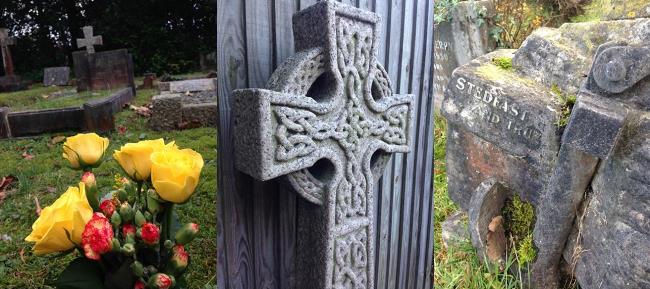
Gravestones blogAnd I heard a loud voice from the throne saying,
‘See, the home of God is among mortals.

He will dwell with them;
they will be his peoples,
and God himself will be with them;
he will wipe every tear from their eyes.
Death will be no more;
mourning and crying and pain will be no more,
for the first things have passed away’
Revelation 21:3-4

Accepting the reality of death for many people can be particularly hard and there are many euphemisms that are used to try to alleviate the finality of human life. Phrases such as the deceased having ‘passed away’ or ‘gone into the darkness’. Believing that they’ve ‘become a star’ or ‘gone to a better place, to be with Jesus or Granny’ etc. are all quite commonplace. Humour also features in sayings such as the cockney rhyming slang ‘brown bread’ for dead or ‘sleeping with the fishes’ with it’s undertones of Mafia involvement. It’s also interesting to discover the origin of some of these phrases; for example ‘kicked the bucket’ actually refers to the grotesque history of lynch mobs standing their victims on upturned buckets, which were then kicked away, or the more practical ‘popped their clogs,’ where the Lancastrian meaning of ‘popped’ equates to ‘pawned,’ so that in order to afford the funeral, the deceased’s family would place their clogs in hock until they could afford to redeem them!

However, death is a reality and needs to be faced, and as Christians we have something that offers a unique reassurance – a hope for the future. When we ‘shuffle off this mortal coil’ – a euphemism courtesy of Shakespeare’s Hamlet – we look to Christ’s promise of eternal life. Just how that will look can differ enormously depending on your theology; but one beautifully imaginative description of what this might be comes at the end of C. S. Lewis’ The Last Battle, a book that is often considered an allegory of the Book of Revelation.

And as He spoke, He no longer looked to them like a lion; but the things that began to happen after that were so great and beautiful that I cannot write them. And for us this is the end of all the stories, and we can most truly say that they all lived happily ever after. But for them it was only the beginning of the real story. All their life in this world and all their adventures in Narnia had only been the cover and the title page: now at last they were beginning Chapter One of the Great Story which no one on earth has read: which goes on for ever: in which every chapter is better than the one before

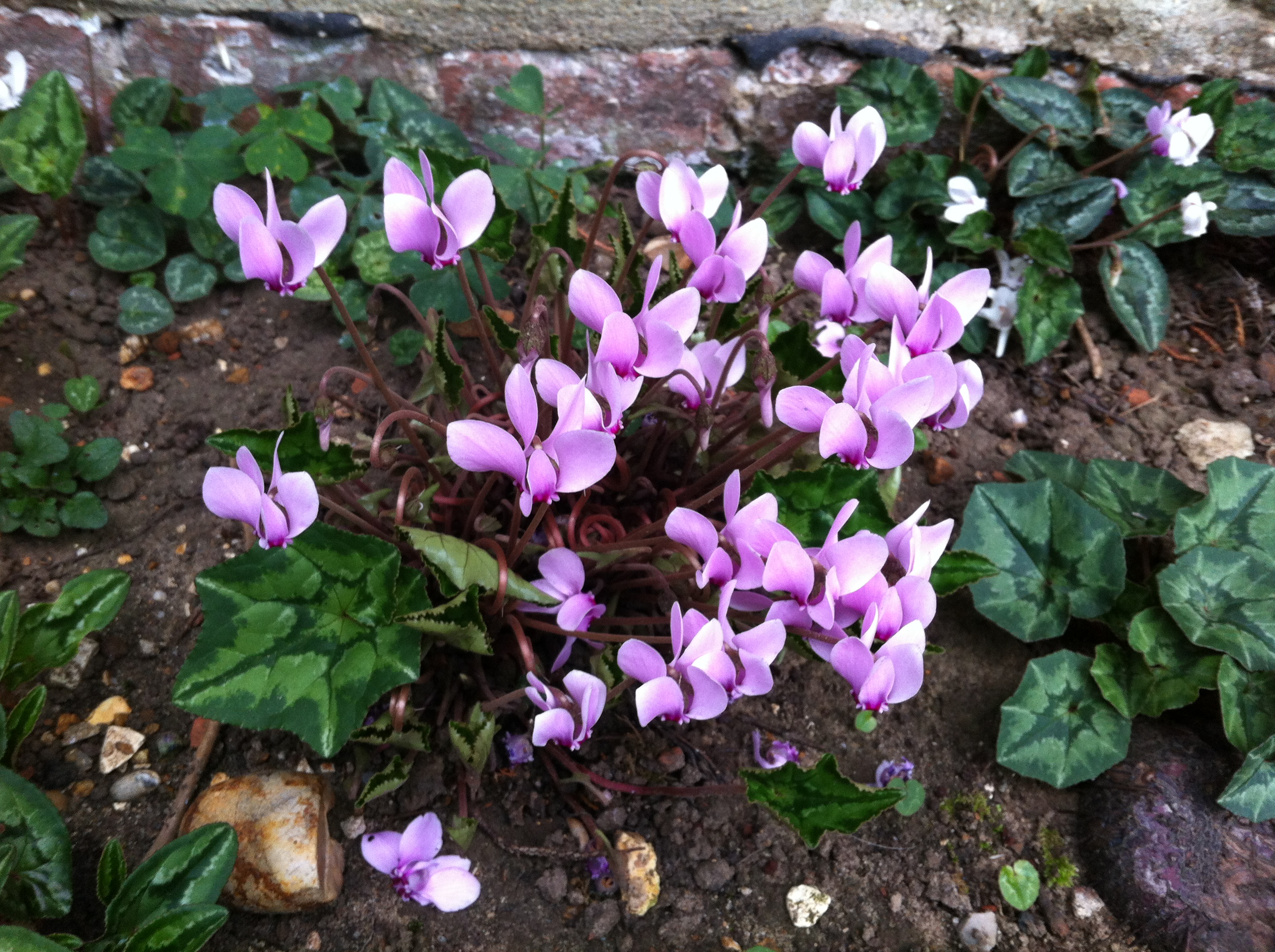
Out of death comes life - tiny cyclamens planted in the graveyard

Out of death comes life – tiny cyclamens in the graveyard

It was also important that we contemplated our own mortality so that we could become aware of our own thoughts and understanding about death because no-one is immune to the physical and emotional aspects of grief. Time spent in reflection enabled us to work through these attitudes in order that we can be better placed in the future to support those who will rely on us doing our ‘job’  both professionally and pastorally.

What is clear in all of this is that when death is not the end of life then death takes on a whole new meaning however it occurs

Death Comes

Death comes out of the shadows,
padding with stealthy footsteps;
like a thief in the night
to steal away life’s breath.

Death comes tumbling on the wind,
choking with gritty determination;
like a sudden desert sandstorm,
to obliterate hope and dreams.

Death comes with iron jaws,
lurking among the undergrowth;
like a hidden gin,
to bind and snare.

Death comes after sentence quashed,
counting the endless days;
like a prisoner of conscience ,
to bring welcome release.

Death comes in the shape of a cross,
sacrificing innocence;
like a lamb led to the slaughter
to redeem and bless humanity.

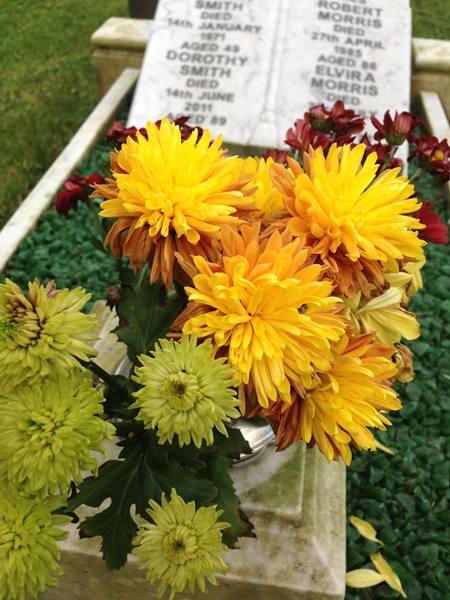
Grave Flowers blog

Go back

Your message has been sent

Warning
Warning
Warning
Warning

Warning.


Let’s Talk About Money

Generous Giving

Generous Giving

I was recently asked to preach a sermon on giving. Not that our giving isn’t already generous in so many ways, but from time to time it’s useful to be reminded not only why we need to give as a response to a generous God, but also how we need to respond to requests to review our level of giving. This topic can be quite a tricky one for lots of churches and so I thought it would be good to share a slightly adapted version. The readings that informed these ideas were Deuteronomy 15:1-11; 2 Corinthians 8:1-3, 9:6-12 and Matthew 6:19-34.

May I speak and may you hear through the grace of our Lord; Father, Son and Holy Spirit

Today, on Bible Sunday, as on any day really, we are asked to think carefully about how important the bible is in helping to bring us closer to and to know God better; about his plans for us and for his world and just what our part in those plans might be, as followers of Christ… and it’s important to remember that ALL of us have a part to play.

The passages above all have a common theme running through them – they speak of the generosity of a God who knows no limit to his blessings for us, and they help us see the response that is expected on our part… to be equally generous in our giving, both of ourselves physically and our prosperity materially. So, I could say that I’m not going to ask you to give serious thought as to what and how you give – but quite honestly that would be as blatant a lie as those telephone calls you get from time to time….

‘Hello madam. How are you today…. now don’t worry, I’m not trying to sell you anything…..’

Now perhaps, like me, you occasionally want to slam the phone down immediately, because you know that that’s exactly what they do want to do, and it’s annoying that they don’t just say straight out what they want from you; so perhaps you will choose to stop reading at this point and click off of the page. But what I am asking you to do… in fact what I’d rather you did, is to carry on and discover some of the reasons, all revealed and supported within the bible, as to how and why each of us needs to be as generous as we are able, and afterwards to spend some time reflecting and praying about your levels of giving and what you might do about that.

We hate talking openly about money, it makes us feel uncomfortable, sometimes we feel a sense of indignation or even guilt but that doesn’t mean that it shouldn’t be talked about. As church members it can seem that the Church is always asking for more… more of our time, more of our money… so that we’re never left in peace. There’s always some job that needs paying for; the parish share to be met, the books to be balanced. So why then should we give?

For where your treasure is, there your heart will be also – Matthew 6:21

If we drive a car we know that we have to pay out to maintain it, if we don’t then eventually the car will stop working and it will be very expensive to repair or replace. If we have a hobby we have to invest a bit of money setting ourselves up with materials and equipment and as we get more proficient at it we may have to spent a bit more on different tools. The buildings in which we sit for church, have been dedicated and sanctified as a place where Christians can gather. If they fell down around our ears we could still gather there, because they’re not just buildings. They also aren’t buildings that should be preserved as pristine museums, so that people can drop in and visit it and say how wonderful it must have been to worship there; so it seems sensible that we try and ensure that we and future generations at least have a roof over our heads.

Therefore, our giving enables worship – whether we are giving of our time on Sunday to be with God, sing his praise, hear his word, share his sacraments, which is the first part of our giving. Or the second part, that our giving of money helps maintain the holy place where we worship, a place of history, a place of beauty, a place of peace and challenge, a place to glorify God.

Our giving of money also helps provide wages and resources for those who minister to us, who lead us in worship, for our music and others who enrich our worship. We need people leading us who are trained and knowledgeable and dedicated to helping us grow in our knowledge of Christ both in word and deed. If we are to sustain and enable that leadership we have to understand that it costs. The early church often paid its leaders in kind – in Matthew’s gospel for example:

Go and preach, ‘The Kingdom of heaven is near!’ … Do not carry any gold, silver, or copper money in your pockets; do not carry a beggar’s bag for the trip or an extra shirt or shoes or a walking stick. Workers should be given what they need – Matthew 10:7, 9-10

Likewise, the medieval church, who asked for donations of bread, wheat, mead and vegetables; although we’ve moved on from that now and use money instead, which is much better because quite frankly I don’t think our ministers or anyone else we have to support could cope with vast quantities of eggs and butter and pots of jam landing on their doorsteps and I’m pretty certain the gas board or the petrol station or the local council wouldn’t understand either when they tried a bit of bartering for their bills.

Our giving enables discipleship – Our giving of time and talent can help children and young people grow in the Christian faith and help those who study together to understand the gospel more fully, so that all can learn how to live faithfully. But it is our giving of money that can help provide resources for this learning, both in our own congregation and throughout our dioceses.

I wonder though how many of us use our own money to provide resources for the church? We think we are being generous… and we are, but we’re actually hiding the true cost of discipleship. We should be coming to the church and our treasurer and saying in order to do this it’s going to cost this, please can you reimburse me. Of course it may be that after having received the money you decide to offer it back as a donation, and you can say that that’s a load of faff, but it’s more valuable that we do realise the true cost. However, we don’t have a bottomless pit of money, but if we all become more aware then we can make sure that we can all contribute to that.

Our giving enables service – our giving of time and talent can assist our congregation in its service to the community, caring for some of those who are most vulnerable in our society. Every single church member can say that they give to the church, in so many different and diverse ways, you serve at his altar, you sing in the choir, you make cups of tea, you comfort the sick, the lonely and the bereaved, you clean, you organise, you lead, you turn up each week; and that’s absolutely wonderful and very sacrificial, but that can’t be treated wholly as a substitute for financial giving

One of the hardest passages in the bible to read is that of the young man who wants to follow Jesus, he knows exactly how he should behave and treat others, he does all those things that we can all do it without dipping our hands into our pockets, but Jesus says it’s not enough, you have to shed your reluctance and reliance on making sure that your nest egg is large enough and instead trust God that he will provide for you.

Therefore do not worry, saying, “What will we eat?” or “What will we drink?” or “What will we wear … your heavenly Father knows that you need all these things. But strive first for the kingdom of God and his righteousness, and all these things will be given to you as well – Matthew 6:31-33

I can almost hear you thinking, ‘Yes, but it would be super if we actually got to use the money that we give, on things that we want to happen and support,’ and it’s true that over the last few years I’ve got tired of thinking that every penny we give is often not quite sufficient to meet the demands of the diocesan Parish Share and has to be topped up by such hard work by the fundraising and social committees.

However, giving to an overarching hierarchy is nothing new either – the early churches were doing it when collecting for the church in Jerusalem, and they appears to do it with a spirit of generosity like the churches in Macedonia; but I believe things will change, particularly in the Winchester Diocese over the next few years, and that hopefully we might be in the more joyful position of deciding exactly what we want to spend our money on with the Parish Share review; which doesn’t mean that we have less to raise but it does mean that we can really get stuck into thinking of way in which the Good news can be brought to more people.

And there’s the nub… Our giving reflects our faith. We could say ‘why can’t the church do less, cut its cloth according to its means, and be content with what we already do, with what we already give’. Well, I suppose that’s one way to go – we could become more inclusive, look after our church; our people, but that would be like ‘storing up for ourselves, ‘treasures on earth, where moth and rust consume and where thieves break in and steal -Matthew 6:20

Surely, we have to realised what the real treasure is – that God has given us life and love, that he has shown us the extent of this love in the life and death of Jesus and that he has promised us new life through Jesus’ resurrection. Right now we can hear the good news of the gospel… and it certainly is good news for ourselves; it’s good news to know that we have personal salvation, it’s such good news that we almost what to hug it and keep it close to us. Yet, if it’s such good news for us why aren’t we bursting to share it with other – the gospel that we proclaim by word and example is a gospel for the world, a gospel for everyone. As Jesus said to his first disciples:

Go therefore and make disciples of all nations, baptizing them in the name of the Father and of the Son and of the Holy Spirit, and teaching them to obey everything that I have commanded you. And remember, I am with you always, to the end of the age – Matthew 28:19-20

I think sometimes we forget that each us of is individually called to proclaim the Gospel, not just a special few, but everyone. So our giving enables mission – our giving of time and talents assists in providing outreach to the community, providing a Christian presence in every part of life, while our giving of money helps to fund projects to bring the gospel to those who have yet to be challenged by it, and enabling the wider Church to comment on the social, moral and political issues of our time.

How more effective it is, when the world takes notice because it sees a group of people who are willing to make generous investment of their time, energy, gifts and money to share and spread the gospel…

The Widow's Mite by James C. Christensen

The Widow’s Mite by James C. Christensen

God calls us to be infinitely generous, like the widow and her mite in Luke’s gospel:

For the others offered their gifts from what they had to spare of their riches; but she, poor as she is, gave all she had to live on – Luke 21:4

That’s a really hard message to hear and live out, but what about making a start by at least considering what we have to spare…maybe we’re still reluctant sometimes to increase our giving because we honestly don’t think we have any money to spare
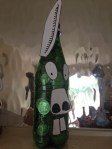
A Hotey Money Box

A Hotey Money Box

I actually surprised myself the other day when I looked at my ‘hotey’ money box. ‘Hotey’ – as in Don Quixote? Yes, I know he’s lost an ear, but it steadfastly refuses to stick back on… We made these at the beginning of Lent. So every time I come back from the shops and have those small coins that make your purse or wallet bulge I pop them in the box, and I also help my husband David prevent himself from wearing holes in his trouser pockets by relieving him of his pocket shrapnel as well…

As you can see it’s pretty full now, and looking at it I think there’s at least £50 in there – just made up of the small amounts of money that was spare and that we haven’t really missed – on average £3 a week … and it doesn’t have to be saved up to be given as a one off gift. Those are great for specific purposes, but it’s much more valuable knowing as a church that you are receiving a regular income, so that you can plan and budget for all the things you want to do and support. That’s not to say that we all have a lot to spare, all of our circumstances are different, but it was interesting to realise that perhaps if we do have some spare capacity to consider what we could do with it. Just imagine if everyone only had a spare 50p a week to increase their regular giving – an average congregation of 70 people could be equally sharing an increase of £1820 per year – a £1 would double that to £3640.

At the beginning, I said that I wanted this to be an opportunity to hear how and why each of us needs to be as generous as we are able, using the bible as our guide. It was not my aim to make anyone feel angry or guilty, but for you to go away prepared to review and reflect, and to then come to a decision, so that the next time you are approached to consider increasing your giving you know what your answer will be. At the end of the day, as Paul said to the Corinthians:

Each of you must give as you have made up your mind, not reluctantly or under compulsion, for God loves a cheerful giver – 2 Corinthians 9:7

Our giving of time, talent and money is a giving for the Gospel… for the Good News, and this fact was brought home to me the other day when I was privileged to be able to look through and choose some books that Sheila and Gordon Rose’s family had passed on to the church; among them were several bibles, and in many of them were personal greetings. One that stood out for me was this one in the front of  a Good News bible.

Gordon had written ‘To Sheila, hoping that it will always be “Good News”’

However on this Bible Sunday, I’m going to let Sheila have the last word, with a prayer that she had written and that was tucked into the front of her bible

A Prayer on Opening My Bible
As I settle for this time of quiet, O God, hush my heart and quicken my understanding.
I bless you for scribes, scholars and translators who have served your holy will.
I bless you for the great Bible Societies that have made this book available in my language.
I pray for a living expectancy, as I wait to learn what you will say to me as I read.
I pray for courage to face new challenges and to embrace new truth
For Christ’s son
Amen

Sermon delivered on Bible Sunday, 26th October 2014

Go back

Your message has been sent

Warning
Warning
Warning
Warning

Warning.

Trip Advisor * * * * * The City Of Rome

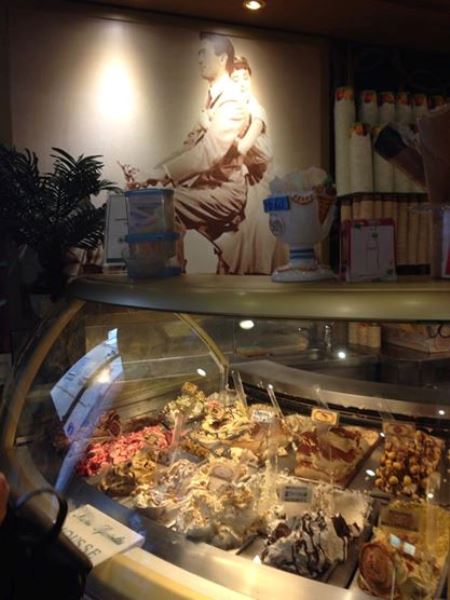
THE Italian Ice Cream shop - Della Palma - Gelato di Roma

THE Italian Ice Cream shop – Della Palma – Gelato di Roma

This final reflection on my visit to Rome provides an overall review of the trip, highlighting some of my thoughts of which I have already written about in the rest of the series and adding new insights

Maybe it’s a wee bit nostalgic to imagine Audrey Hepburn discovering the delights of Rome but nevertheless this Roman Holiday was more of a pilgrimage to discover the origins of the Christian faith in the earthly bound eternal city and which has left a lasting impression of constancy and commitment.

Arriving in the early hours of Tuesday morning, it was left to my imagination what the view might be from the window of my room, as we were welcomed to the Lay Centre at Foyer Unitas; but nothing prepared me for the sheer beauty and sense of antiquity as I looked out to see the Coliseum at the foot of the garden and in the distance the Palatine Hill and other landmarks I’d only read about and yet felt I already knew. Yet, it was watching a small flock of sparrows and wondering if their antecedents had once pecked a living among the Roman temples and busy forums that it really struck home just how incredible this city is in terms of all of our histories.

The View from the Lay Centre at Foyer Unitas

The View from the Lay Centre at Foyer Unitas

Our week was packed with visits to these monuments to a great civilisation, and the grandiose basilicas and mausoleums provided opportunities to understand the importance and power that the Roman Empire wielded across the known world at its height.

Arch of Titus

Arch of Titus

Still, in amongst all of these shows of dominance, the first sparks of the Christian revolution that was to spring into being and eventually triumph, began to reveal themselves. Whether strolling along cobbled streets and entering houses, where the first-century Christians began to meet in secret…

Original Roman Streets at San Gregorio Magno al Celio

Some of the original Roman streets at San Gregorio Magno al Celio

…or circumnavigating the walls of the Coliseum and peering down into the arena space, imagining how it must have felt to be waiting to be brought out to a public spectacle and certain death or hearing about St Peter’s cruel death in the Circus of Nero and seeing where his remains were buried, originally outside the Vatican necropolis. [Supersize Faith] All of these things brought to life those dry, dusty textbooks that we study.

Roman Christianity -The Cross in the Colosseum

Roman Christianity -The Cross in the Coliseum

Perhaps though the most poignant moment came as we gathered below ground and stood together in the building where they believe that St Paul was held whilst he was under house arrest and listened to a reading from his second letter to Timothy, all the while feeling very close to the zealous ‘apostle’ [Within and Without]

From the past to the present, we also had the opportunity to visit and hear about the work of the Comunità di Sant’Egidio [An Example of Cheerful Giving], a group of lay Christians who sacrificially devote some of their spare time to working with many disadvantaged groups within the city. Their ‘soup’ kitchen provides meals for up to a 1000 people each day and care is taken to treat everyone with respect as well as forming ‘familial’ relationships.

The community is also proactive, and its project in setting up and running a restaurant staffed by a unique mix of ‘amico and amica’ – some of whom have learning disabilities – is a great success which is drawing comments from neighbouring establishments who are now beginning to be more inclusive in their own choice of staffing – and the food was delicious too!

Pause for Thought

Pause for Thought

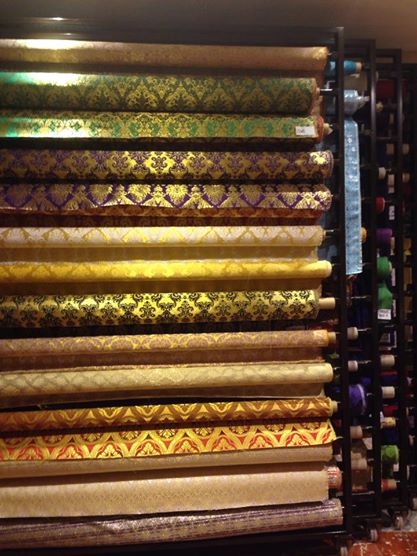
Obviously it wasn’t all about learning – we had plenty of fun too! From surviving the inimitable style of the Rome taxi drivers (would-be extras from ‘The Italian Job’) to browsing along the Via dei Cestari for ecclesiastical ‘tat’ (would that be cardinal red socks or papal purple?).

So much choice!

So much choice!

As well as evenings walking through the busy piazzas soaking up the atmosphere and nightlife. Even the papal audience, which meant several hours sitting under the glaring sun was both interesting (can there be such a thing as a papal groupie?) and at the same time inspirational.

The Pilgrims Gather

The Pilgrims Gather

All in all an incredible week with so much more that I could still tell you about. New sights, new friendships, new understandings. Ciao!

A papal audience with Pope Francis

A papal audience with Pope Francis

Go back

Your message has been sent

Warning
Warning
Warning
Warning

Warning.


Within and Without

St Paul Outside of the Walls

The interior of St Paul Without the Walls, Rome

The third in a series of reflections following a visit to Rome to discover its links with the early Christian church and the church as it is today

I suppose I have a kind of ‘love-hate’ relationship with St Paul… actually hate would be much too strong a word. In my Norfolk ancestor’s parlance, he ‘crazes’ me or even more accurately, he agitates me. Which is actually no bad thing, as it leads me to have to really think about what the reasons were behind what he said and did.

Peter may be predominately remembered within the very centre of the Vatican City State, but it is without the walls of Rome that Paul has his resting place. I wrote in my first reflection about the grandiosity of St Peter’s Basilica, and approaching the Basilica of St Paul Without the Walls after a short train journey, did nothing to dispel my sense that here was yet another ‘cathedral on steroids’, as one member of our group put it.

St Paul Outside of the Walls Exterior

Even so, the majestic colonnaded entrance, over which glowed the breathtakingly beautiful facade, seemed like a peaceful place to sit in that in-between space; with the world rushing by outside and a promise of something extra special to come on the inside. Even the arrival of a couple of noisy excited school groups couldn’t quite  break into the moment; but it was time to move on.

St Paul's martyrdom on the Papal door at St Paul without the Walls

St Paul’s martyrdom on the Papal door at St Paul without the Walls

Entering by the newest papal door, of which there are three, we were reminded that Paul is said to have been martyred by having his head struck off – and this was rather graphically portrayed in one of the door panel. Knelt before a Roman executioner; his hands in chains; the person who through his fragmentary unilateral correspondence has possibly done more to shape our understanding of the Early Church was swiftly silenced – although one could imagine that he was probably still evangelising even as the blade swished through the air.

One night the Lord said to Paul in a vision, ‘Do not be afraid, but speak and do not be silent – Acts 18:9

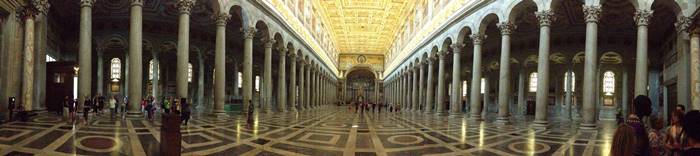
The interior of the church, as the panoramic view above suggests, seemed vast and uncrowded, and yet still conveyed an air of intimacy – although there was some undignified jostling in front of his tomb, where those who knelt in prayer suddenly became aware of cameras by the side of their heads as other desperately tried to ensure they had ‘captured’ the exact record of where his bones lay.

Commercialism was also alive and well, in that for €1 you could light up the apse for a short period of time – enough for all to take advantage of another’s generosity, as evidenced by the rush as the light flicked on to stand as central as you could to it and the flashes and clicks of numerous cameras!

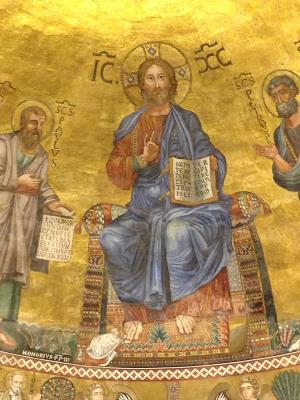
The illuminated painting of the Apse, St Paul Without the Walls

The illuminated painting of the Apse, St Paul Without the Walls

For all its beauty though, it was another place that has become associated with St Paul that had a much more profound effect on me and helped me to reconcile some of my thoughts about Paul’s discipleship.

A simple, now below street level house in the centre of Rome, is said to be the place where Paul was held, in chains, under house arrest. Standing in that bare cell of a room, and listening to Paul speak through the words of what was probably his last recorded letter before his death, the presence of the Holy Spirit was palpable.

Remember Jesus Christ, raised from the dead, a descendant of David—that is my gospel, for which I suffer hardship, even to the point of being chained like a criminal. But the word of God is not chained – 2 Timothy 2:8-9

'The Word of God is not chained'

‘The Word of God is not chained’

Here was a man who at every point following his dramatic conversion, tried to emulate to the nth degree the life of Jesus; a man who held stong views on how the Gospel was to be interpreted; a man, who to our 21st century eyes may appear at times misogynistic, fanatical and arrogant; a man who was not afraid to play the Roman citizen trump card from time to time, and yet through his sheer determination, unwavering belief and absolute trust in the Truth, demonstrated powerfully what it means to live and die for Christ.

I suspect that I will continue to wrestle with my views on St Paul, but meeting him in the places where he dared to follow God’s will for his life can only lead to a greater understanding of his place in God’s mission

For I am the least of the apostles, unfit to be called an apostle, because I persecuted the church of God. But by the grace of God I am what I am, and his grace towards me has not been in vain. On the contrary, I worked harder than any of them—though it was not I, but the grace of God that is with me – 1 Corinthians 15:9-10

The life of St Paul depicted in carved wood panels, Vatican Museum, Rome

The life of St Paul depicted in carved wood panels, Vatican Museum, Rome

Go back

Your message has been sent

Warning
Warning
Warning
Warning

Warning.

Sant’Egidio – An Example of Cheerful Giving

Comunità di Sant'Egidio

Comunità di Sant’Egidio

The second in a series of reflections following a visit to Rome to discover its links with the early Christian church and the church as it is today

Up until a month ago I had never heard of a saint called Egidio, and even when I found out that it was the Italian translation of St Giles I had to look up who he was. Having done so I discovered that Giles was a hermit monk who lived deep in a forest with only a hind [female deer] for company. One day when the king and his retinue came a-hunting, an arrow, intended for the deer, struck and wounded Giles and thereafter he became the patron saint of those who were physically and mentally challenged and as a consequence were often those cast out from society.

It was therefore entirely appropriate when a community of lay Christians chose the church of Sant’Egidio in the Trastevere area of Rome to become a centre for continuous prayer and welcome for the poor and pilgrims. This was back in 1968 and since then the work that the community has done since and is still doing amongst the poor, the homeless, the dispossessed and quite frankly the unloved has been amazing.

Each of you must give as you have made up your mind, not reluctantly
or under compulsion, for God loves a cheerful giver – 2 Corinthians 9:7

 When one thinks of giving it is often in the sense of a monetary capacity – donations to various charities, towards the upkeep of our churches, payrolling the official ministry team – but at Sant’Egidio’s the giving is from the heart, entirely voluntary and selfless. All of the volunteers are lay members of the church, often with full-time paid employment or family commitments who agree to be part of the community as regularly and as often as they can; not simply as an occasional act of philanthropy but as an inclusive life-choice.

Christmas Meal in the church of Sant'Egidio

Christmas Meal in the church of Sant’Egidio

Their main work is in solidarity with the poor and homeless who end up for a multitude of reasons on the streets of Rome,  and who each day are welcomed into the Centre for a meal, use of the washing facilities (both bodies and clothes) and healthcare through the medical centre. The meals themselves are not simply doled out – care and attention is paid to offer a proper substantial meal, with fruits and drinks, presented on cloth-covered tables, proper cutlery and served by the helpers with smiles and respect. At Christmas time this meal turns into a huge banquet served in the church itself with personalised… yes personalised  presents for each and every person there.

‘When you give a luncheon or a dinner, do not invite your friends or your brothers or your relatives or rich neighbours, in case they may invite you in return, and you would be repaid. But when you give a banquet, invite the poor, the crippled, the lame, and the blind. And you will be blessed, because they cannot repay you’ Luke 14:12-14
Prayers are offered each day

Prayers are offered each day

The Community also provides spiritual support to those in need because the heart and the life of the community is in communicating the Gospel both in word and action. Each day prayers are offered at both morning and evening worship. However, it is often spiritual matters of a more practical nature that are of concern. Many of the street people have been abandoned by or lost touch with their families and they are worried about what will happen to them when they die. Here the community steps in to reassure them that even at this moment they can rest assured that as part of the community family they will receive a proper funeral and their memories will be treasured through continuing prayer.

Just some of the Amicos who work in the Sant'Egidio sponsored restaurant

Just some of the Amicos who work in the Sant’Egidio sponsored restaurant

The work of the community doesn’t stop at acting responsively, it is also proactive and its project in setting up and running a restaurant staffed by a unique mix of ‘amico and amica’ – some of whom have learning disabilities – is a great success which is drawing comments from neighbouring establishments who are now beginning to be more inclusive in their own choice of staffing – and the food is delicious too!

Other projects that the community is involved in are working with immigrants, refugees and the Roma people to overcome language barriers where bureaucracy is involved and running ‘Schools of Peace’ for families and children. They are also active in ecumenical dialogue, which is just one of the reasons we were welcomed so warmly during our visit.

All in all I came away from the experience feeling incredibly uplifted by the sheer demonstration of what can be achieved when we choose to live our lives wholly sacrificially –  because joy certainly abounds when Christ is placed at the centre of everything.

The interior of the church of Sant'Egidio, Trastevere, Rome

The interior of the church of Sant’Egidio, Trastevere, Rome

More information about the work of the community can be found here: http://www.santegidio.org/

Go back

Your message has been sent

Warning
Warning
Warning
Warning

Warning.

Roman Reflections – Supersize Faith

The Altar Canopy or Baldacchino, St Peter's Basilica, Rome

The Altar Canopy or Baldacchino, St Peter’s Basilica, Rome

The first of a series of reflections following a visit to Rome to discover its links with the early Christian church and the church as it is today

As an ecumenical advocate it would be hypocritical of me to censure the joy and devotion inspired in fellow Christians and others when visiting holy landmarks. A visit to the Vatican and in particular St Peter’s Basilica in Rome, however, has led me to reflect on how I would wish to express my own idea of reverence and faith.

As humans we are drawn to those places where the people who are part of our history actually walked and talked and left their mark on the landscape. As part of our veneration of their lives we erect memorials so that future generations will know the exact spot where they too might draw closer to these colossi of faith

Yet the hustle and bustle of thousands of pilgrims rushing from one grandiose monument to another without pause to look at what they are actually snapping through their camera lenses; the papal catacombs in which the human remains of the former bishops of Rome repose amidst the splendour of carved marble reliquaries; and being continuously funneled around those holy objects that offer the best ‘selfie’ opportunities, somehow left me cold and wanting to shout ‘Let’s clear the temple!’

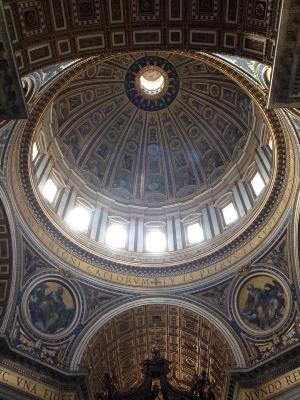
From sky to grave - St Peter's Basilca, Rome

From sky to grave – St Peter’s Basilica, Rome

The Lord is high above all nations and his glory above the heavensPsalm 113:4
Yet, the visit hadn’t started like that. It had actually begun deep underground in the Roman Necropolis directly under the Basilica. Here in the ancient cemetery, originally without the city walls, the brick-built mausoleums, designed to hold the remains of Roman households spoke of reverence. Places where families might occasionally climb up onto the rooves to have a picnic whilst they remembered their departed relatives and loved ones.

Even so, we were still among the glory of the Roman empire, whose prosperity could afford to erect these monuments, whilst the poor and persecuted were buried in pauper’s graves.

Simon Peter was one such as these. After he had met his gruesome death in the Circus of Nero c64AD, his body was laid in the ground and discretely memorialised by the early Christians, many of whom chose to be buried close by. A small ‘trophy’ or physical shrine was erected to mark the grave by the theologian Gaius around the end of the 2nd century and at the beginning of the 4th century the newly converted Emperor Constantine marked the spot with a white marble sarcophagus over which the altar of the basilica was to be built. Now, as then, the open dome of the basilica provides a direct connection from the skies or heavens above, through the baroque grandeur to the simple grave of Christ’s rock and foundation of his church

The dead do not praise the Lord, nor those gone down into silence
Psalm 115:17

I have to admit, that without Pope Pius XI’s desire to be buried as close as was possible to the tomb of St Peter, then these things may have remained undiscovered and maybe they should have. For Simon Peter, the simple fisherman, would surely be turning in his grave, that is if he wasn’t already in heaven, at the way that people have put all their energies into immortalising the saints in stone and precious materials whilst failing to grasp the irony of their riches.

A papal audience with Pope Francis

A papal audience with Pope Francis

Perhaps the latest Bishop of Rome, will continue to lead by example as he sets aside some of this pomp and ceremony and tries to live out his life and ministry close to the people he serves. I do hope and pray so, for all our sakes.

Go back

Your message has been sent

Warning
Warning
Warning
Warning

Warning.


A Life In Books

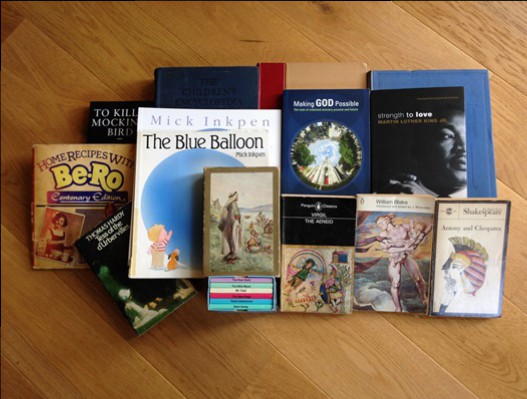
A life in books

A life in books

I was recently asked to list ten book that had had an influence on my life. It’s not as easy as you might think, in fact rather than simply being able to dash off a list each one I chose needed to be balanced against another book, another memory, another situation or point in my life. For each one you discard another three or four could easily take its place.

The final ten are therefore not finite and may not necessarily signify every stage of my life in which a book has featured or even the most important; but they are a representation and compiling the list itself was an exercise in discovering how important literature and reading is in my life and no doubt in many other lives as well.

So here is my list, in no particular order, with a brief explanation as to why it made the final ten.

The Classics

The Classics

Here are the classics, the books I studied at school for my English A Level, but also the ones that I continue to read today

1. Aeneid – Virgil
The legendary epic poem telling the story of Aeneas as he travels from Troy to Rome. It appealed to my sense of adventure and love of history, myths and legends.

2. Selected Poetry of William Blake (and John Keats)
Blake’s poetry and artwork really entered my soul and spoke volumes to me, in particular his Songs of Innocence and Experience, but I had to cheat with the addition of John Keats as his was the first poetry that I wanted to memorise.

3. Anthony and Cleopatra/Macbeth – William Shakespeare
These two Shakespeare plays have become for me just two examples of how words, when beautifully written and composed can be understood by any age. A project to study, create and produce a filmed version of Macbeth using the original language with a bunch of 9 year olds proved that.

Reading as children

Reading as children

First reading books certainly can claim an influence on your life. I could so easily have include the Janet and John books which were my first readers; and the memorable time of being on holiday as a five-year old, sharing the same story with a young fellow vacationer – ‘Look, John, look. See tha’ boats’.

Still it is children’s books that appeal to adults as well that remain timeless.

4. Wind in the Willows – Kenneth Grahame
The world of Mole, Ratty, Badger and the irascible Toad spoke of an idyllic vision of the countryside, punctuated by ill-tempered weasels and the disastrous adventures of an annoying amphibian. This descriptive way of writing was only equalled later by Laurie Lee’s ‘Cider with Rosie’,

5. The Blue Balloon – Mick Inkpen
The well-worn copy of this book is testament to just how loved it was by my children. At two and half, my daughter Lizzie could ‘read’ it from cover to cover; every word perfect, every nuance expressed. It was a sharing book and just one of the reasons that I ordered a new copy so that it may be shared with future generations as well

Love of knowledge

Love of knowledge

6. Encyclopaedias
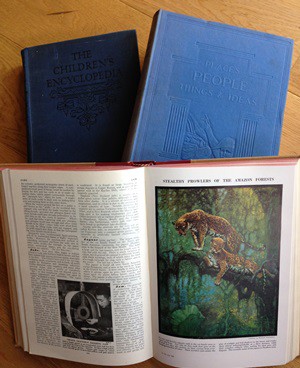
My thirst for knowledge was slaked by the two sets of encyclopedias we owned. One was a series of volumes printed sometime in the early part of the 20th century – the other set from the 50’s. However, both were put to full use, prior to the invention of Encarta and the internet.

Their use nowadays is somewhat limited, but where else could you find Jade, Jam and Jaguars all on the same page!

Strengthening faith

Strengthening faith

My studies have provided me with enough reading material to keep me busy for many a year to come. Whole new bookshelves have had to be created to hold it all, but the basis for it all is found in just one book – The Bible and in particular my 7th choice

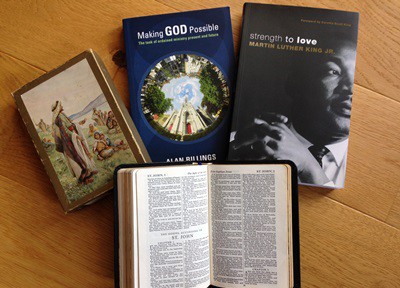
7. The Four Gospels
Matthew, Mark, Luke and John have become essential authors as I follow my vocation, but many years ago they also inspired me to help form my character and outlook on life.

Your word is a lamp to my feet and a light to my path.
Psalm 119:105

8. Making God Possible – Alan Billings
Theology books don’t often make me excited, but it was whilst I was exploring what my vocation might be that I read this book. I suspect is it a bit of specialist, niche book, but it made me want to say – ‘Yes, that’s it, that’s what it’s all about.’

9. The Strength to Love – Martin Luther King Jr
Combine the history and struggle of black, African slaves and 20th century segregation with the teachings of a non-violent pastor and you get insights into a world which I can only imagine and yet have a huge amount of empathy with. These were the subjects of my thoughts about justice and equality as I grew up. MLK’s writings are world-famous, and yet they still speak into so many situations that we still face today

Bero Cookbook blog10. The Be-Ro Cookbook
My final book is actually the 3rd edition of the book I have owned. Despite its dubious sexist cover photos; its dog-eared and bespattered pages tell the story of several decades of cooking favourite recipes. It is also a fact that in spite of those decades, I still need to refer to it each time when making scones for the exact quantities. Why is that I wonder?

So that is the ten that made the list – no mention of Jane Austen, Charles Dickens, Geoffrey Chaucer, Gerard Manley Hopkins, Thomas Hardy, Harper Lee, Homer…..

Just outside the list

Or the many others that fill my bookcase…

Bookcase blog

Why not have a go yourself and see what your list might contain?

Go back

Your message has been sent

Warning
Warning
Warning
Warning

Warning.

On A Midnight Train From Georgia

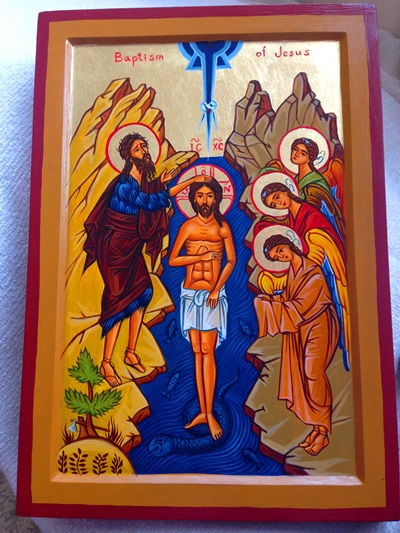
Baptism of Christ Icon - written by Tamara Rigishvili

Baptism of Christ Icon – written by Tamara Rigishvili

To be honest I don’t know if it really was put on the midnight train, or any train for that matter. Maybe it came by plane or postal van, but however it travelled, it arrived safely at my door last week.

The truth though is that it did come from Georgia – Tbilisi, Georgia to be exact – some 2,653 miles to the east of my home, where the very talented artist Tamara Rigishvili lives and works. However, the creation of this beautiful icon came about in what was for me an unusual series of events, which culminated in owning what has become to me a very important representation of the story of Jesus’ baptism.

In April of 2014, I wrote about using this icon to explain the actions performed while making the sign of the cross in Coming Into The Presence of God. Wanting to upload an image of the icon that has been used on that day, I googled several images and came up with one that was taken from Tamara’s website. However, I felt that I needed to get authority to do that, and so I e-mailed her and sought permission, asking her to check out the contents of my blog and with the promise of a link to her site.

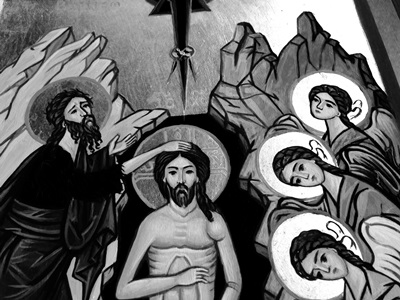
Christ submerged in the water of the Jordan

Christ submerged in the water of the Jordan

Thus a correspondence was begun between two people, thousands of miles apart, who did not know each other, did not necessarily speak the same language (although Tamara’s English is excellent, whilst my schoolgirl Russian is yet to be tested); connected by their common faith, and which resulted in my asking if she would ‘write’ a copy of the icon for me. True to her word, she completed the icon over a three month period and it was then carefully packaged and despatched…

… In the meanwhile, as part of my spiritual direction at college, it was suggested that I meditate on Matthew 3:13-17. This description of Jesus’ baptism is just one of the bible’s explicit passages where the Trinity appear together.

And when Jesus had been baptised, just as he came up from the water, suddenly the heavens were opened to him and he saw the Spirit of God descending like a dove and alighting on him. And a voice from heaven said, ‘This is my Son, the Beloved, with whom I am well pleased.’
Matthew 3:16-17

As a Trinitarian at heart, I have always found that the three-fold nature of God; Father, Son and Holy Spirit has both fascinated and frustrated me. On the one hand each has its own separate identity and characteristics, on the other they are all one and the same. I do not argue against this nor do I find it easy to explain – although traditionally in the Church of England, as a curate it usually falls to their lot to preach on Trinity Sunday each year – so I better get my thoughts in some order by then!

The passage itself presents a beautiful image of being submerged beneath water, and then a figure rising in a sparkling cascade to see the sky above suffused with a pure light that is concentrated in a shaft centred on their head and a clear voice filling the air with a confirmation of their worthiness. What, it was suggested, if that figure were you?

So often we can feel unworthy, and could not imagine such a thing, but we are invited to do so by God as he offers us his love and grace. ‘This is my daughter… this is Linda… this is [insert your name here]’.

I don’t believe that God arranges for these things to come together without a purpose, so as I spend time contemplating that passage alongside my beautiful icon, I hope and pray that you too will accept that grace, knowing that you ARE worthy to receive it.

Matthew 3:13-17

Matthew 3:13-17

For more details of Tamara Rigishvili artwork, please do visit her website

Go back

Your message has been sent

Warning
Warning
Warning
Warning

Warning.

Of Being Challenged

We are challenged to look beyond what we know

We are challenged to look beyond what we think we already know

The last few days have been particularly challenging, both in terms of my personal response to events that have happened and reflections on the responses of others to these situations. On the whole the outcome has been positive and hopeful, but this has been at the expense of other’s sorrow and suffering.

Harrowing pictures of the brutal treatment of Christians and Yazidis as they are persecuted for their faith, left me sobbing for the sheer inhumanity of the perpetrators of these violences. The incomprehension that once again genocide rears its ugly head in the name of religious intolerance and I feel powerless…

Yet, the response of many has been to speak out and simply say ‘It’s not right” and that we will do something about it. Whilst I am not in a position to honestly know whether military intervention is part of a solution; I do know that humanitarian airdrops of food and water were the correct immediate response to alleviate some of the suffering. I also know that the emergency appeals by charities such as Christian Aid for donations enable us all to ‘do’ something towards long-term solutions; and of course there is always prayer.

The outpouring of sorrow for all of the unknown and nameless victims of these atrocities has been matched this week by the sorrow and sadness of the passing of one whom we felt we really did know, the actor Robin Williams. His death has brought to our attention the devastating and often silent suffering of those for whom depression is the ‘black dog’ that they have to live with on a daily basis.

Social media sites and newspapers have been full of messages of condolences and self-identification and some, in their genuine sadness and sense of mourning have inadvertently used phrases and ideologies in their expressions of sympathy, that although well-meaning have highlighted a lack of understanding of suicide and depression. I have personally been humbled to reflect on things that are helpful to say and things that are not, and have learned immensely from those who have challenged these unintentional faux pas.

The fact is that sometimes we all need to challenge what isn’t right, and this Sunday I will be preaching on the story of the Syrophoenician woman who dared to speak out and challenge Jesus because she knew in her heart of hearts that he was the one who could heal her child whether she was Jew or a Gentile, simply because of her faith in him

Then Jesus said to her,“O woman, your faith is great – Matthew 15:28

So I will continue to hold all of these situations in my prayers and whenever possible look for ways to challenge both mine and other people’s assumptions, but hopefully to do so in love.

Have faith that all will be well

Have faith that all will be well

If you are living with depression or care for someone who does you may find this helpful – I Had A Black Dog

Go back

Your message has been sent

Warning
Warning
Warning
Warning

Warning.

Shining Through The Glass


Detail of the Transfiguration Window at St John the Evangelist, Hedge End

Detail of the Transfiguration Window at St John the Evangelist, Hedge End

One of the most beautiful and interesting crafts is that of creating stained glass. Over the years I have visited a great many cathedrals in which this art form has been displayed in the incredible and intricate windows that allow light to enter in a myriad of rainbow hues; but I’ve never really been able to capture with my simple ordinary camera, the extraordinary details and colours that my eyes can discern, of those high and lofty kaleidoscopes.

Even small country churches have their own special windows, and closer to home the church at St John the Evangelist, Hedge End has several, including a series of six tableaux of the life of Christ in the curved apse at its East end. In other windows around the church, these Victorian masterpieces in glass work also tell the stories of the saints whose names are lent to the church building.

St John the Evangelist Window with close up details of the serpent in the chalice

St John the Evangelist with details of the serpent in the chalice

However, as intricate and as detailed as the windows are, it is not really this aspect that fascinates me, but rather the effect they produce as light shines through them; when it falls on white walls and altar linen, the pools of colours shimmering in mirror image

Stained glass reflections

Stained glass reflections

But it is also most effective when everyday objects  such as flower stands,

Flower Shadows blog

Flower shadows

and an aumbry holder…

In the shadow of the aumbry light

In the shadow of the aumbry light

…create ethereal shadows that are wreathed in colour and patches of light.

Even when that light is blocked in some way, what appears to be an ordinary clear glass window reveals its secrets. The imperfections of each pane revealing its own beauty

Imperfections reveal their own beauty

Beauty revealed in imperfection

Perhaps though, the most beautiful example of nature’s own stained glass windows was the one that I glimpsed when I walked in the arboretum at Wolvesey Palace in Winchester the other day…… This then is the light of nature and creation flooding into the church.

Light from nature's stained glass window

Nature’s stained glass window

Still we must be careful not to just allow ourselves to simply bathe in that light, soaking ourselves in its warmth and colour; but instead to remember that before it gets to stream in through those windows into our eyes and hearts, it has already shone on all those outside; where Christ is waiting to for us to join him in helping to build up the kingdom of heaven; and where we can all become living stained glass windows that reflect the rainbow colours of God

A man that looks on glasse,
On it may stay his eye;
Or if he pleaseth, through it passe,
And then the heav’n espie.

The Elixir from The Temple (1633) by George Herbert

Go back

Your message has been sent

Warning
Warning
Warning
Warning

Warning.