Category Archives: Ministry

We Need To Get Out More!

Break Out!

Do not be frightened or dismayed, for the Lord your God is with you wherever you go – Joshua 1:9

Talking to a bright, shiny new ordinand the other day*, I listened as he told me all the wonderful things he’d been up to over the summer break. He’d spent a couple of weeks overseas working with Youth for Christ…. He’d visited his prospective parish and been welcomed during the Sunday services…He’d spent a long weekend at Greenbelt taking part in many worship events and engaging with interesting discussion sessions …. he’d met regularly with his ‘cell’ group and his only regret was that he hadn’t been able to organise a trip to Taizé. Blimey I thought, you’ve managed to pack a lot into your ‘leisure’ time, but I wonder how much time he’d spent just being ‘ordinary’

“If you spend too long in prison you can become institutionalised, and it can be difficult to make that leap of faith over the wall to freedom. This applies to being caught up in church culture too”  Milton Jones ’10 Second Sermons’

Now this wasn’t meant to be a criticism, because dedicating your life to your faith is a noble and sacred thing, but our ministerial and social skills also need to be honed in the ‘real world’ as well. As Christians we can spend a lot of our time being reluctant and occasionally downright scared to talk about our faith with our ‘non-Christian’ friends and acquaintances for fear of being thought obsessive, fanatical and maybe even a little bit weird. We worry that we’ll suddenly become a pariah in the workplace or family.

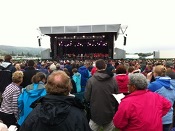
Greenbelt 2013

Greenbelt 2013

So when opportunities come up to join together with like-minded people, we often jump at the chance to spend more and more time in their company. These are the type of people who will understand us, to whom we feel we can speak openly, whom we are sure will make us feel good.

Of course it’s vital that we do get together to learn and equip ourselves.  It’s great to build each other up by sharing knowledge and wisdom, as it helps us become more able to share that with others; people who may be unaware of what makes us tick or who may be beginning to search for meaning in their lives… or asking what is it all about. In addition we also need to engage more with those who appear to have no intention of listening to our ‘news’ however good we present it. We even need to be prepared to engage with outright hostility

The great thing is that all these engagements can often be achieved without the need for words or at least very few words. One of the turning points in my faith journey was the conscious decision to speak openly about my faith to whoever asked. Note the ‘asked’ not ‘I’ll slip the Jesus word in whether it’s appropriate or not’. Not simply to pontificate on the state of their souls,  but  to say that actually  last Sunday I was in church; to talk about the perceived  ‘absurd’  politics of church organisations; to let people know the underlying reasons why I think what I do

‘Preach the Gospel at all times and when necessary use words’ St Francis of Assisi

I’m pretty certain that I’ve never ‘converted’ anybody in my whole life…in fact I wouldn’t want to claim that at all. What I do hope I’ve done along the way is spoken honestly, acted compassionately and served humbly to enable others to catch a glimpse of why I believe what I believe and maybe then explore it for themselves – if not immediately then at some point in their lives.

Spending a lot of time practicing can make us an ‘expert’ in our subject, but it can also make us very one-dimensional. Of course I can choose to participate in lots of extra-curricular activities like roaring from the terraces of Twickenham, rocking at a Coldplay concert or simply going out for meals with ex-work colleagues. However, the simplest thing is to engage in ordinary conversation with whomever I happen to meet – about the weather; what they’re up to at the moment; what’s important to them right now. This exchange of information gives me an insight into other people’s lives and them an insight into mine

As part of bringing about God’s kingdom our task is to come alongside people – that is ALL people – not just that lovely group of fellow Christians who make us feel warm and fuzzy – but the ones who makes us feel prickly and uncomfortable too. Sometimes we just need to get out more!

*To my fellow trainees at Cuddesdon – he is not one of you!

Go back

Your message has been sent

Warning
Warning
Warning
Warning

Warning.

Holy Hogwarts!… An Induction!

/View, Ripon College, Cuddesdon

Window View, Ripon College, Cuddesdon

Saturday, September the 14th 2013 dawned with a glorious sunrise in what would soon become the 34°C shimmering heat of Seville Airport. The evening would find me in a cooler 11°C, singing a beautiful service of Compline.

What happened inbetween involved a plane, a car, a traffic jam, a large group of strangers and a few reams of paper.

This was to be the official start of my training as an Ordinand and it was exciting – despite even the traffic jam!

The Induction Weekend had arrived….

When I consulted the dictionary it actually gave me five senses in which the verb ‘to induct’ could be used [Other dictionaries are available and may give more]. Did they all apply to this rite of passage?

1. To officially give someone a new job or position

I think we all arrived feeling a little aware that we would no longer be the ‘ordinary’ people who worshipped in our local churches, worked in our everyday jobs, were husbands, wives, mums, dads etc.  We were now to be officially know by the title ‘Ordinand’ – each one of us a candidate for ordination. Even so, I still felt quite ordinary because that future occasion, the Ceremony of Induction, when a new Parish Priest is formally presented to their parish was still just a hazy marker somewhere in the distance.

2. To accept people into an exclusive society or group

walls blogLooking around my surroundings there was a perception that here was a place that had produced and nurtured a great many worthy theologians, with its mellow brick walls and quaint passages and stairways. At the same time there was a real sense of modernity and purpose. It may very well be an academic institution but this was to be no vicar sausage factory. ‘Holy Hogwarts‘, as Ripon College, Cuddesdon is affectionately known, demonstrated almost immediately the inclusivity it prides itself on by welcoming such a diverse group of people who will each be individually transformed over the next few years to serve in the Anglican church.

3. To admit as a member; to officially accept someone into a group

Perhaps this was to be the most important part of the induction process. Having arrived late I was unsure how I would fit in – the introductions and icebreaker moments having passed. Plonking down my overnight bag and then being whisked to see one tutor, then straight into a seminar that had already started, I literally only had time to remember to keep breathing! However, the overwhelming friendship shown during our refreshment break and over the rest of the weekend, was enough to make me feel blessed that here were a group of strangers that over our time together would become good companions on the journey

4. To teach someone about something

This is the scary bit! I was never very good at school… either in temperament or academically. I was intelligent, but never really discovered any reason to demonstrate that intelligence in the form of exam results! Now I am about to undertake a Masters Degree in Ministry. The reams of handouts pointed me towards the different modules or topics I could choose. There were options to learn Greek and Hebrew and opportunities for attending additional lectures. I hope that I am mature enough now to apply myself to this form of learning; but I also believe that alongside all I will be learning about ministry, I will also be learning a lot about myself over the next two years. Our formation will come about not only through our capacity to learn but through our ability to be broken open and fulfil the potential God has set aside for us.

5. To produce an electric current by electrostatic or magnetic processes

The Edward King Chapel, Cuddesdon

The Bishop Edward King Chapel, Cuddesdon

This fifth and final sense then is the most exciting! I am saving the interior shots from inside the Bishop Edward King Chapel, a modern architectural miracle, for another blog; suffice to say our Sunday morning Eucharist was electrified by being in such an innovative and uplifting worship space.

Our small congregation, including family and supporters sang and it was as if they had become a multitude. There was a palpable sense of the Holy Spirit moving among us.

The next stage of the journey has begun…..Alleluia!

For more information about the Bishop Edward King Chapel and why it is up for the RIBA Stirling Prize follow this link

Go back

Your message has been sent

Warning
Warning
Warning
Warning

Warning.

God’s Dwelling House

Bread and Wine

Back from my holidays… back from the land of ruby red wines and the paradox of soft crusty bread… back from a country where both of these elements are important not only in everyday life but which permeate those lives in an everyday faith.

Spain has some of the oldest and largest places in which to practice that faith, and one of the highlights of our holiday in Seville was the opportunity to visit some of these amazing buildings, where triumphs of architectural ingenuity sit alongside the brash gaudiness of high altars, reredos and quires.

One of the most interesting we discovered was in Cordoba, and I need to start with a brief history lesson to give an understanding of its significance even today. Now known as the Mezquita, it was  originally the site of the 7th century Visigothic church of St Vincent. The Visigoths were the Spanish branch of the nomadic german Goths,  and ruled in Andalucia until the Moroccan muslims (the Moors) pushed their way up through Gibraltar and began wide scale building projects.

Inside the Mezquita

However, they were sympathetic to Christian places of worship and initially divided the church – merely enlarging the building into a wide and airy worship space and adding a minaret. That was until 600 years later during the ‘Reconquista‘ when King Ferdinand III of Castile reclaimed it for the Catholic church and converted the centre of the mosque into a cathedral and the minaret to a bell tower.

What is particularly interesting to those in favour of creating inter-faith opportunities, is that over the past decade official entreaties have been made by Spanish Muslims to be allowed to pray in the cathedral, but to date these have been declined by the Vatican.

With every great building almost invariably comes a great tower – both an object of practical defence and making sure your neighbours know you’re there, especially if your install a few hundredweight of bells and ring them at every opportunity! I love climbing up towers but for some reason when I’m at the top my brain converts that desire into an ludicrous feeling that despite gravity holding my feet firmly on the ground my whole body will launch itself over the edge… still it never stops me attempting the climb

The towers of Seville Cathedarl, Giraldo Tower and Cadiz

The towers of Seville Cathedral, La Giralda and Cadiz Cathedral

Perhaps the triumph though was to be the visit inside Seville cathedral. Billed as the largest gothic cathedral and third largest church in the world, I had imagined that the highlight would be to sit in front of the high altar or the golden Retablo Mayor. This incredible work of human creativity is indeed the largest in the world, ‘It measures 20 metres high by 18 wide. It tells the life of Christ in 28 intricately carved niches. It has 189 small sculptures. There are four central scenes showing the Nativity, the Assumption of Mary, the Resurrection, and the Ascension of the Lord. The style is Gothic, but the sides are in the Renaissance style. The artists who worked on it include Pyeter Duncart, Jorge Fernandez Aleman, Alejo Fernandez, Roque de Balduque, and Juan Bautista Vazquez’. 

seville altar

The High Altar?

Perhaps you noted the was and the would be – because on this occasion it was hidden behind a rather disappointing 2D photo drape! To be honest though I have always been slightly ambivalent about the extravagance and garish nature of some of these monuments to God. On the one hand feeling impressed by the scale and artistry and on the other aware that God is not contained within a building however majestic it may be. Are these the types of places that God wants us to meet him in?

Biblically, it is true that he did agree that Solomon could build a temple in which he would dwell, having refused to let his father David do so.

Go and tell my servant David, ‘Thus says the Lord: It is not you who will build me a house to dwell in… You will have a son who will rule in peace… His name will be Solomon… He will build a temple for me……When Solomon had finished building the temple of the Lord .. the Lord appeared to him…and said to him: “I have heard the prayer and plea you have made before me; I have consecrated this temple, which you have built, by putting my Name there forever. My eyes and my heart will always be there.

Perhaps then there is something about creating such incredibly awesome buildings in order to demonstrate the glory of God’s majesty, even if it is not and could not be his permanent dwelling place – that space being reserved in our hearts

Seville Cathdral

A small part of Seville Cathdral

The audio guide, therefore, summed it up rather neatly. The architects of Seville cathedral had very clear design specifications, to make it “so grandiose that all those who see it will take us for madmen”. What a glorious way to be a fool for God!

Go back

Your message has been sent

Warning
Warning
Warning
Warning

Warning.

Come to Me, All Who Are Weary

Come to me all who are weary

Come to me all who are weary

Last week as I started to draft out this blog, I was sitting in a small cafe in the middle of the busy market town of Bradford on Avon. Its patrons were a mixture of tourists and locals, all taking the opportunity to grab a bite to eat; a quick coffee. Outside the roads hummed with cars and lorries performing an intricate and continuous dance punctuated by roundabouts and traffic lights. Tucked away in a window bay,  it gave me the chance to spend precious moments just ‘musing’ amidst all the hustle and bustle

Nowadays,  in this all too brief earthly world, it can often appear that everything needs to be planned to the nth degree. People rush headlong into the next thing they think needed doing yesterday, so that the present moment is never savoured and burnout is experienced not only in the gym but equally in everyday living.

So often we take on too much, trying to knit together all our tasks into a beautiful complex pattern only to despair when it all starts to unravel. We long for a breathing space – sometimes we just simply want a chance to breathe. When was  it that it became necessary  to live life at such a breakneck speed that each day blurs into the next?

No doubt we would all end up in chaos if we all decided tomorrow to lay aside our ‘work’ and rush to the nearest beach/mountaintop/woodland to escape it all…. rules and regulations both written and unspoken keep us on track most of the time; still it makes sense that creating regular moments aside is not only sensible and healthy, but essential for our spiritual well-being – so why not make a rule to create a recreation space for ourselves

St Benedict in the sixth century introduced his rules for the monks in his community. Not only were there set times for prayer, work and private study but time was set aside each day for recreation and fellowship. However, if you’re still thinking you’d find it difficult to do something like this daily even taking a few minutes each day to re-centre yourself can be helpful – for me the time spent in morning prayer seems to set me up each day. Take five minutes to start with a moment of quietness and then gradually extend that time a little bit each day. I was also recently reminded that the Jewish faith uses the evening before their Sabbath (Shabbat) to say their prayers so that their minds and bodies can be prepared whilst resting overnight – why not take those five minutes then, to quietly review the the day, giving thanks for all the good things and gaining strength for the day ahead.

Jesus himself knew the benefits of taking time away from his work in prayer and solitude. Whether he ever fully achieved this is uncertain during his ministry years, but at least he attempted to and undoubtedly did cherish that time. Ultimately though his concern was for others ….

‘Come to me, all you who are weary and burdened, and I will give you rest. Take my yoke upon you and learn from me, for I am gentle and humble in heart, and you will find rest for your souls. For my yoke is easy and my burden is light.’ Matthew 11:28-30

…… A welcome invitation. Nevertheless,  for the majority of people the closest thing we get to finding a real space for rest is during an annual holiday – which is exactly what I’ll be doing over the next couple of weeks. This is when we can and should allow ourselves to relax and rediscover our inner self – the self that as children just woke up and made of the day whatever adventure  presented itself to us.

Now where did I put that bucket and spade?

Go back

Your message has been sent

Warning
Warning
Warning
Warning

Warning.

Fun, Faith & Festivals

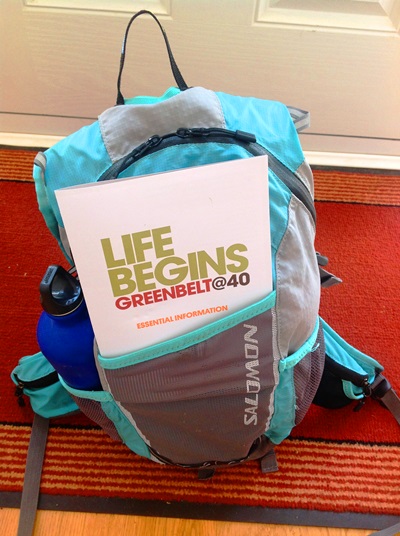
Packed and ready to go!

Packed and ready to go!

Despite being a child of the 60’s [six months as a baby in 1959 doesn’t count]; a teenager growing up around Reading in the 70’s and a fairly liberal-minded, eclectic-music-loving married woman thereafter – there has always been one type of event that seems to have passed me by….the Festival.

Images of the original hippy-love-in Woodstock festival in 1969 caught my attention and the ‘perceived’ debauchery and drug-fuelled excesses of the Reading festival in the seventies seemed tempting but off limits. Even the classical, ‘ever so proper, frightfully good reputation’ of Glyndebourne  wasn’t enough to persuade me to go and sit in a field!

The muddy visions that so often accompanied reports from Glastonbury, looked good fun until you thought about traipsing all that gloop in and out of a tent and the year when my daughter and her friend’s tent almost floated away at Momentum did nothing to modify this opinion

Nowadays though, festivals are de rigueur for everybody from screaming teenagers at T4 on the Beach to classical music’s Proms in the Park – they simply keep popping up everywhere! So when I mentioned to my husband, David, that Greenbelt, a festival that brings people together ‘to explore faith, arts and justice issues‘ was celebrating it’s 40th anniversary this year and that I’d quite like to go, I surprised myself and was even more surprised when he agreed to come along too…. on one condition….. that it didn’t include a sojourn in a tent!

So here we are – festal virgins – all packed and ready to go. Do not let the picture fool you – it may be okay for gap year backpackers to set off with little more than a change of underwear and a song and a prayer but us more mature festival goers need a little extra……. you can’t see them, but the wellies are already packed in the car!

As is my wont, I have scoured the programme and am already looking forward to laughing at Milton Jones’ one liners; getting into the varied rhythms of Amadou & Mariam, the London Community Gospel Choir and Courtney Pine; listening to John Bell just talk and searching out the folk from Hopeweavers. It will also be good to meet up with some old friends that I know are going to be there and maybe meet some new friends. It’s going to be fun!

So I recommend having fun, because there is nothing better for people to do in this world than to eat, drink, and enjoy life. That way they will experience some happiness along with all the hard work God gives them. Ecclesiastes 8:15

And before any earnest, festival aficionados berate us for forgoing the pleasures of the whistling canvas and dewy walks to the lavatories at midnight may I just offer you the hand of hospitality and a warm shower at the Premier Inn should the predicted forecast of rain and storms materialise…

For more information about Greenbelt  go to http://www.greenbelt.org.uk/

Go back

Your message has been sent

Warning
Warning
Warning
Warning

Warning.

Pivotal Moments and the Parable of the Lobster!

Pivotal Moments!

Pivotal Moments!

In life, there are key moments that are scattered along our timelines. Moments that stand out and are remembered as pivotal. Some of them are more general – like birthdays, weddings, the bearing of children… others are personal – times when something has happened that has taken us in a new direction and changed our lives.

Sometimes the change has been welcomed and sometimes it has been scary and uncomfortable. Sometimes we’ve been able to avoid it altogether by simply refusing to acknowledge that there is any need for change. So at church today, at what would be one of those pivotal moments in my life, I thought my talk could revolve around that topic.

All church congregations can become complacent from time to time -or maybe it’s just our particular brand of Anglicanism? We know what is going to happen each week, so we turn up with two or three minutes to spare; find our usual seat; exchange brief pleasantries with the people in the pews in front or behind us; offer a quick arrow prayer that the service will not take too long as we have visitors coming for lunch; settle down to say those well-worn and comfortable words of the liturgy and hope we won’t make it obvious if we go off into a daydream during the sermon…..

I warned them…. I really did! I warned them that some of them weren’t going to like it; some of them would be happy to do it but that some of them would have a little moan about it. However, that they were to moan to me afterwards and not amongst themselves!

I simply asked them to change their positions, to move around and find a different space. Then, when they were sitting comfortably – or uncomfortably as some of them now appeared to be – we did a dramatic reading of one of Jesus’ less well-known parables… the Parable of the Lobster*! Before you start searching for it, you won’t find it in any of the Gospels or even the Apocrypha, but it is a parable nonetheless – a simple story to illustrate a point

The Parable of the Lobster

Narrator: Long ago, when the world was very new – there was a certain lobster who determined that the Creator had made a mistake. So he set up an appointment to discuss the matter.
Lobster: With all due respect, I wish to complain about the way you designed my shell. You see, I just get used to one outer casing, when I’ve got to shed it for another. Very inconvenient and rather a waste of time.
Creator: I see. But do you realise that it is the giving up of one shell that allows you to grow into another?
Lobster: But I like myself just the way I am!
Creator: Your mind’s made up?
Lobster: Indeed!!
Creator: Very well, from now on your shell will not change . . . and you may go about your business just as you are right now.
Lobster: That’s very kind of you. (the Lobster leaves)
Narrator: At first the lobster was very content wearing the same old shell. But as time passed he found that his once light and comfortable shell was becoming quite heavy and tight. After a while, in fact, the shell became so cumbersome that the lobster couldn’t feel anything at all outside himself. As a result, he was constantly bumping into others. Finally it got to the point where he could hardly even breathe. With great effort he lumbered back to his Creator.
Lobster: With all due respect (sighing), contrary to what you promised, my shell has not remained the same. It keeps shrinking.
Creator: Not at all (smiling). Your shell may have gotten a little thicker with age, but it has remained the same size. What happened is that you have changed – inside, beneath your shell. You see, everything changes – continuously. No one remains the same. That’s the way I’ve designed things. And the wisest choice is to shed your old shell as you grow.
Lobster: I see, but you must admit it is occasionally inconvenient and a bit uncomfortable.
Creator: Yes, but remember – all growth carries with it both the possibility of discomfort . . . and the potential for great joy as you discover new parts of yourself. After all, you can’t have one without the other.
Lobster: That’s very sensible.
Creator: If you like, I’ll tell you something more.
Lobster: Please do!
Creator: When you let go of your shell and choose to grow, you build new strength within yourself — and in that strength you’ll find new capacity to love yourself … to love those around you — and to love life itself. That’s my plan for each of you

Afterwards, I commented that before the story I had asked them all to make a change and that I had noted that some of them were very happy to do so and had made quite a radical change, moving far away from where they had been sitting. Others only wanted to make a slight change,  and still others really, really didn’t want to move at all, perhaps being like the lobster at the beginning

The truth is, change, however big or small, is often difficult and uncomfortable, but God calls us to do it many times in our lives. We often try and keep change to a minimum, trying to maintain the status quo, trying to change the circumstances we find ourselves in to fit with what we have planned…maybe weeks, months, years ahead

But what if God were to change those plans? How would you react?

I heard a really good quote the other day by a writer called Bob Goff. He said ‘I used to think I could shape the circumstances around me, but now I know that Jesus uses circumstances to shape me’ Love Does: Discover a Secretly Incredible Life in an Ordinary World

How is he going to shape us so that we can be a blessing in the world, so that we can move out into the world as kinder, gentler people filled with power and filled with strength?

Those plans we made may have to change, but instead of trying to predict how it will affect us far into the future maybe we should think of it simply as what is the next thing that God wants us to do on our journey with him and how are we to do it. Is it to get up and change a particular aspect of your life; is it to go on a walk and spend some time with God; is it to do something radical – to say here I am God?

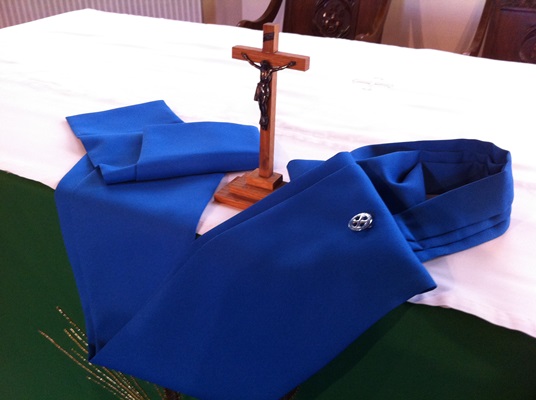
As I mentioned earlier, from a personal point of view, today I am at one of those pivotal moments. At the end of the service I ‘laid down’ my scarf as a Lay Reader in preparation of the move into the new phase of my ministry as an Ordinand. To reach this point there have been many changes in my life – some filled with utter joy and some filled with utter despair.

What I do know is that I haven’t faced it alone because God has met me in the change and has given me a lot of wonderful people to walk alongside me – and most of them were sitting there right in front of me at church.

Change brings a lot of challenges and a lot of blessings – it needs us to be willing to stretch and become more than we already are – but remember that we don’t do it alone. My hope and prayer is that even though change is often difficult and uncomfortable, you’ll welcome it as a tool from God to help you become who he wants you to be. All you have to remember, is that God loves you. Amen

Go back

Your message has been sent

Warning
Warning
Warning
Warning

Warning.

The Bob Goff quote was from Steve Weins blog http://www.stevewiens.com/2013/08/09/what-you-will-need-on-the-road-of-resistance/. Thank you Steve for allowing me to share

*Author unknown – if anyone is aware of the authorship please do let me know

Children Should Be Seen And Not Heard!

Children should be seen and not heard!

Children should be seen and not heard!

A lot of my ministry so far has been with children and young people – whether at home, through the church or through my work with primary schools. So when I was told that I would need to do a 5 minute presentation on a topic of my own choice for BAP (Bishops’ Advisory Panel) I thought that the persistent attitude that some churches have towards children could be a good place to start

Topic chosen – timings……difficult! My original piece came in at 12+ minutes. Editing is easier said than done. How do you cut out words, yet alone sentences, that you’ve spent ages choosing so that they say exactly what you want them to say and still make it have the same impact? Nonetheless, repeated attempts at timings certainly do get the contents into your head, you can work out the parts you stumble at each time, and eventually you get it down to 4 minutes 46 seconds – give or take a second – and you hope with a fair wind and barring a complete meltdown that you’ll get through it.

The piece below is an amalgam of the original and final version just in case you think I delivered this like the actor John Moschitta in the FedEx adverts!

Children Should Be Seen and Not Heard

Children should be seen and not heard… a phrase that was actually coined by a 15th Century clergyman called John Mirks; originally intended to refer to young women, possibly echoing Paul’s exhortation in his first letter to the Corinthians, but now simply meaning young children. It is said to emphasise that you think children should behave well and be quiet. I’m fairly certain however, that this phrase is still very much on the lips of many in our church congregations – those who complain about children talking during the sermon, stares given to parents of fidgety children and God forbid that they should be allowed to run freely up and down the aisle!

Children should be seen and not heard – in fact we’re not too sure that they should even be seen in some cases. Nothing may be explicitly said – although sometimes it is – but this attitude definitely lurks close to the surface. A disingenuous attitude bearing in mind the concern shown about the falling number of children and young people in their congregations, and witnessed by the large number of adverts in the jobs section of the Church Times calling for ministers that will build up ministry to families and young people. The dreadful irony is that the thing that people are asking for may very well turn out not to be what they actually want. They want to see more children; they don’t truthfully want to engage with them.

Somewhat reassuringly, in many churches children’s ministry and youth work are given high priorities and their youth ministry flourishes, but even here this is often done as a separate entity building up the church body but not necessarily building up the body of Christ.

The concern that churches are in decline, particularly where young people are involved is not a new problem. The Church of England’s 2004 report Mission Shaped Church pointed out that ‘We are becoming a nation of non-churched people in terms of Sunday school contact’ – and I use ‘Sunday school’ in its loosest form to represent children’s ministry. The report goes on to say that ‘Even by the end of the First World War, the majority of children were not in Sunday school. Those who were 10 years old in 1950 are now fast approaching retirement, and of them 70% did not attend a Sunday school. That means that the majority of even the elderly are non-churched.’ By the year 2000 figures showed that only 4% of children attended some form of church activity.

Conversely, the church is not attracting 96% of the younger generation. Furthermore, the majority of those who do attend church regularly with their parents, or take part in church workshops, have already decided by the age of 9 to leave, and this is happening not only in the more traditional churches but with evangelical congregations as well; although here the age of decision seems to be higher. The reason for this is that they often feel that they are not engaged by the church, seeing it as yet another form of schooling where they are talked at and not to.

Hence the recognition that young people need to be ‘seen’… because quite frankly if they are not ‘seen’ then for some churches, within as short a period as one generation, there will not be a church for them to be ‘seen’ in.  These congregations are looking for new generations to replace the existing one, members to follow on rather than walk alongside. The trouble is that they want children to be ‘the church of tomorrow’ rather than the church of today.

If we truly believe that God loves everyone without exception and that children can experience God, then churches need to become places where this happens. They don’t need another programme; they need people who are going to make a difference in their lives, who respect their spirituality, allowing them to witness not only in church, but in their own families and beyond. They need to be ‘heard’

How is this to be done? Well neither children nor adults should instruct each other by telling them what to do – it’s never about who can shout loudest or longest to make yourself heard! However, children can still teach adults even without verbal communication. Adults basically need to look at what they ARE – and learn. Look at what they DO – and learn even more

We know from the Bible that God uses children as well as adults to work out his purposes … consider David, Samuel, Josiah – even a young teenage Mary giving birth to Jesus. Moreover, the business of learning from children is one that Jesus himself demonstrated and emphasised.

‘And calling to him a child, he put him in the midst of them, and said, “Truly, I say to you, unless you turn and become like children, you will never enter the kingdom of heaven.Matthew 18:2-3

By doing this he was saying look at the qualities this young person can teach you. He wasn’t asking them to regress to childhood, but to see how the natural humility, honesty, vulnerability and faith of the young are what will ultimately make the difference.

It’s true that churches have been aware of this dilemma and the need to do something significant about it for some time. Programmes like Kidz Klubs and Godly Play were introduced in the late 90’s, and huge investments have been put into youth ministries. Yet the majority of pioneers from these initiatives, now in their 20’s, have left the church in droves and this age group is at an all-time low. Where have they gone? Why are they failing to carry their faith into adulthood?

Recently Messy Church has come to the fore, recognising that if you simply wait for young people and families to step over the threshold on a Sunday morning you could be waiting in vain. Instead it very successfully attracts large numbers of families and young people with no pre-conceived agenda about converting them to ‘bottoms on pews’. Its sponsors, the Bible Reading Fellowship, state on their website that it ‘has deliberately chosen to have a ‘non-controlling’, ‘hands-off’ approach in the way it promotes Messy Church in the hope that this will give God space to grow his church as he wants to, and that it will give everyone encouragement to experiment and innovate’.

If churches are to have children in them, then those children and their parents need to feel welcome just as they are. You need churches where parents feel comfortable; not ashamed or nervous. Worship services where children are free to be … well, children. Even if that means that sometimes they will be loud, will move around, will play and fidget…because that is what children do. Children should not be mini-adults, fulfilling an adult agenda.

It’s about creating experiences to help them to be part of building the Kingdom… because it’s often in the experience that it’s glimpsed – where Kingdom values are not only outwardly expressed but inwardly nurtured as a compass for life.

It’s about providing opportunities for children to be transformed and discipled… where people of all ages gain wisdom from each other; older to younger and younger to older; because you never know the effect that a conversation, an encouraging comment, a ‘get alongside you’ activity will have on the child in a day, a month, a year….. surely every single one of Christ’s disciples needs to be seen AND heard!

P.S. I did manage to remain upright and came in at 4 minutes 54 seconds

Go back

Your message has been sent

Warning
Warning
Warning
Warning

Warning.

What Is This Love?

What is this love?

What is this love?

Please allow me a moment of self-indulgence as we celebrate my daughter and son-in-law’s first wedding anniversary. Lizzie and Lewis were married at St John the Evangelist in Hedge End on Saturday 4th August 2012 and it’s hard to believe that their first year of married life has passed so quickly.

The day itself was such a joyous occasion when we were joined by family and friends to see them blessed not only by God but by all the love that surrounded them

To be sure, marital relationships are not always easy – when the first flush of romance has subsided the hard slog of getting to know each other takes over – finding out what the other likes to eat (*my mother makes the best Yorkshire puddings!); their sleeping habits (your snoring has woken up the neighbour’s baby!); their shopping habits (it’s not the size of your bottom I’m worried about but the hideous colour!); discovering our little foibles (of course I’ve left enough time to get ready!) – but enough about my marriage!

* things to try not to say

What we hope in time within marriage is that our relationship not only with each other but also with God becomes stronger and deeper, because let’s not forget he is part of the relationship as well; and that the love that brought us together will be transformed into a reflection of His love

Happy anniversary Lizzie and Lewis!

What is this love?
a poem written especially for the occasion of their wedding

What is this love?
If not a union when two are joined
in marital estate;
blessed by church and heaven;
strengthened by propitious wishes –
of hope on a journey of discovery

A love springing from the vine,
that sent forth exploratory tendrils
outwards to bind seamlessly –
and then thrusting skyward
in reciprocal ambition,
all the while anchored securely
by the root of Jesse

A love sublime;
honoured by innocence,
yet enflamed by passions
deep within each other;
blossoming like perfect rosebuds –
so tightly curled to unfurl
in velvet beauty; sweetly scented.

It is a love that knows patience
and forbearance,
that acts in kindness,
respectful of each other’s needs –
that forgives completely
and remembers not the cause.

A steadfast love, bound
in mutual trust and respect;
accepting of its own vulnerability
to hurts and wrongs,
yet still spills forth exuberantly
to gladden each heart and
lighten the world it touches

This is a love that seizes the moment
to add memories to life’s album of adventure.
Sharing smiles and tears
which will build a storehouse
of life-enhancing experiences,
guided by the Spirit’s compass

What is this love?
So jubilant in its supremacy,
yet bends its will to another
of great power and gentle nature ;
that bridges time and space
of one love – eternal.

Go back

Your message has been sent

Warning
Warning
Warning
Warning

Warning.

To kvetch or not to kvetch?

Piles of work!

Piles of work!

Maybe it’s just me, but I still get really excited when I come across new words. When I was reading Betsy Kirk’s blog* a few days ago I noticed that she had used the word kvetching. At first I thought it was a typo, but curiosity got the better of me and a quick google came up with a definition and it turns out to be Hebrew slang.

kvetch
1. verb (used without object) – to complain, especially chronically
2. noun – Also, kvetcher, a person who kvetches

The next challenge was to find out if it appeared in any passages in the bible. Again a trawl of bible translations came up with a verse in The Complete Jewish Bible

Do everything without kvetching or arguing– Philippians 2:14

Can’t you just imagine Paul pacing up and down as he dictated his response to the church at Philippi’s moans and groans, pausing to search for that exact work he wanted to use and coming up with kvetching! Trouble is it turns out it has its origins in 1960’s America from the Yiddish word kvteshn.

So biblical Jews did not kvetch – yet their ancestors, the Hebrews, certainly did lots of complaining and chronically so! The books of Exodus, Leviticus, Numbers and Deuteronomy are littered with their gripes – ‘Why have you brought us here to starve when back home we had cucumbers, melons, leeks, onions and garlic… I don’t think much of this flaky bread and there’s no meat in our diets…. (21 days later) What quail again!… I’m thirsty…. let’s go back… we’re all going to die…. etc… etc.’ No wonder Moses retired to his tent a lot – probably with his head under his pillow, mumbling something to Aaron to go and sort them out because he’d had enough!

The fact is it’s really easy to complain about things, it doesn’t take much effort and you get to blame everyone else for what is wrong. Maybe instead of kvetching then we should become kvetchants; there is a difference. Actually I think I just made that word up – try complainants instead. The latter means that some action is taken to rectify the problem.

I can sit and moan about being too hot or I could move into the shade; I can carp on about the fact that there’s nothing good to watch any of the TV channels or I could turn it off and read a book, I can whinge about young people hanging about on the streets or I could volunteer to help out at a youth centre.

Complainants can also act on behalf of other people, to complain about their situations; the lack of facilities for youth in our area, I could get in touch with the local council; the devastating effects of benefit cuts on older people, I could write to my Member of Parliament; the appalling lack of opportunities for every child to have an education,  I could sign a petition to our world leaders.

Returning then to Paul’s reason’s as to why the Philippians shouldn’t be kvetchers:

Do everything without kvetching or arguing, so that you may be innocent and pure as God’s perfect children, who live in a world of corrupt and sinful people. You must shine among them like stars lighting up the sky, as you offer them the message of life. 

As Christian’s we are called to shine as lights in the world – to uncover the dark places and flood them with sunshine and we can’t do that if we sometimes remain sitting in a darkened room waiting for someone to come and open the door and show us the way out, because someone else has obviously forgotten to feed the meter!

No doubt over the next few months there may be many times when I will be tempted to indulge in a bit of kvetching – ‘I’ll never get this essay finished in time…. how am I going to find 500 words to cut out of this presentation…. is theology meant to be this difficult to understand? In which case you have my express permission to gently, but firmly remind me to quit whinging, get on with it and trust that whatever happens, God will be right there in it with me…

*Betsy Kirk’s blog can be found at http://partofthemain.wordpress.com/

Go back

Your message has been sent

Warning
Warning
Warning
Warning

Warning.


Books, books, books

 “I have always imagined that Paradise will be a kind of library.”  ― Jorge Luis Borges


“I have always imagined that Paradise will be a kind of library.”
― Jorge Luis Borges 

I am sat here with a book list in front of me. It’s a fairly long list that was sent to me by the college. Not a list of the books that will be needed for the first term, instead a suggested pre- course reading list.

Of course, as is explained in the accompanying letter, you are not expected to read every single one, but for those of us who may never have undertaken or have been out of formal higher education for a long time it can help to ease us into the way of things to come… On the other hand it’s like a gauntlet has been thrown down!

The thing is I love books – I love the look of them, the feel of them, the smell of them. For me, entering a bookshop like Waterstones* is like letting Augustus Gloop loose in Willie Wonka’s chocolate factory! A well stocked library of books can be a work of art and a chance to scour the shelves can reveal the most unusual titles and topics. Even when a visit to the local bibliothèque is not possible, all I can say is thank goodness for Amazon’s penny booksellers!

There will, of course, be many different sorts of books that will need to be read and studied but one that will stay at the heart of all this literature will be the Bible. We will be required to perform exegesis (drawing the meaning out of a text) and hermeneutics (the science of interpretation) all without a safety net!

One might wonder how we are still trying to understand what the Bible is all about – after all theologians have spent thousands of years talking and arguing about it. This book, or more accurately 66 books in one volume, has led to the exile, to the persecution, even to the political execution of those who have strived to explain what it’s really saying to us

For some the very act of trying to make it available to a wider audience, to allow them to discover its meaning for themselves, has been  a selfless act of courage and determination. In the early 16th  century William Tyndale paid with his life in order to fulfil his mission statement that, “If God spare my life, ere many yeares I wyl cause a boy that driveth the plough to know more of the Scripture, than he doust”, referring to the Pope and clergy of his time, many of whom were probably not even skilled enough to read their own Latin bibles,  and which set him on translating the Bible into English and thus allowing ordinary men and women to be able to ask, ‘What does that mean?”

There are now over 50 different English translations of the bible and a quick count around the house reveals that I have a least a dozen of them. So we now have a choice of reading God’s word in a way that is in tune with our own ‘linguistic ear’

Hopefully, most people will hear or read a least a passage of the bible each day, whether in formal worship or daily devotions. If not there is always a chance to do so during the weekly church service. In the Church of England the lectionary runs on a three year cycle which is intended to cover a very large proportion of the bible, although not all as some people believe

What amazes me, as someone who has to prepare talks or sermons, is that after a few years you find the passages repeating themselves and there is always some concern that you won’t find anything different to say about them. What you actually find happening is that the passage can speak to you afresh and become appropriate to the present circumstances of both yourself and your congregations.

Perhaps then there is plenty more time and reason for us to continue studying God’s word. So if you see me with my nose in a book this summer it probably won’t be the latest Robert Galbraith novel but something much more thrilling!

*Other bookshops are available

Go back

Your message has been sent

Warning
Warning
Warning
Warning

Warning.