Tag Archives: Jesus

Watching and Waiting

Signs of Advent

Signs of Advent

At this time of year, in the lead up to the Christmas celebrations, we spend a great deal of time watching and waiting. What is it though that we are watching and waiting for? Is it for the first sign that Christmas is coming? In that case our watching should have started in September, when the first packs of mince pies appeared in the shops! Maybe the earliest sign that we’re watching for is when, what has become an iconic Coca Cola advert, ‘Holidays are coming, holidays are coming….‘ appears on our television, as the twinkling lorry wends it’s merry way to bring cheer and healthy profits for its stockholders – perhaps the waiting is over when we’ve seen that?

On the other hand we might be watching our credit card groaning under the increase in spending as we are tempted to celebrate the season by purchasing an excessive amount of presents to show our friends and relatives just how much we really love them…… Maybe though, we won’t be waiting for the bill to flop onto our doormat and realise that it will probably take a whole year, if not more to make the repayments – if only we hadn’t bought that one extra present that got put in the cupboard last year and might just do as a raffle prize next time someone asks for one!

Indulging in luxuries, wine, and rich food will never make you wealthy
Proverbs 21:7

What is it we are watching and waiting for? Are we watching our weight as the pounds pile on as we tuck into several Christmas party dinners and surreptitiously open the big box of chocolates that we were saving for Christmas – we can always get a replacement before the day. Or are we waiting for the sales that will start on Boxing Day, so that we can go and hunt out all those bargains… the credit card should just last till then… or maybe we could return that ‘delightful’ jumper that Auntie May bought us, then we can buy what we really want!!

Am I being a bit cynical, a bit ‘bah humbug’. I probably am, but I’m certainly not being holier than thou, because at some point or other I have done all of those things – except for returning the jumper Auntie May! For many people the real joy of Christmas will be doing all or some of these things – and there is love and joy and happiness in coming together, sharing, and giving and receiving gifts. For many of us though there will be a little bit of sadness that people won’t watch and wait for something considerably more important and certainly longer lasting than the use by date on the egg nog.

At church we have started a new year, with the season of Advent, The word Advent is an anglicised version of the Latin word adventus – meaning ‘coming’ – what then or who is coming? Well Christmas is coming (regardless of whether the geese are any fatter) and we will spend these next few weeks preparing to celebrate the coming of Jesus to earth over 2000 years ago. But we’re not really watching and waiting for his birth – that’s already happened; and his resurrection means that we will not really be watching and waiting for his coming among us, because he’s already here in the gift of the Holy Spirit.

What the watching and waiting will involve is a retelling of the ancient stories of a long awaited Messiah, through the visions of the prophets, the blessing of Mary who carried the Christ-child in her womb and the messengers, like John the Baptist, who prepared the way for Jesus’ earthly mission. Perhaps more importantly we will once again be watching and waiting expectantly in preparation for Jesus’ Second Coming, as we put aside some of the excitement and spend some time being penitent and a little more thoughtful.

“So you, too, must keep watch! For you do not know the day or hour of my return”
Matthew 25:13

In the meantime, we can also spend time doing some more watching and waiting…. Watching and waiting for opportunities, whether it’s time or money, to bring to all those around us, who for one reason or another may not have the same chances or opportunities to join in our celebrations, a feeling of hope for the future; and to show once again that Jesus really is the reason for the season!

May God bless us all this Advent

Watching and Waiting

Watching and Waiting

← Back

Thank you for your response. ✨

A Bible Is For Life, Not Just For Sundays?

Read the bible in whatever way possible

Read the bible in whatever way possible

At church recently we took the opportunity to think about the place that God’s word, in the form of the bible, takes in our worship and daily lives. Appropriately, it was on Bible Sunday*

It would be silly to ask you to put your hands up or answer out loud, but I’d like you to think what your answers might be to these questions…

I read the bible……

I read the bible every day……

I read the bible every day and then reflect on what I have read…

I read the bible every day and then reflect on what on what I have read and then try to apply it to my life…

The questions are not intended to be accusatory …. that you really should choose the last one in order to be deemed ‘saintly’. The most important thing is whether you actually read the bible!

At college we may not be required to bring our bibles to each lesson or lecture, where we talk about theology, liturgy and formation, but what has become obvious is just how vital Holy Scripture is to our faith. I don’t mean learning huge chunks of it off by heart or being able to recite whole gospels from memory, although it would be handy knowing exactly who said what, where and when sometimes… No, I mean looking to the bible to provide some guidance and answers to the many questions we have, not only about our faith, but about life in general. In the Book, or books to be more precise, lie all those answers. The problem so often is how we understand or interpret them – whether we accept them as instructions or guidance only.

Some people like to look up passages which have been selected as being particularly helpful for the different emotions we may be experiencing. When we’re worried, it might be calming to read, “Therefore I tell you, do not be anxious about your life” or when facing bereavement to be comforted by “Blessed are those who mourn, for they shall be comforted”, both from Matthew’s gospel or when showing gratitude and thanksgiving to proclaim from the psalms “Let us come before him with thanksgiving.”

Even here though we have to be careful that this is not the only way we experience and use God’s word. There is always the danger that these become our preferred readings, to the exclusion of other, perhaps more difficult passages… and are they simply sentences in isolation whereas the whole verse or chapter may actually have more to tell us?

We also have to be aware of bias. So often nowadays we hear people asserting that their stand on different issues is fully justified because of specific passages in the bible. They trot out verse after verse of carefully selected scripture and vehemently declare this is the truth of the matter because it’s written in the bible and that the bible is the Word of God and you don’t argue with God!

All the while they either consciously or unconsciously blatantly ignore other scripture that might contradict their point of view… just think back to how the ordination of women was debated in the Church or how homosexuality is viewed in general. Surely these contradictory passages too are written in the bible and inarguably the Word of God?

What is does show is that it certainly isn’t easy. This book is not really a teaching manual – but it still does contain all the answers. Whenever we think or talk about God we are allowed to do so using all of our previous knowledge and information, but very much aware of the context in which we do so. What have been our examples, our own life experiences? What have we absorbed though our families, our education, our culture? All of these will give us a unique and corporate vision of what God is about, how he moves in our lives and how he moves us to be in his world. Yet we can’t truly be so individualistic without referring it back to and centring on the Scriptures.

Some people might nowadays treat as laughable the simplistic motto from the 80’s and 90’s of WWJD – What Would Jesus Do, but the basic premise makes perfect sense. When we find ourselves in situations where we have to make decisions it might not be a bad thing to simply ask… if I am trying to be more Christlike in my attitude and behaviour then I really need to understand what examples Jesus has given us… and where do I find that out… in the pages of the Bible.

Whether we’re reading about what Jesus was doing or where he was pointing us to what God was doing through him, fulfilling the prophecies; embodying the word that had gone forth or bringing us hope for the future, if we want to get the truest picture, not just some intellectual theologian’s take on it or an experienced commentator’s exegesis or the humble preacher’s attempt at exposition, then we have to go back to the source.

All those other things are subjective and come with lots of layers of opinion and interpretation. Not that I am saying that any or all of them are incorrect, but we need to peel back those layers and expose the heart of the matter, whether you believe it is the word of God to inspire or the inspired word of  God.  “For whatever was written in former days was written for our instruction, so that by steadfastness and by the encouragement of the scriptures we might have hope.Romans 15:4

'Go back to the source'

‘Go back to the source’

My original question emphasised the fact that the bible is a book that needs to be read. We need to make sure it’s not sitting as a pristine but dusty tome in our bookcases, but that it’s placed where it can naturally come to hand. Why not see it as your bedside table book, full of ripping yarns and adventures. Or put it with your dog-eared and food-specked cook books – using it to create delicious recipes for life or maybe in the glove compartment of your car – a combined road atlas and ‘Haynes’ manual to keep you going straight on the journey?

Wherever you keep it don’t forget that unlike a library book there’s no restriction on who could borrow it, it doesn’t have a return by date and each and every copy, whether it’s an original or translation will only ever be a first edition. Happy reading!

← Back

Thank you for your response. ✨

*Bible Sunday was celebrated on Sunday 23rd October 2013. It is an annual part of the Church of England’s calendar and resources each year are produced by the Bible Society. Follow this link for more information http://www.biblesociety.org.uk/about-bible-society/our-work/bible-sunday/

It’s All Greek To Me!

It's All Greek To Me

It’s All Greek To Me

So apart from introducing the world to democracy, realising that the earth was round and working out some very difficult mathematical calculations… what have the Greeks ever done for us? Well one thing that they’ve done is give me a headache! What shame they didn’t invent analgesics (although they did give us its name from the Greek words ‘without+pain’

Languages can be fascinating – discovering that our everyday words have their origins in Latin, French or Anglo-Saxon with a smattering of Viking thrown in for good measure. The roots of words give us a hint of what they might mean in hundreds of languages

Most modern languages use the classical Latin or Roman alphabet with its 26 letters. So what happens when the letters themselves are unrecognisable? Now I’m not so naive to forget that there are a great many other languages that use scripts and hieroglyphics to enable billions of people to happily produce both beautiful and outstanding literature

This is what the Lord, the God of Israel, says: “Write in a book all the words I have spoken to you” Jeremiah 30:2

It’s possible that Jesus would have spoken and understood Aramaic and read Hebrew scripts – if not understanding a smattering of Latin and Greek. However, it is the Greek that is of interest to me as we undertake a Greek-lite course at college

First there is the basic alphabet with only 24 letters (25 if you double up on the ‘s’ sound). At first it lulls you into a sense of security as you recognise letters that seem familiar…. then you find out out that they say something different! A capital H (eta) says ‘ay’ and P (rho) becomes an R sound. Then there are the impressive squiggles that send your pen backwards and forwards in unnatural directions –

The Greek Letter xi

The Greek Letter xi

I do get the point that some words are masculine and some are feminine… and that just like French there’s no rhyme or reason as to which should be which – but then there’s also 2nd Masculine Declensions and definitive articles….and this is only in the 3rd lesson!

So why subject myself to such apparent torture? Well you have to remember that the Greek speaking world was a hotbed of philosophy and classical thinking and when St Paul chose to take his message to the Gentiles it was into this world that he made such inroads in spreading the Gospel – to the people’s of Corinth, Phillippi and Thessalonica amongst others; and Luke’s Gospel and Acts were almost certainly written with a Greek audience in mind

How wonderful then to make at least a small attempt to read some of the bible in an original language….. And the passage we are starting with – what else but John 1:1

John 1:1

John 1:1

← Back

Thank you for your response. ✨

Sacred Space

Bishop Edward King Chapel, Cuddesdon

Bishop Edward King Chapel, Cuddesdon

In my experience, there are often places that you come across that give you an inexplicable sense of holiness. Whether it is on a wind-swept hermit’s island off of Lindisfarne or a grandiose cathedral with its intricate arches and gilded altars. These are places that faithful people over many years have gathered and worshipped in. These are sacred spaces.

Often these places resonate with something deep within our souls. The Celtic people would have identified them as ‘thin places’ – where you could imagine the thinnest of veils between heaven and earth. Where connections could be felt most keenly between God and his people

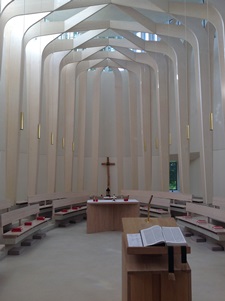
During my recent ‘Worship Weekend’ at Cuddesdon, when we learnt amongst other things about worship, liturgy and church paraphernalia, our worship itself was held in the Bishop Edward King Chapel. This building is new. Its footfall so far light in numbers, its interior still pristine and its audacious appearance still startling on entry. Yet it feels immediately like a sacred place

The Chapel Interior, BEK Chapel,Cuddesdon

The Chapel Interior

The architect of this incredible building, Niall McLaughlin, talks about creating something from an image of a buoyant, tethered boat, with its elliptical shape resembling the nave of a boat with “Jesus asleep resting on a cushion in the prow… and the community gathering within mirroring the expectant disciples’ or of ‘ people collecting together around a hollow in ground [there is a natural hollow on the site of the chapel] ‘This hollow would represent the still place of origin. The tethered boat above would float above it, pulling up as if at sea…. you are drawn upwards yet your feet pull down to ground you. It is this dual motion of cleaving to the earth and being lifted that we want the building to communicate.”

Exterior View of the Chapel

Exterior View of the Chapel

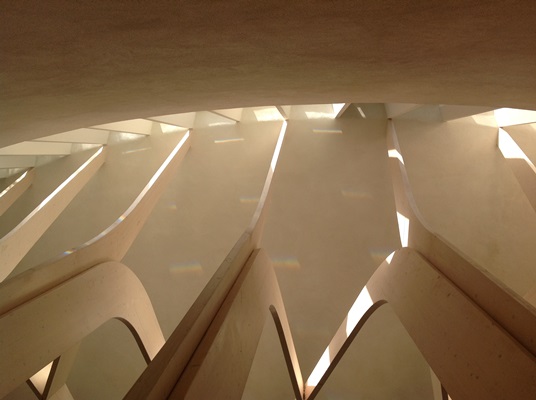
And communicate it did… celebrating Communion, as rainbow patterns chase each other across the nave floor and flickering sunlight bounces off the walls, as the trees that surround the chapel move in rhythm of hymns and breeze, leaves you feeling that God is not only filling this space with his presence, but that the space the building occupies has become part of his creation

The Natural Lights of the Chapel

The Natural Lights of the Chapel

“As the priests were leaving the Temple, it was suddenly filled with a cloud shining with the dazzling light of the Lord’s presence” 2 Chronicles 5:13-14

Hopefully, the pictures give you some sense of the college and architect’s vision, but if you do every get a chance to visit maybe you will discover it for yourself

God cannot be contained in one place….. but containers can be a place to meet him!

The Chapel's Soaring Beams

The Chapel’s Soaring Beams

← Back

Thank you for your response. ✨

Follow this link to find out more about the Bishop Edward King Chapel and the vision behind it http://www.rcc.ac.uk/downloads/Edward%20King%20Chapel%20Description.pdf

A Place to Study!

Cuddesdon Library

Cuddesdon Library

‘But as for you, continue in what you have learned and have become convinced of, because you know those from whom you learned it, and how from infancy you have known the Holy Scriptures, which are able to make you wise for salvation through faith in Christ Jesus.  All Scripture is God-breathed and is useful for teaching, rebuking, correcting and training in righteousness, so that the servant of God may be thoroughly equipped for every good work.’ 2Timothy 3:14-17

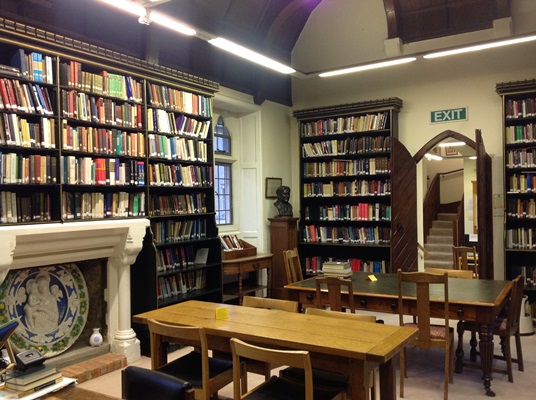
I LOVE LIBRARIES!… Shh….. Sorry, I think I said that a bit loud! I’ve mentioned before about how much I love books – so a room (or rooms) that are stacked from floor to ceiling with them is equally as exciting. There’s that unique smell of printed paper and leather; the burnished gold lettering on some of the oldest books and the fact that the books on the top shelves, whose titles you can’t quite make out, could be reached by climbing up the librarian’s special step ladder!

A cosy study corner

A cosy study corner

Added to all that is the fact that I get to set up my own little workspace right there in the room itself – I have officially died and gone to bibliotheque heaven!

Knowing that I simply have to walk over and pick the book I need off of the shelf makes studying so much easier – it’s all there at my fingertips, although to be honest it wasn’t that easy the first time……I went in, clutching my list of suggested books and tried to find out where they might be.  I was quite familiar with the Dewey system that most libraries use, but then this system covers vast ranges of topics.

Here, it is more specialised – broken down into various religious and theological categories. Each of these categories is labelled A-Z and then further broken down into even more specific grouping before being alphabetised by author. No wonder I was confused. Added to that is the fact that Cuddesdon library is also not just in one room, or indeed several rooms, but is also on various levels – involving walking along corridors and climbing different flights of stairs!

Cuddesdon library skylight

Cuddesdon library skylight

But when you got this as one of the skylights it doesn’t seem such a problem!

Thank goodness for the librarian whose kindness and patience got me started and pointed in the right direction, because no doubt in the future this will become a haven into which I can tuck myself away as essay deadlines loom.

What I am very much aware of is just how lucky I am to be in this situation and I certainly don’t want to take it for granted. There are many millions of children and adults around the world who not only don’t have access to libraries, but who don’t even have the facilities or the option to an education.

As Malala Yousafzai pointed out in her speech to the United Nations, books and pens are the most powerful weapons we can equip people with, they are the basic tools of education that can begin to eradicate poverty and provide opportunities for better job prospects and life goals.

Perhaps I will do well to remember that, especially when I’m feeling a little stressed and anxious about how I’m doing, and instead look to the fact that part of what my training will be about doing whatever is in my power to seek relative fairness and social justice for those in need. Therefore, when I stop for a moment and glance out of the window it will be a good reminder not to be complacent, because there’s a whole other world out there beyond the tranquil fields, hungry for knowledge and education as well

Tranquil views from Cuddesdon library

Tranquil views from Cuddesdon library

← Back

Thank you for your response. ✨


We Need To Get Out More!

Break Out!

Do not be frightened or dismayed, for the Lord your God is with you wherever you go – Joshua 1:9

Talking to a bright, shiny new ordinand the other day*, I listened as he told me all the wonderful things he’d been up to over the summer break. He’d spent a couple of weeks overseas working with Youth for Christ…. He’d visited his prospective parish and been welcomed during the Sunday services…He’d spent a long weekend at Greenbelt taking part in many worship events and engaging with interesting discussion sessions …. he’d met regularly with his ‘cell’ group and his only regret was that he hadn’t been able to organise a trip to Taizé. Blimey I thought, you’ve managed to pack a lot into your ‘leisure’ time, but I wonder how much time he’d spent just being ‘ordinary’

“If you spend too long in prison you can become institutionalised, and it can be difficult to make that leap of faith over the wall to freedom. This applies to being caught up in church culture too”  Milton Jones ’10 Second Sermons’

Now this wasn’t meant to be a criticism, because dedicating your life to your faith is a noble and sacred thing, but our ministerial and social skills also need to be honed in the ‘real world’ as well. As Christians we can spend a lot of our time being reluctant and occasionally downright scared to talk about our faith with our ‘non-Christian’ friends and acquaintances for fear of being thought obsessive, fanatical and maybe even a little bit weird. We worry that we’ll suddenly become a pariah in the workplace or family.

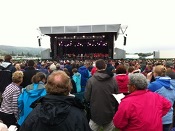
Greenbelt 2013

Greenbelt 2013

So when opportunities come up to join together with like-minded people, we often jump at the chance to spend more and more time in their company. These are the type of people who will understand us, to whom we feel we can speak openly, whom we are sure will make us feel good.

Of course it’s vital that we do get together to learn and equip ourselves.  It’s great to build each other up by sharing knowledge and wisdom, as it helps us become more able to share that with others; people who may be unaware of what makes us tick or who may be beginning to search for meaning in their lives… or asking what is it all about. In addition we also need to engage more with those who appear to have no intention of listening to our ‘news’ however good we present it. We even need to be prepared to engage with outright hostility

The great thing is that all these engagements can often be achieved without the need for words or at least very few words. One of the turning points in my faith journey was the conscious decision to speak openly about my faith to whoever asked. Note the ‘asked’ not ‘I’ll slip the Jesus word in whether it’s appropriate or not’. Not simply to pontificate on the state of their souls,  but  to say that actually  last Sunday I was in church; to talk about the perceived  ‘absurd’  politics of church organisations; to let people know the underlying reasons why I think what I do

‘Preach the Gospel at all times and when necessary use words’ St Francis of Assisi

I’m pretty certain that I’ve never ‘converted’ anybody in my whole life…in fact I wouldn’t want to claim that at all. What I do hope I’ve done along the way is spoken honestly, acted compassionately and served humbly to enable others to catch a glimpse of why I believe what I believe and maybe then explore it for themselves – if not immediately then at some point in their lives.

Spending a lot of time practicing can make us an ‘expert’ in our subject, but it can also make us very one-dimensional. Of course I can choose to participate in lots of extra-curricular activities like roaring from the terraces of Twickenham, rocking at a Coldplay concert or simply going out for meals with ex-work colleagues. However, the simplest thing is to engage in ordinary conversation with whomever I happen to meet – about the weather; what they’re up to at the moment; what’s important to them right now. This exchange of information gives me an insight into other people’s lives and them an insight into mine

As part of bringing about God’s kingdom our task is to come alongside people – that is ALL people – not just that lovely group of fellow Christians who make us feel warm and fuzzy – but the ones who makes us feel prickly and uncomfortable too. Sometimes we just need to get out more!

*To my fellow trainees at Cuddesdon – he is not one of you!

← Back

Thank you for your response. ✨

Come to Me, All Who Are Weary

Come to me all who are weary

Come to me all who are weary

Last week as I started to draft out this blog, I was sitting in a small cafe in the middle of the busy market town of Bradford on Avon. Its patrons were a mixture of tourists and locals, all taking the opportunity to grab a bite to eat; a quick coffee. Outside the roads hummed with cars and lorries performing an intricate and continuous dance punctuated by roundabouts and traffic lights. Tucked away in a window bay,  it gave me the chance to spend precious moments just ‘musing’ amidst all the hustle and bustle

Nowadays,  in this all too brief earthly world, it can often appear that everything needs to be planned to the nth degree. People rush headlong into the next thing they think needed doing yesterday, so that the present moment is never savoured and burnout is experienced not only in the gym but equally in everyday living.

So often we take on too much, trying to knit together all our tasks into a beautiful complex pattern only to despair when it all starts to unravel. We long for a breathing space – sometimes we just simply want a chance to breathe. When was  it that it became necessary  to live life at such a breakneck speed that each day blurs into the next?

No doubt we would all end up in chaos if we all decided tomorrow to lay aside our ‘work’ and rush to the nearest beach/mountaintop/woodland to escape it all…. rules and regulations both written and unspoken keep us on track most of the time; still it makes sense that creating regular moments aside is not only sensible and healthy, but essential for our spiritual well-being – so why not make a rule to create a recreation space for ourselves

St Benedict in the sixth century introduced his rules for the monks in his community. Not only were there set times for prayer, work and private study but time was set aside each day for recreation and fellowship. However, if you’re still thinking you’d find it difficult to do something like this daily even taking a few minutes each day to re-centre yourself can be helpful – for me the time spent in morning prayer seems to set me up each day. Take five minutes to start with a moment of quietness and then gradually extend that time a little bit each day. I was also recently reminded that the Jewish faith uses the evening before their Sabbath (Shabbat) to say their prayers so that their minds and bodies can be prepared whilst resting overnight – why not take those five minutes then, to quietly review the the day, giving thanks for all the good things and gaining strength for the day ahead.

Jesus himself knew the benefits of taking time away from his work in prayer and solitude. Whether he ever fully achieved this is uncertain during his ministry years, but at least he attempted to and undoubtedly did cherish that time. Ultimately though his concern was for others ….

‘Come to me, all you who are weary and burdened, and I will give you rest. Take my yoke upon you and learn from me, for I am gentle and humble in heart, and you will find rest for your souls. For my yoke is easy and my burden is light.’ Matthew 11:28-30

…… A welcome invitation. Nevertheless,  for the majority of people the closest thing we get to finding a real space for rest is during an annual holiday – which is exactly what I’ll be doing over the next couple of weeks. This is when we can and should allow ourselves to relax and rediscover our inner self – the self that as children just woke up and made of the day whatever adventure  presented itself to us.

Now where did I put that bucket and spade?

← Back

Thank you for your response. ✨

Pivotal Moments and the Parable of the Lobster!

Pivotal Moments!

Pivotal Moments!

In life, there are key moments that are scattered along our timelines. Moments that stand out and are remembered as pivotal. Some of them are more general – like birthdays, weddings, the bearing of children… others are personal – times when something has happened that has taken us in a new direction and changed our lives.

Sometimes the change has been welcomed and sometimes it has been scary and uncomfortable. Sometimes we’ve been able to avoid it altogether by simply refusing to acknowledge that there is any need for change. So at church today, at what would be one of those pivotal moments in my life, I thought my talk could revolve around that topic.

All church congregations can become complacent from time to time -or maybe it’s just our particular brand of Anglicanism? We know what is going to happen each week, so we turn up with two or three minutes to spare; find our usual seat; exchange brief pleasantries with the people in the pews in front or behind us; offer a quick arrow prayer that the service will not take too long as we have visitors coming for lunch; settle down to say those well-worn and comfortable words of the liturgy and hope we won’t make it obvious if we go off into a daydream during the sermon…..

I warned them…. I really did! I warned them that some of them weren’t going to like it; some of them would be happy to do it but that some of them would have a little moan about it. However, that they were to moan to me afterwards and not amongst themselves!

I simply asked them to change their positions, to move around and find a different space. Then, when they were sitting comfortably – or uncomfortably as some of them now appeared to be – we did a dramatic reading of one of Jesus’ less well-known parables… the Parable of the Lobster*! Before you start searching for it, you won’t find it in any of the Gospels or even the Apocrypha, but it is a parable nonetheless – a simple story to illustrate a point

The Parable of the Lobster

Narrator: Long ago, when the world was very new – there was a certain lobster who determined that the Creator had made a mistake. So he set up an appointment to discuss the matter.
Lobster: With all due respect, I wish to complain about the way you designed my shell. You see, I just get used to one outer casing, when I’ve got to shed it for another. Very inconvenient and rather a waste of time.
Creator: I see. But do you realise that it is the giving up of one shell that allows you to grow into another?
Lobster: But I like myself just the way I am!
Creator: Your mind’s made up?
Lobster: Indeed!!
Creator: Very well, from now on your shell will not change . . . and you may go about your business just as you are right now.
Lobster: That’s very kind of you. (the Lobster leaves)
Narrator: At first the lobster was very content wearing the same old shell. But as time passed he found that his once light and comfortable shell was becoming quite heavy and tight. After a while, in fact, the shell became so cumbersome that the lobster couldn’t feel anything at all outside himself. As a result, he was constantly bumping into others. Finally it got to the point where he could hardly even breathe. With great effort he lumbered back to his Creator.
Lobster: With all due respect (sighing), contrary to what you promised, my shell has not remained the same. It keeps shrinking.
Creator: Not at all (smiling). Your shell may have gotten a little thicker with age, but it has remained the same size. What happened is that you have changed – inside, beneath your shell. You see, everything changes – continuously. No one remains the same. That’s the way I’ve designed things. And the wisest choice is to shed your old shell as you grow.
Lobster: I see, but you must admit it is occasionally inconvenient and a bit uncomfortable.
Creator: Yes, but remember – all growth carries with it both the possibility of discomfort . . . and the potential for great joy as you discover new parts of yourself. After all, you can’t have one without the other.
Lobster: That’s very sensible.
Creator: If you like, I’ll tell you something more.
Lobster: Please do!
Creator: When you let go of your shell and choose to grow, you build new strength within yourself — and in that strength you’ll find new capacity to love yourself … to love those around you — and to love life itself. That’s my plan for each of you

Afterwards, I commented that before the story I had asked them all to make a change and that I had noted that some of them were very happy to do so and had made quite a radical change, moving far away from where they had been sitting. Others only wanted to make a slight change,  and still others really, really didn’t want to move at all, perhaps being like the lobster at the beginning

The truth is, change, however big or small, is often difficult and uncomfortable, but God calls us to do it many times in our lives. We often try and keep change to a minimum, trying to maintain the status quo, trying to change the circumstances we find ourselves in to fit with what we have planned…maybe weeks, months, years ahead

But what if God were to change those plans? How would you react?

I heard a really good quote the other day by a writer called Bob Goff. He said ‘I used to think I could shape the circumstances around me, but now I know that Jesus uses circumstances to shape me’ Love Does: Discover a Secretly Incredible Life in an Ordinary World

How is he going to shape us so that we can be a blessing in the world, so that we can move out into the world as kinder, gentler people filled with power and filled with strength?

Those plans we made may have to change, but instead of trying to predict how it will affect us far into the future maybe we should think of it simply as what is the next thing that God wants us to do on our journey with him and how are we to do it. Is it to get up and change a particular aspect of your life; is it to go on a walk and spend some time with God; is it to do something radical – to say here I am God?

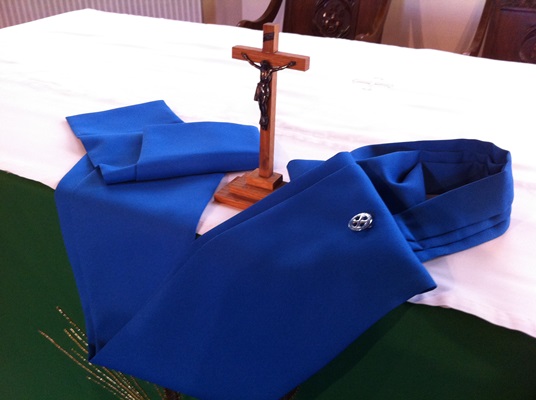
As I mentioned earlier, from a personal point of view, today I am at one of those pivotal moments. At the end of the service I ‘laid down’ my scarf as a Lay Reader in preparation of the move into the new phase of my ministry as an Ordinand. To reach this point there have been many changes in my life – some filled with utter joy and some filled with utter despair.

What I do know is that I haven’t faced it alone because God has met me in the change and has given me a lot of wonderful people to walk alongside me – and most of them were sitting there right in front of me at church.

Change brings a lot of challenges and a lot of blessings – it needs us to be willing to stretch and become more than we already are – but remember that we don’t do it alone. My hope and prayer is that even though change is often difficult and uncomfortable, you’ll welcome it as a tool from God to help you become who he wants you to be. All you have to remember, is that God loves you. Amen

← Back

Thank you for your response. ✨

The Bob Goff quote was from Steve Weins blog http://www.stevewiens.com/2013/08/09/what-you-will-need-on-the-road-of-resistance/. Thank you Steve for allowing me to share

*Author unknown – if anyone is aware of the authorship please do let me know

Children Should Be Seen And Not Heard!

Children should be seen and not heard!

Children should be seen and not heard!

A lot of my ministry so far has been with children and young people – whether at home, through the church or through my work with primary schools. So when I was told that I would need to do a 5 minute presentation on a topic of my own choice for BAP (Bishops’ Advisory Panel) I thought that the persistent attitude that some churches have towards children could be a good place to start

Topic chosen – timings……difficult! My original piece came in at 12+ minutes. Editing is easier said than done. How do you cut out words, yet alone sentences, that you’ve spent ages choosing so that they say exactly what you want them to say and still make it have the same impact? Nonetheless, repeated attempts at timings certainly do get the contents into your head, you can work out the parts you stumble at each time, and eventually you get it down to 4 minutes 46 seconds – give or take a second – and you hope with a fair wind and barring a complete meltdown that you’ll get through it.

The piece below is an amalgam of the original and final version just in case you think I delivered this like the actor John Moschitta in the FedEx adverts!

Children Should Be Seen and Not Heard

Children should be seen and not heard… a phrase that was actually coined by a 15th Century clergyman called John Mirks; originally intended to refer to young women, possibly echoing Paul’s exhortation in his first letter to the Corinthians, but now simply meaning young children. It is said to emphasise that you think children should behave well and be quiet. I’m fairly certain however, that this phrase is still very much on the lips of many in our church congregations – those who complain about children talking during the sermon, stares given to parents of fidgety children and God forbid that they should be allowed to run freely up and down the aisle!

Children should be seen and not heard – in fact we’re not too sure that they should even be seen in some cases. Nothing may be explicitly said – although sometimes it is – but this attitude definitely lurks close to the surface. A disingenuous attitude bearing in mind the concern shown about the falling number of children and young people in their congregations, and witnessed by the large number of adverts in the jobs section of the Church Times calling for ministers that will build up ministry to families and young people. The dreadful irony is that the thing that people are asking for may very well turn out not to be what they actually want. They want to see more children; they don’t truthfully want to engage with them.

Somewhat reassuringly, in many churches children’s ministry and youth work are given high priorities and their youth ministry flourishes, but even here this is often done as a separate entity building up the church body but not necessarily building up the body of Christ.

The concern that churches are in decline, particularly where young people are involved is not a new problem. The Church of England’s 2004 report Mission Shaped Church pointed out that ‘We are becoming a nation of non-churched people in terms of Sunday school contact’ – and I use ‘Sunday school’ in its loosest form to represent children’s ministry. The report goes on to say that ‘Even by the end of the First World War, the majority of children were not in Sunday school. Those who were 10 years old in 1950 are now fast approaching retirement, and of them 70% did not attend a Sunday school. That means that the majority of even the elderly are non-churched.’ By the year 2000 figures showed that only 4% of children attended some form of church activity.

Conversely, the church is not attracting 96% of the younger generation. Furthermore, the majority of those who do attend church regularly with their parents, or take part in church workshops, have already decided by the age of 9 to leave, and this is happening not only in the more traditional churches but with evangelical congregations as well; although here the age of decision seems to be higher. The reason for this is that they often feel that they are not engaged by the church, seeing it as yet another form of schooling where they are talked at and not to.

Hence the recognition that young people need to be ‘seen’… because quite frankly if they are not ‘seen’ then for some churches, within as short a period as one generation, there will not be a church for them to be ‘seen’ in.  These congregations are looking for new generations to replace the existing one, members to follow on rather than walk alongside. The trouble is that they want children to be ‘the church of tomorrow’ rather than the church of today.

If we truly believe that God loves everyone without exception and that children can experience God, then churches need to become places where this happens. They don’t need another programme; they need people who are going to make a difference in their lives, who respect their spirituality, allowing them to witness not only in church, but in their own families and beyond. They need to be ‘heard’

How is this to be done? Well neither children nor adults should instruct each other by telling them what to do – it’s never about who can shout loudest or longest to make yourself heard! However, children can still teach adults even without verbal communication. Adults basically need to look at what they ARE – and learn. Look at what they DO – and learn even more

We know from the Bible that God uses children as well as adults to work out his purposes … consider David, Samuel, Josiah – even a young teenage Mary giving birth to Jesus. Moreover, the business of learning from children is one that Jesus himself demonstrated and emphasised.

‘And calling to him a child, he put him in the midst of them, and said, “Truly, I say to you, unless you turn and become like children, you will never enter the kingdom of heaven.Matthew 18:2-3

By doing this he was saying look at the qualities this young person can teach you. He wasn’t asking them to regress to childhood, but to see how the natural humility, honesty, vulnerability and faith of the young are what will ultimately make the difference.

It’s true that churches have been aware of this dilemma and the need to do something significant about it for some time. Programmes like Kidz Klubs and Godly Play were introduced in the late 90’s, and huge investments have been put into youth ministries. Yet the majority of pioneers from these initiatives, now in their 20’s, have left the church in droves and this age group is at an all-time low. Where have they gone? Why are they failing to carry their faith into adulthood?

Recently Messy Church has come to the fore, recognising that if you simply wait for young people and families to step over the threshold on a Sunday morning you could be waiting in vain. Instead it very successfully attracts large numbers of families and young people with no pre-conceived agenda about converting them to ‘bottoms on pews’. Its sponsors, the Bible Reading Fellowship, state on their website that it ‘has deliberately chosen to have a ‘non-controlling’, ‘hands-off’ approach in the way it promotes Messy Church in the hope that this will give God space to grow his church as he wants to, and that it will give everyone encouragement to experiment and innovate’.

If churches are to have children in them, then those children and their parents need to feel welcome just as they are. You need churches where parents feel comfortable; not ashamed or nervous. Worship services where children are free to be … well, children. Even if that means that sometimes they will be loud, will move around, will play and fidget…because that is what children do. Children should not be mini-adults, fulfilling an adult agenda.

It’s about creating experiences to help them to be part of building the Kingdom… because it’s often in the experience that it’s glimpsed – where Kingdom values are not only outwardly expressed but inwardly nurtured as a compass for life.

It’s about providing opportunities for children to be transformed and discipled… where people of all ages gain wisdom from each other; older to younger and younger to older; because you never know the effect that a conversation, an encouraging comment, a ‘get alongside you’ activity will have on the child in a day, a month, a year….. surely every single one of Christ’s disciples needs to be seen AND heard!

P.S. I did manage to remain upright and came in at 4 minutes 54 seconds

← Back

Thank you for your response. ✨