Tag Archives: Peter

Transforming The Imperfect

Sermon preached on Sunday 29th June 2025 – St Peter and St Paul based on Acts 12:1-11, Matthew 16:13-19

May I speak and may you hear through the Grace of our Lord: Father, Son and Holy Spirit. Amen.

Today the church celebrates Peter and Paul, hence our very brief foray into back into red vestments. Two men, both in their way founders of the Christian church. Peter an original disciple and Paul the visionary missionary. However, our texts on this occasion focus on Peter or Simon Peter or Cephas.

They also feature the most amazing jail break ever. Not one for cinematic viewing, with explosions, masked accomplices and a speedy get away car, but an unopposed walk out to freedom, or at least for the moment, freedom.

A week or so ago, Charlie and I accompanied some 90+ Year 6 pupils to their annual Year 6 Leavers’ service. The coach journey was noisy, with excitement and anticipation, and the day was very warm as we threaded our way through to the cathedral from our drop off point, to the great West door, or doors to be more precise.

For many students, this was their first visit to the cathedral, and it’s always great to see their expressions change from their normal everyday ‘we’re too ‘grown up’ for this now’, to a real ‘Wow!’ moment as they step through the door.

Of course, when they look back at the jigsaw puzzle that is the West window, and hear about its destruction at the hands of the Cavaliers during the English Civil war – although the legend of masses of Cavaliers on horseback entering the cathedral and shooting their guns or lobbing the bones of the saints and bishops to break the window is not supported by specific records – it becomes even more amazing.

However, standing in front of the Great Screen behind the high altar and seeing all of the figure sculptures, most of which had been removed in the Tudor reformation and thus spared this destructive mayhem, a real sense of the majesty of Christ at the very centre of those who were part of his story and who took up and continued the work he had started on earth become apparent.

There, placed above Jesus’ head to the left, or at Jesus’ right hand is Peter, holding an exceptionally large key. In fact if we look at our very own East Window we can see Peter in the top left hand corner – with Paul, holding those keys.
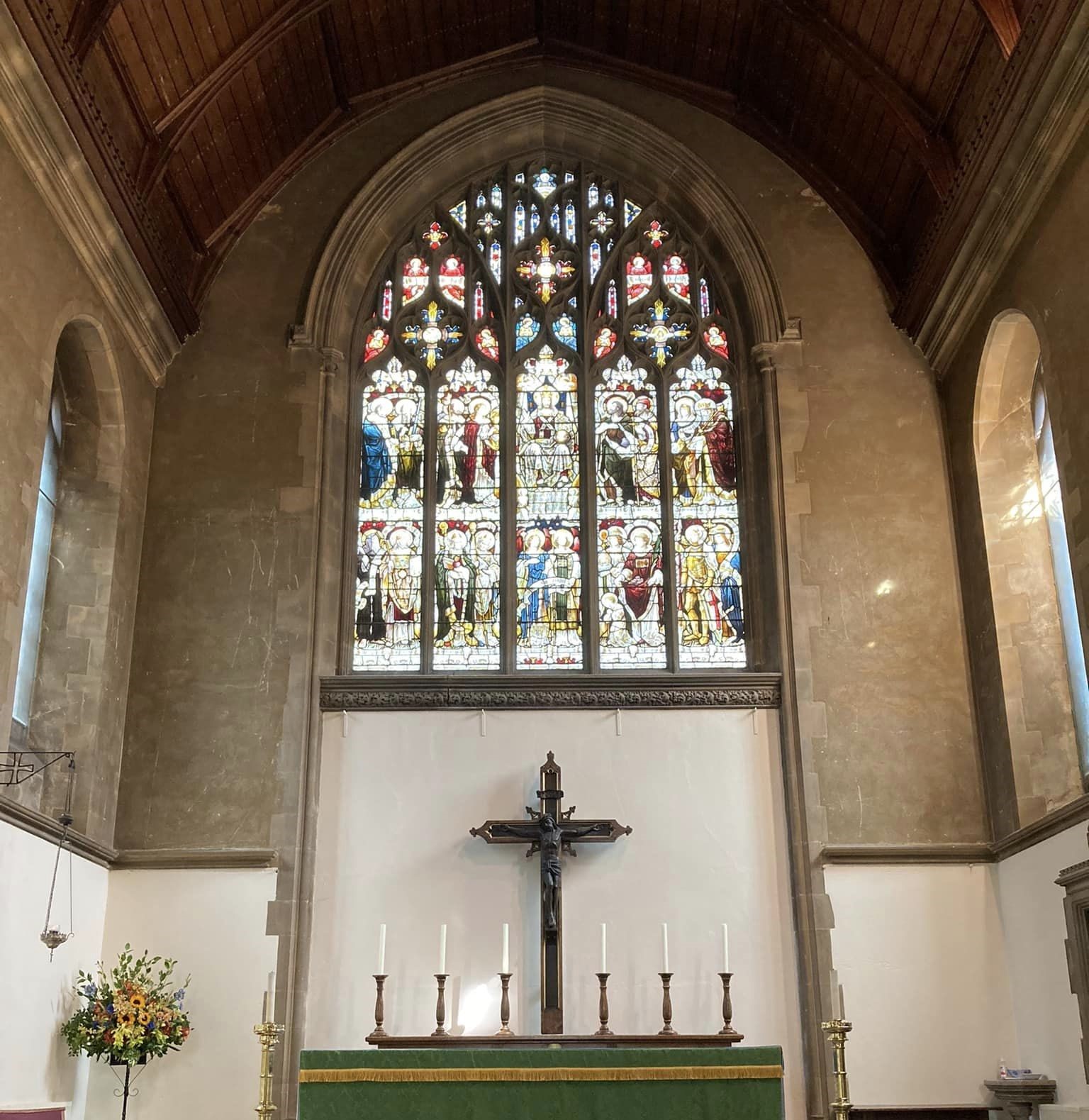
The East Window at St James’ Church, West End, Southampton

Peter, the disciple, who so often gets it wrong as he works his way through coming to faith, but whose faith and trust in God, in the person of Jesus is unshakeable. His is a journey of transformation, and our two readings this morning reveal that journey. In fact, these two moments, separated by a few years, reveal a shaping of faith that many of us can relate to. Peter is not perfect, but he is faithful—and more importantly, God is faithful to him.

In our gospel reading, Jesus asks a pointed question, ‘But who do you say that I am?’ and it is Simon Peter who answers with boldness and clarity, ‘You are the Messiah, the Son of the living God.’ This is Peter at his finest, as moment of divine insight; and Jesus responds not with mere affirmation but with a calling: ‘‘Blessed are you, Simon son of Jonah! … I tell you, you are Peter, and on this rock, I will build my church… I will give you the keys of the kingdom of heaven’.

People often wonder when and why Simon becomes Peter, and here we have the moment. The name Peter or Petros in Greek. literally means ‘stone’ or ‘rock’. The term ‘rock’ in the Bible often symbolizes strength, stability, and reliability, yet we know Peter was not always any of these things. He would deny Christ. He would falter. But Jesus sees the finished product even while Peter is still under construction. And God doesn’t wait for us to be perfect to call us. He calls us, then perfects us.

We also have to remember that whilst Peter was the ‘rock’, Jesus remained the cornerstone, the foundational stone in a building, acting as a reference point for the rest of the structure. Again, holding symbolic significance, representing that strength and stability, and the beginning of a new endeavour. Later in Ephesians 2, we hear of the Jews and Gentiles coming together as God’s people, ‘built on the foundation of the apostles and prophets, with Christ Jesus himself as the chief cornerstone’.

But now let’s turn to our reading from Acts. Here we see Peter, no longer the impetuous fisherman, nor the fearful denier by the fire. He is a leader of the church. And he is in prison. King Herod has killed James, and Peter to be next. He is chained between soldiers, guarded by sixteen men. The situation is hopeless from a human standpoint.

But the passage says, ‘the church prayed fervently to God for him’. And in the darkest hour—the night before his execution—God sends an angel. Chains fall off. Iron gates miraculously open. And Peter walks out, dazed, into the freedom only God can give.

This is the same man who once sank in fear on the water. This is the same man who once wept bitterly after denying Christ. but who at the beginning of the passage is sleeping in peace on the eve of death. What has changed? Well, Peter has learned to trust God completely. He doesn’t panic. He doesn’t beg. He rests – knowing now, after years of walking with Jesus, that even in prison, God is in control.

So where does that leave us? Where are we on our own journey of transformation? Some of us are like Simon in Matthew’s gospel—full of zeal, making bold confessions, still growing. Whilst some of us are like Peter in Acts – learning to be at peace and placing our trust in God in all eventualities.

And God sees us not as we are, but as the people we are becoming. He is building His church—not on perfect people—but on those who confess him truly and trust him deeply. And Peter’s journey, from bold confession to miraculous deliverance, reminds us that no one is beyond God’s reach, and no situation is beyond His power. So let us place our complete trust in him now, because God is still writing our stories. Amen.

God’s Time Is In The Waiting

Sermon for the Second Sunday of Advent based on 2 Peter 3:8-15a and Mark 1:1-8

May I speak and may you hear through the Grace of our Lord; Father, Son and Holy Spirit. Amen

I hate waiting… I’m a completer / finisher and if something needs completing or finishing why wait around. Get on and do it straight away. Soonest done, soonest mended, soonest you can move on to the next thing. Yet haste is not always on the side accomplishing the best results. Yes, it creates a sense of achieving a lot in as little time as possible, but it’s also possible that things get missed, that plans change, that you have to go back and do it all again!

It’s taken me a long time to realise that time is not something to be got through as quickly as possible. Time is a precious commodity and the freedom of youth and endless days of pleasure give way to a sense of time passing too quickly towards its ultimate conclusion.

A recent spell of three hours in the waiting area of the Royal South Hants walk-in a few weeks ago, actually got me sitting and contemplating the nature of waiting. Situations such as this throw together a group of people each with different needs and attitudes, and I found myself noticing that the medical staff had perfected a list of priorities which was sensible and fair, however much everyone looked up each time hoping they were the next to be called through. The possible broken limbs, the youngest children, those who might be in immediate need of treatment to prevent further deterioration, and those who knew it wasn’t a matter of life and death but would really like some relief from their present condition.

The trouble with time is that it is a human concept, to be regulated and measured, and for those who believe a literal understanding of the beginning of time as described in the Genesis narrative it can seem that God ordained the hours, the days and the weeks to give us the rhythm of nature and seasons to measure our earthly existence.

It’s an interesting conundrum, and one which I recently spent discussing with some 8-year-olds at school the other day. I have to say that these are some of the best moments in my work as a school chaplain, when children divert me away from discussing how they might present a bible story in their Child-Led Collective Worship and morph into pondering the bigger questions in life. From annunciation to childbirth to creation in the space of two questions. From the miracle of Jesus’ conception to the lack of stories of his childhood to the question of how Adam and Eve’s son’s managed to find wives. Then back to the key question, but who created the creator and did he really do it all in six days.

Of course, the best way to answer these questions is to deflect it back to the questioner… What do you think? No, it’s not a get out clause, but it gives a chance for them to express what they might be thinking but not quite wanting to suggest in case it’s the worst answer ever and Reverend Linda will scoff at their ignorance and everyone else will laugh. To be honest you don’t get that sense of reticence with 8-year-olds, and they are actually very respectful and will listen to each other.

So, the response that God would have done it in God’s time and if he could create two people why could he not have gone on to create a few more. Nevertheless, it was the first statement that I heard so confidently expressed, and here this morning we hear the same point being made from the pen of St Peter, ‘do not ignore this one fact, beloved, that with the Lord one day is like a thousand years and thousand years are like one day.’

 Peter is noting that the completion of God’s plan for his creation should not be something we are concerned about on a human timeline, but how we spend that waiting time, so that when and if it should happen in our lifetime, we could stand before God with a clear conscious that we had striven for all that is demanded of us as followers of Christ.

The fact is God’s plan has never been set to a particular timescale. He has been one of those draughtspeople who will take things back to the drawing board, recalculate and adjust depending on what is now wanted and needed.

If we look back over the Old Testament stories, we can clearly see God making these adjustments. He’d tried ripping up the original blueprint and starting again with Noah and his family, he’d given detailed plans to various architects of faith, including Abraham and Moses and he’d sent engineers into the field with instructions of what needed doing such as his prophets, Elijah and Isaiah, but it would seem that the people didn’t grasp the vision or understand what sort of kingdom he was trying to build.

It seemed that the workers had downed tools and were taking a long vacation, and God was silent… Except he wasn’t, he was busy pulling together the next part of his plan, and it would be the greatest draft yet because it needed to be absolutely right, and it needed to be a one off. He had tried giving chance after chance, now he was doing something new, something amazing.

So, what sort of publicity campaign would he run. How many global publishers would he engage to follow up the big launch? As always God surprises us. No big fanfare, well apart from a host of angels in the middle of the night. A teenage girl, a reluctant fiancé, in a land under foreign rule, a rag-tag bunch of shepherds and a foreign diplomatic visit. An aged couple in the temple and a wild-haired man in the desert, not exactly front-page news.

But he was here, and the next part of the plan was about to begin; ‘the beginning of the good news of Jesus Christ, the Son of God’. Today we focus on that beginning as John announces that the time has come, to repent and turn back to God, because time is running out.

He speaks with urgency and recognises that he is merely the preliminary act. The messenger sent ahead to prepare the way. And Jesus was coming out of his own time of preparation, not just a mere 40 days in the desert, but thirty odd years of learning, observing, listening, and waiting and it was now his time.

For John his understanding was likely to be that this was it, this would change everything, the Messiah had come, and things would never be the same again, and of course they weren’t. However, God’s plan was still not marching in time with that of his people and we can see that some two thousand earthly years later that his plan is still being worked out.

Nonetheless, it’s sometimes hard to see amongst this world of increasing secularism and human conflict the bigger and brighter plan for us. Someone asked a question the other day as to whether we were really living in the end times at the moment, and that maybe we’d all be better off if God did bring these times to an end. It’s hard to deflect such a question because of course there is no answer to that. God’s time is not our time, so we just have to wait.

But it’s in the waiting that we can make a difference. We can still share the Good News, we can represent Christ in what we do and say, we can show people that there is always hope. However dark a tunnel is, it is just that a tunnel, a means to get from one place to another, and as we move through it there will always be that glimmer of hope and light that appears at the opening.

We have to be patient, yet active. To wait, but to do so with hope. To mark time but to make the most of it. To let God be the completer / finisher in his own time.

This Advent we wait once again to share the Good News, God is with us. Amen

Go back

Your message has been sent

Warning
Warning
Warning
Warning.

Where Were You?

When they ask, ‘Where were you the day that Jesus died?’ What am I going to tell them?

That I was standing at the foot of the cross, comforting his mother? That I was berating the authorities and telling them what a mistake they were making? Or that I was locked in a room in full self-preservation mode?

What have these last three years taught me, if not to take chances, to shake a soft fist at those who misuse their transient powers and to trust that God has everything in hand. But now the man, who was showing us a new way of living, who was a true teacher of what it means to love God and to love one another; the man whom I was proud to declare as ‘the Messiah, the Son of the living God.’ My closest and most dearest friend, has gone, and perhaps with it all of our hopes and dreams.

Yes, there were signs and warnings, he’d tried to prepare us, but perhaps we were too slow or too dull to really understand what he was talking about. Why would he look at me, Simon, son of Jonah, simply a fisherman and see someone who would be a rock on which to build anything, let alone his church.

How could he trust me to do such a thing, when I couldn’t even trust in him, even though he showed me time after time that I should. That it was possible to step out of my comfort zone and achieve the impossible. How confident I had felt when he told me to do just that and step out of the boat onto those foam flecked waves, eyes set firmly on him, able to walk as he walked. Until my trust wavered and was replaced by this same fear. Even then he caught me, but who will be there now to catch me when I fail, as fail I surely will without him.

So many incredible things that I’ve witnessed, the things we couldn’t explain, miracle after miracle, yet he couldn’t have done any of them if he wasn’t truly God’s Son. Not only satisfying people’s bodies with such meagre portions, the five loaves and two fishes, but curing their ailments, restoring their dignity, giving them another chance in life.

And those whom he literally did give them another chance to live, raising the widow’s son and Jairus’ daughter, and his dear friend Lazarus. I remember Martha, so annoyed that we were delayed, yet still hoping for the impossible, and sweet Mary, whose tears moved him and all us to tears. His breathing life back into them all to show God’s glory, but where is His glory now?

So many people whose lives have been turned around simply because they believed in him. A man who broke the rules to show us what was really important and all I could do at the end was to deny I even knew him. Such shame I will carry deep in my heart all the days that I have left to me.

Indeed, this weight of sorrow bears me down, yet it is nothing compared to the agony he must have suffered. John, with the assurance of youth, was brave enough to be with him at the last and has told us of the cruel way that they treated him. His head already bleeding from the crudely fashioned crown of thorns, they made him carry is own cross, the sheer weight of it too much, that it caused him to stumble and a complete stranger from the coastal town of Cyrene was made to help him. How ironic that it was my namesake that did what I should have been brave enough to do.

And then the taunts and jeers; the deep sorrow of the women and the unconscionable behaviour of the guards, gambling for his clothes. Yet, all who witnessed it to the very end say that his thoughts were for others, asking that they be forgiven, with his talk of paradise and concern for others future well-being.

This human life, so precious to us, that we cling to it as if there is nothing else that matters, yet His has been taken away. Did he feel that he had been abandoned? Forsaken, by his friends, by God himself? Even the one who betrayed us all, Judas, is dead. His heart and mind so full of despair and darkness that he couldn’t bear what he had done.

And when the end came, the sheer dark void of the moment, the world plunged into night as the light of the world was extinguished by those whose power is fickle and fleeting. Surely, theirs is not to be the triumph.

As he died, so the earth trembled and shook so hard that it tore not only the temple curtain in two, but each of our hearts. We will wait until it settles again and use the tools he has given us to try and tell the world what he lived to show us. That we must turn once more to God, to trust in his goodness and mercy and live lives that reflect his love for us, for each other and for Him.  

His body is now sealed in the cold of the tomb and no doubt the women will honour it once the Sabbath is over. But our greatest gift will be to keep his memory alive. For there can be no more talk of abandonment. Our work is just beginning.

When they ask, ‘Where were you the day that Jesus died?’ What am I going to tell them?

Amen

Go back

Your message has been sent

Warning
Warning
Warning
Warning.

Come and See…

Sermon preached on the Second Sunday of Epiphany based on the following readings John 1:29-42 and 1 Corinthians 1:1-9

May I speak and may you hear through the Grace of God; Father, Son and Holy Spirit. Amen

‘Come and see, come and see,’ was a request I often got from one of the children, to go with them and admire what they had been drawing or chalking on the easel. I’d learned not to declare, ‘what a wonderful elephant’ when it turned out to be a fire engine; risking disappointment that their efforts were unrecognisable. Instead, a few tentative enquiries and invitation to tell me all about what each bit represented, to listen to what I was looking at helped me see what was being revealed right in front of my eyes.

 Our gospel passage this morning is another epiphany moment as Jesus begins his calling of the disciples, with an invitation, not only to come and see where he was staying, but to come and listen to what he had to say, so that his identity would be recognised and understood

Just a few verses before we had been given by John the most beautiful description of Jesus as the Word made flesh. He is God revealed to humans – in ourselves the expression of God – so that we might see him and believe. The question is – what do we see and what do we believe?

But first, let’s return to what John, the writer of the gospel, saw and believed on that first encounter with Jesus. Do we actually know that John was there? The consensus among theologians is that here was a group of Galilean fishermen, from a community around Bethsaida, which actually means ‘Fishtown,’ and that along with brothers Simon and Andrew were the sons of Zebedee, James and John.

Andrew is a disciple of John the Baptist along with one other, who are eyewitnesses to John’s testimony and affirmation of who Jesus was revealed to be through his baptism and who are standing with him when he declares for the second time that ‘Here is the Lamb of God.’

John the Baptist gives Jesus this new title that does not appear elsewhere in the Gospels. Yet it would have had great significance for those listening. A sacrificial lamb, pure of all blemishes, innocent and meek, and it is worth reflecting on this title as an image of the meekness of Jesus who, even in the fiery, apocalyptic book of Revelation, believed to have been authored by John the Gospel writer as well, still appears as a lamb ‘standing as if it has been slaughtered.’

John the shadowy, beloved disciple does not reveal himself as the other disciple with Andrew, but the visionary quality of the language points to him being present as the other eyewitness. However, it is Andrew who after accepting Jesus’ invitation to ‘come and see’ and spending time listening to what Jesus had to say makes the boldest declaration to his brother, Simon. ‘We have found the Messiah, the anointed or holy one,’ the prophesied promised deliverer of the Jewish nation and saviour of humankind. It is significant that Simon’s brother makes this confession early on, as later, the retitled Peter will make the same bold statement having witnessed several miracles and declaring his continuing allegiance to Jesus’ mission.

For John the Baptist he is the Son of God, for Andrew the Messiah, for John the Evangelist the Lamb of God, for Peter the Holy One. Each of them have received the invitation to ‘come and see,’ and each of them sees Jesus as something different. So, what is it about Jesus that each of us who receive that same invitation actually see?

The invitation to get to know Jesus is a personal one. It starts at a different time and in different circumstances for each of us. Andrew and John were asked directly, ‘What are you looking for’ and their response was for a teacher, ‘Rabbi.’ They were looking for someone who could help them learn more about God and his purposes, as well as a guide to how they should live. How true is that for you?

Are you attracted by Jesus as a shepherd, a person who protects and leads people in the right direction, securing for them a place of safety and nourishment.

Or is it the angry Jesus, who rails against injustice and demands restitution and freedom from everything oppressive and unjust. Who values those with the least power as the most precious.

Perhaps, it’s the compassionate Jesus, whose healing power can work miracles and bring suffering to an end, who rejoices at the restoration to full life, yet weeps at the death of a loved one before offering hope for eternal peace and reunion.

Even maybe the Jesus who shares our tiredness and emotions, revealing himself to be fully human and capable of wanting to escape from life at times, to take stock and re-emerge refreshed and restored to carry on the work we have been given.

Whatever it is that makes us first accept that invitation to ‘come and see’ it is only the catalyst to get to know him better, to listen to what he has to say and to be confident to make that invitation available to others to come to know him better.

Despite the failings of the Corinthian church to be united in their understanding of God, Paul is positive when he reminds them that by accepting the invitation to get to know Jesus, they have been enriched in speech and knowledge, given spiritual gifts and strengthened so that they will be able to persevere until the day when they are fully united with Jesus. It is also addressed to ‘all those who in every place call on the name of our Lord Jesus Christ, both their Lord and ours.’

The Gospel of John was written to prove that Jesus Christ is the Son of God. As an eyewitness to the love and power displayed in the miracles of Jesus, John gives us an up-close and personal look at Christ’s identity. He shows us that Jesus, though fully God, came in the flesh to distinctly and accurately reveal God, and that Christ is the source of eternal life to all who believe in him.

Each of us is given that chance to take a close and personal look at Christ’s identity when we recognise the moment and respond to his invitation to ‘come and see.’ Whatever it is that attracted us to get to know the person of Jesus more, to listen to his words, to be moved by his actions there will be others out there waiting for that same invitation.

Let’s pray at their epiphany moment we are the ones to say to them ‘come and see’ for yourself.

Amen

Go back

Your message has been sent

Warning
Warning
Warning
Warning.

Denying Ourselves


Photo Credit: Werner Volmari / Unsplash

Sermon for the 12th Sunday after Trinity based on the following readings:
Romans 12:9-21 and Matthew 16:21-end

May I speak and may you hear through the Grace of our Lord; Father, Son and Holy Spirit. Amen

I have recently found out the rather wonderful news that one of my daughters, Lizzie, is expecting and I am to be a nana for a second time. Everything is progressing well, although it’s been hard on her husband Lewis as he has not been able to attend any of her scans with her, which could have been a bit scary if the news were not so good.

However, a blood test has revealed that she has gestational diabetes, the news of which came just as she had enjoyed a piece of homemade cake, so no more treats for a while. Hopefully, she will be able to control this by denying herself some of the more sweet things in life and although it will be a minor hardship she will change her lifestyle for the benefit of her unborn child – a necessary form of suffering.

Suffering you may say… suffering…. is that really suffering? Well suffering means to undergo pain, distress or hardship and it can be physical, emotional, or mental. It can be as simple as not getting what you want or as tough as living with a terminal illness. Whatever level of suffering it might be, it was the one thing that Jesus told his disciples both he and them and those that came after would face in one way or another.

Alongside this they were to ensure a change in their lifestyles to that of self-denial, defined as ‘the willingness to deny oneself possessions or status, in order to grow in holiness and commitment to God’. It is an essential part of our Christian life to renounce our egos, where we are the centre of existence (which, lets be honest, goes against our natural inclinations) and recognise instead that Jesus is our true centre.

Carol spoke last week about Peter’s naming of Jesus as the Messiah as a pivotal moment in his story, and we can see that from now on there is a distinct change of mood. Less of the teaching in parables and more about warnings of what lies ahead for him and his followers.

Once again it is Peter who resists the idea of such a thing happening, but even Peter himself was soon to come to understand exactly what was required. The disciples had already showed what it meant to step away from the life that they knew, to go out into a world that is sometimes so diametrically opposite to what Jesus was teaching and to see this through to the bitter end.

‘If any want to become my followers, let them deny themselves
and take up their cross and follow me. “

The idea of self-denial is, as Dietrich Bonhoeffer once said, that ‘‘When Christ calls a man (and you can substitute woman here), he bids him come and die’. This is the ultimate act of selflessness but through denying ourselves each day, our life in Christ grows, strengthens, and develops more and more. Christ now becomes our life.

So, what does that life look like? Well Paul, in his letter to the Romans outlines what the Christian life might look like with this new way of thinking; a complete contrast to the idea of community put forward by the empire. In the community of Christ, people are called to honour each other, whether they are the wealthiest, highest status members of the group or the lowliest workers and migrants. Love is not to be measured or mechanical, but genuine, joyful and from the heart.

There is to be no more sycophancy and toadying to those more prominent in society in order to get ahead – Uriah Heaps there were to be none! Instead we are to look in completely the opposite direction – to the needs of the poor, offering hospitality, a meal, work if we have it, anything to make people’s lives better. And the streets of Rome could be pretty lawless in those days, so it made sense to align yourself with the Roman ‘mafia’ and give as good as you got. Again, not so says Paul, instead you should offer a blessing to those who persecute you, don’t repay evil for evil, live at peace and leave the wrath to God.

Paul’s way of imagining what self-denial means should be no different nowadays if we are to be part of Christ’s community. It is sometimes a hard path to walk and can lead to personal suffering, and there is no doubt that from time to time, like Christ, we will stumble under the weight of the cross we are being asked to take up. But it is also the only way to life.

The promise is that those who commit themselves totally to Jesus will, one day, see his glory and be welcomed into his kingdom, and if we’re lucky, we may also glimpse his glory in this life as well.

Amen

Go back

Your message has been sent

Warning
Warning
Warning

Warning.

Faith – By Sight? By Touch?

The Eagle Lectern at St James’ Church, West End

A recording made of an informal talk for a Service of the Word for St James’ Church, West End during the present Coronavirus Pandemic whilst our church door are locked. A transcript of the talk is printed below as well.

based on the following readings:

Psalm 16 – The Golden Secret, A precious song engraved in gold by King David
from The Psalms – Poetry on Fire (Passion Translation© tPt

1 Keep me safe, O mighty God
I run for dear life to you, my Safe Place.

2 So I said to the Lord God,
‘You are my Maker, my Mediator, and my Master.
Any good thing you find in me has come from you’

3 And he said to me, ‘My holy ones are wonderful,
my majestic ones, my glorious ones,
fulfilling all my desires’

4 Yet, there are those who yield to their weakness,
and they will have troubles and sorrows unending.
I never gather with such ones,
nor give them honour in any way.

5 Lord, I have chosen you alone as my inheritance,
You are my prize, my pleasure, and my portion.
I leave my destiny and its timing in your hands’

6 Your pleasant path leads me to pleasant places,
I’m overwhelmed by the privileges
that come with following you,
for you have given me the best!

7 The way you counsel and correct me makes me praise you more,
for your whispers in the night give me wisdom,
showing me what to do next.

8 Because you are close to me and always available,
my confidence will never be shaken,
for I experience your wrap around presence every moment.

9 My heart and soul explode with joy – full of glory!
Even my body will rest confident and secure.

10 For you will not abandon me to the realm of death
nor will you allow your Holy One to experience corruption.

11 For you bring me a continual revelation of resurrection life,
the path to the bliss that bring me face-to-face with you.

and Acts 2:14a, 22-32 and John 20:19-31  

May I speak and may you hear through the Grace of our Lord; Father, Son and Holy Spirit

Can we simply believe what we see? I would say yes, most of the time. Even so, sight can deceive the brain because after all isn’t that what we call magic? We only have to think of magicians who have claimed to have made whole buildings disappear, such as David Copperfield and the Statue of Liberty, and the people there as witnesses at the time would have sworn on their lives that it really did happen – they saw it with their own eyes.

No don’t get me wrong, there is no suggestion of magic taking place in any part of our gospel this morning, or indeed in any part of the Easter story, but sight and witnessing are at the heart of it – except there was one who despite all of this wasn’t convinced – he doubted.

A few weeks ago, I spoke about worrying and how it wasn’t helpful, in that it can produce fear; may be a bit like the fear some of us might be feeling at the moment because of the necessary self-isolation and social distancing; and what fear does to your mind is that it leaves you doubting, it paralyses your thoughts. This sort of doubt is definitely not helpful. It’s the thing that stops us from doing the things that God is calling us to do. As the psalmist said, ‘You are my Maker, my Mediator, and my Master. Any good thing you find in me has come from you’

‘You are my Maker, my Mediator, and my Master.
Any good thing you find in me has come from you’
Psalm 16:2

Doubt, therefore, can stop us realising our true potential when we think, ‘I doubt God would want to know someone like me’ – yet we forget that we are exactly as God created us to be in all our diverse and different personalities, blessed with a variety of gifts and talents

On the other hand, doubt can be a useful, self-check tools – giving us a moment to pause and to consider. Perhaps Thomas was right to say, ‘hold on a minute, I not only need to see this for myself, but I need to have physical evidence as well’, because surely the physical always trumps the visual? So, when Jesus appears a second time he offers this opportunity for Thomas to confirm his physical presence – that he was not just some holographic projection. Yet in both of his appearances it doesn’t record that any of them reached out and actually touched Jesus. On the contrary, Thomas immediately answered Jesus’ offer with a firm declaration, ‘My Lord and my God’.

This was pure faith, the same faith that enabled Peter to later step forward and point out to the crowd that King David was undoubtedly dead and it was his faith that led him to boldly and unflinchingly declare ‘we all are witnesses that Jesus rose from the dead’.

We all are witnesses that Jesus rose from the dead
Acts 2:32

Oh, that we would be so bold, the ones that have not seen and yet have come to believe. How though are we to convince people about the truth of the resurrection? If we go back to that first encounter that the disciples had with Jesus, we can actually see that his main concern is not to provide proof of this. The first thing he offers is reassurance that its really him and the disciples rejoice – but Jesus moves swiftly on – his purpose isn’t to linger on the miraculous fact that he’s risen from the dead, but rather to enable the disciples and us, through the power of the Holy Spirit to forgive and to be able to discern when it is called for. He is inviting them and us to extend the same Peace he spoke to them in that locked room, to begin to share that in faith with others, to start others on that journey of discovering the truth for themselves.

Yet how can we do this when our own faith journeys can often be full of ups and downs. There are times when our faith runs deep and there are times when doubt threatens to take over. The fact remains that we simply cannot force anyone else to believe – indeed we can not even force ourselves to believe. Faith comes only and always as a precious gift – but it is helped by being surrounded with others who carry and hold that gift of faith as lovingly as we do.

Whether our faith runs deep or shallow we can still live as one who believes, bearing witness in our words and actions to the truth that Jesus lives because God brings us ‘a continual revelation of resurrection life’. Sight may be fallible, the physical may be convincing, but as John declares in his purpose for writing these things down, it is the written word that is something tangible, to provoke thought and reflection, to come back to time and again, to give us better understanding through our experiences to show something in a new light.

Fear can be overcome; doubt can be set aside, and faith and belief are the keys to life in all its fullness through the name of Jesus Christ our Saviour and Redeemer.

Alleluia! Christ is risen!
He is risen indeed! Alleluia! Amen


Go back

Your message has been sent

Warning
Warning
Warning

Warning.


Treasure in Clay Jars


Jars of clay

What is it that makes us special? Thoughts from this morning’s sermon focussing on the reading 2 Corinthians 4:5-12

May I speak and may you hear through the grace of our Lord, Father, Son and Holy Spirit. Amen

I am nobody special. I will never become a worldwide known church leader. I will probably never become a diocesan-wide known church leader, but that’s okay. I will never be troubled by celebrity and stardom. I may appear from time to time in some charming local newspaper article about fetes or fundraising, but the paparazzi will not be camped outside of my door; that’s not a problem. My name will never be immortalized with a monument set up by the local community, although perhaps for a generation there will be some who will speak fondly of me, it won’t matter.

A remnant of my thoughts may continue to exist somewhere in the ether of the world-wide web, but it will probably be something that people accidentally come across whilst searching for something else, an amusing diversion, but quickly clicked away from – and that will be absolutely fine.

This isn’t an attempt at false modesty or to deny that any gifts or talents that I may have aren’t being put to good use. It isn’t to say that my existence is worthless or that I haven’t loved and been loved. It’s just that I am not special in my own right. But then very few people are. In the bible, those whom God chose to make known his message, were very often the most ordinary of people, they did not seek to proclaim themselves, in fact they were often reluctant to do so. But they trusted that God would give them the words to say, the actions to do and the courage to keep on trusting even when things looked like it would come to nothing.

Take for example Mary, the mother of Jesus, a young girl chosen not for her status, for we hear in the Magnificat, her song of praise to God when she visits her cousin Elizabeth, that ‘God has looked with favour on the lowliness of his servant’. Nor for her connections, betrothed as she was to a humble carpenter; but someone who was a woman of great humility and whose strength came from her knowing that she had achieved nothing except what God had enabled her to do, ‘for the Mighty One has done great things for me’.

Or perhaps we can think of Peter, a simple fisherman, whose enthusiasm often overtook his reasoning, whose bluntness many times led him to say exactly what he thought rather than reflect on what he was being taught. Tender hearted and inconsolable when he realised that he had thought only of himself when challenged about his relationship with Jesus, but who, when filled with the Holy Spirit was bold and fearless in proclaiming the gospel, ‘But Peter, standing with the eleven, raised his voice and addressed them’.

And of course there are many more from inarticulate Moses; through ‘I know best’ Jonah; to womanizing David, all unlikely choices to participate in God’s mission, all fragile human beings in their own right, but they were given the power to be something special… Like humble clay pots they contained a treasure.

Now if you’re going to place a valuable thing in some sort of vessel would you choose a clay jar? Yet, it really is the most appropriate material.

I wonder how many of you saw the series, The Great British Pottery Throw Down, a bit like the Great British Bake Off, but baking of another sort, in which contestants were given various types of clay and challenged to make things from simple drinking pots to whole toilet systems. Workhorse utilities to elaborate designs and functions yet fashioned from that most basic commodity, a lump of earth.

Middleport-Pottery-in-the-Summer-The-Great-Exhibition-Pottery-Throwdown-25

Pottery Toilet from the Great British Pottery Throw Down

When Paul is referring to jars of clay, he is referring to humankind itself – that we are the clay jars, a metaphor that takes us back to the description in Genesis, of God forming humans from the dust of the earth. However, we are called to hold within us the shining treasure, ‘the light of the knowledge of the glory of God in the face of Jesus Christ’. But the fact remains that vessels made of clay are not very sturdy. If you tip over or drop a piece of pottery it is easily broken, but Paul says there is a reason for God trusting us to hold within us this treasure. We are reminded that on our own we have no power, no special strengths or talents, we are as fragile as a jar of clay, but God’s all-surpassing power ensures that this clay can sustain all sorts of pressures so that his divine treasure is taken care of.

Paul reminds us that even as fragile, human beings, easily broken it is not only Christ’s life, but also his death that has made a change in us. He goes on to describe it in his letter to the Galatians, “I have been crucified with Christ and I no longer live, but Christ lives in me. The life I live in the body, I live by faith in the Son of God, who loved me and gave himself for me”(Galatians 2:20); Reminding us again that as jars of clay, we can’t depend on our own power and strength.

And the overriding purpose for this is ‘so that the life of Jesus may also be made visible in our bodies’. As Christians we are called to act as guiding lights and at other times flash warning signs; we need to seek out those in darkness and draw people into the light. We are called to live our lives as beacons of hope to those around us. Each of us will do this in different ways, some of us will become blazing flares that light up the whole sky around us, whilst others will be the constant inextinguishable glow of embers providing warmth and comfort.

Like an ordinary lump of clay, God forms each and every one of us into something that is useful and beautiful; like a potter he fires us in the kiln of life to give us extra strength, and he places within us the light of Christ so that we can shine out of the darkness.

As I said at the beginning, I nor anybody else is special if we live in our own right, but when we become the bearers of Christ’s light then that makes us special beyond measure.

Amen

The Potter's Hands

Go back

Your message has been sent

Warning
Warning
Warning

Warning.

Servanthood – A Call To Serve

Based on Readings: Acts 11:27-12:2; Matthew 20:20-28

Your first sermon in a new church is always a tricky affair. How will the congregation react? What’s it like up in the pulpit? Is your style of preaching appropriate? Although you may have preached many times before, when you have been doing so in one particular church, in one particular place, to one particular group of people, you know that you have built up a relationship and a rapport over many years. Suddenly, the people looking back at you from your new viewpoint are strangers and this is the first time they have heard your thoughts and are eager to see what the new Curate has to say.

Add to all of that the fact that it’s the church’s Patronal Festival, when the life and character of the particular saint that the church is dedicated to has probably been discussed, dissected and generally mulled over for many years and you feel you have to come up with something new?

Sunday 26th July 2015 saw me climbing up into the pulpit at St James, West End, Southampton, to do just that. Here then is an abridged version of my talk.

May I speak and may you hear through the grace of our Lord; Father, Son and Holy Spirit

Today we are here to celebrate the patronal festival of St James. James the fisherman, not to be confused with James brother of Jesus or James the author of an epistle. He is one of the closest companions of Jesus, alongside Peter and John, and together with them he is one apostle about whom we know quite a lot about his background and character. We know his father was Zebedee, a Galilean fisherman from whose boat James and his brother John answered Jesus’ call, and biblical scholars have reasoned that their mother was Salome, about whom we’ll hear more about in a minute.

I wanted to find out some interesting facts about James, but I suspect that you may have heard them all before… however, they are all new to me and here are a few I found especially interesting.

St James 'Son of Thunder'

St James ‘Son of Thunder’

 James has a nickname… ‘Son of Thunder!’ Whoa, that’s great… ‘Son of Thunder!’ …makes him sound like he should be in an Avengers movie. Apparently he got this after John and he asked Jesus if they should ‘call down fire from heaven’ to destroy a village and its inhabitants who had been less than welcoming. Needless to say his offer was declined.

You may have also wondered why there is a scallop shell on the church logo. Well, I hope that today you will all be going home to dine on Coquilles St Jacques à la Provençale…no?

This delicious dish of scallops, white wine and mushrooms is traditionally eaten on St James’ feast day, a reference to the saint’s appearance at the battle of Clavijo in the 9th century, riding on a white horse and adorned in scallop shells. On that occasion the Christians were able to defeat the Moors and the rallying cry of the Spanish troops, from that time became ‘Santiago!’

In our New Testament reading, we hear of James’ violent death at the hands of Herod Agrippa. He was the first of the apostles to suffer martyrdom, just over a decade after Christ’s crucifixion and resurrection. However, the Spanish have a special place for St Iago, as James is translated, as they believe that his remains were buried in Compostela, having been transported there in a stone boat by angels, a place that has become the third greatest place of Christian pilgrimage after Jerusalem and Rome.

Some really interesting facts and stories; speaking of a man of great loyalty, fiery of spirit but willing to serve Christ to the point of offering up his life. However, in our gospel reading he and his brother have to stand by and watch as their mother tries to secure a favourable position for her boys in the new earthly kingdom she believes Jesus is bringing about. In Mark’s gospel this incident sees the brothers themselves asking for this advantageous position, but Matthew, writing some 25 years later, distances the disciples from this overly ambitious request and chooses their mother to press their case. Interestingly, it’s possible that this was because of their family relationship, as Salome is identified by the gospel writer John, as Jesus’ mother’s sister, making her his aunt and the brothers his full cousins.

What it shows is that the disciples were still thinking about personal reward and distinction without personal sacrifice. Jesus, however, knows that the kingdom he is to bring about is not about earthly values, and that whilst he doesn’t doubt their faith and commitment, it will be the Father’s decision as to what that looks like in the long run. You can imagine what the other apostles, said to James and John afterwards, perhaps some of them chastised them that their mother had spoken out in such a way or they were annoyed that the brothers were trying to gain extra favour. Whatever, it was they were angry about, Jesus points out that being one of his followers is not about human leadership values but instead true greatness comes through servanthood.

I wonder though what we think of when we are called to become servants or even as Paul puts it slaves. I suspect we could have a vision of Downton Abbey and life downstairs, although this particular portrayal is certainly a rosier picture than what it was actually like for many servants. But it’s not really about being powerless at the mercy of others. Instead, we should think about what servants do… they serve… Only three weeks ago at my ordination service the role of serving was emphasised time and again throughout the service. Let me read just one bit from the declarations that we had to make – first the bishop read out the job description.

They are to serve the community in which they are set, bringing to the church the needs and hopes of all the people. They are to work with their fellow members in searching out the poor and weak, the sick and lonely, and those who are oppressed and powerless, reaching into the forgotten corners of the world, so that the love of God may be made visible.

This then is the role of a deacon, to be a servant and what my title is for this first year. However, I don’t stop being a deacon after the year’s up, in fact you never stop being a deacon. Thomas is still a deacon; Bishop Tim is still a deacon and Archbishop Justin is still a deacon*. Once a deacon always a deacon, but despite it being a clerical title every one of you here could also be called deacons.

We are all called to serve in a variety of ways. We are called to serve in the worship life within this church building, whether as ministers or choir members; as servers or sidespeople; as cleaners or flower arrangers for example – everyone offering their gifts and time to build up the church community. But we are also called to serve and to be available to our wider community finding out ways in which the church as a body can meet their needs and be a beacon of hope. The great thing is that we are not called to do it alone as individuals, but to work with and support each other, being proactive as well as reactive. Then, as we serve we will become the visible signs of God’s love to all his people.

Deacons scarf blogOne of the visible symbols of being a clerical deacon is that I wear my stole slightly different to Thomas, who has been priested and I know some of you wondered why. Again it is to do with servanthood. During the Last Supper Jesus removed his outer robe and tied a towel around his waist in order to wash his disciples’ feet. In the ordination service it was the bishop or in my case the abbot who did just that to me.
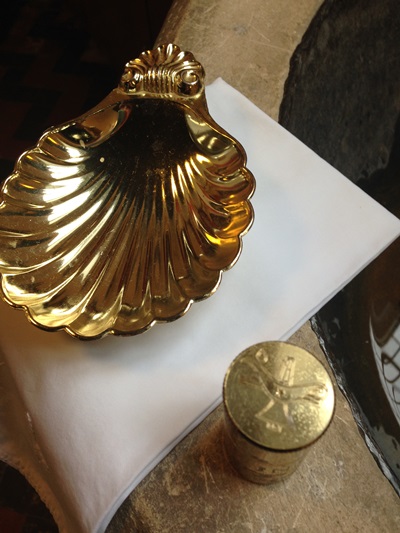
For Christ it was a way of showing the extent to which he was prepared to humble himself to take on the form of a servant. He was demonstrating to us that we have to set the needs of others before our own. When we remove our outer pride and clothe ourselves in humility then we too can bow down in readiness to serve others

To some people in our society nowadays that seems like an alien concept, where self-satisfaction counts for more than self-giving. Surely by becoming a servant we also make ourselves vulnerable to abuse – we become doormats rather than open doors. I would disagree – if we are serving God and actively seeking how we can bring about justice and mercy for the vulnerable then we will have opened the doors to Christ’s kingdom.

Perhaps we should all consider how we can become more like those visible signs of Christ to those around us. Are we prepared to offer everything so that God’s kingdom can be brought about both on earth and in the future? It’s certainly a challenge and not an easy one. Jesus knew this, but he had trust in his followers. He never doubted that James and John would maintain their loyalty; he knew they had ambitions and their faults, but they didn’t turn away from him – they were prepared to give their all. In the same way he has trust in all of us.

For those of us who were here on my first Sunday, we sang the words ‘Brother, sister, let me serve you; let me be as Christ to you; pray that I may have the grace to let you be my servant too’. We have all been called to serve in this place. God has placed us here for a purpose; to serve him and to serve one another. Unquestionably, in doing that we cannot fail to become those visible signs of Christ’s love.

Amen

*Reverend Thomas Wharton (Priest in Charge, St James, West End); Tim Dakin (The Right Reverend The Lord Bishop of Winchester) and Justin Welby (His Grace The Lord Archbishop of Canterbury)

©The image used at the top of this blog is copyright and permission to use it has been sought from and granted by the artist. For details of how you can purchase a copy of this or of any of Debbie’s other artworks please visit https://www.etsy.com/uk/shop/DebbieSaenz


Go back

Your message has been sent

Warning
Warning
Warning
Warning

Warning.

Changing Doubts Into Hope

Baptism with water and the Holy Spirit

Baptised with water and the Holy Spirit

It’s not often that you start a talk in church with a piece of music. However last Sunday, the second of Easter (yes we are still celebrating Easter long after the chocolate eggs have been eaten and the hot-cross buns finally toasted) I decided to see if the congregation were up for a bit of ‘Name that Tune’ The piece in question was the theme tune from Star Wars, Episode 4, ‘A New Hope’

We were celebrating a Eucharist, made all the more special because it was to include a baptism. Our readings included the story of Thomas meeting the resurrected Jesus and it was, looking to the future we are being offered, that we hopefully were to discover that morning

First though I want to ask you a question… Is it just me?? Or do we all have moments of doubts? Doubts about whether we are capable of doing something – if we have the ability or the strength? Doubts about whether we can trust others to carry out the things they have promised to do. Doubts about what the right thing to do is? Doubts about what our purpose in life is? Doubts about where God is in our lives? Is it just me??

Everyone doubted that Noah could build an ark – and yet he went on to achieve this incredible feat of engineering; Sarah doubted that she would ever have children and even laughed in God’s face and yet she went on to be the co-founder of a great nation Moses doubted that he had the articulate skills to face up to Pharaoh, yet with the help of his brother Aaron he went on to bring the Israelites out of Egypt and into the Promised Land. Elijah doubted that God was with him when he fled in fear for his life to Mount Horeb and yet it was there that he encountered him in that ‘still, small, voice’ guiding him as to what to do; Peter doubted when he walked on the water and yet there he was at Pentecost speaking out boldly and clearly, and of course the eponymous Thomas

So the other disciples told him, ‘We have seen the Lord.’ But he said to them, ‘Unless I see the mark of the nails in his hands, and put my finger in the mark of the nails and my hand in his side, I will not believe.’ John 20:25

So it certainly seems that God has no problem with us having doubts from time to time, after all we’re only human and we’re very often not in a position to see the bigger picture or what the future holds for each of us. What is it that we need to turn those doubts into belief I wonder? What proof will be good enough? For Thomas it was physical proof that the man he had been following and believed in had truly risen from the dead and was very much alive and standing in front of him. Maybe the only proof we’ll accept is when something we’ve doubted would happen has actually happened then we’ll believe it, or maybe if something didn’t happen when we feared it might. Good concrete evidence is often what we seek to allay our doubts and fears

Doubt often comes about because of a fear of failure; fear that we will let people down; fear that what we desire won’t come about. And maybe it won’t – not in the way we think or hope it will… and that I think is the key. The need to change our outlook from negative to positive, changing our doubts into hopes, putting our faith in God not in ourselves. All the while we hold on to our doubts then we are stopping ourselves from believing that things are possible.

Psalm 16 is sometimes translated with the subtitle ‘the hope of the faithful, a prayer of trust and security in God’ and it’s a beautiful lament from David which contains the following lines,

I praise you, Lord, for being my guide. Even in the darkest night, your teachings fill my mind. I will always look to you, as you stand beside me and protect me from fear. With all my heart, I will celebrate, and I can safely rest. I am your chosen one. You won’t leave me in the grave or let my body decay. You have shown me the path to life, and you make me glad by being near to me.’

Appropriate words as we celebrate Christ’s resurrection, but also appropriate for our own lives, as Peter in his first letter tells us, ‘By his great mercy he has given us a new birth into a living hope through the resurrection of Jesus Christ from the dead’ – a living, breathing hope that has been placed in all of us.

Font blog

The waters of baptism in the font at St John the Evangelist, Hedge End

And this morning we witnessed that hope being placed into a young child, Noah; whose baptism symbolised a new birth, not of water but of the Spirit. A hope that will be new and vibrant, a hope that will be reflected in the love and example that he receives from his parents, grandparents and godparents; a hope that Noah will need to have reaffirmed from time to time not only by his family, but by the whole family of Christ.

Because it’s all our responsibility to look to the hope that has already been placed in our own lives and to remain steadfast in trusting that God knows what he’s doing and all will be well.

Regrettably, as we’ve already seen, there may still be creeping moments of doubt. Again as Peter puts it, ‘even if now for a little while you have had to suffer various trials.’ And let’s be honest, all of us have and may be having to face various trials, some more than others, some harder to bear than others. Maybe our faith has been tested to the limits, but, if through it all, we don’t lose hope and believe that we will be given the strength to endure it, then just like metal that when it is tempered by fire is made stronger, so our faith will emerge with genuine hope for whatever the future may bring; and just like Thomas we will be able to declare, ‘My Lord and my King

Jesus tells his disciples, standing there right next to him, that they are blessed because they have seen for themselves with their own eyes and have no reason to doubt only to believe. How foolish we must seem to others to believe in something we’ve never seen, yet we have all come to or are coming to faith in so many different ways. What is it that convinces us that we should believe? Is it a personal encounter with Jesus; is it the love shown to us by those around us; is it an example of a friend, or was it that we just couldn’t believe that our lives are nothing more that this brief span of time. Whatever it was that started you on your journey of faith, be hopeful and hold on to it and remember how blessed you are.

The promises we make to the newly baptised, to support them in prayer, example and teaching we should also make to each other. We should push all of our doubts to one side as we are welcomed into the fellowship of faith and remember instead the one hope to which we are all called

Let’s celebrate that hope, and as always, may Christ’s peace rest in you…Amen

Expect the unexpected in our font!

Always expect the unexpected in our font!

Go back

Your message has been sent

Warning
Warning
Warning
Warning

Warning.

Seeds of New Life

Seeds and Bread

Seeds and Bread

Except a grain of wheat falls into the ground and dies, 
it remains alone. But if it dies, it bears much fruit’
John 12:24

 On Monday in Holy Week our church holds an informal communion and this year we were reminded of the seeds of hope and the bread of life through the beautiful liturgy of Dorothy McRae-McMahon from her book Liturgies for the Journey of Life published by SPCK

This simple and reflective service allowed us space to offer our prayers where we believed we saw the signs of the seeds of new life, however small, by placing the single seeds we had been given at the beginning of the service onto Christ’s table, where seeds are turned into bread, as we named the sign we saw and the hope we have

Also to quietly listen to Psalm 42:1-9 and to hear the Gospel through a meditative reading I had prepared based on John 12:1-11.

 Seeds of New Life

It seems incredible that we’re all here together again. It fact it is far beyond incredible and yet I must somehow believe it. Look at them all – relaxing and enjoying the meal that Martha has prepared for us. My wonderful, hardworking sister Martha – not at all as bossy as she appears but kind-hearted and generous, and so very grateful to the man who is our guest of honour this evening.

An honoured guest indeed, and yet he has become one of the family, certainly no airs and graces, just a gentle and humble presence. As I catch his eye, he smiles at me, a look of genuine love – and yet just a few weeks ago it could have been so very different.

Silence

Then I was aware that my illness had taken such a grip on me that my family was beyond hope, and yet they still had faith that he would come. They had tried to hide their tears from me, but I still heard them sobbing as the night passed and I felt myself slipping away to death and to nothingness. ..

… That was until I heard his voice, telling me to come out; but out from where? Everything seemed muffled until I realised that my whole body had been wrapped in cloths for my grave, yet the insistence in his voice gave me a sense of urgency and so I stumbled into the bright light before falling at his feet.

As I said, beyond belief… and yet I do believe.

Silence

Many of his travelling companions are with him tonight. They’ve stopped here in Bethany on their way to Jerusalem for the Passover Festival. I can hear Peter, with his loud, gruff voice cheerfully retelling stories of what they’ve been up to since we last met, and Thomas – careful, thoughtful Thomas – listening intently, and occasionally interjecting to correct some small inaccuracy of what Peter is saying, which Peter takes in good humour.

On the other side of the room, I can see Judas, looking as if he’s brooding about something. I often wonder what it was that Jesus saw in him when he called him to be one of the disciples. They say he’s good at making the small amount of money they have stretch just that little bit further, although they often seem short of cash. Still God provides for them somehow.

Silence

And at least we’ve been able to provide some warm food and plenty to drink; and Martha hasn’t had to scold Mary too much to get her to help get things ready. I can see Mary now, sitting right in amongst those nearest to him. She been so excited since she knew he was coming, full of smiles as if keeping a secret but trying not to let it burst out.

Suddenly it’s as if the room has been transported to the middle of Solomon’s garden of delights; the air heavy with a strong fragrance, familiar and yet unfamiliar. Of course… it’s nard, that purest of perfumes and also one of the most expensive. That must have been what Mary was hiding and it must have cost her a great deal, at least 300 denarii – a most precious gift indeed.

Silence

A gift that she has broken open and is now using to anoint his feet; an act of pure devotion, yet one which I can see is making her sorrowful as tears roll down her cheeks and fall on his feet, and which she wipes away with her beautiful long hair, her own glory.

The smell has obviously reached Judas’ nostrils as well, and he seems incensed, querulously asking why so much money has been wasted; that she would have been better of giving it to help the poor or maybe he wanted it in the common purse for another purpose. My dear friend was having none of it, rebuking Judas and pointing out that regrettably there would always be poor people among us, and what she has done was simply what she would do on the day of this burial. Instead we should be more worried that we might not always have him.

Silence

I wonder what he means. Perhaps he’ll soon be moving on again. Things have undoubtedly become a little more difficult. Ever since he miraculously restored me to life I have noticed that people are very confused, several of them shy away, ducking into doorways and crossing over when I walk along the streets. Still more though want to see for themselves and vast crowds of people are starting to visit our village. They too are discovering how incredible the things that he does are. It’s certainly rattling the chief priests; they don’t like to see their authority threatened.

Perhaps it’s best then that he goes away, and Mary can save the rest of the perfume till much later… Cheer up Judas, your teacher knows what he’s doing.

Go back

Your message has been sent

Warning
Warning
Warning
Warning

Warning.